
When someone searches air ambulance services near me, it usually means a hard day has already started. A loved one is in a small hospital that can’t provide the next level of care. A physician is recommending transfer. A travel manager is trying to get an executive home safely after a medical event abroad. The pressure is immediate, and the details can feel impossible to sort out in real time.
The good news is that the process becomes manageable once you know what to check first, what questions to ask, and where financial risk tends to hide. Air medical transport is a mature part of modern care delivery, not a fringe option. The global air ambulance services market was valued at USD 14.6 billion in 2022 and is projected to reach USD 32.9 billion by 2030, with North America holding 49.5% of the market, according to Grand View Research on the air ambulance services market.
Your Guide to Medical Air Transport
Air ambulance transport exists for one reason. It moves a patient to the right care environment faster than a standard route can.
That can mean a helicopter from an accident scene to a trauma center. It can also mean a fixed-wing medical aircraft transferring a patient between cities, states, or countries when a commercial flight isn’t appropriate. In practice, many families looking for air ambulance services near me are not dealing with a dramatic roadside emergency. They’re dealing with an urgent transfer, a fragile patient, and a hospital team asking for a decision.
When air transport makes sense
A doctor usually requests air medical transport when the patient needs one or more of these:
- Higher-acuity care: The local hospital can stabilize the patient, but not treat the underlying condition.
- Specialized destination: The patient needs a trauma, neuro, cardiac, burn, or pediatric center.
- Distance or delay issues: Ground transport would take too long or introduce avoidable clinical risk.
- Continuous critical care: The patient needs monitoring and intervention during transport.
A useful way to think about it is simple. The aircraft is only part of the service. The actual product is time plus medical capability plus coordination.
Practical rule: The best transport plan is the one that matches the patient’s medical condition, not the one that sounds fastest on paper.
The first priority
Before anyone compares providers or asks about aircraft, confirm three facts with the treating facility:
- Is the patient stable for transport right now
- What level of care is required during the flight
- Has the receiving hospital accepted the transfer
Those answers shape everything that follows, including whether the right option is helicopter, fixed-wing, or waiting until the patient is safer to move.
Families often ask, “Do I need the nearest provider?” Not always. You need the right provider. Distance matters, but medical capability, coordination experience, and billing transparency matter just as much.
Finding Accredited Air Ambulance Providers
The fastest mistake people make is calling the first number they find and assuming they’re speaking to the aircraft operator. Sometimes they are. Sometimes they’re speaking to a broker.
That distinction matters. The operator controls the aircraft, crew, medical setup, and scheduling. A broker may arrange the mission, but may not control the asset or the bedside-to-bedside details. In a stressful moment, that extra layer can create confusion about who is responsible.

What to verify on the first call
Start with direct questions. If the answers are vague, keep looking.
- Are you the direct operator or a broker: Ask who owns or controls the aircraft used for the mission.
- What medical crew will be on board: You want a clear answer about the clinical team assigned to the patient.
- What type of aircraft are you proposing: Helicopter and fixed-wing missions solve different problems.
- Who handles hospital coordination: The best providers speak directly with the sending and receiving teams.
- Can you explain pricing clearly before departure: If the answer feels slippery, treat that as a warning sign.
A capable coordinator won’t speak in buzzwords. They’ll ask about diagnosis, current location, destination, oxygen needs, mobility limits, and whether the patient is in ICU, step-down, or emergency care.
Why accreditation and regulation matter
Families often search for air ambulance services near me and assume all medical flights operate to the same standard. They don’t.
Look for providers that can discuss accreditation, flight rules, and medical protocols in a concrete way. If you want a plain-English overview of the framework behind compliant transport operations, Air Trek’s air ambulance regulations guide is a useful reference before you authorize a flight.
Here’s a quick screening table you can use during calls:
| What to ask | Strong answer | Red flag |
|---|---|---|
| Who is operating the flight | Clear operator identity | “We work with many partners” without specifics |
| Who is the medical decision-maker | Named clinical lead or transport team process | Unclear chain of responsibility |
| How is transfer coordinated | Direct hospital-to-hospital coordination | Family must manage core logistics alone |
| How is pricing handled | Written estimate and billing explanation | Refusal to discuss billing until after transport |
A practical note for corporate teams
Travel managers and executive assistants often become the default coordinator during a medical event. If that’s part of your role, basic life support familiarity helps you ask better questions and communicate more clearly with clinicians. A concise primer like ProMed Certifications online BLS can help non-clinical staff understand the language used in urgent transport decisions.
If a provider can explain the mission in plain English, that’s usually a good sign. If they hide behind jargon, billing terms, or rushed pressure, slow the conversation down.
Understanding Costs and Navigating Insurance
The medical crisis gets everyone moving fast. Billing often lags behind, and that’s where many families get blindsided.
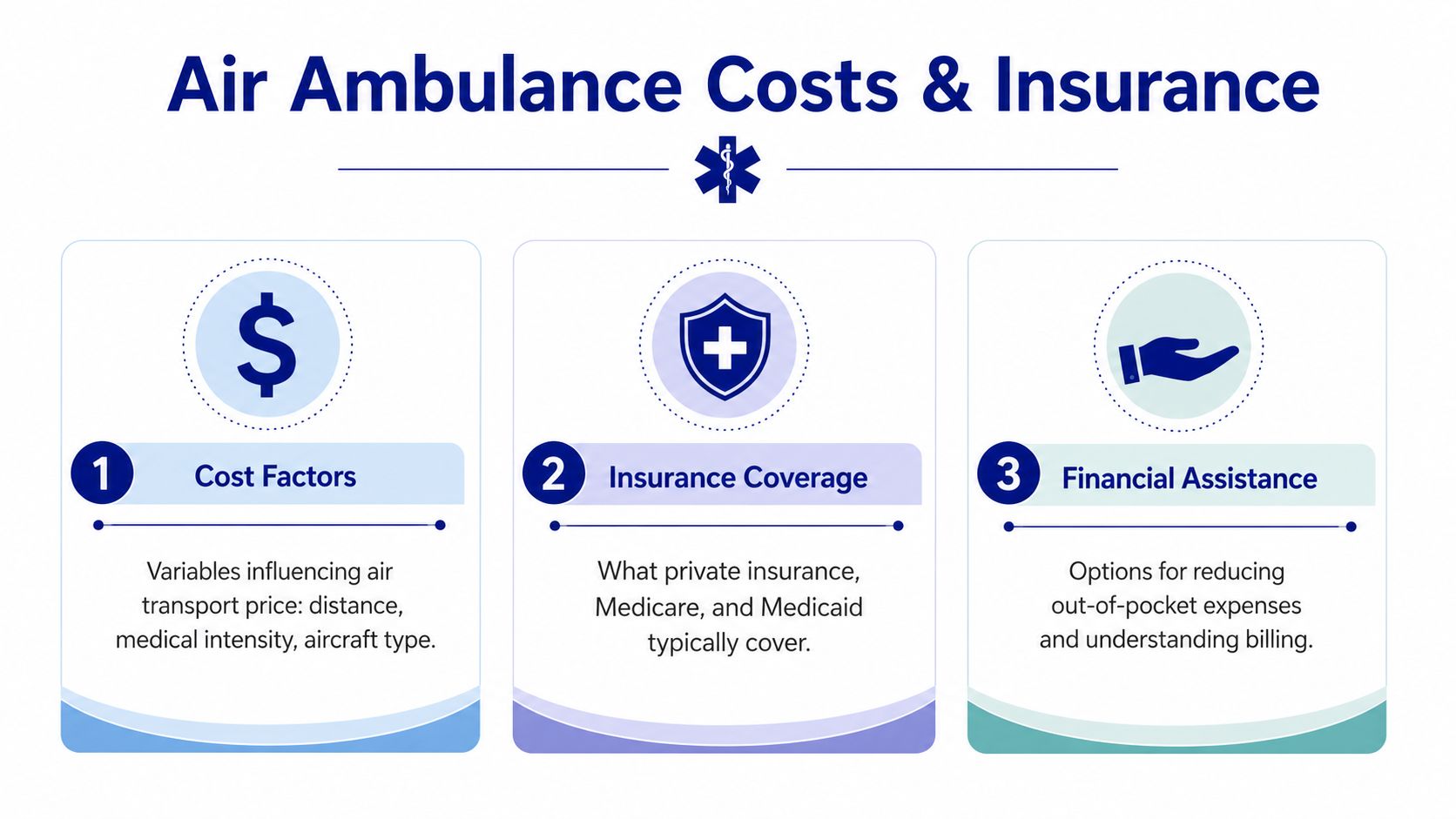
A realistic cost discussion starts with three moving parts. Aircraft type, distance, and medical intensity all affect the final price. A short helicopter scene flight is not billed the same way as a longer fixed-wing inter-facility transfer with advanced monitoring and multiple handoffs.
Where surprise bills come from
One of the most important facts in this space is still one of the least discussed during the first phone call. A 2017 GAO study found that 69% of air ambulance transports for privately insured patients were out-of-network, and more recent reporting notes that some balance bills reached 9.5 times Medicare rates, according to Risk & Insurance’s analysis of the air ambulance rate debate.
That means a family can make a medically appropriate decision and still end up facing a painful financial dispute afterward. The issue isn’t only the transport itself. It’s the gap between what the provider charges and what the insurer recognizes.
A practical billing walk-through
Here’s what usually happens in real life.
A physician orders transfer. The family agrees because the patient needs higher-level care. The flight team is arranged quickly, often with little opportunity to compare contracts or network status. The patient is moved safely. Days or weeks later, the insurer processes the claim and questions medical necessity, network status, or reimbursement level. That’s when the family learns the clinical emergency and the financial emergency are two different events.
This is why I tell people to ask billing questions early, even when it feels uncomfortable. Good operators expect it.
Questions to ask before the aircraft departs
Use this list with both the air ambulance provider and your insurer.
- Is this provider in-network for this policy: Get a direct answer from the insurer if possible.
- If out-of-network, how will reimbursement be calculated: Don’t settle for “it depends.”
- Will the provider issue a written estimate: Ask for the transport scope in writing.
- Who submits the claim: Clarify whether the operator bills insurance directly.
- Could the claim be denied on medical necessity grounds: This question matters more than many families realize.
- What patient responsibility could remain after insurance: Ask for the range in plain language, even if it can’t be exact.
What works better than hoping
People often ask whether there’s a way to reduce the chance of a billing shock before an emergency happens. There can be. Review your policy language while you’re calm, not while you’re standing in a hospital hallway. If you’re trying to understand where standard coverage ends and extra protection may begin, this quick guide to supplemental health insurance gives a practical overview.
A short comparison can help:
| Approach | What it helps with | What it doesn’t solve |
|---|---|---|
| Calling only the nearest number | Fast contact | Doesn’t confirm operator quality or billing terms |
| Relying only on insurance card assumptions | Basic starting point | Doesn’t verify air transport reimbursement details |
| Getting written transport and billing info | Clarifies expectations | Won’t remove every coverage dispute |
| Pre-planning with a trusted provider or membership | Better readiness and fewer surprises | Still requires policy review and smart questions |
The worst time to learn how your policy treats air transport is after the aircraft has landed.
What to Expect During a Medical Evacuation
A medical evacuation feels mysterious to most families because they never see the system until they need it. In practice, the better operations are methodical.
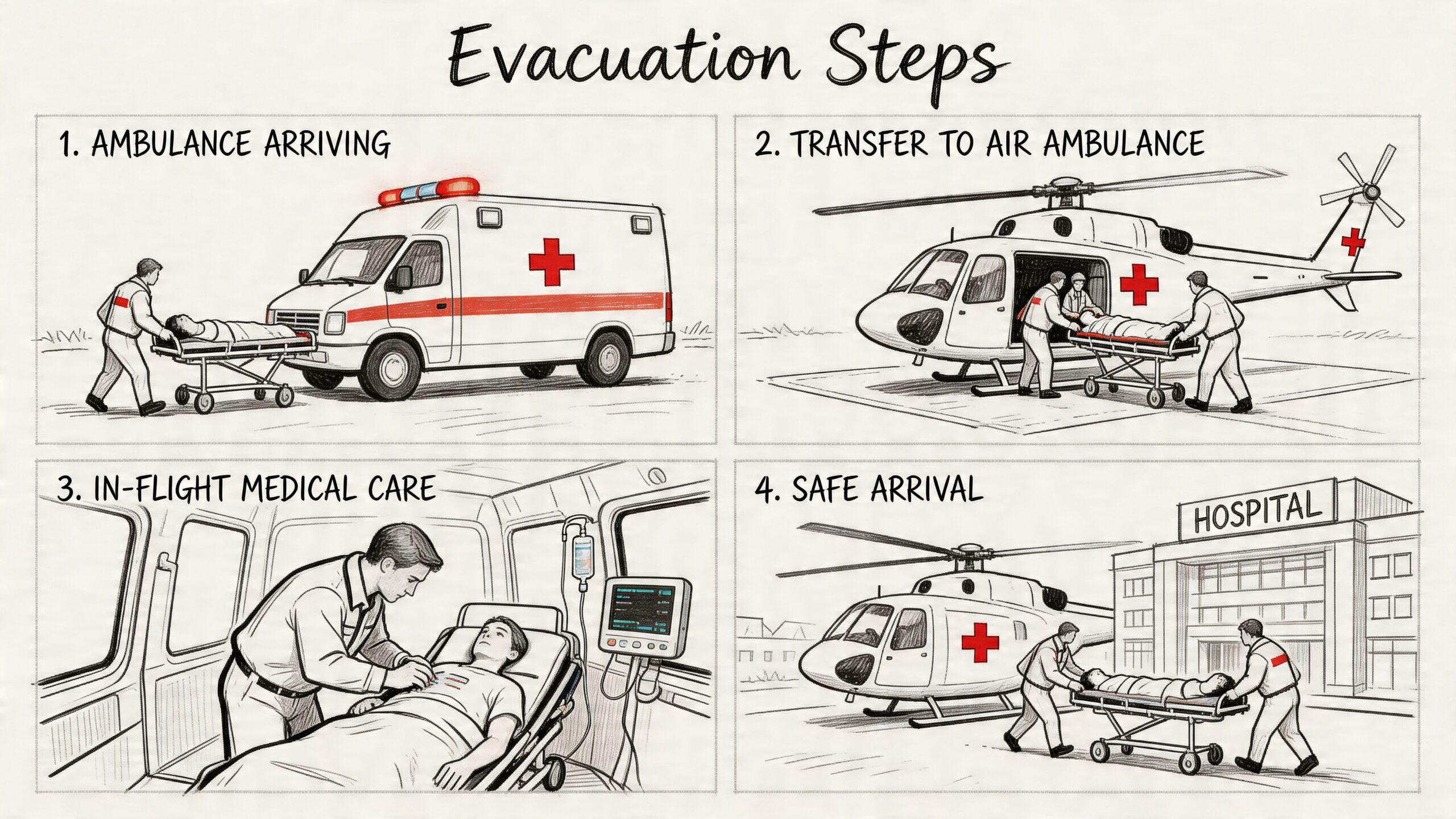
The process starts with a clinical handoff, not a runway. The sending physician shares the patient’s status, diagnosis, vital support needs, and destination request. The flight team reviews whether the patient is appropriate for transport and what level of care the mission requires.
What the transport team is doing
Most families focus on the aircraft. The crew is what matters most.
A well-run mission includes a continuous chain of responsibility from bedside pickup through arrival at the receiving facility. The team checks records, medications, oxygen requirements, equipment compatibility, airport or helipad logistics, and ground transfer arrangements on both ends. If you want a sense of the clinical thinking involved, Air Trek’s medical transport protocols overview shows how structured these decisions should be.
Helicopter versus fixed-wing in real situations
Helicopter EMS has a specific role. It’s especially useful when ground delays would compromise care or when a patient must reach a trauma-capable destination quickly. In certain critical scenarios, a meta-analysis found 86.0% survival for helicopter EMS patients versus 11.2% for ground EMS only, as reported in this helicopter EMS meta-analysis in PubMed Central.
That doesn’t mean helicopter is always better. It means the transport mode has to match the clinical situation and geography.
What families should expect during the trip
Families usually want answers to four immediate questions:
- Will someone update us: A competent coordinator gives regular status updates.
- Can a companion come: Sometimes yes, depending on space, weight, and medical priority.
- What should go with the patient: Identification, insurance information, medication list, and relevant records.
- Who receives the patient: The crew hands off directly to the accepting medical team.
A short visual can help if you want to see the flow of a typical mission:
Smooth evacuations don't happen because everyone works faster. They happen because everyone knows their role before the wheels move.
Proactive Planning with Memberships and Pre-Arrangements
Air medical transport is often only considered after a physician says the words out loud. That’s understandable. It’s also why so many families make expensive decisions with almost no time to evaluate them.
Pre-arrangement changes that dynamic. It gives families, frequent travelers, and corporate teams a framework before the emergency starts. That framework usually includes a preferred provider, stored passenger information, known contact points, and a financial plan for transport-related risk.
Who benefits most from planning ahead
Some groups have more exposure than others:
- Frequent cross-border travelers: Distance can complicate routine hospital transfers.
- Families with second homes or extended stays away from major centers: Access questions show up fast when local care is limited.
- Corporate travelers across the Americas: Duty-of-care planning is easier when transport relationships are set early.
- Households managing complex medical conditions: The less improvisation required, the better.
Memberships can help here, but they need to be evaluated carefully. The right question isn’t “Do they offer one?” The right question is “What does it reduce, and under what circumstances?”
What to review before joining any program
Look closely at the operating footprint, transport types covered, household eligibility, exclusions, and how claims are handled. Some programs are built around emergency response in defined service areas. Others fit planned transfers or broader travel patterns better.
Use this checklist when comparing options:
Geographic fit
The membership should match where you live, work, and travel.Transport scope
Clarify whether it applies to helicopter response, fixed-wing transfers, or both.Billing process
Ask how the program interacts with private insurance and what happens if a claim is disputed.Operational control
Find out whether the membership is tied to a direct operator or a network that may subcontract missions.
Why pre-planning reduces stress
Pre-planning doesn’t eliminate uncertainty. It reduces the number of decisions you have to make under pressure.
For travelers and families who want a standing option in place, Air Trek’s membership options for private and medical transport planning are worth reviewing as part of a broader preparedness strategy. The strongest plans combine provider vetting, realistic insurance review, and a transport partner that can coordinate across borders without making the family chase details.
Why Discerning Travelers Choose Air Trek
A family is in a hospital room in Mexico. The receiving physician is in Florida. Someone needs to confirm the aircraft, the medical team, the landing permits, the ground transfer, and who is responsible for the bill. In moments like that, travelers and family offices do not choose an operator based on branding. They choose the team that can answer clearly and keep the mission under control.
Air Trek has earned that trust through decades of coordinated private and medical aviation work. The company has been in operation for more than 45 years, and that experience shows up where clients feel it most. In communication, in cross-border logistics, and in the ability to solve problems without creating new ones for the family.

What experienced clients look for
The strongest operators make a stressful situation more manageable because they are organized before the call comes in.
Clients usually judge an air ambulance provider on a few practical points:
- Single-point coordination: One team should handle the aircraft, medical staffing, permits, hospital communication, and ground transport.
- Cross-border competence: International and Caribbean missions often require more than flight planning. They also require document control and timing discipline.
- Plain-spoken billing guidance: Families need to know what is covered, what may not be covered, and where surprise charges can appear.
- Discretion: High-profile travelers, executive assistants, and family decision-makers value privacy, especially when a medical event interrupts a trip.
Air Trek’s Florida base and long experience across the Americas make it a practical fit for travelers who split time between the U.S., Canada, the Caribbean, and Latin America.
Why the financial conversation matters
A polished flight operation is only part of the job. The other part is preparing clients for the financial side before the transport is airborne.
Surprise billing often starts with confusion about who is operating the flight, how insurance will process an out-of-network claim, and which parts of the trip fall outside the air segment itself. A provider that addresses those points early helps families make better decisions under pressure. For frequent travelers, that is also why pre-arranged planning and membership options matter. They do not guarantee that every cost disappears, but they can reduce uncertainty and shorten the decision path when time is tight.
Details seasoned travelers ask about
Families with pets sometimes face an added layer of planning, especially during non-emergency transfers or longer-distance relocations. Air Trek’s broader private aviation experience makes that conversation easier to have in practical terms, instead of treating it as an afterthought.
That flexibility also matters for clients who need more than a basic airport-to-airport flight. Bedside-to-bedside coordination, customs timing, and family communication often determine whether a transfer feels controlled or chaotic.
Three questions that quickly reveal whether a provider is prepared
How soon should the call happen once air transport is mentioned
As soon as the sending team says a transfer may be needed. Early calls create better aircraft, routing, and staffing options.
What should a provider explain without being pressed
The medical configuration, who is operating the aircraft, the expected handoffs, and how billing will be handled.
Why do experienced travelers keep a relationship in place before they need it
Because emergencies compress decision time. A known operator with a clear process reduces confusion and lowers the odds of financial surprises at the worst possible moment.
Frequently Asked Questions About Air Ambulance Services
Can a family member fly with the patient
Sometimes, yes. It depends on the patient’s condition, aircraft configuration, weight limits, and medical priority. Ask early, because the answer can differ between helicopter and fixed-wing missions.
How do I know whether I need a helicopter or a fixed-wing aircraft
This decision should be driven by the clinical team and the operator. According to AAMS coverage information cited in the verified data, 86.2% of the U.S. population lives within a 15 to 20 minute helicopter response radius, but that covers only about one-third of U.S. geographic area. For longer inter-city or regional transfers, fixed-wing aircraft are often the necessary and more practical choice.
What should I have ready before the transport team arrives
Keep these items together if possible:
- Patient identification: Government ID if available
- Insurance information: Front and back of the card
- Medical records: Recent notes, imaging discs, medication list
- Contact list: Family decision-maker and receiving physician details
Can I choose my own provider
In non-scene transfers, often yes. In immediate emergency response situations, local dispatch or clinical urgency may narrow the choice. If there’s any room to choose, ask whether you’re speaking with the direct operator and whether they can explain billing clearly.
What should I ask first when calling air ambulance services near me
Ask these three questions first:
- Are you the direct operator or a broker
- What level of medical crew will be on this mission
- How will billing and insurance be handled
Those answers tell you a lot, quickly.
If you’re comparing air ambulance services near me and want a provider that can coordinate medical transport, private charter logistics, and family travel realities with clarity, contact Air Trek to discuss immediate transport needs or proactive membership planning.