
Coordinating travel for a group of ten, eleven, or twelve people usually breaks down in the same places. Flight times stop lining up. Bags get split across tickets. Someone ends up in a middle seat on a connection while the rest of the group lands somewhere else. If the trip matters, whether it's a management team moving between meetings or a family trying to start a holiday without airport friction, commercial travel often turns into a logistics project.
That's why people start looking at a 12 passenger private jet. Not because they want a flashy cabin photo for the group chat, but because they need control. One departure time. One airport plan. One baggage discussion. One aircraft matched to the actual trip.
The useful question isn't “What's the nicest 12-seat jet?” It's “What aircraft can move our group, our bags, and our schedule with the fewest compromises?” If you're still early in the process, this practical walkthrough on how to book a private jet helps frame the steps before you request quotes.
Your Guide to Private Group Travel
A typical request sounds simple at first. A leadership team needs to visit multiple cities in a short window. Or a family of twelve wants to leave from the same airport, bring golf clubs or extra luggage, and avoid turning the first day of the trip into a chain of delays.
The problem is that group size changes everything. Once you get beyond a small private aircraft, seat count alone stops being useful. A group of twelve may fit on several aircraft types on paper, but that doesn't mean each one will handle the route, bags, and airport choices equally well.
Why groups look at private aviation
For this size of group, private flying usually solves four practical problems:
- Schedule control: The aircraft leaves when the group is ready, not when the airline timetable allows.
- Airport flexibility: Private terminals make it easier to use airports that are closer to the final destination.
- Privacy for the whole party: Business discussions, family time, or high-profile travel stay contained to one cabin.
- Simpler movement on the ground: Everyone arrives together, with less risk of missed connections or split itineraries.
Practical rule: For group travel, the real luxury is coordination. When one aircraft moves everyone at once, the trip becomes easier to manage before it becomes more comfortable.
When a 12 passenger private jet makes sense
This category tends to make sense when the trip is long enough that cabin comfort matters, or when the cost of delay is higher than the cost of the aircraft. That applies to roadshows, board travel, destination weddings, family vacations, sports travel, and executive itineraries with tight timing.
It also works well when the travelers want a cabin that supports both work and rest. On a longer flight, that difference matters more than people expect.
What a 12 Passenger Jet Really Means
A 12 passenger private jet is a buying shortcut, not a precise aircraft category. In charter practice, that headcount can point to a large super-midsize jet on one trip and a heavy jet on another. Both may seat twelve. They will not deliver the same result once range, bags, runway length, and passenger comfort are factored in.
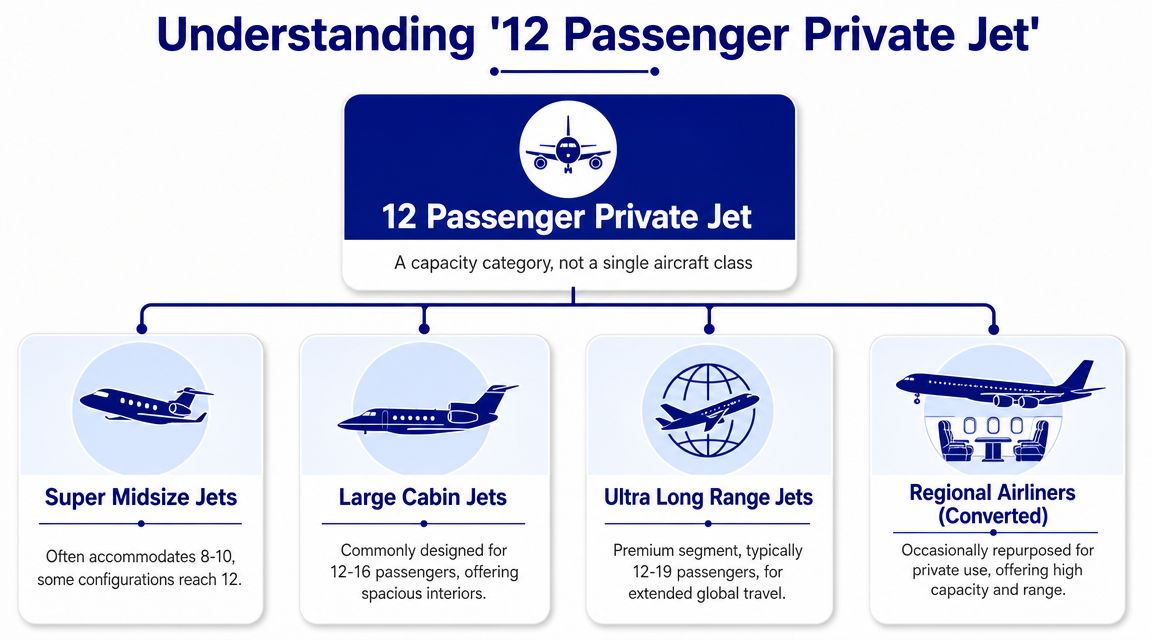
That is the point clients often miss at the start. A seating label answers how many people can board. It does not answer whether the aircraft can take twelve adults, full luggage, and enough fuel for the route without giving something up.
Why seat count can mislead
Two aircraft can both be sold as 12-passenger options and still suit very different missions. One may be ideal for a domestic trip with moderate bags and good runway access. Another may be the better tool for a longer sector where the group wants more cabin room, more baggage volume, and fewer compromises on payload.
This is why operators match the aircraft to the mission first. For a charter client, the primary question is usually not, "Can it seat twelve?" It is, "Can it carry this group, with this baggage, on this route, into these airports, in a way that still feels comfortable?"
What actually changes in this part of the market
The practical differences usually show up in four areas:
- Cabin volume: Twelve seats in one aircraft may feel efficient. In another, the same headcount feels relaxed enough for a longer day of travel.
- Range with a real passenger load: Published range figures are only a starting point. A full cabin and bags can change what is realistic.
- Baggage capacity: Ski gear, golf clubs, garment bags, and family luggage can rule out an aircraft that looked fine on paper.
- Airport performance: Some trips depend on getting closer to the final destination, and not every jet in this seating band is equally comfortable with shorter runways or more limiting airport conditions.
Cost differences follow those capability differences. Aircraft in this band can sit far apart in acquisition cost, operating cost, and charter rate, even when the brochure headline says the same thing. For a client, that usually means one simple thing. Similar seating does not mean similar value for the trip.
The same planning logic shows up on the ground. If you are comparing regional group options outside aviation, this guide to Australian group transport makes a similar point. Capacity is only one part of the decision. Route, luggage, and trip type usually decide what works best.
A 12-passenger label is the start of the conversation. The right aircraft is the one that can fly your mission cleanly, with the group and baggage you actually have.
Common Aircraft for Groups of Twelve
When clients ask for options in this category, the conversation usually narrows quickly to a few familiar names. Not because they're the only choices, but because each one represents a distinct way to handle a group mission.
Four aircraft clients often consider
Gulfstream G550 is often discussed when the trip has serious range demands and the group wants a long-cabin experience. It's a common reference point for international or long domestic sectors.
Bombardier Challenger 605 is known for a roomy cabin feel that works well for business groups and family travel where comfort in flight is a major priority.
Dassault Falcon 2000 usually comes up when the mission needs a balanced platform. It's often considered by travelers who want solid cabin comfort without moving to a larger long-range aircraft than the trip requires.
Embraer Legacy 600 tends to appeal when cabin layout and baggage practicality matter. It's a sensible option for travelers who want distinct onboard zones.
12-Passenger Jet Model Comparison
| Aircraft Model | Typical Seating | Cabin Height | Max Range (approx.) | Best For |
|---|---|---|---|---|
| Gulfstream G550 | Around 12 in many layouts | Spacious stand-up cabin | Long-range mission capability | Long domestic trips and select international flying |
| Bombardier Challenger 605 | Around 12 in common charter layouts | Spacious stand-up cabin | Strong transcontinental capability | Corporate groups wanting cabin comfort |
| Dassault Falcon 2000 | Around 10 to 12 depending on layout | Stand-up cabin feel | Well suited to longer regional and transcontinental missions | Balanced business and leisure travel |
| Embraer Legacy 600 | Around 12 in many executive layouts | Stand-up cabin | Built for longer sectors with practical cabin zoning | Groups with luggage and mixed onboard needs |
How to use a table like this
This kind of comparison is helpful, but it won't choose the aircraft for you. The same model can fly very differently depending on the route, weather, baggage load, and cabin configuration.
Here's the better way to evaluate options:
- Start with the route. Nonstop expectations shape the list immediately.
- Account for the passenger count. Twelve adults traveling light is different from twelve travelers with large bags and equipment.
- Check the airport pair. Runway and field conditions can narrow choices before cabin preferences do.
- Then compare cabin experience. That's where model preference starts to matter.
A good charter advisor won't sell the aircraft with the biggest brochure appeal. They'll narrow the field to the aircraft that can do the job cleanly.
Inside the Cabin Space Comfort and Amenities
A group of twelve can board the same aircraft and have two very different experiences. On the right jet, people can spread out, work, eat, and rest without stepping around each other. On the wrong one, the seat count works on paper, but the cabin feels full the moment everyone is onboard with briefcases, garment bags, and carry-ons.
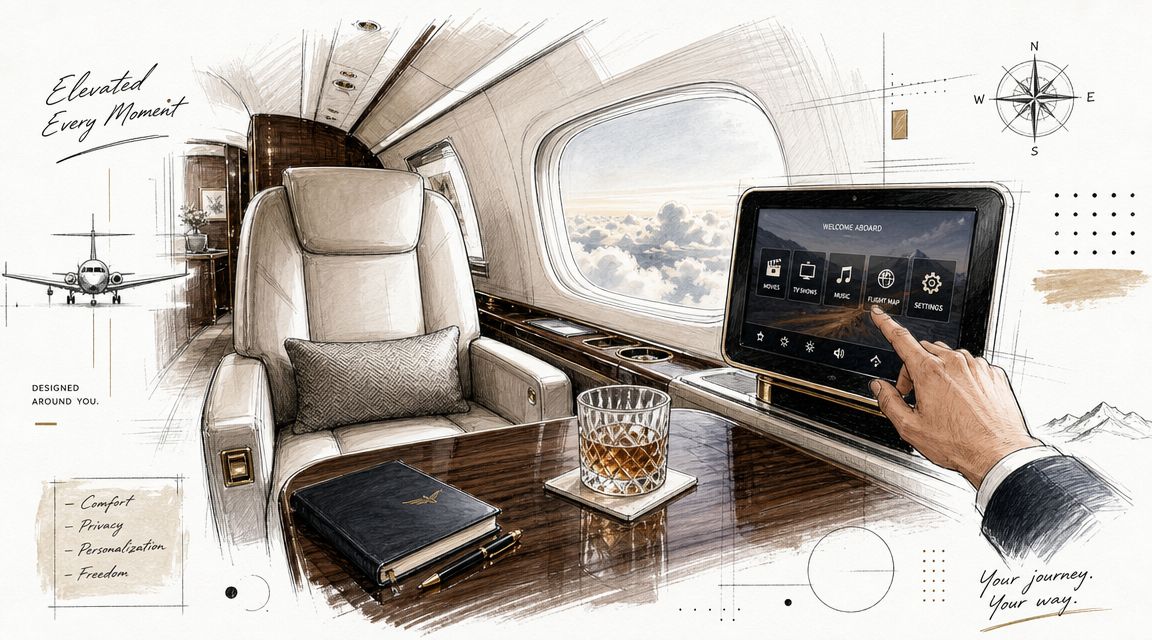
For this category, cabin comfort usually comes down to a handful of features that change how the flight feels:
- Stand-up headroom
- A flat-floor cabin
- Separate seating zones
- A private lavatory
- A galley suitable for proper catering
- Seats that support rest, not just short-haul sitting
Those details matter more than polished wood or branded glassware. A cabin with real headroom and defined zones gives people options. One group can talk through a deal up front while others stay quiet in the rear. A family can keep children settled in one area without taking over the whole cabin.
Layout is what clients notice first.
A twelve-seat configuration is not automatically a comfortable twelve-person configuration. Some aircraft do a better job with movement through the cabin, access to the lavatory, and usable table space. Others can seat the group but feel tighter once everyone is in place and the bags are loaded. That trade-off shows up quickly on flights long enough for a meal, laptop work, or any attempt at rest.
The strongest cabin setups for this size of group usually include a club arrangement for face-to-face conversation, enough separation between zones to reduce noise, and seating that can support a genuine rest period on early departures or evening returns.
A few practical examples:
- Corporate travel: Club seating and larger tables make it easier to brief, review documents, and hold a normal conversation.
- Family trips: A divan or aft seating area gives children or accompanying staff their own space.
- Longer day trips: A proper galley supports real catering instead of handing out snacks and calling it meal service.
- Flights with mixed priorities: Separate zones let part of the group work while others rest.
What usually causes disappointment is simple. Clients focus on whether the aircraft can seat twelve and ask about comfort later. The better question is whether the cabin can carry twelve people in a way that suits the mission. For a short hop, that threshold is lower. For a longer sector, the difference between enough seats and enough usable cabin space becomes obvious very quickly.
That is why cabin choice should follow the trip plan. If the mission involves presentations, meals, downtime, or a full passenger load with personal baggage, cabin layout deserves as much attention as the aircraft name on the quote.
Understanding Performance Range and Capabilities
A group of twelve can fit on more than one aircraft category. That does not mean each option will fly the same trip equally well. Range claims are published under specific conditions, and charter planning has to account for the trip you are flying, not the brochure version.
A 12 passenger private jet usually sits in the super midsize to heavy jet range. That opens up longer missions, but capability still depends on four variables working together: passenger load, baggage, fuel, and runway performance.
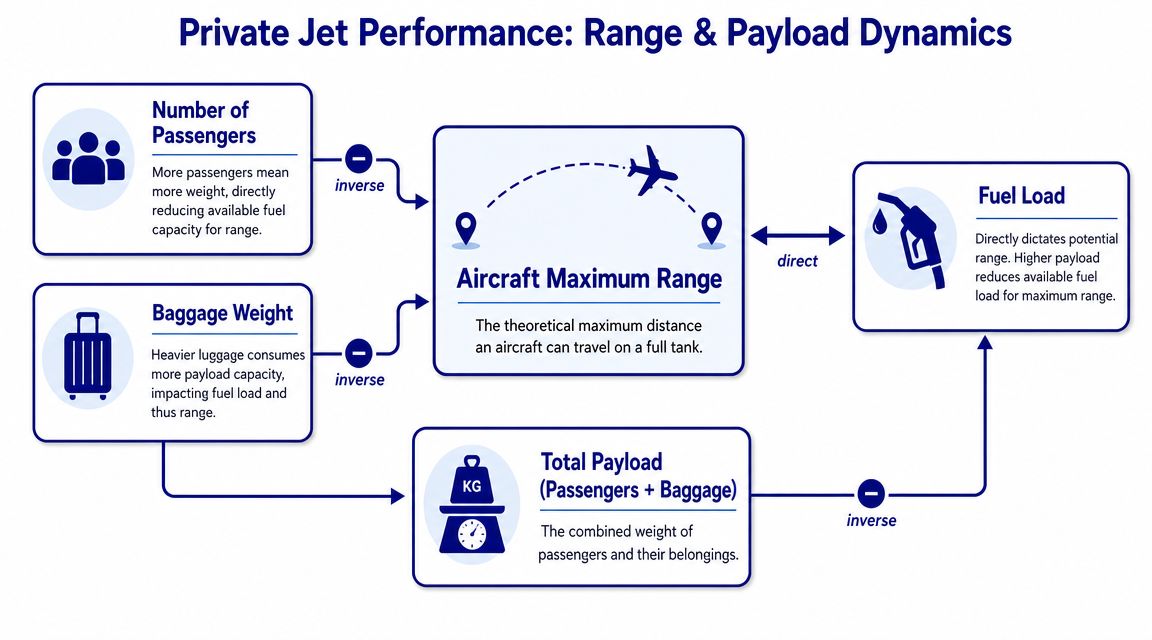
The give-and-take behind every route
Here is what operators are balancing on every flight release:
- Passengers
- Baggage
- Fuel
- Airport performance
Add people and bags, and available fuel may need to come down. Add a shorter runway, high temperatures, or a high-elevation airport, and the same aircraft may leave with different limits than it would from a major coastal airport. That is why a jet that looks ideal for twelve on one route can become a compromise on another.
This comes up often on ski trips, golf weekends, and multi-day business travel. The passenger count stays the same. The baggage profile changes the recommendation.
Questions that determine the best fit
Clients get better aircraft recommendations when they ask route-specific questions such as:
- Can this aircraft carry our full group and baggage on this exact city pair?
- What changes if we face strong headwinds or need a different alternate airport?
- Are either of our airports limiting takeoff weight or landing performance?
- Is a brief fuel stop more efficient than booking a larger aircraft for the whole trip?
Operational note: The best aircraft for twelve passengers is the one that can complete your mission from your preferred airports with the baggage plan you actually have.
That is the difference between seat count and mission capability. Seat count tells you how many people can board. Mission capability tells you whether the aircraft can move that group efficiently, with acceptable reserves, on the route you care about.
Why longer trips expose weak assumptions
The farther you fly, the less room there is for casual assumptions. Headwinds, reserve fuel, alternates, runway length, and payload all start to matter more. On paper, several jets may look interchangeable. In practice, one may go nonstop with bags, another may need a fuel stop, and a third may require baggage limits that the group will not accept.
This is also where airport choice matters. A convenient secondary airport may save hours on the ground and still be the right answer, but it can narrow aircraft options if the runway is short or conditions are hot. An experienced charter team will test both the route and the airports before recommending a model.
Clients planning costs should build the conversation around mission details early, because aircraft capability and pricing move together. A useful starting point is this guide to private jet charter pricing factors.
Ask whether the aircraft can perform your trip well, with your group, your bags, and your airports. That is how you choose the right jet for twelve people.
How to Plan and Budget Your Charter Flight
A group of twelve is ready to leave Friday afternoon. One traveler has golf clubs, another is bringing a dog, and the destination airport is close to the resort but has tighter operating limits than the larger airport nearby. That trip should not start with “Which 12-seat jet is available?” It should start with “What does this mission require?”
That approach usually saves both time and money.
Start with the trip, not the label
A charter plan works best when the aircraft is matched to the job. Seat count is only one input. For a group of twelve, key questions include how far you need to fly, how much baggage is coming, which airports you want to use, and how much schedule flexibility you have.
Different trips push the recommendation in different directions.
Corporate travel often centers on departure timing, airport access, and a cabin layout that lets passengers work en route. If the itinerary includes multiple stops, ground time and repositioning can affect both price and practicality.
Family or leisure travel usually puts more pressure on baggage space, pet handling, and airport convenience at the destination. Bulky vacation gear can rule out an aircraft that looked fine on a simple seating chart.
Event travel often requires the group to arrive together within a narrow window. In those cases, operational reliability and airport slot or parking constraints matter as much as cabin size.
Build the quote around the actual mission
The most useful charter quotes are built from specifics. A jet that can seat twelve may still be the wrong fit for twelve people on your trip if the route is long, the bags are bulky, or the airport is restrictive.
A Gulfstream G550, for example, is a long-range aircraft with a stand-up cabin and a large baggage compartment, as shown on this Gulfstream G550 fleet page. That makes it a strong candidate for many group missions. It does not make it the automatic answer. Payload, route conditions, and airport performance still need to be checked against the day's plan.
Before asking for pricing, have these details ready:
Passenger list
Include adults, children, staff, pets, and anyone with mobility or medical considerations.Baggage plan
List the actual items, not just the number of bags. Skis, golf clubs, garment bags, presentation materials, and coolers can change the recommendation.Airport pair
Give the preferred departure and arrival airports, plus any acceptable alternates.Schedule flexibility
A one-hour adjustment can widen aircraft availability or reduce cost.Trip priority
Decide what matters most. Nonstop flying, the closest airport, lowest price, or the most spacious cabin.
This is the information brokers and operators use to narrow the field quickly and avoid quoting an aircraft that looks right on paper but creates friction later.
Budget around the full trip
The cheapest hourly rate does not always produce the lowest trip cost. I see this regularly with groups that focus on advertised seating and ignore the mission details. A lower-priced aircraft can become the more expensive option if it needs a fuel stop, cannot use the preferred airport, or forces the group to split baggage into a separate solution.
Good quote review is straightforward. Ask what aircraft is being proposed, how the cabin is configured, whether the baggage assumption matches your trip, and what routing or airport assumptions are built into the price. Ask for the all-in trip cost, not just the hourly figure.
For travelers who want context before speaking with a broker, this private jet charter pricing guide explains the cost drivers that typically shape a charter quote.
Practical ways to control cost
Flexibility helps. Shifting departure time, accepting a technical fuel stop on the right route, or using a nearby alternate airport can improve pricing without making the trip inconvenient.
Aircraft category matters too. A super-midsize jet may work better than a large-cabin jet for a shorter mission with moderate bags. On a longer route with twelve adults and heavy luggage, paying more for the larger aircraft can be the more efficient decision because it avoids stops or payload restrictions.
Frequent flyers sometimes compare on-demand charter with membership programs to get more predictable pricing and faster booking. Air Trek is one option in this space. It offers on-demand private charter, membership options, and empty leg access for travelers whose trip pattern fits those formats.
The right budget starts with the mission you plan to fly. That is how you choose well for a group of twelve.
Frequently Asked Questions About 12 Passenger Jets
How much luggage can a group of 12 really bring
There isn't one fixed answer that applies to every aircraft. Luggage capacity depends on the model, the cabin layout, and how far the aircraft needs to fly that day. Soft bags are often easier to accommodate than hard-shell luggage, and specialty items can change the recommendation fast.
If your group is traveling with bulky items, raise that early. It's one of the easiest ways to avoid choosing the wrong aircraft.
How far in advance should I book
Earlier is better when the trip includes a specific airport pair, a peak travel period, or a firm preference for a certain aircraft category. Last-minute charter is often possible, but more lead time usually gives you a cleaner set of options.
For group travel, earlier planning also helps with catering, ground coordination, and passenger manifest accuracy.
Are pets allowed on larger jets
Often, yes. Pet policies depend on the operator and the route, but larger cabin aircraft are usually more manageable for travelers bringing animals because the cabin gives everyone more room to settle in comfortably.
The right question isn't just “Are pets allowed?” Ask how the pet will be accommodated during the specific mission.
Is a 12 passenger private jet still the right choice in the years ahead
That depends on how you define “right.” Recent coverage shows aircraft manufacturers are pursuing cleaner aerodynamics and lower-emissions designs, with some next-generation business jet projects described as potentially entering service by 2030, according to this report on a future private jet program. For travelers, that's a reminder to think beyond seat count and consider long-term operating relevance, especially if they fly often.
If your schedule is flexible, another question worth asking is whether an already-positioning aircraft can meet the mission. This overview of empty leg flights in the USA is useful for understanding that option.
A good charter decision is rarely about finding the biggest cabin you can afford. It's about finding the smallest compromise for the trip you actually need to fly.
A 12 passenger private jet can be an excellent solution for business teams, families, and event groups. But the right choice depends on mission capability, not brochure seating. Range, baggage, airport performance, and cabin layout decide whether the flight feels easy or awkward. Match those correctly, and private aviation does what it's supposed to do. Save time, reduce friction, and move the whole group on your terms.
If you're planning a group trip, speak with a charter specialist and build the decision around your route, baggage, and airport needs first. That's how you choose the right aircraft with fewer surprises.