
A lot of event problems first show up at the curb.
The ceremony starts on time, the ballroom looks perfect, the speaker is ready, and the catering team is in position. Then guests start texting. One car can't find the entrance. A shuttle is queued behind rideshare traffic. A VIP is standing outside the wrong hotel. Suddenly, the event feels disorganized before anyone has seen the first table setting or opening slide.
That's why special event transportation isn't a side task. It's part of the event itself. Arrival shapes mood. Departure shapes the last memory. In between, every transfer affects timing, cost, and how looked-after people feel.
For destination events, that starts even earlier than most planners expect. If guests are flying into a regional market, something as simple as arranging hassle-free Algarve airport transfers can remove the first layer of stress and set the tone before check-in.
Smart planning isn't about adding luxury for its own sake. It's about matching the mode, timing, and level of service to the experience you want people to have. A board retreat needs different transportation than a wedding weekend. A stadium event needs different controls than a private dinner. The right answer is rarely one vehicle type. It's a system.
The Unseen Detail That Defines an Event Experience
A guest never says, “The routing matrix was excellent.”
They say the day felt smooth. They say they didn't have to think. They say the wedding felt elegant from the moment they landed, or the summit felt polished before registration even opened. That reaction usually comes from transportation decisions made well in advance.
Poor transport planning creates a specific kind of friction. It makes an expensive event feel cheap. People wait in the wrong place, arrive overheated, miss intros, or leave early because the return feels uncertain. None of those failures look dramatic on a run sheet, but every one of them changes the guest experience.
Transportation is hospitality in motion. When it works, guests feel guided. When it fails, they feel managed.
The most useful shift is to stop thinking only about moving bodies between points. Think about transition moments. Airport to hotel. Hotel to venue. Venue to after-party. Closing reception to late-night return. Those are emotional moments as much as operational ones.
What guests actually notice
Guests notice things planners often underestimate:
- Clarity: They know where to stand, what vehicle to expect, and who to contact.
- Pace: They're not rushed when they should feel welcomed, and they're not delayed when timing matters.
- Privacy: Senior executives, family principals, and public figures often need separation from the main guest flow.
- Comfort: Luggage, accessibility, weather exposure, and seat quality all affect mood.
- Consistency: The transportation style should match the event's tone, not fight it.
Ask yourself a simple question. If a guest judged the professionalism of your event only by the first and last transfer, what would they conclude?
That question usually reveals whether you need shared shuttles, dedicated executive cars, a mixed fleet, or a completely different arrival plan.
Assessing Your Real Transportation Needs
Most transportation mistakes start with a shallow brief.
“Need cars for 150 people” isn't a transportation plan. It's a headcount. Real planning starts when you separate who is traveling, when they move, what experience they should have, and where congestion will appear.
The Transportation Research Board's guidance notes that special event transport planning can improve safety, benefit non-drivers, and is specifically designed to reduce traffic, parking, and stress through tactics such as shuttle services, transit services, and parking management, reflecting a broader shift toward managed demand rather than simple vehicle supply (TRB guidance on transportation demand management for special events).
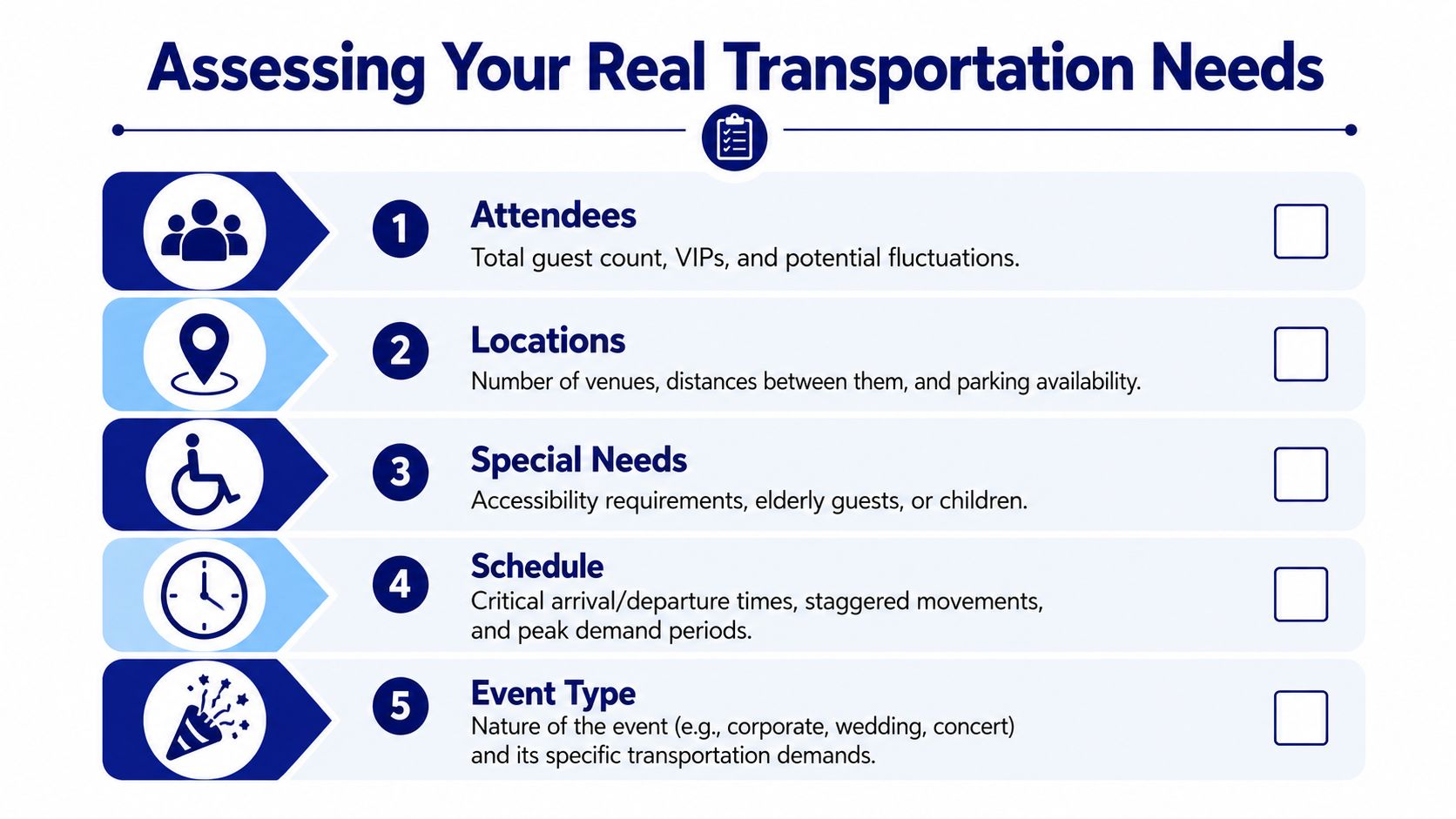
Start with guest groups, not total attendance
A wedding weekend may have one guest list, but it usually has several transportation profiles. The couple's immediate family may need flexible private transfers. Older relatives may need low-step boarding and shorter wait times. General guests may be fine with fixed shuttle loops. Vendors may need entirely different access windows.
A corporate event works the same way. Your keynote speaker, executive team, sponsors, and attendees should not automatically be moved with the same service model.
Use these questions early:
- Who needs flexibility? Executives, hosts, speakers, or family principals often require dedicated service.
- Who can travel in waves? General attendees usually fit fixed departures well.
- Who has mobility considerations? Accessibility can't be solved on dispatch day.
- Who is carrying equipment or formalwear? Luggage and garment handling affect vehicle choice.
Map the journey, not just the route
A route is a line on a map. A journey includes timing, pressure, and expectations.
For each movement, identify:
Origin and destination
Airport to hotel sounds simple until flights arrive in clusters, luggage retrieval varies, and guests use different terminals or fixed-base operators.Critical timing window
A reception shuttle can absorb minor delay. A board meeting arrival cannot.Guest mindset
Are people expected to socialize, decompress, work, or make an entrance?Likely friction points
Tight venue access, valet conflicts, security checkpoints, weather exposure, and poor signage all matter.
Practical rule: If two guest groups need different levels of reliability or privacy, separate their transportation plan even if they're going to the same place.
Questions people actually ask
Clients usually ask practical questions, and they should:
- Do all guests really need door-to-door service?
- Is parking at the venue an asset or a trap?
- Should arrivals be staggered or synchronized?
- Will a luxury vehicle improve the experience, or just raise cost?
- What happens if guests ignore the shuttle plan and book their own rides?
Those questions lead to better plans than “How many vehicles do we need?”
A clean needs assessment gives you something more valuable than a vendor quote. It gives you a filter for every decision that follows.
Matching the Vehicle to the Vision
The right vehicle doesn't just carry people. It reinforces the event's tone.
A polished sedan for a speaker arriving from the airport sends one message. A branded shuttle loop for conference attendees sends another. A coordinated air and ground plan for family principals or executives tells guests that timing, privacy, and control matter. None of these choices are better than the others. They're better only when they fit the event.
Large events rarely succeed with a single-mode mindset. The 2002 Winter Olympics in Salt Lake City remain a useful benchmark because post-event analysis estimated 2.52 million transit rides during the Games, with average daily movement of about 100,000 light-rail rides, 42,000 shuttle bus rides, and 80,000 regular bus rides. The same analysis estimated that the Mountain Venue Express shuttle carried about 30,000 people out of cars and removed roughly 12,500 vehicles from the roads, showing why multimodal planning matters when demand surges beyond normal capacity (Salt Lake City Winter Olympics transportation analysis).
How each mode changes the experience
Some events call for efficiency first. Others need staging, privacy, or image control. That's why selection should start with event fit.
| Transport Mode | Ideal Group Size | Best For… | Key Consideration |
|---|---|---|---|
| Executive sedan or SUV | Small VIP movements | Speakers, principals, board members, family elders | Best when schedule flexibility and privacy matter more than shared efficiency |
| Sprinter van | Small to mid-size groups | Bridal party, sponsor teams, media crews, golf outings | Good balance of comfort and coordination, but boarding speed and luggage space still need planning |
| Mini coach or shuttle bus | Mid-size guest waves | Hotel-to-venue transfers, conference loops, off-site dinners | Strong for predictable waves, weaker for guests who expect on-demand departures |
| Motor coach | Large groups | Stadium events, conventions, multi-hotel consolidation | Efficient for volume, but staging and curb access can become the real bottleneck |
| Limousine or specialty vehicle | Small groups with ceremonial value | Weddings, galas, milestone celebrations | Works when arrival is part of the event, not when throughput is the priority |
| Private jet | Individuals, families, or small executive groups | Tight schedules, remote destinations, confidentiality-sensitive travel | Air segment solves timing and privacy, but ground coordination still determines the final experience |
When premium modes are practical, not just luxurious
A private aircraft can be a logistical tool, not just a status signal. If a speaker needs to visit multiple cities before an appearance, if a family is traveling to a remote wedding destination on a narrow schedule, or if senior executives need privacy before a sensitive retreat, air charter may protect the event from commercial airline friction.
For planners comparing aircraft options, a 12 passenger private jet can make sense when the travel party needs to stay together and arrive on a schedule that doesn't align well with commercial service.
That said, private air only solves part of the problem. A guest who lands flawlessly and then waits at the wrong pickup point still has a broken experience.
What works and what doesn't
What works
- Dedicated VIP transport: Separate cars for high-stakes passengers.
- Uniform shuttle strategy: Consistent branding and dispatch for attendee groups.
- Mode mixing: Air, executive cars, and shared ground transport used intentionally by guest type.
- Venue-first vehicle choice: Selecting smaller vehicles when access roads, gates, or drop zones are tight.
What doesn't
- One-size-fits-all booking: Treating executives, elderly guests, and general attendees identically.
- Overbuying prestige: Choosing limousines where guests mainly need punctual shuttle circulation.
- Ignoring curb conditions: Booking large coaches for venues that can't stage them cleanly.
- Leaving the last mile unresolved: Solving airport arrivals but not venue access or departure waves.
Vendor checks that matter
Before confirming any operator, verify practical basics:
- Insurance: Ask for current proof and confirm it fits the service type.
- Regulatory standing: For air operators, confirm FAA-related compliance matters through the provider. For ground carriers, check applicable DOT and local licensing requirements.
- Dispatch structure: Who controls day-of changes?
- Fleet substitution policy: What appears if the assigned vehicle becomes unavailable?
- Accessibility capability: Don't assume availability. Confirm the exact vehicle arrangement.
A beautiful fleet list doesn't tell you how an operator handles a late flight, a blocked loading zone, or a guest who boarded the wrong shuttle.
Building Your Timeline and Budget
Transportation budgets break when planners price vehicles but ignore time uncertainty.
That's the hidden variable in special event transportation. Congestion, security checks, delayed departures, staging constraints, pickup confusion, and venue overruns all stretch labor and vehicle utilization. Public planning guidance highlights the operational complexity of these trips, and one of the most useful commercial lessons is simple: the vehicle often isn't the biggest cost driver. Time uncertainty is (NCHRP guidance on special event transport planning challenges).
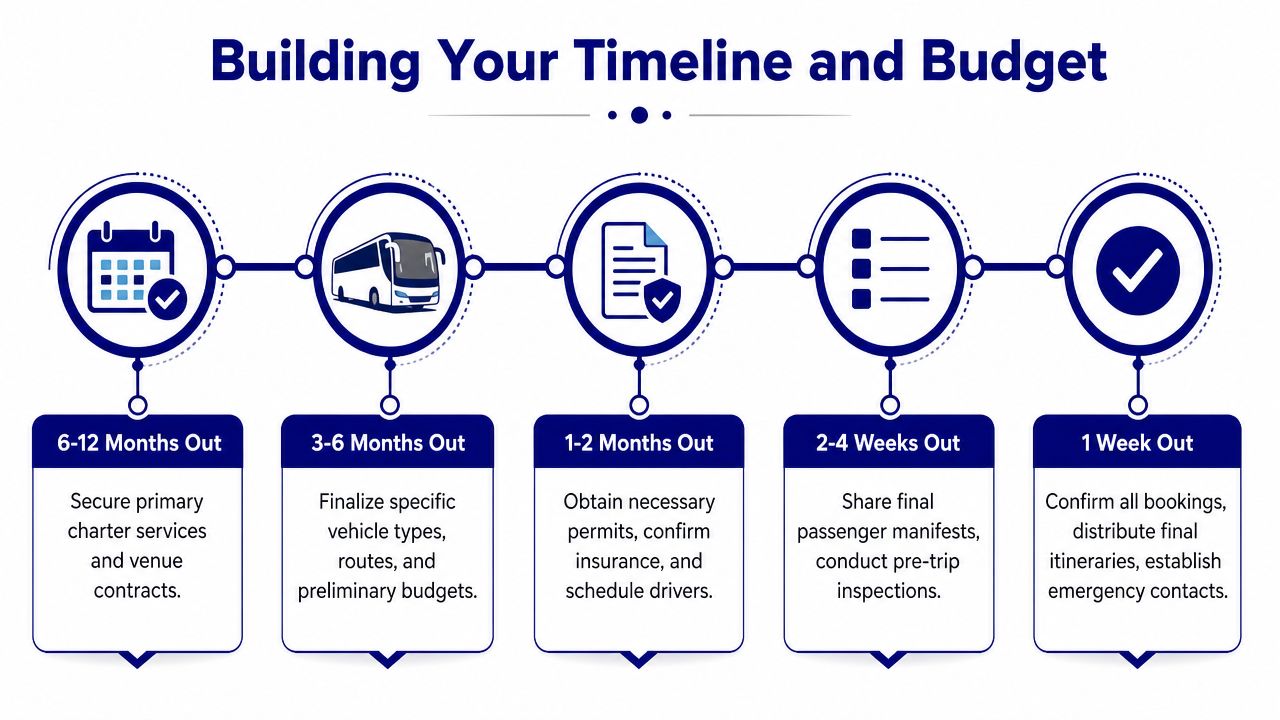
Build the budget around risk, not just rates
A quote for a sedan, shuttle, or aircraft only tells part of the story. The final spend depends on how much uncertainty your event creates.
Look at these budget categories before you approve anything:
- Base transportation service: The obvious line item, but not the whole picture.
- Waiting and staging exposure: Delayed exits and venue backups can extend service windows.
- Traffic and rerouting risk: Road closures and event congestion affect labor time and scheduling.
- Parking and access fees: Some venues make bus circulation easy. Others make it expensive and slow.
- Guest no-shows or self-booking: Empty reserved seats still cost money, and unplanned rides create cleanup costs later.
- Late schedule changes: Last-minute additions are usually expensive because they compress dispatch options.
If you're pricing aircraft as part of the mix, it helps to understand how charter structures work before event pressure starts. A planning resource like private jet charter pricing is useful for setting expectations around what affects total trip cost, especially when schedules are fluid.
A practical booking rhythm
Booking windows depend on market pressure, seasonality, and event type, so rigid formulas don't help much. What does help is sequencing decisions in the right order.
Early stage
Lock in the transportation concept. Decide whether you need shared transfers, dedicated VIP movements, or a hybrid model. This is also the moment to identify hard constraints such as remote venues, multiple airports, or limited motor coach access.
Middle stage
Confirm vehicle classes, key routes, pickup logic, and fallback options. Don't wait to address luggage handling, accessibility, or venue loading restrictions.
Final stage
Freeze manifests, issue instructions, and test the day-of operating plan. The closer you get to event day, the less valuable abstract options become.
Questions worth asking before you sign
- If the event runs late, how is additional time billed?
- What counts as wait time versus active transfer time?
- Who pays for route changes caused by venue or city restrictions?
- Can the operator handle split departures if guests leave in uneven waves?
- Is there a dispatch contact with authority to make changes instantly?
Budget for delay before delay happens. It's cheaper than trying to buy flexibility on the day.
A strong transportation budget isn't the lowest quote. It's the one that survives reality.
Coordinating Logistics and Communicating with Guests
Execution usually fails for one of three reasons. Guests don't know what to do. Vehicles can't move where they need to move. Or the plan assumes everyone will behave exactly as instructed.
FHWA guidance offers a solid operating backbone for special event transport plans: disseminating traveler information, managing and controlling traffic, and managing travel demand. It also recommends setting event-specific performance objectives and measures for traffic flow, safety, and parking so teams can make real-time adjustments before congestion spirals (FHWA special event transportation management guidance).
Traveler information has to be painfully clear
Guests won't study your logistics notes the way your operations team will. They need short, direct instructions delivered at the right time.
That means every guest communication should answer five things:
- Where do I go?
- When should I be there?
- What vehicle am I looking for?
- Who do I contact if something changes?
- What happens if I miss the assigned departure?
If the event itself is complex, broader planning references can help align all moving pieces. Teams juggling venue flow, staffing, ticketing, and guest circulation often benefit from a resource like mastering event logistics for 2026, especially when transportation has to sync with entry timing and on-site operations.
The master movement sheet
Every serious event needs one document, even if the working version lives in software. It should include:
- Passenger groups: VIPs, speakers, attendees, family, vendors
- Assigned service type: Dedicated car, shared shuttle, standby, or ad hoc
- Driver and dispatch contacts: Names and direct numbers
- Pickup instructions: Exact curb, gate, hotel entrance, or fixed-base operator location
- Load windows: Not just departure times, but boarding windows
- Escalation path: Who can approve changes fast
For private aviation movements, pickup instructions at the airport need extra precision because guests may arrive through different facilities than commercial passengers. A page like how private jet pickup works at the airport can help non-aviation stakeholders understand why those instructions must be exact.
Special considerations people forget until late
These details tend to surface after contracts are signed, which is too late.
- ADA-compliant vehicles: Confirm exact accessibility arrangements, not broad promises.
- Pets: VIP and family travel sometimes includes animals. Ground and air policies must align.
- Luggage transfer: Airport-to-hotel and hotel-to-venue baggage flow often needs separate handling.
- Weather plan: Heat, rain, and formalwear can change loading strategy.
- Security flow: Some principals need discrete entrances and staggered arrivals.
Clear communication reduces demand spikes. When guests know their correct pickup window and location, they stop creating unplanned transportation demand.
What successful day-of coordination looks like
The best day-of operations don't feel dramatic. The venue knows when shuttles stage. Dispatch knows who has boarded. Guest services knows who to call. Security knows which arrivals need separation. Hotel staff understand where to direct people.
That level of coordination doesn't happen because everyone is talented. It happens because the transportation plan was communicated in plain language and updated when reality changed.
Contingency Planning for a Seamless Recovery
The luxury isn't perfection. It's recovery.
When transportation breaks, guests rarely care why. They care whether someone took control quickly. That's why contingency planning matters more than polished initial scheduling. The event that recovers well often feels better managed than the one that got lucky.

Scenario planning that actually helps
A useful contingency plan doesn't say “have backups.” It names likely failures and assigns actions.
Corporate summit problem
A keynote speaker's commercial flight is canceled on the morning of the event. If the appearance is mission-critical, the recovery path should already be defined. That may mean a backup speaker sequence, remote appearance capability, or an alternate transport option. For some planners, providers such as Air Trek are part of that toolkit when private charter flexibility is needed for schedule-sensitive executive travel.
Wedding weekend problem
The ceremony runs late, and the return shuttles are now out of sync with venue curfews and guest expectations. The recovery plan should specify whether departures convert to rolling service, whether one vehicle stays as a late shuttle, and who communicates the revised return instructions.
Sporting event problem
Police traffic control changes the access road two hours before gates open. If your plan depends on a single approach route, service starts unraveling fast. The fallback needs alternate staging instructions, revised guest messaging, and a designated person who can update drivers in real time.
Build the response structure before you need it
Good recovery depends on decision rights. If everyone has to ask permission, you lose time.
Set these roles in advance:
- Operations lead: Owns transportation decisions
- Venue liaison: Confirms curb, gate, and staging changes
- Guest communications lead: Pushes updates to attendees
- VIP handler: Manages principals and high-priority travelers
- Vendor escalation contact: Has direct authority with transport providers
The backup plan should be specific enough that a new team member could run it under pressure.
Questions clients should ask before event week
- What's the substitute plan if a vehicle goes out of service?
- Who monitors flights and arrival changes?
- How will guests be informed if pickup points move?
- Is there standby capacity for critical passengers?
- What changes require client approval, and what can dispatch decide on its own?
The final test is simple. If one transfer fails, does the whole event wobble, or does the system absorb it?
That's the difference between transportation that merely exists and transportation that protects the experience.
Special event transportation works best when it's treated as part of the event's design, not an afterthought. The right plan matches the vehicle to the moment, the budget to real uncertainty, and the guest instructions to actual behavior. When that happens, arrivals feel intentional, departures feel easy, and the event holds its shape even when conditions change.