
You're probably looking at a South Florida trip right now and trying to avoid the usual commercial-airline tradeoff. Leave early, stand in lines, hope the connection works, then lose more time on the ground. If your schedule is tight, your group matters, or you're traveling with family, clients, or pets, that approach stops making sense fast.
A private jet to Fort Lauderdale solves a very practical problem. You control departure timing, use airports that fit your real destination, and step into a quieter, more predictable process from the start. For business travelers, that means less downtime. For leisure travelers, it means the trip starts like a vacation instead of a logistics exercise.
Why Fly Private to Fort Lauderdale
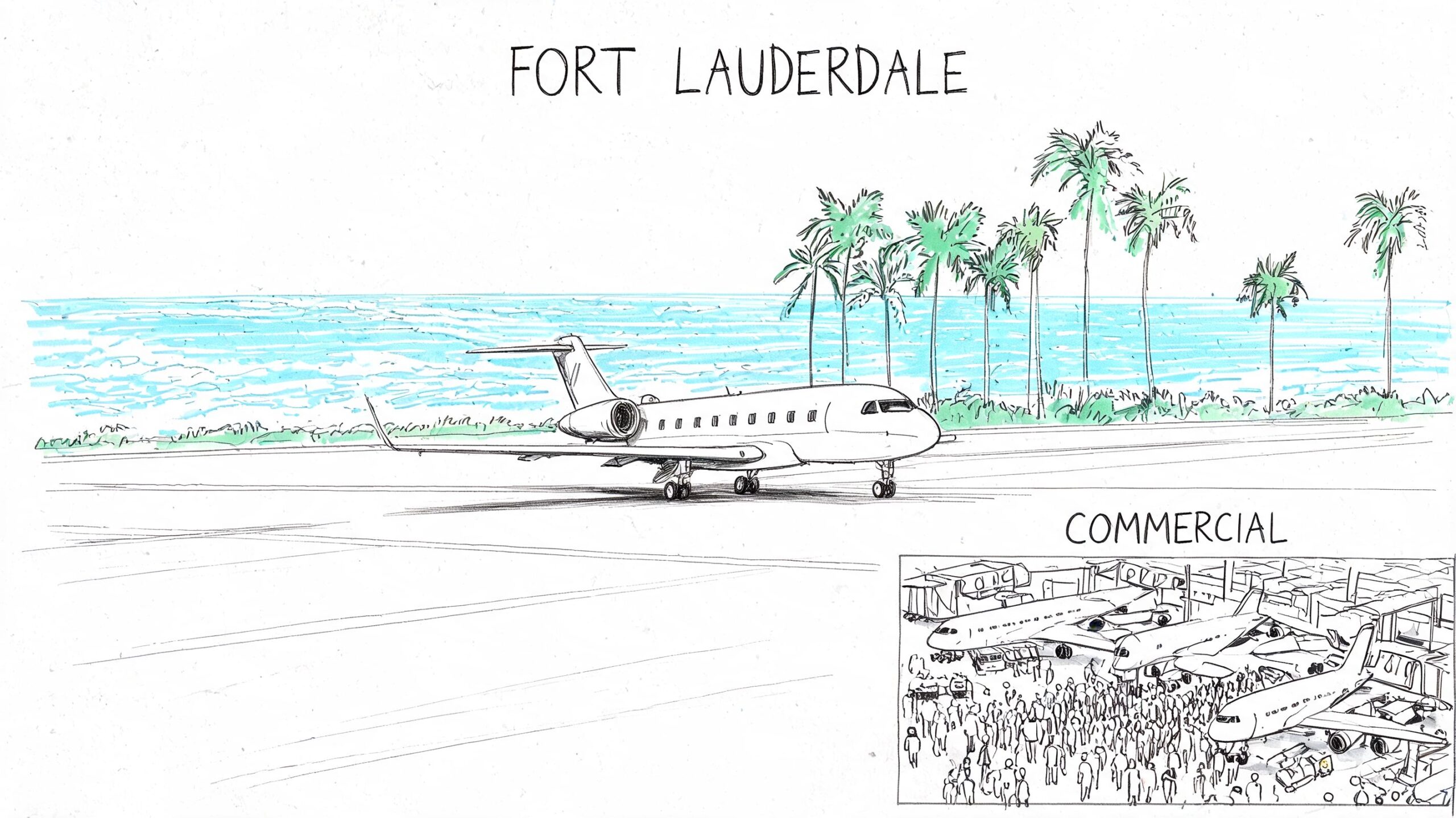
A typical Fort Lauderdale trip has more moving parts than people expect. Maybe you've got a meeting near downtown, a yacht departure near Port Everglades, dinner in Miami, or a family stay on the beach with bags, golf clubs, and a dog in tow. Commercial service can get you into South Florida, but it rarely gets you there on your terms.
That's one reason Fort Lauderdale works so well for private aviation. Fort Lauderdale-Hollywood International Airport recorded 18,860 private jet departures in 2024 and ranked 20th nationwide for private aviation traffic, according to 2024 private jet airport rankings. That level of activity matters because it reflects a mature market. Crews, handlers, and ground providers are used to serving private flyers at volume.
What travelers usually gain
- Time control means you build the day around your schedule, not an airline bank.
- Closer access helps if your real destination isn't the airline terminal but a marina, office, resort, or private residence.
- A calmer process makes a difference when traveling with executives, children, older family members, or pets.
- Flexible ground planning lets you pair the flight with a car service that matches the same standard. If you need that side handled well, this guide to black car service is useful for thinking through airport pickups and local transfers.
Practical rule: Private flying pays off fastest when the value of your time is higher than the inconvenience of airline schedules.
Fort Lauderdale also works for travelers who don't want to default to Miami. You still get strong access to the broader South Florida corridor, but with more flexibility for both business and leisure itineraries. That's often the difference between a trip that feels rushed and one that feels managed.
Choosing Your Fort Lauderdale Arrival Airport
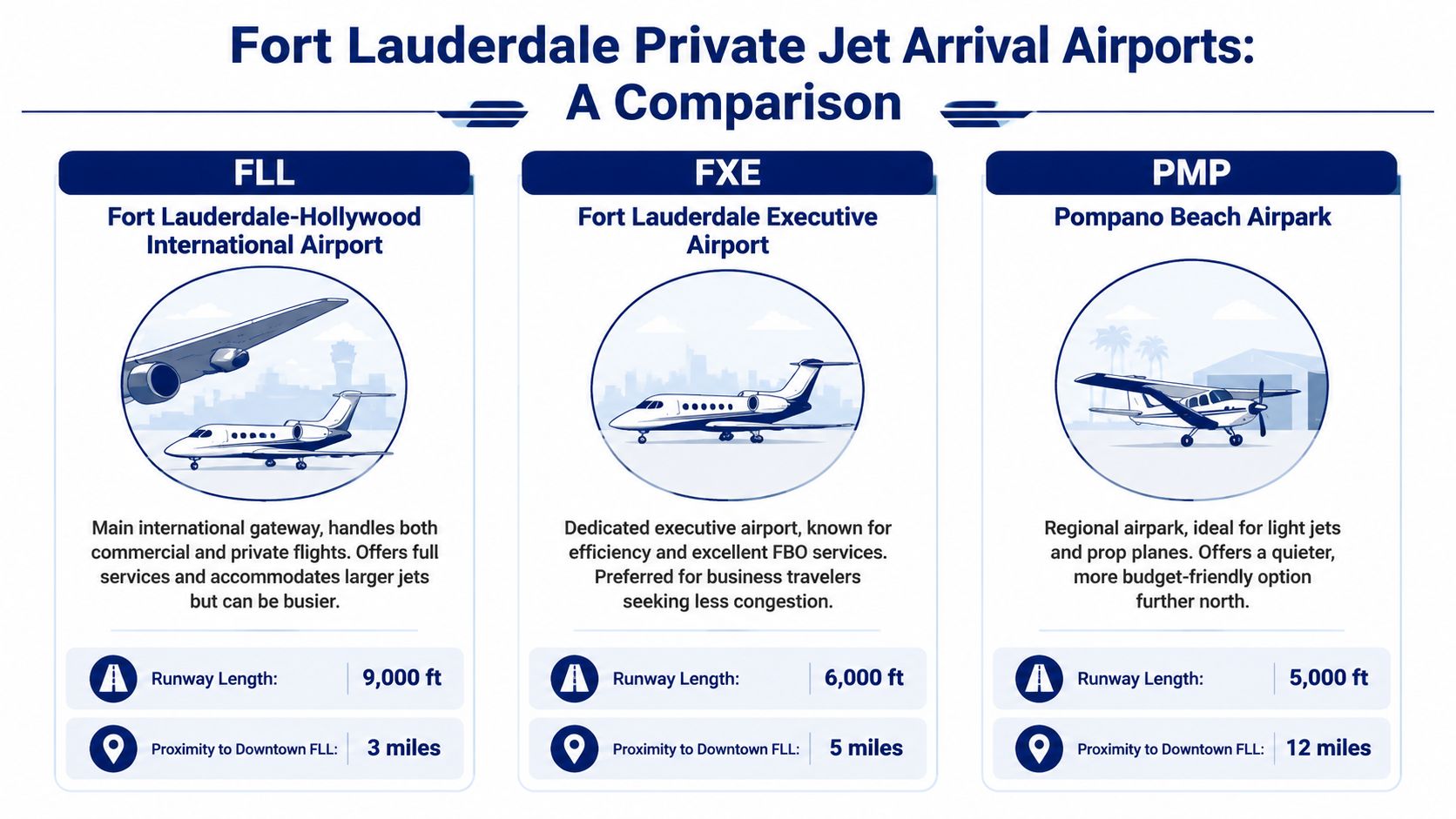
The biggest mistake I see is choosing the airport by name recognition instead of by mission. If someone searches for a private jet to fort lauderdale, they often assume FLL is automatically the right answer. Sometimes it is. Sometimes it costs you extra ground time for no good reason.
FLL for international access and larger aircraft
FLL is the obvious choice when you need a full-service airport with strong infrastructure. It supports private flights through multiple FBOs and has a 9,000-foot runway. It also delivers 95% on-time performance for private charters versus 75% for commercial flights, supported by efficient ground handling and on-site U.S. Customs, according to Air Partner's FLL airport guide.
Use FLL when these points matter:
- You're arriving internationally and want smoother customs handling.
- You're using a larger cabin aircraft that benefits from longer runway margin.
- Your destination is near Port Everglades or central Fort Lauderdale.
- You want maximum support services such as fueling, maintenance, and premium FBO amenities.
FLL is busy, but that isn't automatically a negative. For many travelers, the infrastructure outweighs the traffic.
FXE for speed and executive trips
Fort Lauderdale Executive often makes more sense for business flyers who don't need the scale of FLL. It's a strong option for shorter turns, easier movement, and a more executive-focused experience. If your meetings are in the Fort Lauderdale or Boca corridor, FXE can feel more efficient from wheels down to car door.
This is especially true if your aircraft category fits the field comfortably and you're not relying on the broader international support stack that pushes travelers toward FLL.
If your trip is domestic, schedule-sensitive, and centered on business meetings, FXE often wins on simplicity.
A more detailed side-by-side breakdown is available in this comparison of FLL and FXE for private flying.
PBI and OPF when Fort Lauderdale isn't the whole story
Some itineraries say “Fort Lauderdale,” but the actual destination is farther north or farther south. That's when Palm Beach International or Opa-locka can become smarter options.
Here's the practical lens:
| Airport | Best fit | Trade-off |
|---|---|---|
| FLL | International arrivals, larger jets, cruise access, central Fort Lauderdale | More overall activity |
| FXE | Business aviation focus, efficient domestic arrivals, executive schedules | Less ideal for some larger-aircraft or international scenarios |
| PBI | Palm Beach, Jupiter, northern Broward edge | Longer drive if you're staying in central Fort Lauderdale |
| OPF | North Miami, Miami Beach, southern part of the metro area | Less convenient if your destination is firmly in Fort Lauderdale |
The right question to ask
Don't ask, “Which airport is closest on the map?” Ask these instead:
- Where am I ending up? Beach hotel, office tower, yacht, private home, or cruise terminal all change the answer.
- What aircraft am I using? Runway and support matter.
- Is customs part of the trip? If yes, airport choice narrows quickly.
- Will ground traffic erase any flying advantage? In South Florida, that happens more often than people think.
Choose the airport that shortens the whole trip, not just the flight segment.
Selecting the Right Aircraft for Your Trip
You land in South Florida at 10:30 a.m., but the day only works if the airplane fits the trip before wheels-up. The wrong aircraft shows up as lost time, tighter baggage limits, extra fuel stops, and a cabin that feels too small for the people and purpose on board.
Aircraft selection starts with the mission. Route length, passenger count, luggage, pets, onboard work needs, and airport constraints matter more than cabin prestige on a Fort Lauderdale charter.
For short regional hops
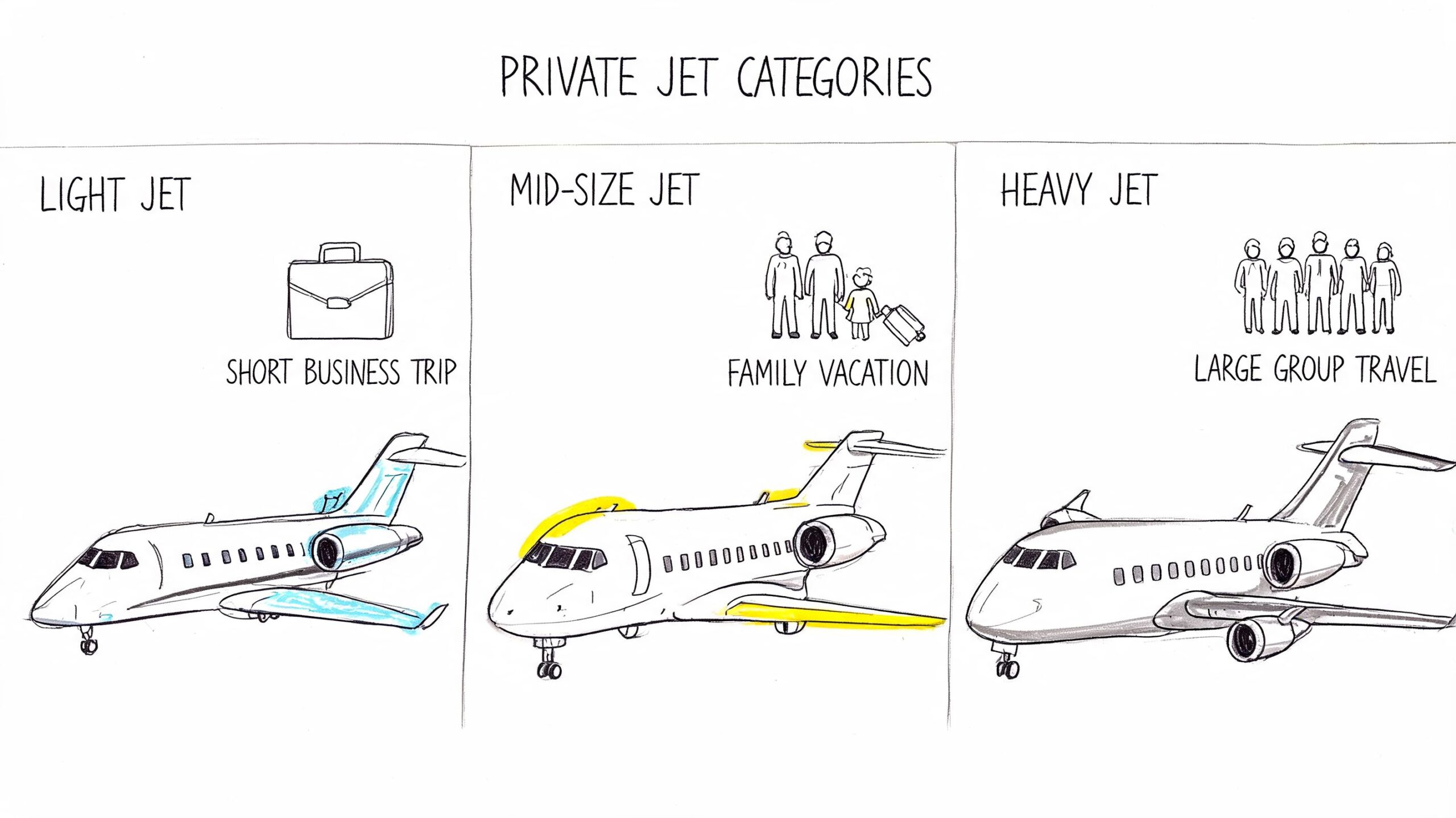
For South Florida, the Bahamas, or nearby Southeast trips, a turboprop or light jet is often the sensible choice. These aircraft keep operating costs lower and usually make a lot of sense for travelers who care more about getting in and out efficiently than stretching out in a larger cabin.
Evojets points out in its Fort Lauderdale airport guide that light jets such as the Phenom 300 are a practical fit for shorter Florida flying.
Typical fit:
- Couples or small groups
- Day trips and short business meetings
- Lighter baggage loads
- Travelers bringing a small pet in cabin
- Passengers using Fort Lauderdale as one stop in a multi-city itinerary
One caution. “Short flight” does not always mean “small plane.” Golf bags, strollers, dog crates, or five adults with full-size luggage can push a light jet past the point where it is still the best value.
For business teams and longer domestic trips
Midsize and super-midsize jets are often the best balance for Fort Lauderdale itineraries. They give business travelers enough cabin room to work and talk comfortably, while also carrying more baggage and handling longer legs with fewer compromises.
For many clients, this is the sweet spot.
NBAA's business aircraft guidance shows how aircraft in these categories are built for longer stage lengths and stronger passenger comfort than entry-level cabins, which is why they are so commonly used for domestic trips of meaningful length. See the NBAA aircraft overview.
A super-midsize jet can also help on Northeast to South Florida flying because speed, climb performance, and weather tolerance are better than what you usually get in a smaller light jet. That does not mean every trip needs one. It means the savings on a smaller aircraft can disappear quickly if the mission includes winter weather, a full passenger load, or schedule pressure. If you want a clearer sense of how aircraft category changes the quote, our guide on what changes the price of a private jet charter in Florida breaks that down in practical terms.
When a heavy jet makes sense
Heavy jets serve a specific job. They work well for coast-to-coast trips, larger groups, travelers with a lot of luggage, and passengers who want a true stand-up cabin for a longer day of flying.
They are not automatically the smart buy.
I usually recommend a heavy jet to Fort Lauderdale only when the cabin, range, or baggage requirement is real. If the trip is two or three people from the East Coast, paying for that extra airplane rarely improves the mission enough to justify the cost. If the trip is eight passengers with bags, a nanny, and a dog heading to a yacht or extended stay, the heavy jet often solves problems before they happen.
Quick selection guide
| Trip profile | Usually the smart choice |
|---|---|
| Intra-Florida or nearby regional flight | Turboprop or light jet |
| Small executive group from the Midwest | Midsize jet |
| Northeast trip with tighter timing or winter weather concerns | Super-midsize jet |
| Larger group, longer domestic route, or substantial baggage | Heavy jet |
The best aircraft choice shortens the full travel day, not just the flight time. That includes baggage fit, pet accommodations, ground transfer timing, and how the airplane performs on your actual route.
Understanding Private Jet Charter Costs
Often, the first question is about price, but the useful question is, “What am I paying for, and what changes the quote?” That's how you compare options correctly.
For Fort Lauderdale trips, private jet charters can range from $5,000 for short regional trips to over $60,000 for cross-country flights in heavy jets, and a midsize jet from Chicago to the area typically costs between $18,000 and $26,000, based on BlackJet's Florida charter pricing overview. Those numbers are broad by design. Real quotes move based on the aircraft, routing, timing, and positioning.
What drives the final number
A quote usually shifts because of a few core variables:
Aircraft class
A light jet and a heavy jet don't just differ in size. They differ in fuel burn, crew needs, range, and operating cost.Trip length
Longer sectors add flight time. Shorter flights can still look expensive if the operator has to reposition an aircraft into your departure point.Season and availability
South Florida gets busier when demand concentrates around high-travel periods. Availability tightens, and the most attractive aircraft go first.Operational details
International handling, premium catering, and overnight logistics can all influence the final quote depending on the mission.
How to read a quote without getting fooled
The cheapest quote on the page isn't always the best value. Ask what's included and what assumptions sit behind it. If one quote depends on a less convenient airport, a tighter baggage limit, or a less suitable aircraft, it may not be comparable at all.
A good quote should answer:
- Which airport pairing is being used?
- What aircraft model or category is assigned?
- Is the trip one-way or round-trip?
- Are schedule changes realistic if the day moves?
One resource that explains these moving parts well is this guide to what changes private jet pricing in Florida.
A transparent quote doesn't just give a number. It shows why that number is the right one for the trip.
A practical way to budget
If you're trying to set expectations internally for a corporate trip or family plan, budget by mission type instead of by generic “hourly rate” thinking.
| Mission | Budget logic |
|---|---|
| Short regional hop | Expect the lower end of the market if aircraft positioning is favorable |
| Midwest to Fort Lauderdale in a midsize cabin | Use the cited Chicago range as a realistic planning reference |
| Cross-country in a large cabin | Expect the premium end, especially if flexibility is limited |
That approach leads to fewer surprises and better aircraft decisions.
Finding Value with Empty Leg Flights
Empty legs are one of the few real ways to lower private charter cost without lowering the standard of travel. An empty leg is a repositioning flight. The aircraft needs to move anyway, and the operator offers that segment at a reduced rate if your timing lines up.
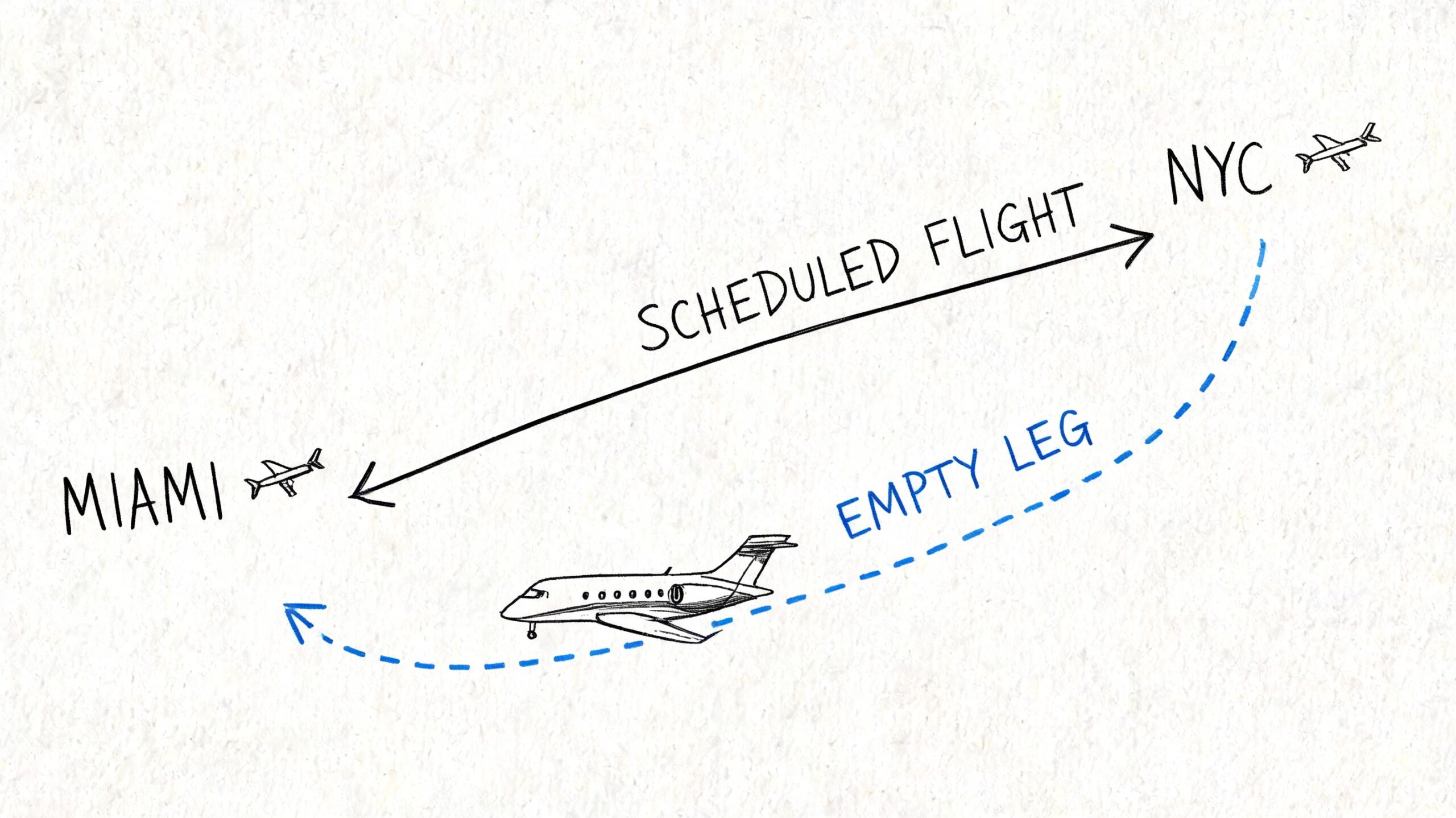
That matters in South Florida because aircraft reposition through the region constantly. Verified pricing for Fort Lauderdale indicates that, amid post-2025 fuel price stabilization, empty leg availability from hubs like New York and Chicago has increased, and a light jet charter from NYC can drop to as low as $5,000 versus a standard charter of $9,500, according to Paramount Business Jets' Fort Lauderdale charter page.
When empty legs work well
Empty legs are strongest when your schedule has flexibility. If you can shift departure by part of a day, use a nearby airport, or accept one-way travel, value improves fast.
They're a smart fit for:
- Leisure travelers with flexible start times
- Couples and families booking one-way segments into South Florida
- Travel managers who can align a team trip with a preexisting reposition
- Event travel where arrival matters more than exact departure hour
They're less useful when your trip is rigid, highly customized, or dependent on same-day backup options.
What to ask before booking one
Ask direct questions. Empty legs can be excellent, but they're not the same as a fully bespoke charter.
- How firm is the departure time?
- What happens if the underlying aircraft schedule changes?
- Is this one-way only?
- Which airport is being used?
If you want a plain-English explanation of how these trips work, this empty leg flight guide is a solid starting point.
A short video can also help clarify the concept before you book:
One practical option in this space is Air Trek, which arranges on-demand charter and empty leg flights in Florida and across the Western Hemisphere. The useful part for travelers is the ability to compare a standard itinerary against a reposition opportunity instead of assuming the first quoted structure is the only one available.
The Booking Process and What to Expect
First-time charter clients often expect the process to feel complicated. In practice, it's usually much simpler than booking a layered commercial itinerary with upgrades, seat assignments, baggage issues, and airport timing buffers.
Step one through departure day
You'll usually start with the essentials:
Route and timing
Departure airport, destination, preferred windows, and whether the trip is one-way or round-trip.Passenger details
Headcount, any children, pet travel, and whether anyone has mobility or privacy requirements.Baggage and trip style
Golf clubs, garment bags, skis, strollers, or business presentation gear can affect aircraft fit more than people expect.
Once those details are clear, the charter coordinator can narrow airport options and aircraft categories quickly. The best proposals don't just list a plane. They match the plane to the trip.
What the day of travel feels like
Private terminal travel is straightforward. You arrive at the FBO, check in with the desk or your charter contact, and wait in a lounge instead of moving through the commercial terminal process. When the aircraft is ready, you walk directly to it.
That simplicity is why many repeat flyers stay with private aviation even when they could fly first class commercially. The friction is different.
Arrive prepared, but don't arrive like you're flying commercial. The process is faster, more personal, and far less crowded.
Small details that improve the trip
A smooth charter usually comes down to details handled early:
- Ground transportation should be confirmed before wheels up.
- Catering requests should match the flight length and passenger preferences.
- Schedule buffers still matter in South Florida, especially if your final leg is by car during busy periods.
- International documents should be reviewed well before departure if customs is involved.
If you tell the charter team the actual shape of the day, not just the route, the trip tends to run cleanly.
Essential Policies and FAQs for FLL Travel
The most common Fort Lauderdale charter questions aren't about glamour. They're about practical day-of-travel issues. Can I bring the dog? How much baggage fits? What if I'm arriving from outside the U.S.? Can catering be adjusted for kids or dietary restrictions?
Can I bring my pet on a private jet to Fort Lauderdale
Usually, yes. Pet travel is one of the clearest reasons families choose charter service in the first place. The verified data on this point is strong: 70% of high-net-worth families prioritize pet-inclusive flights, according to this FlyXO route page covering private travel demand around Fort Lauderdale.
That tracks with what travelers ask in real life. They don't want a separate pet transport process. They want the animal with them, in the cabin, under clear procedures.
A few practical questions to ask early:
- What size and breed is the pet?
- Will you use a carrier or a harness setup?
- Are there destination-specific rules after landing?
- Do you need water, relief stops, or special coordination on the ground?
How much baggage can I bring
Private charters are more flexible than airlines, but baggage still has to match the aircraft. Soft-sided luggage is often easier to work with than hard cases. Odd-shaped items matter more than simple suitcase count.
If you're carrying golf clubs, multiple garment bags, medical equipment, or pet gear, mention it at quoting stage. Don't save that for the day of departure.
What about customs, catering, and special requests
If you're arriving internationally, document review and manifest details need to be handled correctly before departure. For domestic trips, the main issue is usually timing and coordination rather than paperwork.
Catering can usually be customized for the group. So can cabin setup, ground transfers, and other trip-specific requests. The key is simple: ask early.
The easiest private flights are the ones where the operator knows the real trip, not just the airport pair.
Fort Lauderdale is a strong private aviation market because it supports both routine executive flying and more customized family travel. If your trip includes pets, complex baggage, or a tight ground schedule, those details aren't extras. They are the trip.
If you're planning a private jet to Fort Lauderdale, the best results come from matching the airport, aircraft, and schedule to your actual itinerary. That usually saves more time and stress than chasing the lowest headline quote.