
A jet drops a family in Nassau for a long weekend. The passengers step off, the bags come out, the crew handles the handoff at the FBO, and within a short window the aircraft has to move again. Sometimes it returns to its base. Sometimes it repositions to another airport for the next paying trip. Either way, that next segment may leave with no one on board.
That’s the part of private aviation many travelers never see.
If you’ve been asking what is an empty leg flight, the short answer is simple. It’s a private jet segment that exists because of another booked charter. The better answer, and the one that matters if you’re considering booking one, is that empty legs can be a smart travel tool when your schedule has room to flex and your route lines up with aircraft movement.
Used well, they’re not just a discounted novelty. They’re a practical way to access private aviation with strong value, especially for travelers moving around Florida, the Caribbean, and other charter-heavy corridors.
The Hidden Opportunity in Private Aviation
People tend to think about private aviation from the passenger’s seat. They picture the departure lounge, the quick boarding process, and the convenience of flying direct. They don’t think about what the aircraft has to do before pickup or after drop-off.
That’s where the opportunity sits.
A one-way charter often creates an operational problem for the operator. The airplane may need to fly empty to get into position for its next assignment, or empty to return home after completing the trip. Those flights still happen whether or not anyone buys them. That’s why the market for empty leg flights exists at all.
Why this matters to travelers
For the right traveler, an empty leg isn’t a compromise in the usual sense. You still use private terminals. You still avoid the normal commercial airport routine. You still get the privacy and time savings people book charters for in the first place.
What changes is control.
You usually don’t shape the trip from scratch. The route already exists because somebody else’s charter created it. If that route, timing, and aircraft happen to fit your plans, you can step into a seat that would otherwise fly empty.
Practical rule: Empty legs work best when the traveler can adapt to the aircraft’s schedule, not the other way around.
Who tends to use them well
The travelers who get the most value from empty legs usually share a few traits:
- Flexible planners: They can leave earlier, later, or even a day different from their original preference.
- Route opportunists: They watch major charter corridors and jump when a useful city pair appears.
- Small groups or families: They can divide the flight cost across several travelers.
- Executives with room in the calendar: They care about time and privacy, but not every trip is tied to an immovable meeting.
That’s the inside track. Empty legs aren’t for every trip. But for the right trip, they can be one of the sharpest buys in private aviation.
How Empty Leg Flights Actually Work
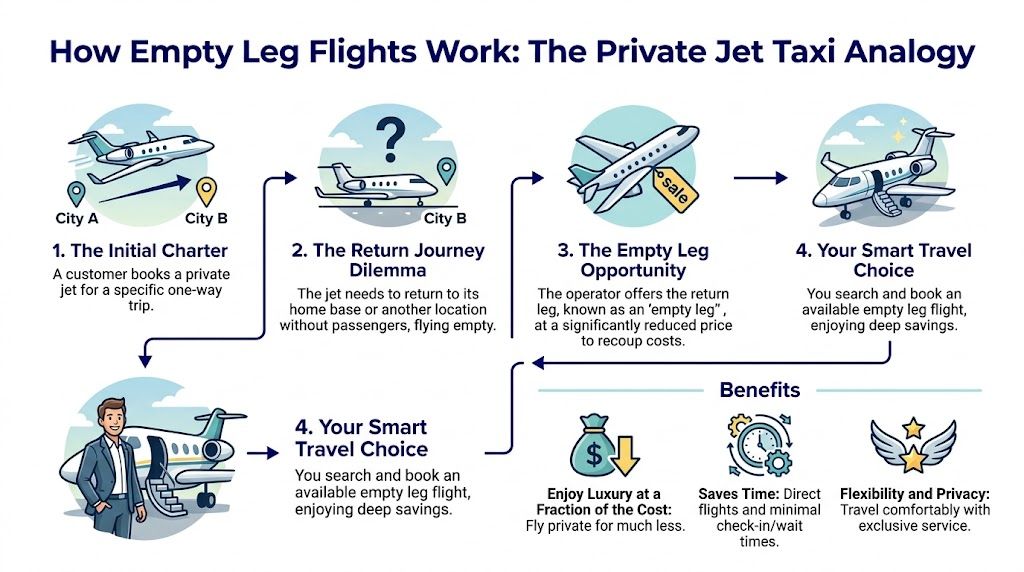
An empty leg flight is a repositioning segment created by a primary paid charter. The aircraft needs to move to pick up its next client, return to base, or continue to another scheduled assignment. If that segment can be sold, an operator may release it at a reduced rate instead of flying it without passengers. Magellan Jets’ explanation of empty leg flights outlines the two most common setups: inbound positioning and outbound return.
This distinction is important because travelers sometimes confuse an empty leg with a casual extra flight or a lesser version of a charter. It is neither. The aircraft, crew, and operating standards are the same. What changes is who controls the schedule.
Inbound positioning
This happens before the main client trip.
An aircraft may be based in Florida, while the paying passengers are departing from another airport. The jet still has to get to that departure point, and that repositioning leg can sometimes be offered for sale. For a flexible traveler, useful opportunities can be found on routes that were never advertised as scheduled service. A seat is not the product. The aircraft movement is.
Outbound return
This is the version travelers usually notice first.
A client books a one-way trip and finishes at the destination. The airplane then has to head back to base or continue to its next assignment. That follow-on segment becomes the empty leg. If your trip lines up with that route and timing, you can book the aircraft for far less than you would pay for a made-to-order charter.
Why operators list them
Operators list empty legs to recover revenue on a flight that is already in the schedule. They are not creating a special deal from scratch. They are trying to offset the cost of a necessary aircraft movement.
That is why empty legs behave differently from regular charter inventory. They appear late, change fast, and can disappear if the primary charter moves or cancels. A standard private charter flight option is built around your mission. An empty leg is built around the operator’s mission first, and your trip only works if it fits inside that framework.
I tell clients to remember one simple rule. The airplane was going anyway.
A simple way to remember it
- A traveler books the main charter
- The aircraft has to reposition
- The operator offers that segment for sale
- A flexible buyer takes it if the route and timing fit
That is how empty leg flights work in practice. For travelers who can move quickly and accept some schedule risk, they are less of a bargain-bin option and more of a tactical way to use private aviation well.
Quantifying the Savings on Empty Leg Flights
Price is where empty legs stop being a curiosity and start becoming a serious option.
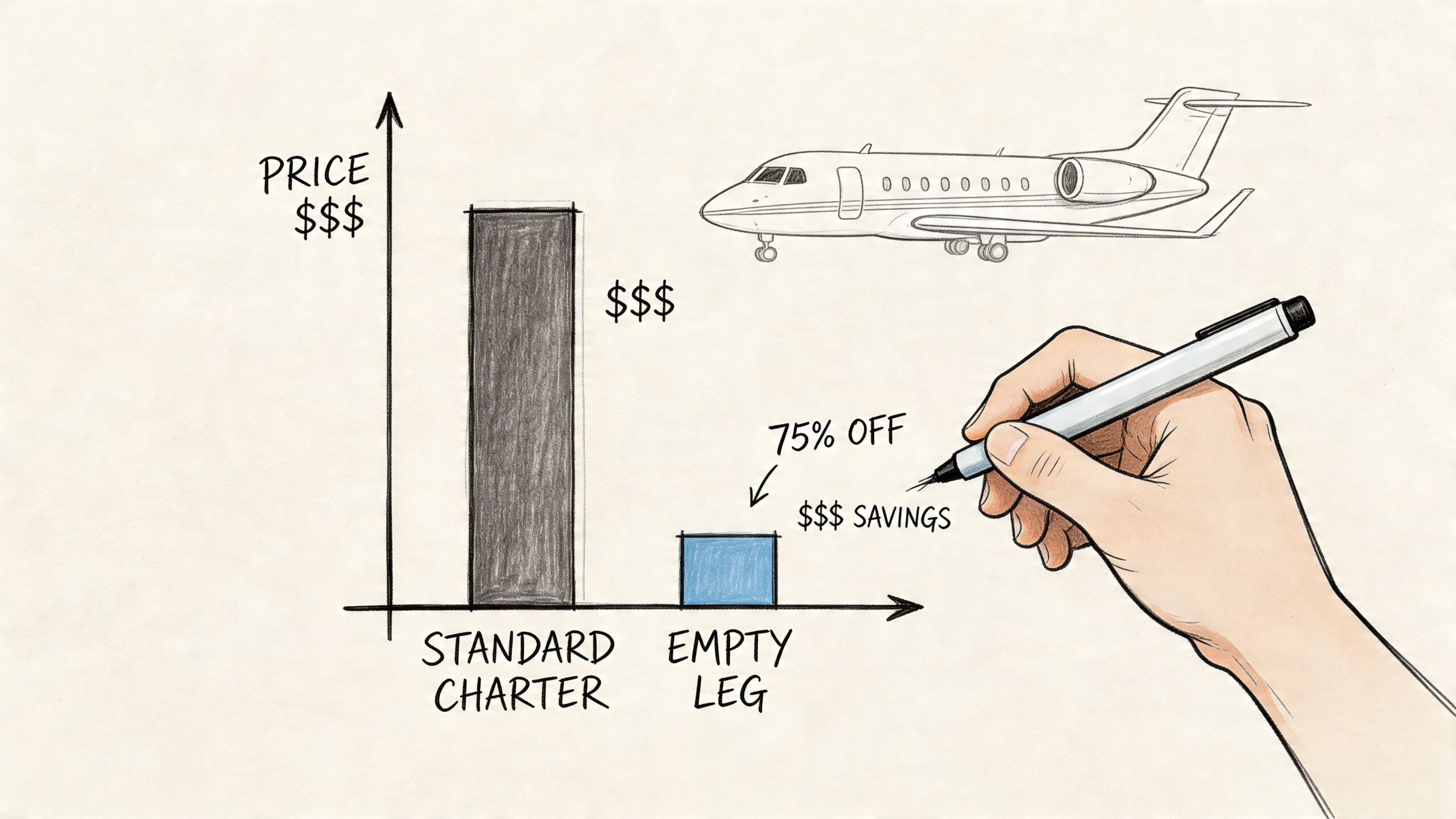
In practice, the savings can be steep. Empty legs often come in well below the cost of booking the same aircraft as a custom one-way charter. That price gap exists because the operator is trying to recover part of the cost of a flight that is already scheduled, not build a trip around your exact requirements.
That distinction matters more than the discount headline.
A standard charter gives you control. You pick the departure window, the airport pair, the aircraft category, and the pace of the trip. An empty leg gives you a fixed route and timing at a reduced rate. For travelers who can work inside those limits, the value can be hard to ignore.
I usually tell clients to run the comparison in practical terms, not just percentage terms. Ask what the lower fare buys you in real use. If the trip still gets your group where it needs to go, on a route you would have chartered anyway, the savings can shift private aviation from a stretch purchase to a rational one.
That is especially true for one-way leisure trips, short-notice family travel, and business flyers who have some schedule room. A team trying to avoid a full day of airline connections may decide the reduced empty leg price justifies the move. A family heading to a resort may find that splitting the cabin cost makes the numbers work in a way a full charter would not.
If you want a better baseline before comparing a standard quote against an empty leg offer, Air Trek’s guide to what changes the price on Fort Lauderdale private jet routes gives useful context on aircraft type, route length, airport fees, and timing.
A Florida corridor example
South Florida is a good market to watch because aircraft move through it constantly. Routes into the Bahamas, South Florida, and parts of the Caribbean can produce useful empty leg opportunities, particularly for travelers who are open on departure time and do not need a perfectly matched return.
The savings are only part of the equation. You still keep the parts of private flying that many travelers care about most:
- Direct routing
- Private terminal access
- Short ground time before departure
- A cabin reserved for your group
That combination is what makes empty legs strategic instead of merely cheap. The right traveler is not just spending less. They are buying time, privacy, and convenience at a price that can compete far more favorably with the alternatives.
A short explainer helps if you want to see the pricing logic in plain terms.
The right way to think about value
Treat empty leg pricing as an opportunity with conditions attached.
The best use case is a trip you wanted to take anyway, on dates you can flex, in a market where repositioning flights show up often. If that describes your travel pattern, the savings can be substantial enough to make private aviation part of your regular toolkit rather than a once-a-year splurge.
The Pros and Cons of Booking an Empty Leg
A traveler spots a private jet from South Florida to the Bahamas at a fraction of standard charter pricing, books it, and gets the trip they wanted with private terminal access and no airline friction. Another traveler books an empty leg for a fixed event, the primary charter shifts, and the plan falls apart. Both outcomes are normal. The difference is fit.
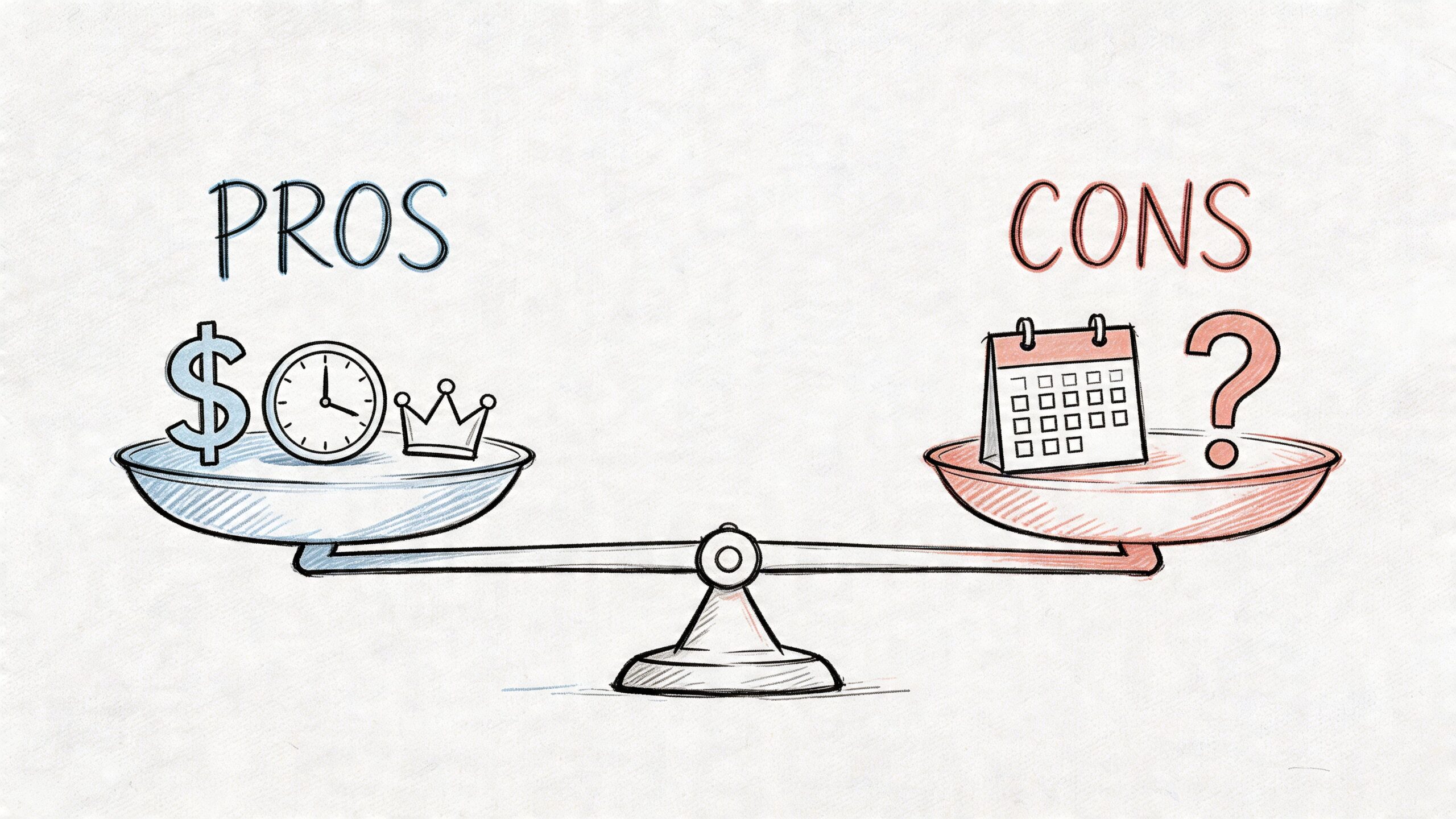
Empty legs work best as a strategic buy, not a custom charter substitute. You are purchasing a preexisting aircraft movement that happens to match your trip closely enough. For travelers who can work with that structure, the value can be excellent.
What works well
Price gets the attention, but it is not the whole advantage.
A key benefit is access to private flying on a route that already exists. You still depart through a private terminal, avoid the commercial airport routine, and keep the cabin to your own group. If the route, timing, and airport options line up, that can be a very efficient way to travel.
Empty legs tend to perform well in a few specific situations:
- Weekend leisure trips: You can leave within a broader window and adjust around the aircraft’s timing.
- Group travel: Families and small groups can spread the cost across several seats.
- One-way itineraries: The model fits travelers who do not need the aircraft to wait or return with them.
- Flexible business travel: Privacy and speed matter, but the trip can absorb a schedule change if needed.
What usually causes problems
The trade-off is control.
The aircraft is repositioning for an operational reason. That means the route is fixed, the departure window is narrower than a normal charter, and the flight can change if the original customer changes plans. As noted earlier, cancellation and schedule-change risk is real enough that travelers should build around it, not ignore it.
That is why I rarely recommend an empty leg for a cruise departure, a wedding arrival, a court appearance, or any trip with a hard deadline and no backup. In those cases, a standard charter costs more but buys certainty.
A practical decision filter
Use a simple screen before you book:
| Question | If the answer is yes | If the answer is no |
|---|---|---|
| Can you leave earlier or later than planned? | Empty leg may fit | Full charter is safer |
| Do you have a backup plan if the flight changes? | Keep evaluating | Avoid it |
| Is your destination close to the listed route or airport options? | Strong candidate | Ground transfer or repositioning may erase the value |
| Is this a leisure trip or a flexible business trip? | Good use case | Book for reliability instead |
What savvy travelers do differently
Experienced buyers use empty legs selectively. They do not try to force every trip into the model.
The strongest empty leg bookings usually have two or three pressure valves built in. A flexible departure window. More than one acceptable airport. A plan B if the aircraft schedule moves. That is the inside track. The travelers who do well with empty legs are not just bargain hunting. They know which trips can absorb flexibility, and they use that flexibility to get private aviation at a much better value.
How to Book an Empty Leg Flight A Practical Guide
A traveler in South Florida wants to get to Nassau for the weekend. The fixed points are simple: two passengers, light bags, no need to return on the same aircraft. The variable is everything that makes empty legs work in practice. Miami or Fort Lauderdale. Friday late afternoon or early evening. Nassau or a nearby arrival option with a short transfer. That is the mindset that gets bookings done.
The practical advantage is speed. Empty legs reward travelers who know their acceptable range before they start shopping.
Set your booking parameters first
Start with three decisions.
First, list every airport you can use, not just the ideal one. A traveler who can use Fort Lauderdale, Opa-locka, or Miami has a better shot than someone locked into one field.
Second, define your time window. A two or three hour range is much easier to place than one exact departure time.
Third, decide what trade-off still feels worth it. Some clients will accept a longer drive on the ground to save substantially on the flight. Others care more about convenience than price. You need that answer before an option hits your inbox.
Where empty legs usually show up
Empty legs typically appear through operator emails, broker desks, charter sales teams, and private aviation booking networks. Air Trek also circulates repositioning opportunities on routes it already serves, which matters if you are looking at common patterns such as South Florida, the Caribbean, the Bahamas, or Latin America.
The channel matters less than your response time. Good options do not sit around long, and availability can change fast if the underlying aircraft schedule shifts.
If you are booking with an operator directly, review the company’s charter policies and procedures before you send payment. That gives you a cleaner read on terms, passenger requirements, and operational expectations.
A booking process that holds up in practice
Use a short screening process before you commit:
Match the route to your actual trip
Close counts, but only to a point. A lower fare loses its appeal if the ground transfer becomes expensive or time-consuming.Confirm the aircraft fits the mission
Check seating, baggage space, pets, and any special handling early. Empty leg buyers sometimes focus so hard on price that they skip basic fit.Ask for the terms in plain language
You want to know what happens if the original charter moves, cancels, or changes airports. Get the answer before you pay, not after.Check whether the quote is one-way only
It usually is. If you need a return, price that separately so you are judging the full trip cost, not just the attractive half.Be ready to authorize quickly
Empty leg inventory is time-sensitive. If the route, terms, and aircraft work, hesitation usually costs the opportunity.
One mistake I see often is a traveler treating an empty leg like a standard charter request. It is a different purchase. You are buying a useful segment inside an existing schedule, not building the schedule around yourself.
Sample flight comparison
Below is a simple way to evaluate a common South Florida to Bahamas trip.
Sample Flight Comparison: Fort Lauderdale (FLL) to Nassau, Bahamas (NAS)
| Feature | Standard On-Demand Charter | Empty Leg Flight |
|---|---|---|
| Schedule control | You choose the preferred departure time | Departure is tied to the repositioning schedule |
| Route | Built around your requested mission | Available only if that segment already exists |
| Aircraft choice | Selected for your trip and preferences | Determined by the aircraft that needs to reposition |
| Trip changes | More accommodating, subject to operator terms | More limited because the flight depends on another booking |
| Best fit | Fixed business trips, events, hard-timed travel | Flexible leisure trips, opportunistic one-way travel |
Booking mistakes that erase the value
A few habits cause problems quickly.
- Chasing one exact airport narrows your options more than many travelers realize.
- Assuming a matching return will appear can turn a cheap outbound into an expensive overall trip.
- Ignoring baggage and passenger details can create aircraft fit issues late in the process.
- Waiting for a perfect match usually means losing a good one.
The best empty leg buyers are disciplined, not just price-conscious. They know where they can flex, they verify the terms, and they move when the trip fits. That is how empty legs become a strategic tool instead of a gamble.
Are Empty Legs As Safe As Regular Charters
This is the right question to ask, and the answer should be direct. Yes, empty legs operate under the same safety framework as regular charter flights.
The lower price doesn’t mean a lower standard. It means the aircraft is already scheduled to move, and the operator is selling that segment instead of flying it without passengers.
According to Silverhawk Aviation’s explanation of empty leg flights, empty leg flights operate under the same FAA Part 135 requirements as standard charters. That includes pre-flight checks under 135.411, crew qualifications, and maintenance schedules. The same source also notes that ARGUS Platinum-rated operators like Air Trek maintain 99.8% dispatch reliability on all flights, whether the segment has passengers or not.
What stays the same
If you book an empty leg on a properly run charter operation, the fundamentals do not change:
- The aircraft is maintained on the same schedule
- The crew meets the same qualification standards
- The trip is flown under the same charter rules
- Operational oversight does not loosen because the price is lower
That matters because travelers sometimes confuse a discounted charter segment with a “spare” flight or a less formal one. It isn’t. The savings come from how the flight entered the schedule, not from reduced operating discipline.
What you should still check
Even when the regulatory framework is the same, smart buyers still verify the operator’s procedures and trip terms. If you’re reviewing operator standards, a published set of policies and procedures is worth reading before booking any private flight category.
Safety equivalence doesn’t remove the need for due diligence. It tells you where the baseline should be.
The practical takeaway
The primary risk difference with empty legs is usually operational flexibility, not safety. The concern is whether the flight changes because the primary charter changes. It’s not that the aircraft suddenly becomes less compliant or less professionally flown.
That distinction matters. It keeps the decision focused on the actual trade-off instead of the wrong one.
Frequently Asked Questions About Empty Legs
Can I bring pets on an empty leg flight
Often, yes, but the answer depends on the operator, the aircraft, and the route. Ask early, not after payment. Pet acceptance, kennel needs, cleaning requirements, and any destination-specific paperwork should be confirmed before the booking is locked.
For families who regularly travel with animals, this matters more on empty legs because the aircraft and timing are already fixed. You’re matching your pet travel needs to an existing movement rather than building a custom trip around them.
What happens if my empty leg is canceled
This is the question many first-time buyers ask too late.
Because the flight exists due to another charter, a change in that primary trip can affect your booking. Before you pay, ask for the exact cancellation, refund, and rebooking terms in writing. Don’t assume your rights will look like a commercial airline itinerary. They often won’t.
Can I change the departure time or destination
Usually not in any meaningful way.
An empty leg works because the aircraft already needs to move on a defined schedule. Minor operational adjustments may happen, but you generally aren’t buying a customizable product. If schedule control is a must, a standard on-demand charter is the cleaner fit.
Are empty legs good for business travel
Sometimes, but only for the right kind of business trip.
They can work well for internal travel, site visits, relationship trips, or meetings with timing slack. They’re less suited to investor roadshows, legal appearances, major presentations, or any event where a delay or cancellation would create outsized cost.
How far in advance should I look
Start early, but stay realistic.
Some opportunities show up with useful notice. Others appear close to departure because aircraft movement changes quickly. The best approach is to know your acceptable routes and time windows in advance, then act fast when a match appears.
If you’re evaluating what is an empty leg flight for an upcoming trip, the smartest approach is simple. Use it when your route is close, your schedule has room to flex, and the savings materially improve the decision. For fixed, no-fail travel, book a standard charter. For opportunistic one-way travel, an empty leg can be exactly the right tool.