
You're probably making this decision because the usual trip to Miami isn't working anymore. Maybe it's a same-day business meeting that can't absorb airport delays. Maybe it's a family trip where managing bags, connections, and rigid airline schedules sounds worse than the flight itself. Maybe you need to land close to where you're staying, not just in the general South Florida area.
That's where a mission-first approach helps.
When clients ask about a private flight to Miami, the first useful question isn't “Which jet should I book?” It's “What does this trip need to accomplish?” A board meeting in Brickell, a weekend with children in Miami Beach, a quick hop to the Bahamas, and a multi-stop sports or event itinerary all point to different airport choices, aircraft, timing, and quote structure.
That's how seasoned charter planning works. Start with the mission. Then choose the aircraft, the airport, and the booking strategy that fit the trip.
Why a Private Flight to Miami Is the Smarter Way to Travel
A client leaves the Northeast at 8 a.m., needs to be in Brickell by lunch, and wants to be home the same night. On a commercial itinerary, that day is exposed to parking delays, security lines, gate changes, and whatever the airline does with the schedule. On a private flight, the plan starts with the meeting time and works backward from there.
That is the main advantage.
A private flight to Miami makes sense when the trip has a clear job to do. Business travelers use it to protect a full day of meetings. Families use it to cut down handoffs, connections, and long waits with children or pets. Event travelers use it to arrive close to a venue, marina, or hotel on a schedule that fits the event, not the airline timetable.
Why Miami works well for private aviation
Miami is one of the stronger private charter markets in the country, which gives travelers more flexibility than they would have in a thinner market. Miami International serves more than 80 airlines and roughly 150 destinations worldwide, according to Miami airport market statistics. In practical terms, South Florida has the traffic, airport mix, and operator activity to support very different trip profiles.
That matters because a healthy charter market usually gives clients more than one workable path. A same-day executive trip, a family vacation, and a weekend event movement may all call for different aircraft and airport choices, but Miami can support each one.
We see that every day on Florida private charter routes and trip planning. The smartest bookings start with the mission, then match the aircraft and airport to the schedule, passenger count, and ground destination.
Practical rule: If the cost of losing time on the ground is higher than the premium for controlling the schedule, private travel is a logistics decision, not a luxury purchase.
What the cost conversation should sound like
First-time clients often assume charter pricing only works for celebrities or large corporations. The better approach is to compare the full trip outcome.
Published market estimates for Miami show a wide spread by aircraft class, from turboprops at the lower end to midsize jets at a much higher hourly rate, as noted in that same airport overview. The lesson is not that every Miami trip should be private. The lesson is that aircraft selection drives value.
A three-person business team may avoid hotel nights, protect billable time, and make two meetings in one day. A family of five may place more value on direct routing, baggage flexibility, and a calmer airport process. Those are different missions, so they should be evaluated differently.
Who benefits most from flying private to Miami
Private charter tends to fit a few trip types especially well:
- Business-critical travel: Same-day meetings, investor visits, site tours, and trips where a delay affects revenue or decision-making.
- Family and group travel: Travel with children, pets, strollers, golf clubs, or several checked bags.
- Special-event schedules: Weddings, yacht departures, sports weekends, and time-specific social events.
- Multi-stop itineraries: Trips that combine Miami with the Bahamas, another Florida city, or a second meeting on the same routing.
The smarter way to evaluate a private flight to Miami is simple. Start with what the trip needs to accomplish. Once that is clear, the value of schedule control, airport access, and reduced travel friction becomes much easier to judge.
Choosing Your Miami Airports for Maximum Convenience
Most first-time clients start by naming Miami International. Sometimes that's correct. Often it isn't.
The better starting point is your final destination in South Florida. If your hotel, office, home, or marina is your actual endpoint, the airport should support that plan instead of creating a long, frustrating drive after landing.
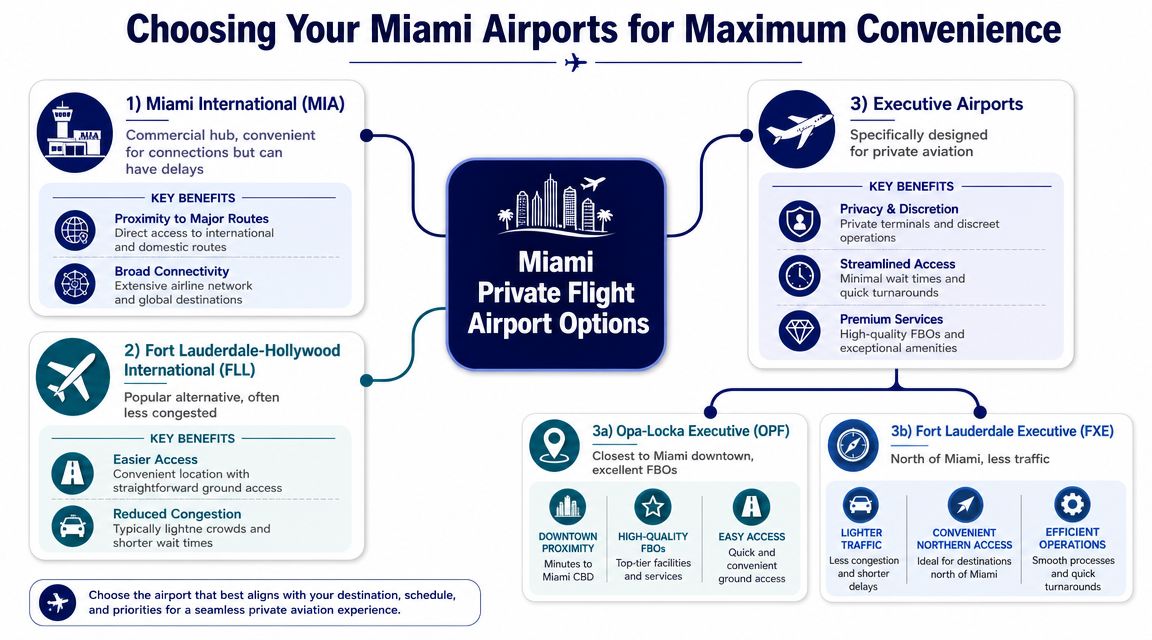
Match the airport to the neighborhood
A private charter isn't just about the airplane. It's also about where the wheels touch down.
Opa-Locka Executive Airport
Good for many travelers heading toward central Miami areas, business districts, or Miami Beach. It's a standard choice in private aviation because the airport is built around that traffic pattern rather than around commercial airline volume.Miami Executive Airport
Often worth considering if your plans are farther south. If your end point isn't downtown or the beach corridor, this can be the more sensible routing.Miami International Airport
Sometimes useful when proximity to airline connections matters or when the rest of your itinerary depends on the commercial airport ecosystem. It can still work for private flyers, but it won't always feel as efficient as a dedicated executive field.Fort Lauderdale area airports
A strong option for travelers staying north of Miami or trying to avoid certain traffic patterns through the urban core.
What works in practice and what doesn't
The most common mistake is booking based on the city name alone. “Miami” on the itinerary doesn't tell you enough. South Florida is spread out, and ground time can wipe out some of the efficiency you gained in the air.
A better process is to ask:
- Where do you need to be within an hour of landing?
- Are you meeting a car service, a hotel transfer, or a boat?
- Are you traveling during a period when road congestion will matter more than usual?
- Is the group staying together, or will people split off in different directions?
Airport choice should shorten the whole trip, not just the flight.
If you're comparing South Florida options broadly, it helps to review regional charter patterns through Air Trek's Florida air charter coverage, especially if your itinerary may work better through Fort Lauderdale or another nearby airport instead of forcing a Miami arrival.
A simple decision filter
| If your priority is | Usually the better fit |
|---|---|
| Commercial connectivity | MIA |
| Dedicated private aviation flow | OPF |
| Southern Miami-Dade access | Miami Executive |
| Northern Miami or Broward access | Fort Lauderdale area airports |
Local knowledge pays off. The right airport can save hassle. The wrong one can leave you sitting in traffic wondering why you bothered to charter in the first place.
Selecting the Right Aircraft for Your Mission
Aircraft selection gets overcomplicated when people shop by brand names or cabin photos first. The practical way is to choose by mission. What are you trying to do, who's traveling, what are you bringing, and how far are you going without creating operational strain or unnecessary cost?
That's the decision framework charter coordinators use every day.
Start with the trip type
A private flight to Miami can mean very different things operationally.
A short regional business trip for a few passengers points one way. A family traveling with bulky luggage points another. A coast-to-coast itinerary or a group that wants more cabin comfort for longer legs usually requires a larger category. The aircraft should fit the trip cleanly, not barely.
Three details shape most recommendations:
Passenger count
Not just seats on paper. You want comfortable seating, especially if people are working, traveling with children, or carrying extra personal items.Baggage profile
Suitcases are one thing. Garment bags, golf clubs, strollers, presentation materials, or pet equipment can change the recommendation quickly.Stage length
The length of the trip affects whether a smaller aircraft is practical, efficient, or the wrong tool.
Aircraft Class Comparison for Miami Flights
| Aircraft Class | Passengers | Non-Stop Range (Approx.) | Best For |
|---|---|---|---|
| Turboprop | Small groups | Short regional sectors | Quick nearby trips, shorter international hops, travelers prioritizing value |
| Light jet | Small groups | Short to medium trips | East Coast city pairs, business travel, fast in-and-out missions |
| Midsize jet | Mid-size groups | Medium to longer domestic trips | More cabin comfort, more baggage, longer nonstop routing |
| Heavy jet | Larger groups | Long-range missions | Coast-to-coast travel, larger parties, higher comfort expectations |
How to think about each category
A turboprop is often underrated. For short missions, it can be exactly right. If the trip is relatively short, the runway environment matters, and the goal is practical access at a lower entry point, this category deserves a serious look.
A light jet is where many first-time charter clients land. It works well for common business missions and city-pair flying where speed and efficiency matter more than having the largest cabin.
A midsize jet usually becomes the answer when clients want more breathing room, better baggage flexibility, or a route that starts stretching beyond what feels comfortable in a smaller cabin.
A heavy jet or long-range cabin makes sense when the mission itself demands it. This is less about appearance and more about payload, cabin environment, and route logic.
The wrong aircraft usually looks fine in the quote and feels wrong on travel day.
Questions worth asking before you approve an aircraft
Ask these before you sign anything:
- Will this aircraft handle our real baggage, not just our passenger count?
- Is this the right cabin for the full route, or just the cheapest category that technically works?
- Are there airport or runway considerations affecting the recommendation?
- If plans change slightly, does this aircraft still fit the mission?
One common mistake is trying to force everyone into the smallest category to save money. Sometimes that's reasonable. Sometimes it leads to a revised quote, luggage restrictions, or a cabin that doesn't suit the trip.
Mission-first planning solves most of that. Once the trip purpose is clear, the aircraft choice usually becomes much more obvious.
Decoding Charter Costs and Finding Smart Value
A client asks for a private flight to Miami, gets three quotes back, and assumes the lowest one is the best deal. Then the trip's full details start surfacing. Extra bags. A different airport. A later departure. The quote changes, and the cheap option often stops looking cheap.
That is why cost planning works best when the mission is clear first. If the purpose of the trip is defined from the start, the pricing usually becomes easier to read and much easier to compare.
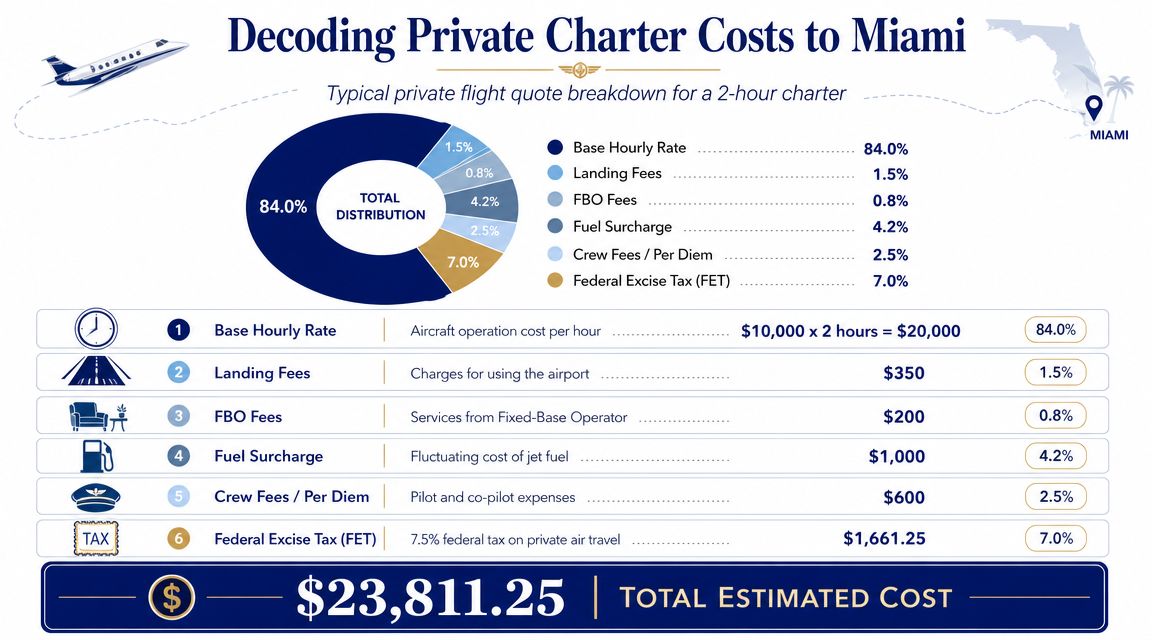
Real route examples help frame the market
Published route-level market data gives a useful reference point for how pricing changes by distance and aircraft type. A one-way Miami to New York private charter can start around $12,000 to $18,000 in a light jet, while Miami to Los Angeles can start around $30,000 to $35,000 on a super-midsize jet. Shorter trips, such as Miami to the Bahamas, can be as low as $2,500 to $5,000 on a turboprop, according to Air Charter Advisors' Miami charter market guide.
Those ranges matter because they show what drives the total. Distance matters. Aircraft category matters. Trip structure matters too, especially if the aircraft and crew need to wait, reposition, or work around a tight schedule.
What a usable quote should show
A serious quote should let you check whether the aircraft and itinerary fit the trip you are taking.
Review these points closely:
Aircraft category and mission fit
The cabin should suit the passenger count, baggage load, and route without forcing compromises that show up later.Airport and handling assumptions
South Florida pricing can shift based on which airport is used, what services are requested, and how long the aircraft is on the ground.Known trip requirements
Pets, catering, ground transportation, revised departure windows, and multi-stop planning should be disclosed early so the quote reflects reality.
Ask for an all-in number built around the actual mission, then compare quotes on the same assumptions. For a clearer explanation of how these charges are typically presented, review this private jet charter pricing guide.
Where smart value actually comes from
Value in private aviation usually comes from choosing the right tool for the trip.
For a short regional business run, a smaller aircraft may be the most sensible option if it covers the route comfortably and keeps the total under control. For a family trip with luggage, strollers, golf clubs, or a longer flight time, paying more for cabin space and baggage capacity can be the better decision. I have seen clients spend less on the initial quote and then lose that savings in revisions, airport changes, or simple discomfort on the day of travel.
Flexible scheduling can also lower the cost. Repositioning opportunities sometimes create discounted charter options, but they only work when the traveler can accept the aircraft's timing and routing limitations. They are a useful tool, not a planning foundation.
The best-value charter is usually the one that fits the mission cleanly the first time.
Common pricing mistakes first-time clients make
These are the issues that create avoidable cost problems most often:
Comparing only hourly rates
Hourly pricing alone does not tell you what the trip will cost.Keeping trip details vague too long
Changes in passenger count, baggage, airport choice, or timing often trigger a revised quote.Treating flexible inventory like fixed transportation
Discounted repositioning flights can be worthwhile, but they do not suit trips with rigid schedules.
The stronger approach is simple. Define the mission first, ask for a quote built around that mission, and compare offers line by line. That is how first-time charter buyers avoid surprises and find real value instead of just a low opening number.
The Booking Process from Quote to Takeoff
The booking sequence for a private flight to Miami is straightforward when the trip details are clear. It becomes messy when the mission is loosely defined and everyone tries to “figure it out later.” That usually leads to re-quoting, changed aircraft options, or last-minute stress that was easy to avoid.
The smoother route is to lock in the essentials first.
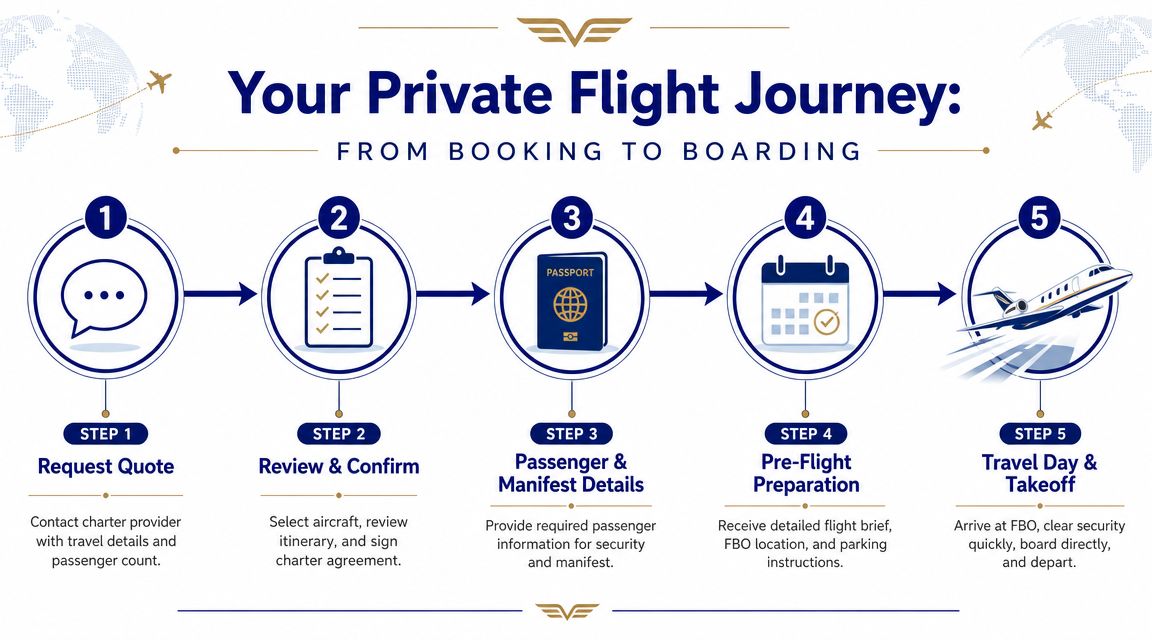
The sequence that works
Industry guidance suggests booking a private charter 4 to 6 weeks in advance for the best aircraft selection and pricing, and passengers should generally plan to arrive at the FBO 15 to 30 minutes before departure, according to Volato's private jet booking guide.
That timing isn't about formality. It's about preserving options.
Here's the usual flow:
Request the quote early
Give the origin, destination, preferred dates, passenger count, and any essential requirements. If pets, oversized bags, or multiple stops are involved, say so immediately.Review aircraft options
At this stage, mission-first planning pays off. You're not just comparing jets. You're confirming the right fit.Confirm itinerary and sign the agreement
Read the routing, airports, schedule, and listed services carefully.Pay and finalize the manifest
Full passenger details matter. For international sectors, accuracy matters even more.Receive travel-day instructions
You should know the FBO location, arrival time, and any car-service details well before departure.
If you want to compare that workflow with another operational overview, Air Trek's guide on how to book a private jet outlines the same general checkpoints from inquiry through confirmation.
What first-time clients should prepare in advance
A lot of friction disappears when the lead traveler or travel manager gathers the right details up front.
Passenger list
Full names exactly as required for travel documentation.Baggage summary
Don't just say “a few bags” if the group is carrying golf clubs, presentation cases, or pet gear.Special requests
Catering, car seats, pet travel, and ground transportation should be part of the initial discussion.Airport flexibility
If you can use more than one South Florida airport, say that early. It can widen your options.
What travel day actually feels like
This is usually the moment when first-time private flyers realize why people keep coming back. You drive to the FBO instead of a crowded main terminal. You check in quickly. You board directly. The process is short because it's built around the aircraft, the crew, and your party.
Bring government ID, confirm the passenger list one last time, and arrive at the right FBO. Most travel-day problems come from simple detail misses, not from the flight itself.
What doesn't work is assuming private travel means no prep at all. It's easier than commercial flying, but accuracy still matters. The difference is that the process is compact and much more controllable.
Your Questions Answered About Flying Private to Miami
A client calls on Thursday afternoon. They need to be in Miami Saturday for a family celebration, want to bring the dog, and may need to push the return by a few hours. That is usually when the important questions start. Not about leather seats or champagne, but about what happens if plans shift, who is operating the flight, and how to avoid paying for the wrong setup.
Those questions matter because the right charter decision starts with the mission. A fixed business meeting, a flexible weekend with family, and a high-stakes event trip should not be booked the same way.
How do I verify safety before booking?
Start with the operator. Ask who the direct air carrier is, what certificate they fly under, and whether they can clearly identify the crewed aircraft being offered. If the answer feels vague, keep asking.
Good charter coordination should give you specifics, not general reassurance. You want to know who is responsible for the flight, what standards they follow, and whether the aircraft and crew match the trip you are planning.
Can I bring my pet on a private flight to Miami?
In many cases, yes. Pet travel is common on private charters, but approval depends on the operator, the aircraft, and the details of the trip.
Say it early. Share the pet's size, breed, carrier needs, and whether you are flying one way or round trip. If the mission includes children, multiple bags, or a smaller cabin aircraft, that information helps the charter team confirm the right fit before the itinerary is locked in.
What if I need to change the departure time?
Private aviation gives you more room to adjust than commercial travel, but every change still has limits. Aircraft positioning, crew duty rules, airport hours, and the timing of your request all affect what can be changed.
A one-hour shift is very different from a same-day rewrite. If your schedule may move, say so at the quoting stage. That often leads to a better airport choice, a more realistic aircraft option, or a departure plan with some built-in flexibility.
Are empty-leg flights a good option for Miami?
They can be a smart buy for the right mission. They work best for travelers who care more about price than exact timing and can accept that the schedule may change or disappear if the underlying aircraft movement changes.
For a fixed wedding, a cruise departure, or a Monday morning meeting in Brickell, I usually treat empty legs as an opportunity, not a plan. For a flexible leisure trip, they can make sense. As noted earlier, first-time private flyers should view them as schedule-dependent options rather than guaranteed inventory.
What's typically included onboard?
The basics are usually straightforward. You can expect a private cabin, direct boarding through the FBO, and light refreshments on many flights.
Everything beyond that should be confirmed. Wi-Fi, specific catering, enclosed lavatory requirements, child seating needs, and cabin layout vary by aircraft. A short executive trip from the Northeast has different onboard priorities than a family flight carrying beach gear, strollers, and snacks for three children. Mission-first planning keeps you from paying for features you do not need, or missing the ones you do.
How do I avoid surprise charges?
Ask for the quote in plain terms and review what could change the price. The usual pressure points are deicing, overnight crew costs, repositioning, premium catering, ground transportation, and schedule changes after confirmation.
Before approval, check these details carefully:
- Departure and arrival airports
- Passenger count and names
- Baggage, pets, and special items
- Requested ground transportation
- Expected schedule flexibility
Clear trips are easier trips. A private flight to Miami usually goes well when the purpose of the trip is defined first, then matched to the right airport, aircraft, and schedule from the start.
If you are comparing options, write the mission in one sentence before you request quotes. Who is traveling, where you need to end up after landing, what you are bringing, and how fixed the schedule is. That one step usually leads to better choices and fewer expensive changes later.