
You're probably starting from a familiar place. The family wants one trip that feels special. One child wants a beach, another wants action, the grandparents need an easier pace, and you want the whole thing to run without spending the first and last days wrestling with airports, luggage rules, missed connections, and meal timing.
That's where many so-called luxury trips fall apart. The hotel may be excellent, but the experience around it isn't. Families end up buying a premium product while still managing a standard-travel headache.
For affluent families, the definition of luxury has changed. It's less about visible extravagance and more about control. Control of timing. Control of privacy. Control of pace. The best luxury family vacations feel smooth because someone designed the moving parts to work together, not because the bathroom fixtures are expensive.
People also ask practical questions at this stage. Is a resort still the best fit for a mixed-age group? When does a villa make more sense? Is private aviation just a splurge, or does it solve real problems for families? And how do you build a trip that works for toddlers, teens, parents, and grandparents at the same time?
Redefining the Modern Luxury Family Vacation
Family demand is not the issue. Complexity is. The 2025 NYU Family Travel Survey found that 92% of parents plan to travel with their children, and 57% of those trips are expected to be multigenerational, including grandparents. That matters because the old vacation template was built for a simpler group: parents and children, one hotel room block, one flight schedule, one activity rhythm.
That model breaks down fast when one traveler needs assistance, another naps at noon, one teenager wants independence, and a parent still needs enough quiet to call the trip restorative.
What luxury means now
Modern luxury family vacations are built around friction reduction. If the trip demands too many compromises before you even arrive, it doesn't feel luxurious. A beautiful suite can't fix a dawn departure, a long connection, and an overtired child melting down before dinner.
The strongest itineraries solve for questions like these:
- Can everyone travel on a schedule that respects sleep, mobility, and energy levels?
- Can the family stay together without feeling crowded?
- Can adults have privacy without isolating the children from the experience?
- Can the plan flex if weather, fatigue, or mood changes the day?
Practical rule: If the itinerary only works when every family member performs perfectly, it isn't a luxury plan. It's a fragile plan.
Families often spend too much time comparing room categories and not enough time evaluating the full experience chain. That includes departure timing, airport process, ground transfers, meal windows, activity spacing, and recovery time between major moments. Those are the details children feel immediately and adults remember later.
Why customization matters more than amenities
The industry still pushes a one-size-fits-all answer. Usually it's a large resort with a long list of amenities. Sometimes that's right. Often it isn't. A family with grandparents may need shorter walking distances and easier dining access. A family with younger children may care more about arrival simplicity than having six restaurants on property. A family with older children may benefit more from flexible day planning than a kids' club.
Even the downtime needs planning. Families who want better in-villa moments often do well with a few purposeful screen-free play ideas ready before departure. It's a small detail, but it changes how smoothly afternoons, transfer windows, and rainy hours unfold.
The best luxury family vacations begin the moment you leave home. If the travel model supports the family, the destination has a chance to shine. If it doesn't, the destination spends half the trip compensating for stress you carried in with you.
Choosing Your Ideal Family Destination in the Americas
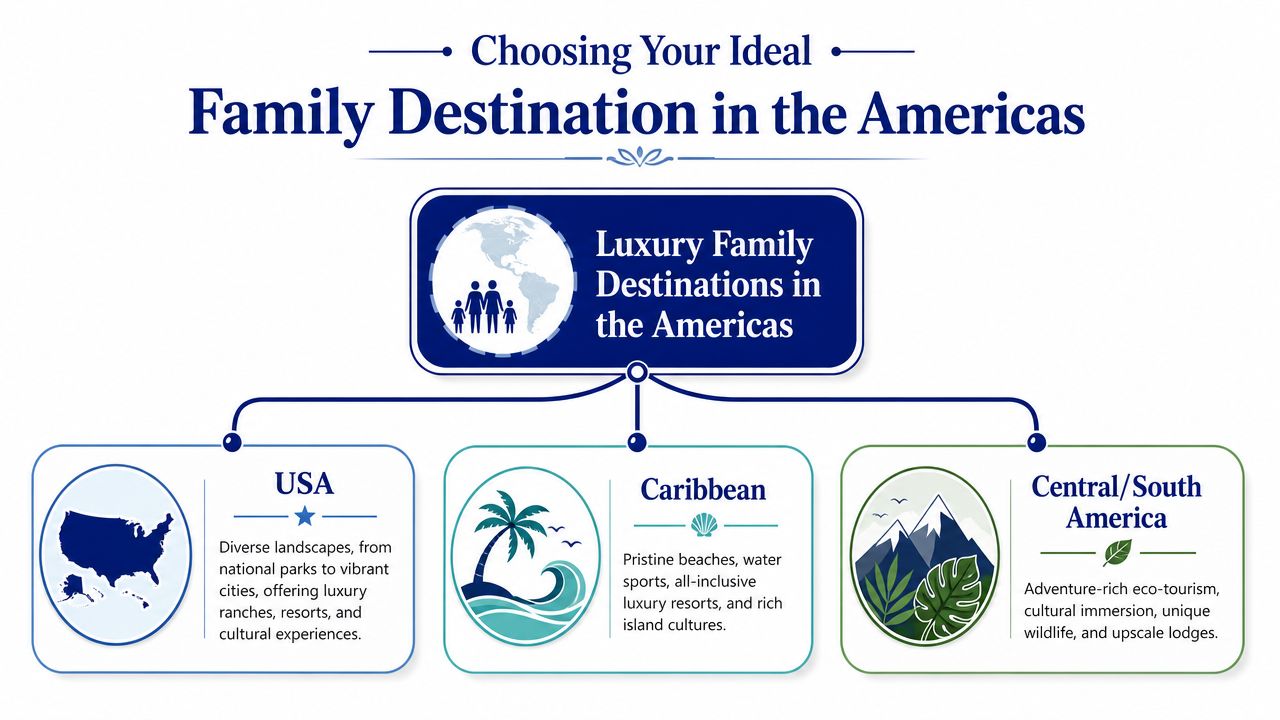
A good destination isn't just beautiful. It fits the family you're traveling with. The right choice depends less on prestige and more on flight time, pace, age mix, and how much structure your group wants.
Start with the family, not the map
Before you shortlist destinations, answer four questions:
Who needs the easiest logistics?
Usually this is a toddler, a grandparent, or anyone with medical or mobility considerations.What kind of days does your family enjoy?
Some groups like one anchor activity and lots of free time. Others want constant movement.Is this a short reset or a deeper trip?
A long weekend and a ten-day itinerary should not use the same destination criteria.Do you need privacy or built-in social energy?
Some families relax in a villa. Others prefer the momentum of a polished resort environment.
A practical way to choose by region
Here's how I'd frame the Americas for luxury family vacations.
| Region | Best for | Watch for |
|---|---|---|
| USA | Easy domestic planning, varied landscapes, shorter trips | Some destinations require more driving than families expect |
| Caribbean | Beach-first vacations, calm reset, easy warm-weather rhythm | Resort style can dominate the experience if you want more customization |
| Central and South America | Adventure, culture, wildlife, more distinctive itineraries | More moving parts, which increases the need for tighter coordination |
Best-fit thinking by family type
Families with young children
You want ease. Calm water, short transfer times, simple meal patterns, and accommodations where naps don't trap everyone in one room. In this category, island and coastal destinations often outperform more ambitious itineraries because they reduce transitions.
For families looking at a quick Bahamas-style escape, practical routing matters as much as the hotel. Air access and transfer simplicity can make or break the trip, especially when children are tired before you arrive. A focused destination example like flying to Bimini helps show how close-in island travel can work when you keep the plan tight.
Families with teens
Teens usually want momentum, novelty, and some degree of choice. They respond well to destinations where the vacation can include outdoor adventure, boating, cultural exploration, or space to roam without the whole group moving as one unit all day.
A destination succeeds here when it offers parallel experiences. One part of the family can stay active while another has a slower morning, then everyone reconvenes for a strong dinner or sunset outing.
Some families don't need the “best” destination. They need the destination with the fewest forced compromises.
Multigenerational groups
Aspirational destination lists often fall short of meeting the needs of multigenerational trips. A multigenerational trip needs more than good weather and a luxury address. It needs accessibility, shade, meal flexibility, proximity between rooms or suites, and activities that don't split the family into incompatible tracks.
The best destinations for this group usually offer all of the following:
- Short decision windows so plans can change day by day
- Mixed activity intensity without long transport times
- Reliable medical access if needed
- Good private space for rest between shared experiences
Questions worth asking before you commit
Use these when comparing destinations:
- Will this place still work if one traveler needs a slower day?
- How many transitions happen between airport, transfer, lodging, and activities?
- Are we choosing this because it's fashionable, or because it fits our family well?
- Will the adults still enjoy it if the children's schedule drives the day?
A destination doesn't need to impress everyone on paper. It needs to function gracefully in real life.
Selecting Your Accommodation for Space and Serenity
Once the destination is right, the lodging decision determines how the trip feels at breakfast, after naps, during rain, and in the hour before dinner. Those are the moments that reveal whether you chose well.
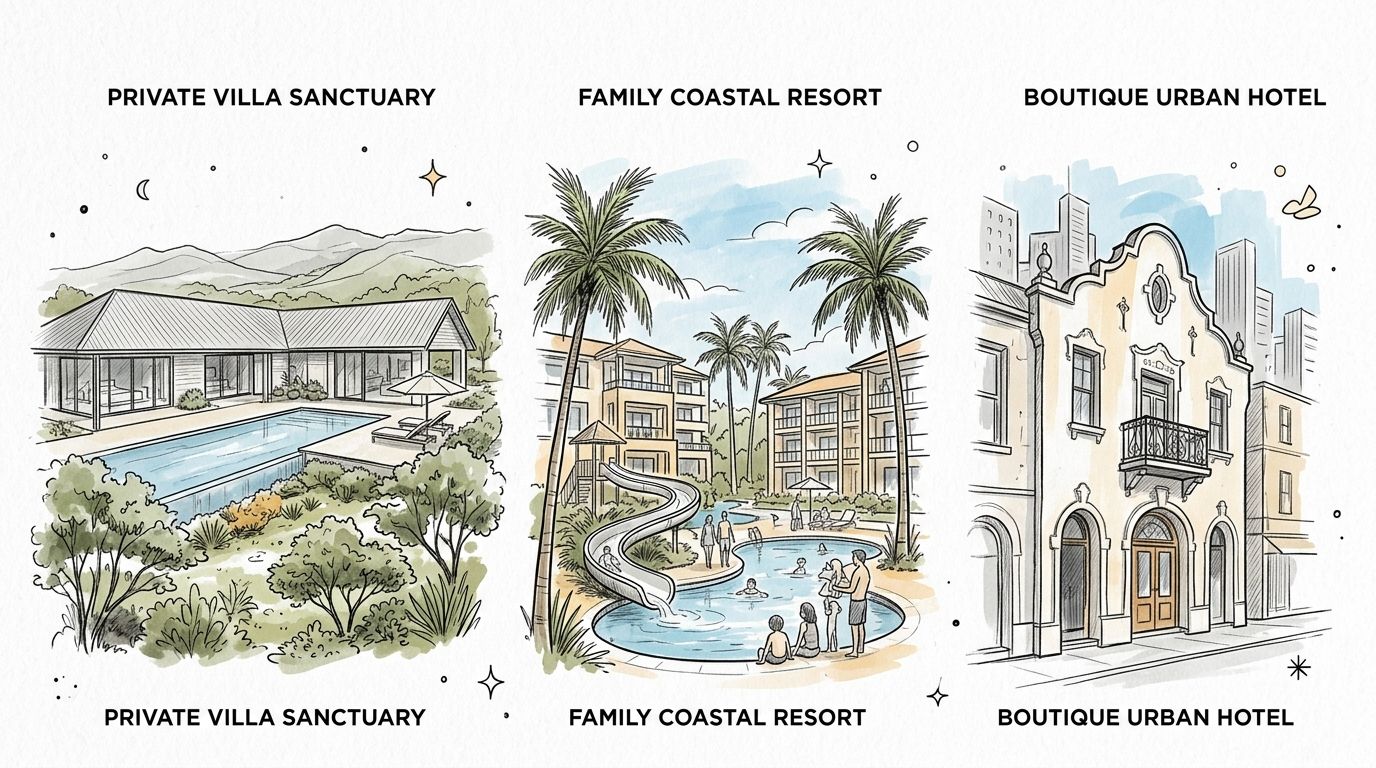
Private villa, resort, or boutique hotel
There isn't a universal winner. There is only the right match for your family's operating style.
| Accommodation type | Best when | Less ideal when |
|---|---|---|
| Private villa | You want space, privacy, and control over schedule | You rely on on-site dining variety and built-in child programming |
| Five-star family resort | You want convenience, amenities, and easy activity access | You dislike crowds, noise, or fixed rhythms |
| Boutique hotel | You want intimacy, design, and highly personal service | You need extensive kids' infrastructure or lots of room to spread out |
When a villa is the smarter luxury choice
A villa works exceptionally well for multigenerational groups and families that value private rhythm over public amenities. You can set breakfast when you want it, put children down without ending the adults' evening, and create natural separation between quiet time and active time.
That said, not every villa is equal. Families should pay close attention to layout, staff support, transportation access, pool safety, and whether service is responsive or just marketed that way. If you're assessing inventory, looking at examples of Spacious luxury vacation rentals can help you compare what usable family space looks like beyond pretty photography.
What “anticipatory” service looks like
McKinsey notes that top luxury operators create an anticipatory experience by centralizing guest preferences from booking, dining, and concierge touchpoints, then training staff to pre-build room and activity plans so service feels intuitive rather than reactive, as outlined in its analysis of how the world's best hotels deliver exceptional customer experience.
For families, that standard matters more than marble and thread count.
Here's what to look for instead of generic “family-friendly” messaging:
Preference capture before arrival
Staff should already know children's ages, dietary issues, sleeping arrangements, allergies, mobility needs, and celebration details.Thoughtful room preparation
The best properties don't wait for you to request every minor adjustment after check-in.Flexible dining coordination
Families need alternatives when one person is late, one child melts down, or grandparents want an earlier meal.Discreet problem-solving
Real luxury service doesn't make you repeat your needs to five different people.
A great accommodation feels like it has one brain, even though many people are working behind the scenes.
Common accommodation mistakes
Families overspend when they choose the property that photographs best instead of the one that functions best.
The most common errors are:
- Booking too little space because the nightly rate looks better
- Choosing a large resort when the family wants privacy and calm
- Choosing a villa without enough service support
- Ignoring internal distances across a sprawling property
- Assuming “suite” means separate, usable family zones
Luxury family vacations work best when the accommodation removes decision fatigue. If you're constantly managing room logistics, dining timing, and noise issues, you didn't buy serenity. You rented complexity in a beautiful setting.
Arranging Your Travel Private Charter vs Commercial
This is the decision that reshapes the whole trip. Not symbolically. Operationally.
Many affluent families begin by asking which resort they should book. In practice, the bigger question is how they want to travel. A strong property can still feel hard if the journey in and out is rigid, crowded, and poorly timed for the people taking the trip.
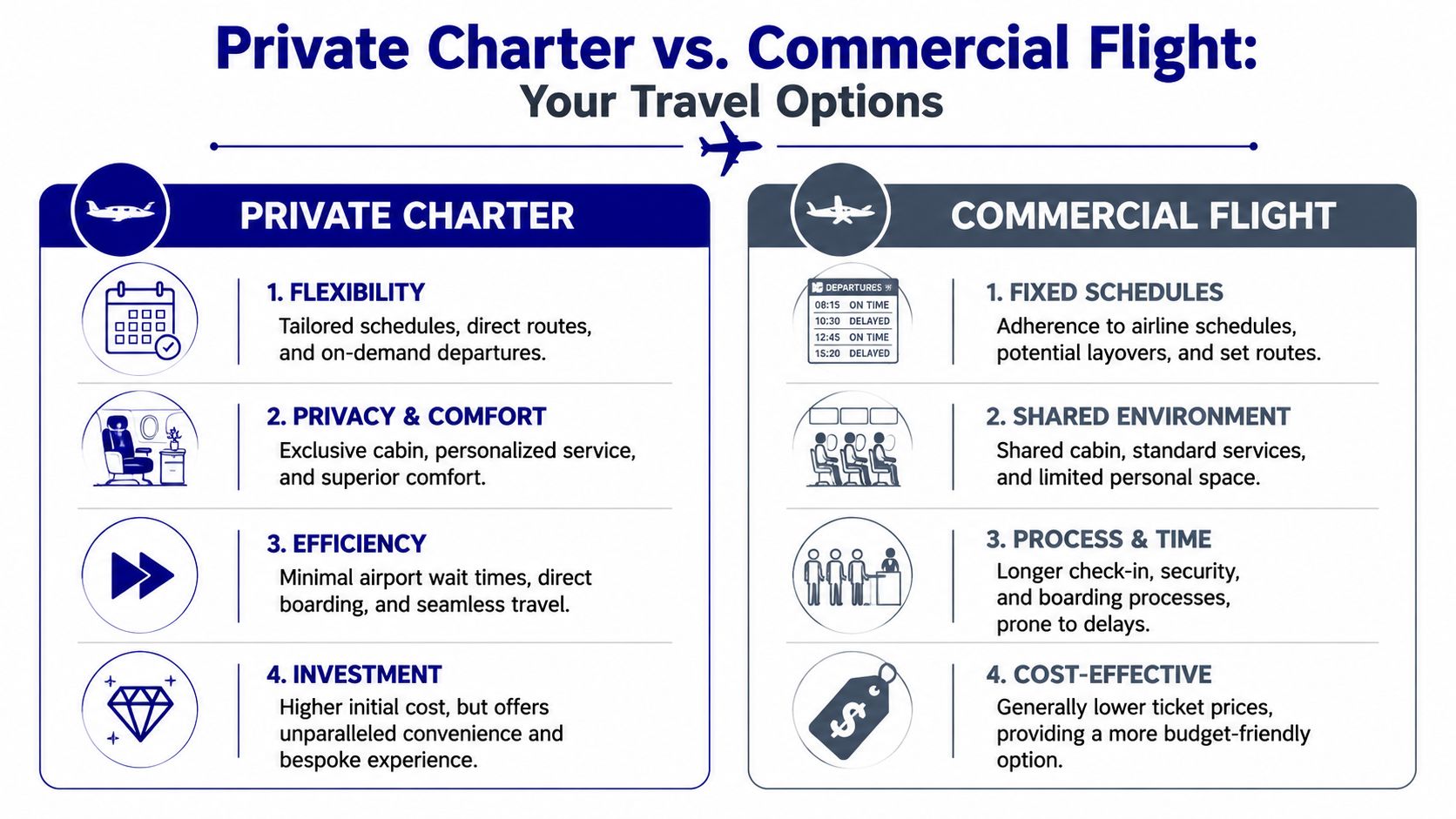
A useful framing comes from independent luxury family travel coverage, which points out that many affluent families are shifting focus from “which resort is best?” to which travel model reduces rigid schedules, airport stress, and loss of privacy. That's the practical case behind private charters in luxury family travel.
Where commercial travel still makes sense
Commercial first class or business class can work well when all of the following are true:
- Your family is small
- The route is nonstop and well-timed
- No one has unusual luggage, pet, or mobility needs
- You don't mind working around airline schedules
- A delay won't unravel transfer, meal, or sleep plans
If that describes your trip, commercial can be perfectly reasonable. There's no need to force a private solution where the operational gain is modest.
Where private charter changes the outcome
Private charter becomes a serious planning tool when the family's needs are mismatched with airline systems. That often includes multigenerational groups, families traveling with pets, parents managing children with strict routines, or anyone trying to reach destinations where commercial service adds unnecessary legs and waiting.
The advantages are concrete:
Schedule control
Departure times can match your family's actual day. That means fewer pre-dawn wakeups, better alignment with naps and medication timing, and smoother arrivals.
Easier airport process
Private terminals reduce the heaviest friction points in family travel. Less waiting. Less crowd exposure. Less stress before boarding.
Better privacy
Children can be children without performing in a cabin full of strangers. Parents can feed, settle, and manage the family more naturally. Grandparents can rest without the noise and interruption level of a busy commercial environment.
Packing freedom
The practical value here is often underestimated. Families traveling for beach destinations, sport outings, celebrations, or long stays tend to carry more gear than standard airline logic likes. Private travel handles that reality better.
Pet inclusion
For many households, the vacation doesn't feel complete if the dog can't travel comfortably. In-cabin pet travel changes the options available to the family.
If your trip depends on timing, privacy, and low-friction movement, the flight isn't just transportation. It's the backbone of the itinerary.
Questions families ask most
Is private charter always better?
No. It's better when flexibility and stress reduction are worth more to you than the lower fare structure of commercial service.
Is it only for ultra-long trips?
Not at all. In many family itineraries, shorter regional flying is where private travel feels most efficient because it eliminates the clumsy parts of the journey.
Does it simplify the planning process?
Yes, especially when the trip has multiple generations, pets, special luggage, or tight timing. The cleaner the air plan, the easier it is to build everything else around it.
A simple comparison
| Factor | Private charter | Commercial |
|---|---|---|
| Departure timing | Built around your schedule | Built around the airline's schedule |
| Airport experience | Fast and private | Standard terminal process |
| Privacy | Full-cabin privacy | Shared environment |
| Routing | More direct, depending on destination | Often requires connections or compromises |
| Family flexibility | High | Limited |
If you're weighing the process itself, a practical guide to how to book a private jet helps clarify what details matter before you request options.
Luxury family vacations often succeed or fail before the hotel ever enters the picture. Families remember the atmosphere of the journey. If the outbound trip is calm, private, and well-timed, the vacation starts with momentum instead of recovery.
Budgeting for Excellence and Finding Value
A family of six can spend heavily on a luxury vacation and still buy the wrong shape of trip.
I see it often on first-time high-end family itineraries. The budget gets built around the headline items, the villa rate, the flights, the resort name. The true cost sits in the gaps between them: extra rooms because the layout does not work for grandparents, peak-time transfers that waste half a day, activity plans that look polished on paper but wear out younger children by day two.
That is why a luxury family budget should be built around the operating model of the trip. Private travel has changed that model. Families are no longer limited to the standard resort package with fixed arrival days, fixed meal plans, and fixed transfer patterns. A custom plan lets you choose where privacy matters most, where service matters most, and where flexibility is worth paying for.
Price the trip as a system
A nightly room rate tells you very little on its own. The better question is whether the full plan works for your group without expensive corrections after arrival.
Start with these categories:
- Air travel, including charter time, commercial premium cabins, baggage needs, and airport transfers
- Accommodation, with the right bedroom layout, staff setup, and privacy level
- Local transport, especially if the destination requires boats, helicopters, or long road transfers
- Food and beverage, beyond what a rate may include
- Private experiences, guides, childcare, water activities, and celebration meals
- Contingency funds, for weather changes, medical needs, schedule shifts, or a last-minute extra room night
Families usually find value not by cutting the rate in one place, but by avoiding three or four smaller mistakes that add up fast.
Spend where it removes friction
The best budgets are not the lowest budgets. They are the clearest ones.
If your group includes grandparents, toddlers, a nanny, or teens with separate interests, money spent on trip structure usually delivers more than money spent on a more photogenic suite. A larger villa near the marina can beat a more famous beachfront resort if it cuts transfer time, gives everyone private sleeping space, and makes meal timing easier. A private charter can justify itself if it preserves two usable vacation days and removes connection risk for a group traveling with strollers, golf clubs, or ski gear.
There is a trade-off. Private travel raises the transportation line item. It often lowers the hidden cost of stress, wasted time, and rigid resort logistics. For multigenerational families, that trade is frequently worth making because the aircraft is not an add-on. It is the backbone of a schedule built around the family rather than the airline and the resort.
Where savings make sense
Some cost control improves the trip instead of shrinking it.
- Use prepaid rates selectively if your dates are fixed by school holidays, milestone events, or villa availability
- Reduce hotel moves and stay longer in one strong base rather than splitting the trip into too many stops
- Book the right room or villa configuration first so you do not end up paying for upgrades, day rooms, or extra babysitting support later
- Stay flexible on flight positioning if private air is part of the plan, since empty leg charter opportunities can reduce cost for families who can adjust timing
- Pack intentionally so you are not buying duplicates of basics on arrival. Families traveling with younger children often do well with a detailed packing guide for parents of toddlers
I caution families against false savings. The cheapest airport transfer is expensive if it cannot handle your luggage and child-seat needs. The cheaper room category is expensive if parents lose privacy and children lose sleep. The lower airfare is expensive if an overnight connection derails the first two days of the trip.
The questions that keep budgets honest
Before approving a plan, ask:
- What are we optimizing for: privacy, ease, celebration, or lowest total spend?
- Which dates and components are fixed, and where do we still have flexibility?
- Will a cheaper choice create time loss, stress, or extra spending elsewhere?
- Are we paying for amenities we will use, or for a brand name that looks reassuring?
- Does private air improve this trip enough to justify making it the center of the plan?
Clear answers make large budgets easier to defend. They also lead to better vacations. Luxury family travel now works best when every major component is customized to the group, and that usually starts with the flight plan rather than the resort brochure.
Crafting Your Itinerary Packing and Safety Tips
A polished family itinerary has rhythm. It doesn't stack every highlight into one compressed schedule. It leaves room for rest, appetite changes, weather shifts, and the simple fact that children and grandparents rarely move through a destination at the same speed.
A five-day example that works
Take a five-day beach itinerary in the Caribbean. Day one should be an arrival day in the true sense of the word. Light lunch, time in the room or villa, pool or beach close to the property, and an easy dinner. Don't book a sunset cruise because it sounds elegant. Most families are still recalibrating.
Day two can carry the first major shared experience. A private boat outing, a guided coastal excursion, or a curated family beach setup works well because everyone is still fresh. Keep the afternoon open. Younger children may need sleep, and adults usually appreciate a quiet reset after the first organized event.
By day three, split the day intentionally. One branch of the family can pursue activity, while another stays slower. Rejoin later for a special dinner. Day four is often the best day for a signature experience because everyone knows the place by then. Day five should taper. Late breakfast, easy packing, calm departure rhythm.
Packing for comfort instead of compliance
Private travel changes how families pack. You don't have to build the whole packing plan around standard airline restrictions, tiny toiletries, and aggressive bag editing. That doesn't mean overpack. It means pack for the trip you want to have.
Useful categories include:
- Children's comfort items that preserve sleep routines
- Pool, beach, and activity gear you'd rather not rent
- Medication and health essentials kept close and clearly organized
- One dinner-ready outfit per person instead of aspirational overpacking
- Weather backup items for wind, sun, or rain
If you're traveling with younger children, a practical packing guide for parents of toddlers is worth reviewing before you build your own list.
Pack for transitions, not just for photographs. The most useful items are the ones that make the in-between hours easier.
Safety that feels reassuring, not dramatic
Luxury families don't need alarmist advice. They need clean planning. That means confirming any medical needs before departure, understanding the destination's hospital access, carrying prescriptions in a straightforward travel kit, and making sure every transfer is clearly coordinated.
For families traveling with older relatives or anyone with health considerations, ask practical questions early:
- How far is advanced medical care from the property?
- Who knows the family's medication schedule?
- Are there dietary restrictions the property has already confirmed?
- Does every traveler have documents and emergency contacts organized?
The safest itineraries are the ones with fewer avoidable weak points. Good timing, clear transfers, reliable lodging, and a realistic daily pace do more for peace of mind than any last-minute scramble ever will.
Your Luxury Vacation Booking Checklist
The families who enjoy these trips most are rarely the ones who spend the most. They are the ones who make decisions in the right sequence, before preferences turn into last-minute compromises.
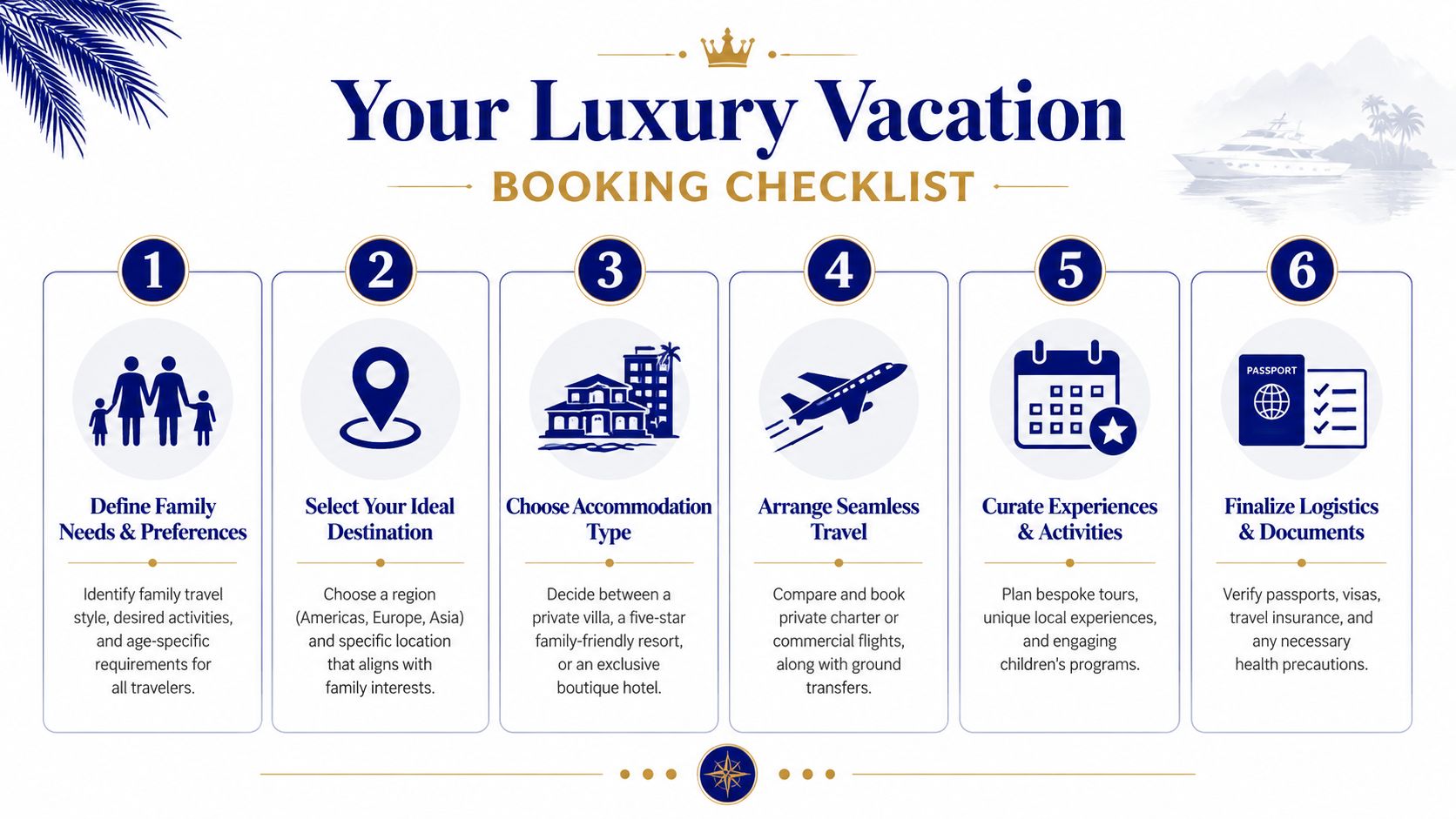
Use this checklist before you book
Confirm who is traveling
Finalize the guest list first. Include children, grandparents, nannies, security, and anyone joining for only part of the trip. A multigenerational itinerary works well only when the flight plan, room setup, and ground transfers reflect the group.Set the trip's priorities early
Decide what matters most. Privacy, beach access, kids' programming, spa time, boating, golf, or easy medical access all push the plan in different directions. Families often want everything, but the best bookings come from ranking priorities rather than treating every preference as equal.Choose the destination around the family, not the brand name
A well-known resort can still be the wrong fit if the transfers are long, the layout is difficult for older relatives, or the schedule feels too rigid for young children. Customized private travel works best when the destination supports the group's pace and habits.Pick the accommodation model that matches how your family lives
Villas give you control, quiet, and room to spread out. Full-service resorts give you staffed convenience and built-in activities. Private residences within branded resorts often offer the best balance for families who want space without giving up service. The trade-off is simple. More privacy usually means less spontaneous access to shared amenities, while more resort structure usually means less flexibility.Build the budget around the full experience
Start with the big pieces: accommodations, air, airport handling, transfers, dining, childcare, activities, and contingency spend. Headline nightly rates rarely reflect the true cost of a luxury family trip, especially once you add peak-date pricing, larger accommodations, and private logistics. Families who budget accurately from the start make better choices and avoid paying premium rates for rushed fixes later.Lock in the flight strategy before the rest hardens around it
For high-net-worth families, private air is often the framework for the vacation, not an upgrade added at the end. It determines departure windows, connection risk, luggage freedom, pet access, arrival energy, and whether grandparents and young children can travel on a realistic schedule. Commercial service can still make sense on some city pairs, but once you are coordinating multiple generations, resort check-in timing, and private ground transport, customized air planning usually becomes the more practical option.
A strong booking checklist should reduce friction, not add paperwork. If these six decisions are clear, the rest of the trip becomes much easier to organize well.