
You need to get from one city to another, privately, and you only need the aircraft one way. You don't want to pay for positioning you didn't ask for, and you don't want a vague sales pitch about “luxury for less.” You want to know whether an empty leg is a smart buy, or whether it only looks good on paper.
That's the right question.
Empty leg charter flights can be one of the best values in private aviation when your trip lines up with the aircraft's existing movement. They can also be the wrong tool if your meeting time is fixed, your destination is fixed, or your group expects the flexibility of a standard on-demand charter. The difference comes down to how well your travel needs match the operator's already-set routing.
Most articles stop at the headline discount. That's not enough. Travelers and corporate buyers usually care more about the equation: How much control are you giving up, and what is that loss of control worth on this trip?
The Smart Way to Fly Private for Less
A business traveler needs to get from South Florida to the Northeast for a one-way meeting. A family wants to start a Caribbean holiday without commercial connections. A sports traveler needs to leave quickly after an event and has no use for a round-trip booking. In each case, private aviation may make sense. The question is whether the price lines up with the value.
Empty leg charter flights can solve that problem, but only in the right circumstances.
These flights exist because the aircraft already has to move for operational reasons. If your trip matches that scheduled repositioning segment, you may get private aircraft access at a lower cost than a standard on-demand charter. If your trip does not match, the discount stops mattering quickly.
That is the part buyers need to understand early. Empty legs are a fit-driven product. They reward flexibility. They do not reward rigid planning.
Empty legs work best when the traveler adapts to the flight, not when the flight has to adapt to the traveler.
In practice, I see three situations where they make the most sense:
- Business travelers with schedule flexibility who care more about avoiding airline friction than choosing an exact departure time
- Leisure travelers who can shape the trip around available routing
- Frequent private flyers who already understand the difference between lower price and lower control
The trade-off is straightforward. You are buying around the operator's existing aircraft movement, not building a flight from scratch around your preferences. That usually means less room to change the departure time, airport pairing, or aircraft type once the option is on hold. Travelers who want that level of control should book a standard charter, not an empty leg.
Savings can be meaningful, and empty legs are often marketed at a steep discount to normal charter pricing. Still, the discount alone does not make a trip a good deal. The right fit does. A lower fare loses its value fast if the aircraft departs too early for your meeting, lands too far from your destination, or disappears because the underlying primary charter changes.
If you want a plain-language explanation of how these repositioning segments work, our guide to private jet deadhead flights breaks down the same concept from the operator side.
The smart way to use empty legs is simple. Start with the trip you can afford to be flexible on, then measure the savings against the loss of control. When that balance works in your favor, empty legs can be one of the better values in private aviation.
What Are Empty Leg Flights and Why Do They Exist
An empty leg is a repositioning flight an aircraft makes without passengers after a one-way charter or before its next booked trip. The airplane still needs to move, whether that means returning to base, picking up the next client, or getting into position for an early departure the following day.
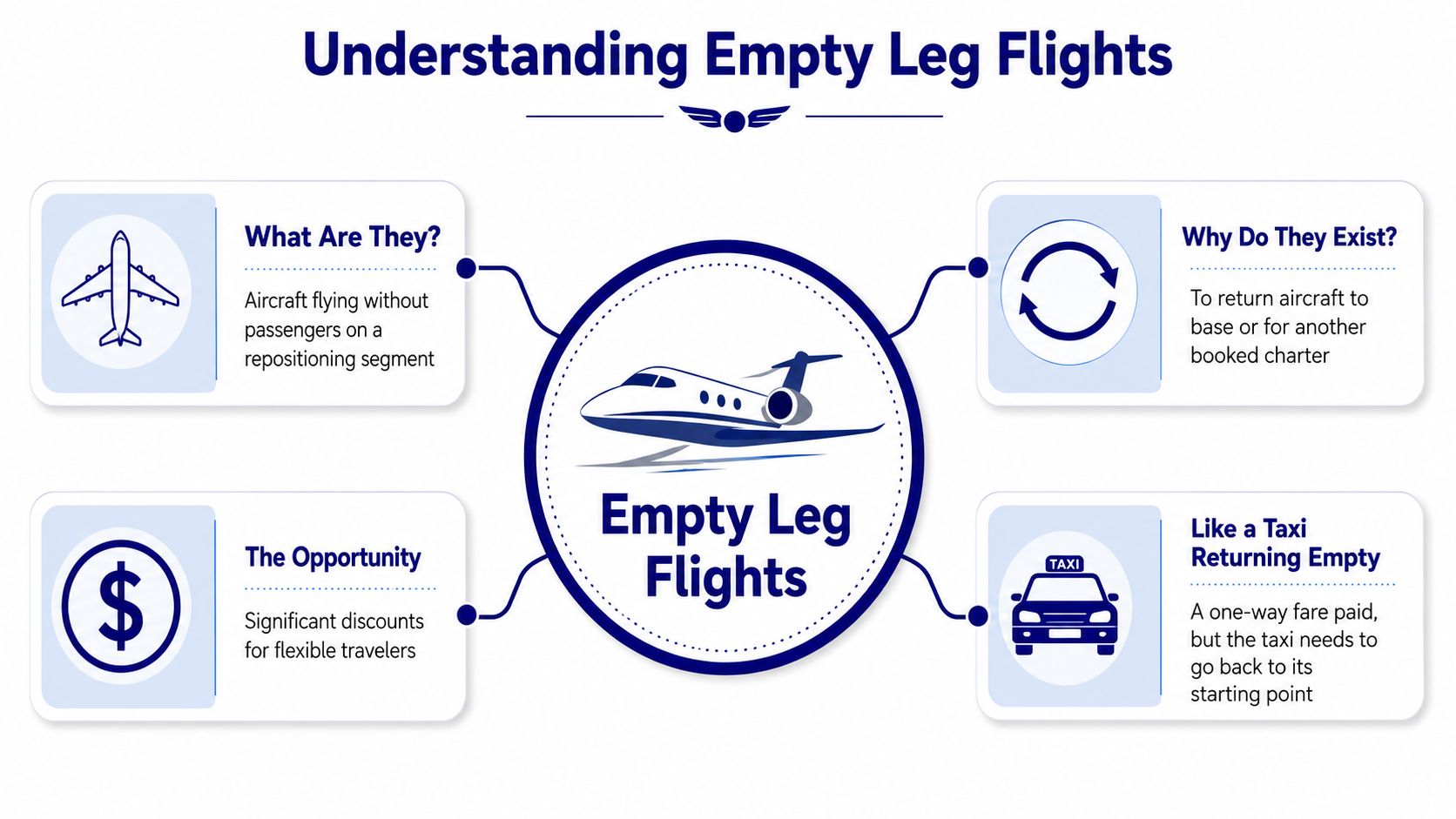
That is why these flights exist.
From an operator's side, a repositioning segment still carries real cost. Fuel, crew duty, landing fees, parking, handling, and maintenance exposure do not disappear because the cabin is empty. If there is a chance to place a passenger on that route and recover part of the trip cost, many operators will try to sell it rather than fly it empty. The Points Guy's explanation of empty leg private jet flights outlines the model and notes that these flights are often priced well below standard charter rates.
The operator's math
The economics are simple, but buyers often misunderstand them. An empty leg is not spare inventory in the airline sense. It is a byproduct of another mission.
That distinction matters because the primary charter drives the schedule. If the original client changes plans, the empty leg can move, or disappear entirely. Operators are not being difficult when that happens. They are following the trip that created the repositioning segment in the first place.
What the traveler is buying
You are buying access to a flight that already has a reason to operate, with limited ability to reshape it around your preferences.
In practical terms, that usually means:
- The routing is largely set
- The departure window is narrow
- The aircraft is the aircraft assigned to that movement
- Changes can erase the savings because the flight stops being an empty leg
This is the value equation. A lower fare helps only if the existing route and timing already fit the trip well enough. If they do, empty legs can be a smart buy. If they do not, the discount often gets eaten up by inconvenience, extra ground time, or the need for backup travel plans.
For a plain-language look at the same concept from the operator side, this guide to private jet deadhead flights explains why these repositioning segments appear and why they can be so time-sensitive.
Why travelers see more of them now
Empty legs are more visible than they used to be because charter marketplaces and broker platforms publish this inventory faster and to a wider audience. The flights themselves are not new. The distribution is.
That broader visibility can make empty legs look more predictable than they are. They are still tied to aircraft movement, crew legality, maintenance planning, and the needs of the original paying charter. That is why some empty leg opportunities are excellent values, while others are only cheap on paper.
The Real Deal Typical Savings and Key Trade-Offs
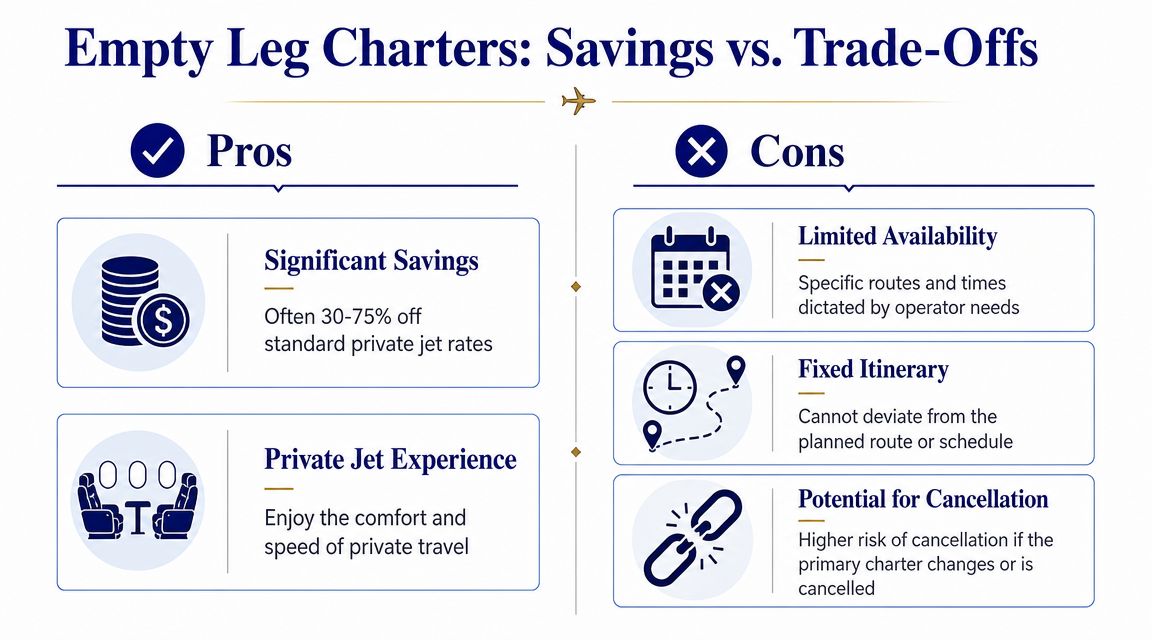
The discounts can be substantial. That part is true. Industry explanations regularly describe empty legs at about 50% to 75% below standard charter pricing, because the operator is trying to monetize a flight that must reposition anyway.
What most buyers need, though, isn't another reminder that the number can be attractive. They need a way to decide if the lower price still looks good once trip friction shows up.
When the savings are real
Empty legs usually deliver strong value in a narrow set of situations:
- One-way travel fits perfectly because the aircraft is already moving one way
- Your schedule has slack so a narrow departure window doesn't break the trip
- Your departure and arrival points are close enough to the published routing that you aren't adding major ground transfer friction
- Your group is comfortable with the assigned aircraft rather than shopping categories
For these trips, the trade can be excellent. You keep the privacy, direct routing, and airport convenience of private aviation while lowering the cost materially.
Where buyers get tripped up
The practical limits aren't hidden. They're built into the product.
Stratos Jets' discussion of why empty legs can't simply be “really, really cheap” makes the core issue clear: the key question isn't just how large the discount is. It's when the discount outweighs the operational risk of inflexibility. Their explanation also notes that empty legs are predetermined by route, date, and aircraft and are usually released only a few days before departure.
Practical rule: If arriving late would cost you more than the empty-leg discount saves, the cheaper quote isn't the cheaper trip.
That applies especially to corporate travel. If a missed board meeting, delayed site visit, or overnight hotel shift carries business cost, the empty leg may stop making sense even if the fare looks compelling.
The three constraints that matter most
Fixed route
An empty leg exists because the aircraft already needs to go from one specific airport to another. Some flexibility around nearby airports may be possible in a broader charter discussion, but the core route is not a blank canvas.
Fixed timing
These flights often appear shortly before departure. That can work well for travelers with adaptable calendars. It doesn't work well for people who need planning certainty far in advance.
Fixed mission priority
The repositioning need comes first. Your booking is attached to that need. If the underlying charter changes, the empty leg can change with it.
For travelers comparing options, a standard private jet charter pricing guide is useful because it frames what you're paying for in a normal charter: flexibility, customization, and control. Empty legs remove much of that control, and that's exactly why the price can be lower.
A better question to ask before booking
Don't ask only, “How much am I saving?”
Ask these instead:
| Decision question | Why it matters |
|---|---|
| Can I leave within a narrow time range? | Empty legs rarely fit rigid calendars |
| Would a route change break my trip? | You need a fallback mindset |
| Is the destination exactly right, or just close? | Ground transport can erase part of the value |
| Am I comfortable deciding fast? | Good inventory doesn't wait |
If the answers point toward flexibility, empty legs can be a sharp tool. If not, they can become a stressful compromise.
A Step-by-Step Guide to Finding and Booking an Empty Leg
Empty legs reward preparation more than browsing. By the time many travelers start searching, the good options are already being discussed, held, or gone. The buyers who secure them tend to know their acceptable routes, travel windows, and passenger details before inventory appears.
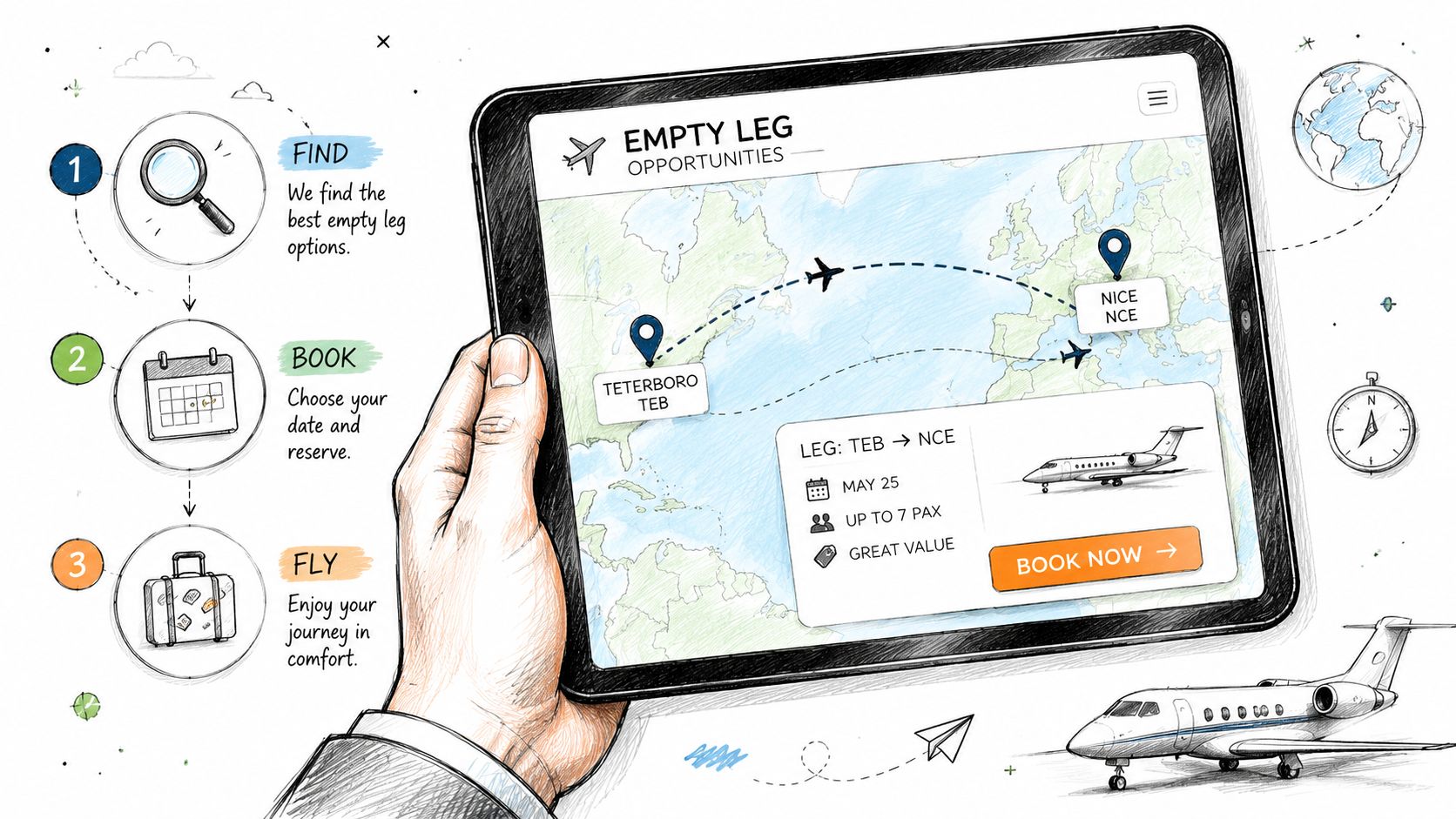
Step one: define your flex points
Start with the variables you can bend.
Maybe your destination is fixed, but your departure date can move. Maybe your meeting city is fixed, but you can use more than one airport. Maybe you need a certain seating capacity, but not a specific aircraft model. Those details matter because empty-leg inventory doesn't reward vague requests.
A useful request sounds like this:
- Route range: Fort Lauderdale, Miami, or Boca Raton to Teterboro or White Plains
- Travel window: Thursday afternoon through Friday morning
- Passenger count: Four adults, light baggage
- Decision speed: Ready to confirm same day
That is far easier to match than “Need something private to New York next week.”
Step two: watch the right channels
The market is shifting toward short-notice digital distribution. This industry video discussion on empty leg visibility and mobile app distribution notes that many flights are discovered through mobile apps and operator email lists shortly before departure. It also highlights the practical consequence: better visibility can mean more competition for the same time-sensitive inventory.
Use more than one discovery path:
- Operator email alerts for direct inventory notices
- Broker relationships when you want someone monitoring several channels
- App-based listings when you're comfortable moving quickly
If you want a direct operator option, Air Trek's booking process for private jets is one example of how travelers can submit trip details and discuss available charter or empty-leg options without treating the search like a generic ticket purchase.
Step three: respond like a ready buyer
Many travelers lose the flight by asking broad questions, waiting on internal approval, or going silent while “thinking about it.”
When inventory is moving in real time, be ready with:
- Passenger names and count
- Preferred contact method for immediate follow-up
- Ground transport needs, if any
- Payment readiness
- A yes-or-no decision framework before the quote arrives
If you need three rounds of internal discussion to approve a short-notice trip, empty legs probably aren't your best booking strategy.
Step four: confirm the operating terms
Before you commit, ask practical questions people often skip:
- What happens if the underlying charter changes?
- Is this exact aircraft confirmed, or still subject to repositioning changes?
- Which airports are being used on each end?
- How much baggage fits comfortably for this aircraft and passenger load?
- What arrival time at the terminal is expected?
This isn't about being difficult. It's about making sure the deal is operationally useful, not just financially attractive.
Step five: keep a backup mindset
The best empty-leg users don't rely on a single outcome. They know what they'll do if the trip shifts or disappears. That might mean keeping a standard charter option in reserve, moving the meeting time, or accepting that some trips require full flexibility.
That mindset is what turns empty legs from a gamble into a disciplined buying decision.
Real-World Empty Leg Examples and Sample Routes
A client based in Palm Beach wants to be in Teterboro tomorrow afternoon. If a repositioning flight happens to match that need, the trip can price well below a standard one-way charter. If the aircraft is leaving from a different South Florida airport at 7:00 a.m. and cannot wait, the discount may stop mattering. That is the core empty-leg calculation.
The routes that show up most often are the ones with heavy one-way private flying and frequent aircraft repositioning. In practice, that usually means corridors such as South Florida and the Northeast, New York and South Florida after weekends, or mainland U.S. departures into the Caribbean during seasonal swings. Major metro pairs also produce opportunities, especially when operators are repositioning after a custom charter.
Route activity alone does not create value. The useful question is whether the published empty leg matches your actual trip closely enough to save money without creating new cost elsewhere.
Empty Leg Savings Snapshot Sample Routes
Exact quotes change by day, aircraft, airport pair, and the charter behind the repositioning flight. A realistic way to read sample routes is to compare where empty legs tend to work well, and where the trade-offs start to eat into the savings.
| Route | Aircraft Type | Standard Charter Economics | Empty Leg Reality | Where the Value Usually Holds Up |
|---|---|---|---|---|
| South Florida to the Northeast | Light or midsize jet | Full charter buys schedule control and airport choice | Empty legs appear regularly during busy seasonal flows, often on short notice | Strong fit for one-way trips with flexible departure timing |
| Northeast to South Florida | Light, midsize, or super-midsize jet | Pricing varies widely by date and airport demand | Good inventory can show up after weekends, holidays, and event traffic | Works well if you can accept the aircraft and schedule as listed |
| Mainland U.S. to the Caribbean | Midsize, super-midsize, or heavy jet | Full charter cost reflects customs planning, routing, and mission length | Savings can be meaningful, but timing and airport details matter more here | Best for leisure travelers with date flexibility and simple baggage needs |
| Major metro to major metro | Varies by stage length and cabin need | Standard charter makes more sense when meeting times are fixed | Empty legs can be attractive, but they are less forgiving if plans shift | Good option for travelers who value price over customization |
What these examples show in practice
Some city pairs generate more empty-leg opportunities because aircraft are already moving through them. That does not mean inventory will appear on demand, or that every listing is a genuine bargain for your trip.
I advise clients to test three points before getting excited about a route:
- Does the departure airport work for your ground schedule?
- Does the timing save the trip, or complicate it?
- After ground transport, overnight costs, and schedule friction, are you still ahead versus a standard charter or first-class commercial option?
That last point gets missed all the time.
A discounted empty leg from a secondary airport can still be the wrong buy if it adds a long drive, forces an extra hotel night, or leaves too early for the people taking the trip. On the other hand, when the route, timing, and airport line up cleanly, empty legs can deliver real value. The best examples are usually simple one-way missions where the traveler is flexible and the published flight already does most of the job.
Common Pitfalls to Avoid When Booking Empty Legs
Most disappointment around empty legs comes from one mistake. The buyer expects a custom charter experience at surplus-inventory pricing. That's where frustration starts.
A disciplined approach avoids that mismatch.
Treating the quote like a draft itinerary
Some travelers assume they can reshape the mission after seeing the price. They want a later departure, a different airport, or a longer wait on the ground. Once those requests stack up, the economics that made the empty leg attractive can disappear.
What to do instead:
- Accept the trip as published first
- Ask whether any changes are possible second
- Be prepared for the answer to be no
That keeps expectations aligned with the product.
Waiting too long to decide
Empty legs don't reward slow internal process. If your team needs multiple signoffs, legal review, and long comparison shopping, the aircraft may be gone before you finish the first round.
A better approach is to set booking rules before opportunities appear. Decide in advance what route range, price level, passenger count, and schedule tolerance qualify for immediate approval.
Focusing only on the flight price
A lower fare can still produce a worse trip if the aircraft lands far from your final stop, departs at an awkward hour, or forces extra overnight cost, leading buyers to confuse nominal savings with real savings.
Ask practical trip-level questions:
| Pitfall | Better question |
|---|---|
| Chasing the biggest discount | Does this flight actually fit the trip? |
| Accepting airport mismatch | How much ground time does this add? |
| Ignoring timing risk | What happens if this shifts? |
| Assuming any aircraft will do | Does this cabin and baggage profile suit the group? |
Assuming aircraft choice will be broad
On a standard charter, you can often compare categories and weigh speed, cabin, baggage, and budget. On an empty leg, the aircraft is usually part of the existing mission. If you need a very specific cabin layout, pet setup, or baggage profile, your options can narrow fast.
Forgetting that the original mission matters
This is the one buyers should remember most. Your empty leg exists because another trip created it. If that trip changes, your trip can change too.
That doesn't make empty legs unreliable by definition. It means you should book them with the right use case. They're strong for flexible travelers. They're less suitable when the trip carries no tolerance for change.
Frequently Asked Questions About Empty Leg Flights
Can I book an empty leg far in advance
Sometimes, but long lead times are the exception. Most empty legs appear only after the primary trip is confirmed, so availability often tightens close to departure. If the trip cannot move and the timing matters more than price, a standard charter is usually the better fit.
Are empty leg flights as safe as regular charters
They should be operated under the same charter standards as any other legal on-demand flight from that operator. The lower price reflects repositioning economics, not a lower operating category.
The key check is the operator. Confirm who is running the flight, under what charter authority, and whether the aircraft and crew are being provided under the same standards you would expect on a full-price charter.
What happens if the original flight that creates my empty leg is canceled
This is the main trade-off buyers need to respect. If the original mission changes, the empty leg can move with it or disappear altogether.
Ask before you book: What happens if the primary charter cancels, departs earlier, departs later, or switches aircraft? A serious broker or operator should answer that clearly and explain whether you will receive a refund, a replacement option, or a new quote for a standard charter.
Can an empty leg be cheaper than commercial first class
Yes, in the right situation. A well-matched empty leg can cost less than several first-class tickets, especially when a group is splitting the cabin and the route closely matches the repositioning segment.
That comparison still misses the key decision. The better question is whether the lower fare still produces a workable trip once you factor in fixed timing, limited rerouting, and the chance that the underlying mission changes. Cheap private flying is only a good deal when the trip still works on the operator's terms.
Who should seriously consider empty legs
Empty legs make the most sense for travelers with built-in flexibility.
They tend to work well for:
- travelers with adjustable departure times
- couples or families planning leisure trips around available routes
- business travelers with a backup option
- flyers who value private access but do not need full schedule control
They are a weaker fit for hard-start meetings, event departures, and any trip where a same-day change would create real cost or disruption.
If you are comparing a one-way private trip with a flexible schedule, empty leg charter flights can offer real value. The strongest bookings are not the ones with the biggest advertised discount. They are the ones where the savings outweigh the loss of control.