
You’re probably reading this after one more draining airport day. You parked far from the terminal, stood in a security line that barely moved, watched your boarding time slide, and then spent the next hour guarding a charger near a crowded gate.
Private aviation feels different long before the airplane moves. The shift begins on the ground, at the general aviation center. That’s the part many first-time charter clients overlook, even though it often determines whether your day feels controlled or chaotic.
A general aviation center is where private flying stops being an abstract luxury idea and becomes a practical transportation system. If you understand how these facilities work, you understand why private charter saves time, protects privacy, and handles travel with far less friction than the main airline terminal.
Beyond the Crowded Main Terminal
Most travelers know the commercial rhythm by heart. Show up early. Build in extra time because you expect a line somewhere. Wait for announcements. Hope your bag, your seat, and your schedule all survive the process.
A general aviation center changes that sequence. You drive to a smaller, purpose-built facility on the airport property, walk into a quiet lounge or reception area, confirm details with the desk, and board close to departure. No gate crowd. No wrestling with overhead-bin space. No broadcasting your itinerary to a terminal full of strangers.
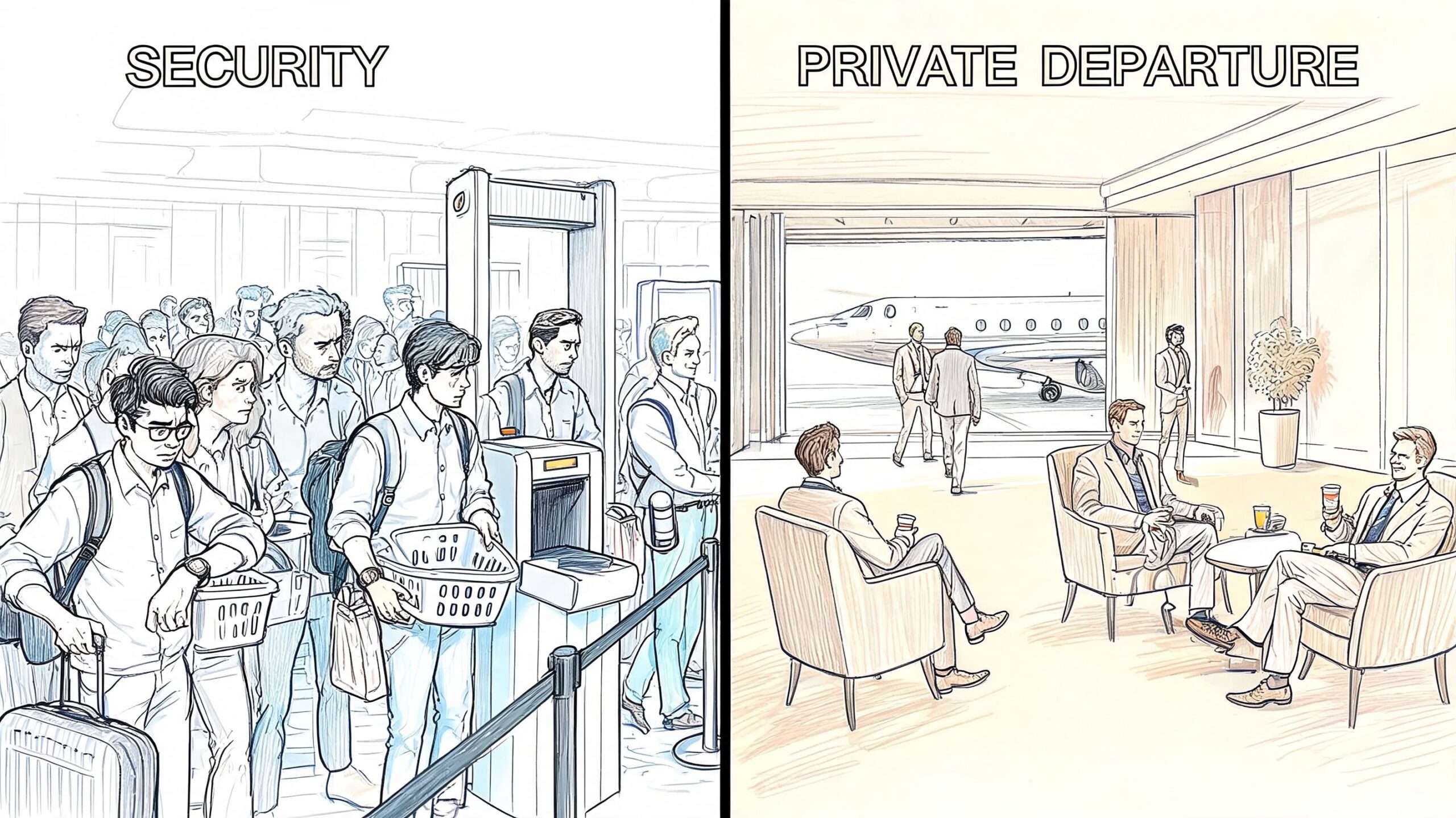
The reason this matters isn’t just comfort. It’s infrastructure. General aviation sustains 1,330,200 jobs and contributes $339.2 billion in annual U.S. economic output as of 2025, according to the NBAA report on general aviation’s economic contribution. That scale tells you this isn’t a niche side entrance. It’s a major operating system for business and leisure flying.
What travelers notice first
The first difference is emotional. The second is operational.
- Arrival feels intentional: You’re not entering a mass-transit environment built around airline schedules.
- Staff know your flight details: The people at the desk usually know who’s coming, where the aircraft is parked, and what ground transportation is arranged.
- The handoff is tighter: Car to lounge, lounge to ramp, ramp to cabin happens with fewer moving parts.
A well-run general aviation center doesn’t just make private flying look polished. It removes avoidable handoffs.
This same principle shows up on the ground after landing. If you’re arranging the rest of a trip and want that same door-to-destination efficiency, services such as The Algarve Experience transfers are a useful example of how dedicated ground coordination keeps travel smooth after the flight ends.
Why frequent flyers care
People often ask, “Isn’t the airplane the whole point?” Not really. The aircraft matters, but the general aviation center is what protects the schedule around it. It’s the gateway that turns private charter into a practical alternative, not just a nicer seat.
What Exactly Is a General Aviation Center
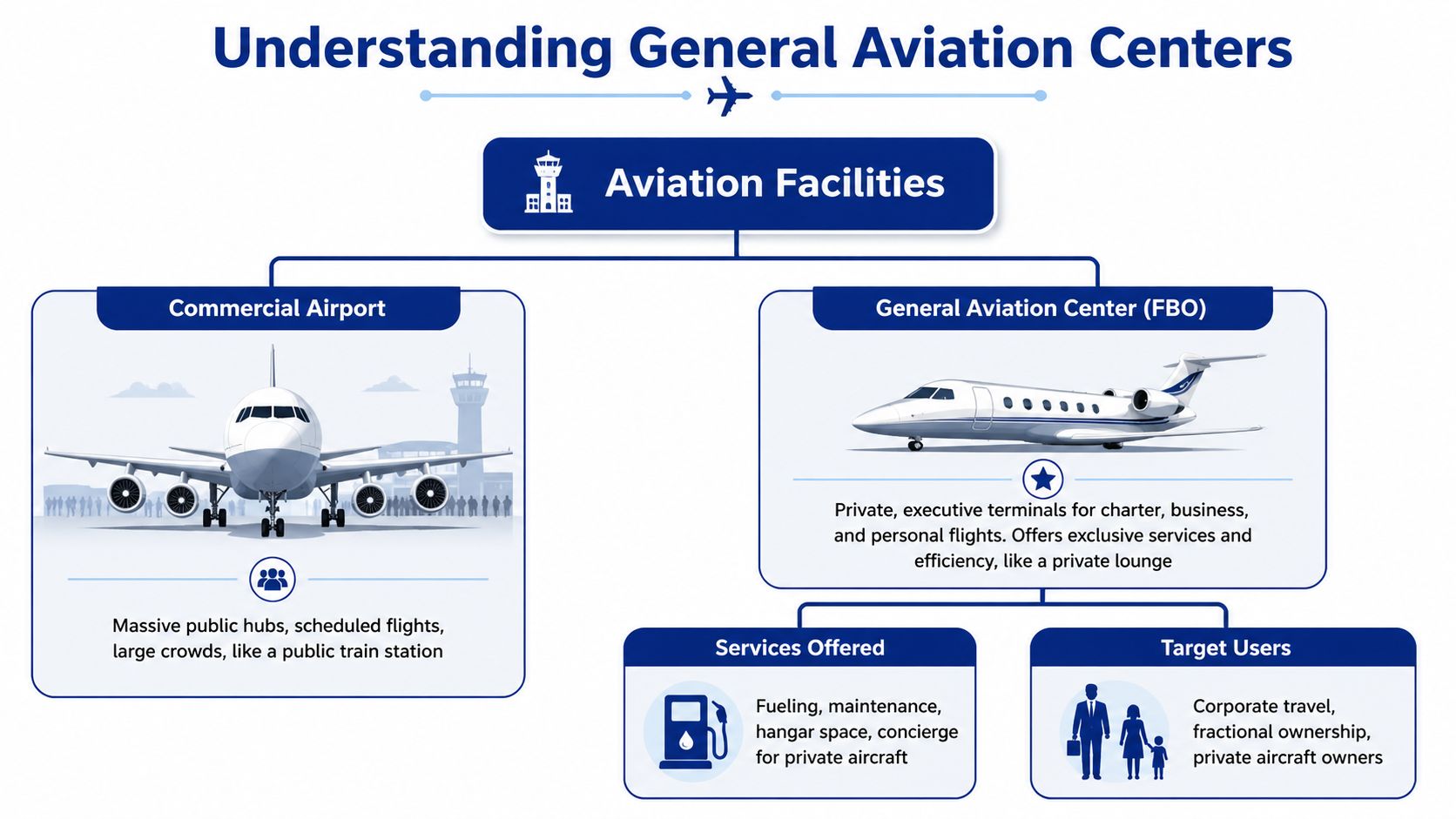
If a commercial airport terminal is a public train station, a general aviation center is the private entrance with a concierge desk, secure vehicle access, aircraft support, and direct access to the ramp.
It serves flights outside the airline terminal model. That includes business aviation, charter, owner-operated aircraft, training activity, and other non-airline operations. In the United States, that network is extensive. General aviation serves over 4,800 public-use airports and is operated by over 600,000 certificated GA pilots, as noted by AOPA’s general aviation statistics page.
The three parts that matter
Most travelers use the term loosely, but operationally a general aviation center usually revolves around three core areas.
The FBO
The Fixed-Base Operator, or FBO, is the customer-facing hub. Think of it as the front desk, lounge, dispatch point, and service coordinator in one place.
Passengers check in, pilots coordinate fuel and handling, crew review weather and routing, and ground transportation gets staged at the center. If customs support is available, that process may also be coordinated through this facility.
The hangars
Hangars are the secure garages of private aviation. Aircraft are stored there between trips, protected from weather, and brought in for inspections, cleaning, or maintenance support.
From a traveler’s perspective, hangars matter because they affect aircraft readiness. A center with strong hangar access usually handles weather changes and overnight staging more smoothly than a field with limited covered space.
The ramp or apron
The ramp is where the aircraft parks, loads, unloads, fuels, and turns for the next mission. On many airports, efficiency is often won or lost on the ramp.
Insider view: If the ramp is cramped, congested, or poorly organized, everything slows down. Boarding, fueling, catering, baggage, and towing all start tripping over each other.
Why the physical setup matters
People often assume every private terminal offers the same experience. It doesn’t. One general aviation center may be built for piston aircraft and training traffic. Another may be optimized for turbine aircraft, international arrivals, and fast executive departures.
That difference affects:
- How close your car gets to the aircraft
- How quickly bags are loaded
- Whether crew can turn the flight efficiently
- How private the experience feels
When someone asks, “Can’t I just fly private from any airport?” the practical answer is: only if the general aviation center can support the aircraft, crew, and passenger needs for that trip.
The Services That Redefine Your Travel Day
The best general aviation centers don’t overwhelm you with amenities. They solve operational problems before they become passenger problems.
That starts with basics done well. Fuel is available when the aircraft needs it. Ramp staff are ready when the airplane arrives. Passenger vehicles are coordinated so no one is standing around with luggage waiting for a phone call to be answered.
Ground handling that keeps the trip moving
Ground handling sounds technical, but the traveler feels it in simple ways. Bags move quickly. Catering is onboard when you arrive. The cabin is set. The aircraft is positioned where boarding is easy.
For crew, good handling support means fewer delays caused by missed small steps. For passengers, it means the trip feels clean and direct instead of pieced together.
Fuel support is more important than most travelers realize
One of the strongest behind-the-scenes indicators of an FBO’s reliability is fuel planning. FBOs are often required to maintain a minimum fuel storage capacity equal to three days of peak demand, according to minimum standards for FBO fuel storage capacity.
That matters because fuel disruptions ripple fast. If a facility can’t support demand, the problem doesn’t stay on the ramp. It becomes a passenger delay, a crew duty issue, or a reroute.
Operational rule: Ask whether the airport and FBO are known for smooth turns during busy periods, not just whether the lounge looks good online.
Passenger services that actually save time
The visible services matter too, but only when they reduce friction.
- Private waiting areas: Useful because you can work, take a confidential call, or sit with family without gate noise.
- Concierge coordination: Helpful when the car service, hotel handoff, catering, or baggage support is aligned to the flight.
- Direct boarding access: Valuable because it cuts out the last layer of terminal delay.
At some locations, international passengers may also benefit from more efficient customs handling than they’d expect in a commercial setting. The exact process depends on the airport and trip profile, but the principle is the same. Fewer handoffs usually means a faster arrival.
What works and what doesn’t
A polished lobby doesn’t guarantee a strong operation. I’d take a modest FBO with sharp line staff and disciplined dispatch over a flashy one with slow ramp coordination every time.
What works:
- Clear communication between desk and ramp
- Staff who know your aircraft type and trip profile
- Reliable access hours
- Fast vehicle-to-aircraft transitions
What doesn’t:
- A beautiful lounge with weak ground handling
- Confusing arrival procedures
- Poor after-hours support
- Facilities that cater more to appearance than execution
If you want a sense of how these services come together in an actual charter operation, Air Trek outlines them on its private charter services page.
The Traveler Experience GA Center vs Commercial Terminal
The difference becomes obvious when you compare the trip step by step. Commercial terminals are designed to process volume. A general aviation center is designed to process a specific flight and the people on it.
Travel Journey General Aviation Center vs Commercial Terminal
| Travel Stage | Experience at a GA Center | Experience at a Commercial Terminal |
|---|---|---|
| Arrival and Parking | Drive to a smaller facility, usually close to the door, with a shorter handoff from vehicle to check-in area | Navigate terminal roadways, parking structures, shuttles, and longer walks |
| Security Screening | Security procedures are handled in a more direct, private environment tied to the flight operation | Security is centralized, public, and built for high passenger volume |
| Pre-Flight Waiting | Quiet lounge, smaller setting, easier to work or relax privately | Shared gate space, announcements, crowding, and limited privacy |
| Boarding | Walk directly to the aircraft or take a very short escorted transfer | Wait for boarding groups, gate changes, and final calls |
| Deplaning | Step off, collect bags quickly, and leave through the FBO with ground transport nearby | Taxi, deplane through the terminal system, wait for bags or curb access |
Where the real value shows up
The value isn’t only that private is more comfortable. It’s that the whole day becomes more predictable.
A business traveler can hold a call in the lounge without half the terminal hearing it. A family with children can move from car to cabin without turning the airport itself into the hardest part of the trip. An executive team can land, leave the airport quickly, and get to the meeting instead of spending energy on terminal logistics.
The best comparison isn’t luxury versus economy. It’s controlled movement versus public queueing.
Common questions travelers ask
People usually ask the same practical questions:
- Do I still go through security? Yes, but the process is handled very differently from the airline terminal flow.
- How early do I need to arrive? Usually much closer to departure than with a commercial flight, because the environment is built around your aircraft movement rather than mass boarding.
- Is it only about comfort? No. Privacy and time are the primary operational advantages.
For travelers who value schedule control, the general aviation center is what changes the experience, not just the cabin itself.
How to Choose the Right General Aviation Center
Not every general aviation center is the right fit for every trip. The best choice depends on destination access, airport congestion, operating hours, aircraft compatibility, and how strong the FBO support is on that field.
A common mistake is choosing only by city name. The better question is, “Which airport gets me closest to the actual destination with the least friction on the ground?”
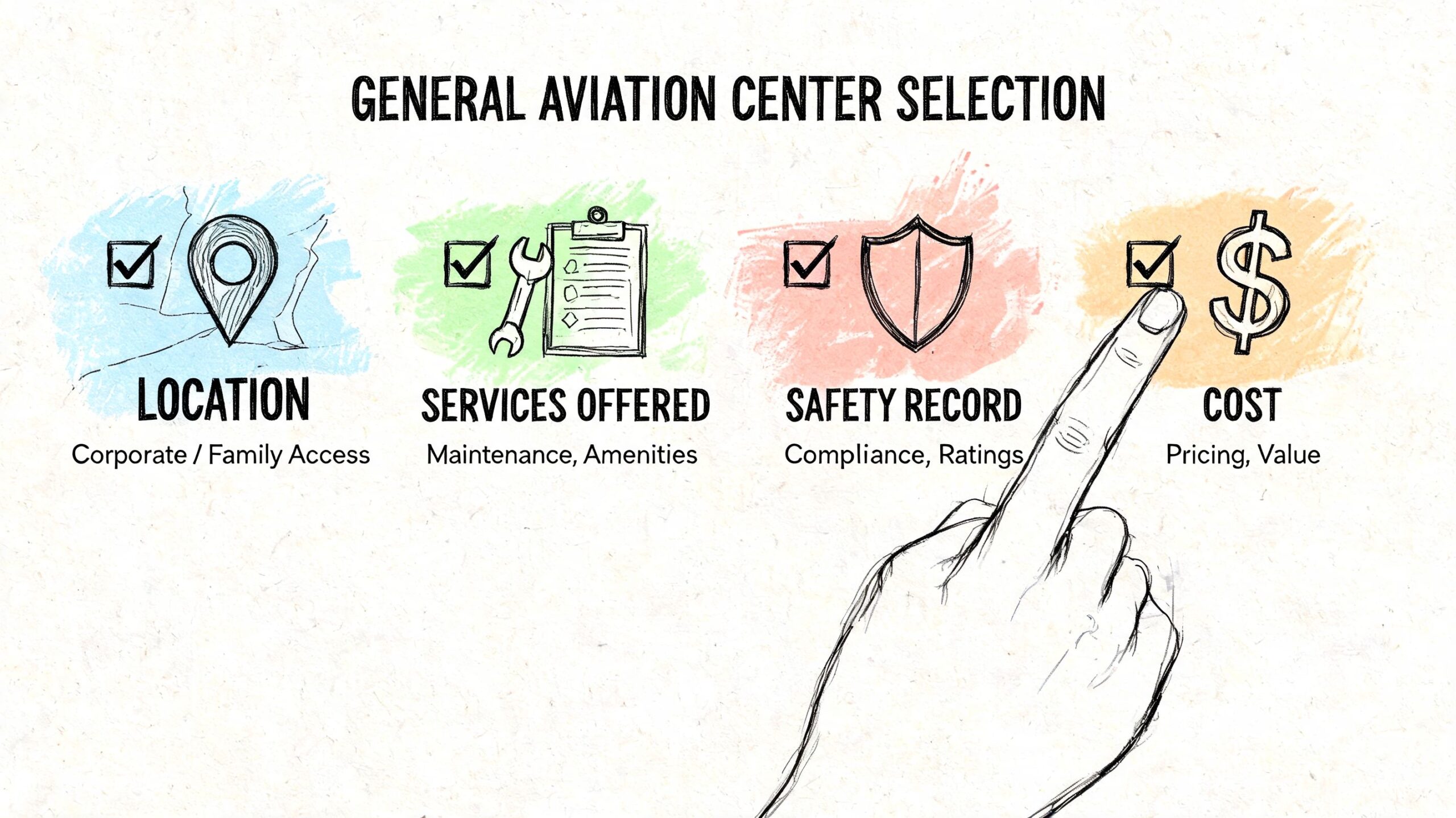
Four things to evaluate first
Location against ground reality
Closer isn’t always faster. A major airport may look ideal on a map, but if roadway access, construction, or ramp congestion is heavy, a nearby secondary field can produce a smoother trip.
Service depth
Ask what the center can support. Some FBOs are excellent for domestic turns but less convenient for international arrivals, special catering, or complex passenger requests.
Hours and responsiveness
A facility may look strong during business hours and become far less useful late in the evening or early in the morning. That matters on charter flights, where schedule flexibility is part of the value.
Ramp and aircraft fit
A center needs to fit the mission. Light aircraft, midsize jets, and larger cabin aircraft don’t all place the same demands on ramp space, handling, and staging.
Why local airport knowledge matters
A good example is Miami. A $94 million runway upgrade at Miami International Airport in 2025 can create short-term disruption for GA operations, which is why alternate FBO planning in nearby markets matters, as noted in reporting on Miami airport infrastructure upgrades and their operational impact.
That’s where experience shows. If a primary field becomes cumbersome, a smart operator looks at nearby alternatives based on the trip’s actual priorities. Is the goal downtown access, lower friction, easier customs flow, better schedule integrity, or lower repositioning cost?
Selection advice: Don’t ask only, “What’s the nearest airport?” Ask, “Which general aviation center gives this mission the cleanest outcome?”
Practical questions to ask before booking
Use these when evaluating a trip:
- How close is the FBO to my real destination? Not the city center in theory, but the meeting, resort, home, or marina you’re headed to.
- Does the airport stay efficient during busy periods? Some facilities look good until demand spikes.
- What’s the backup plan if the primary airport gets congested? Strong operators already have one.
- Will this airport feel private or mixed with heavier public traffic? That can change the tone of the trip fast.
If you’re weighing South Florida options specifically, Air Trek’s guide to Fort Lauderdale private airport choices is a useful example of how airport selection changes the experience.
Book Your Seamless Journey with Air Trek
Understanding the general aviation center is the inside track. It’s the facility that turns private charter from a nice idea into a smooth, controlled travel day.
With over 2,200 charter companies operating in the U.S., experience matters, and Air Trek brings a 45-year history of five-star service plus long-standing relationships with top FBOs across the Western Hemisphere, as described on the Air Trek company overview. That matters when the trip calls for smart airport selection, reliable ground coordination, and backup options that protect your schedule.
If you want a trip built around convenience instead of terminal friction, request details through Air Trek’s private charter quote page.
Frequently Asked Questions About General Aviation Centers
Can non-pilots use a general aviation center
Yes. Most passengers using a general aviation center are not pilots. The facility is there to support charter clients, aircraft owners, business travelers, families, and their guests.
Do general aviation centers have security
Yes, but it doesn’t look like the airline terminal process. Security is handled in a more controlled, flight-specific environment. The exact procedure depends on the airport, operator, and trip.
Are general aviation centers only for private jet owners
No. Charter passengers use them all the time. You don’t need to own an aircraft to depart from a general aviation center.
Can families use a general aviation center
Absolutely. In practice, these facilities are often easier for families because the environment is quieter, boarding is more direct, and there are fewer public chokepoints to manage with children and luggage.
What about pets
Pet travel is one of the clearest practical advantages of private aviation. Policies still need to be coordinated in advance, but general aviation center departures are usually far easier for pets than crowded airline terminals.
How early should I arrive
That depends on the operator and airport, but you generally won’t need the long pre-arrival buffer associated with commercial flights. Your charter provider will give you a specific show time.
What should I ask before choosing one
Ask about vehicle access, operating hours, ground transportation coordination, baggage handling, customs support if needed, and whether there’s a strong alternate airport option if conditions change. Those answers tell you more than lounge photos ever will.