
You're probably making the same calculation most South Florida flyers make. Is it smarter to book a flight into Boca Raton itself, or use a larger nearby airport and handle the extra drive on the ground?
That's the key question behind most searches for jets Boca Raton. The answer usually isn't about luxury. It's about protecting the day. If your schedule is tight, your passengers matter, and the trip has a business or family consequence attached to it, airport choice and aircraft fit matter more than the phrase “private jet to Boca Raton.”
A good charter decision starts with the mission. Where are you going after landing? How many people are traveling? How much luggage is coming? Are you trying to get in and out the same day, position an aircraft for repeat use, or solve a last minute transportation problem without wasting half the day in traffic?
Why Private Jets in Boca Raton Make Sense
A typical South Florida travel day can unravel before you ever leave the ground. You leave early, hit traffic anyway, work around terminal congestion, then lose more time waiting for boarding, bags, or a delayed departure slot. By the time you're airborne, the main advantage of your itinerary is gone.
That's why private aviation works so well in Boca Raton. For many travelers, the benefit isn't indulgence. It's control. You cut out the slow parts that don't add value and keep the parts that do, including direct routing, a quieter departure process, and an arrival that puts you closer to where you need to be.

Boca works because it's already an aviation market
Boca Raton didn't become relevant to private flying overnight. Its airport history goes back to 1936, when it began as a grass strip, and it was selected for military use in 1941. A Boca Raton Airport history overview also notes modern business aviation capacity including 125 T-hangars, over 290 based aircraft, and two full-service FBOs.
That matters because established private aviation airports usually function better for repeat flyers than airports that merely allow charter traffic. There's a local operating rhythm. Crews know the field. Ground support is part of the environment, not an exception.
Practical rule: If you fly private often, choose airports that support aircraft owners, crews, and repeat operations, not just occasional passenger drop-offs.
The use cases are broader than many people expect
Boca Raton works for several very different trip types:
- Executive day trips: Meetings within Florida or up the East Coast where time on the ground matters more than onboard bells and whistles.
- Leisure departures: Family or couples' travel where privacy, easier boarding, and luggage flexibility are worth paying for.
- Regional flying: Short sectors where a turboprop or light jet can save more time door to door than people expect.
- Managed aircraft activity: Trips that involve repositioning, maintenance coordination, or owner scheduling, not just point-to-point charter.
The key point is simple. Boca Raton is not just a place to arrive. It's a place where private aviation is actively based, managed, and moved.
Choosing Your Gateway Airport and FBO
The biggest mistake people make with jets in Boca Raton is assuming the closest airport is automatically the right airport. Sometimes it is. Sometimes it isn't.
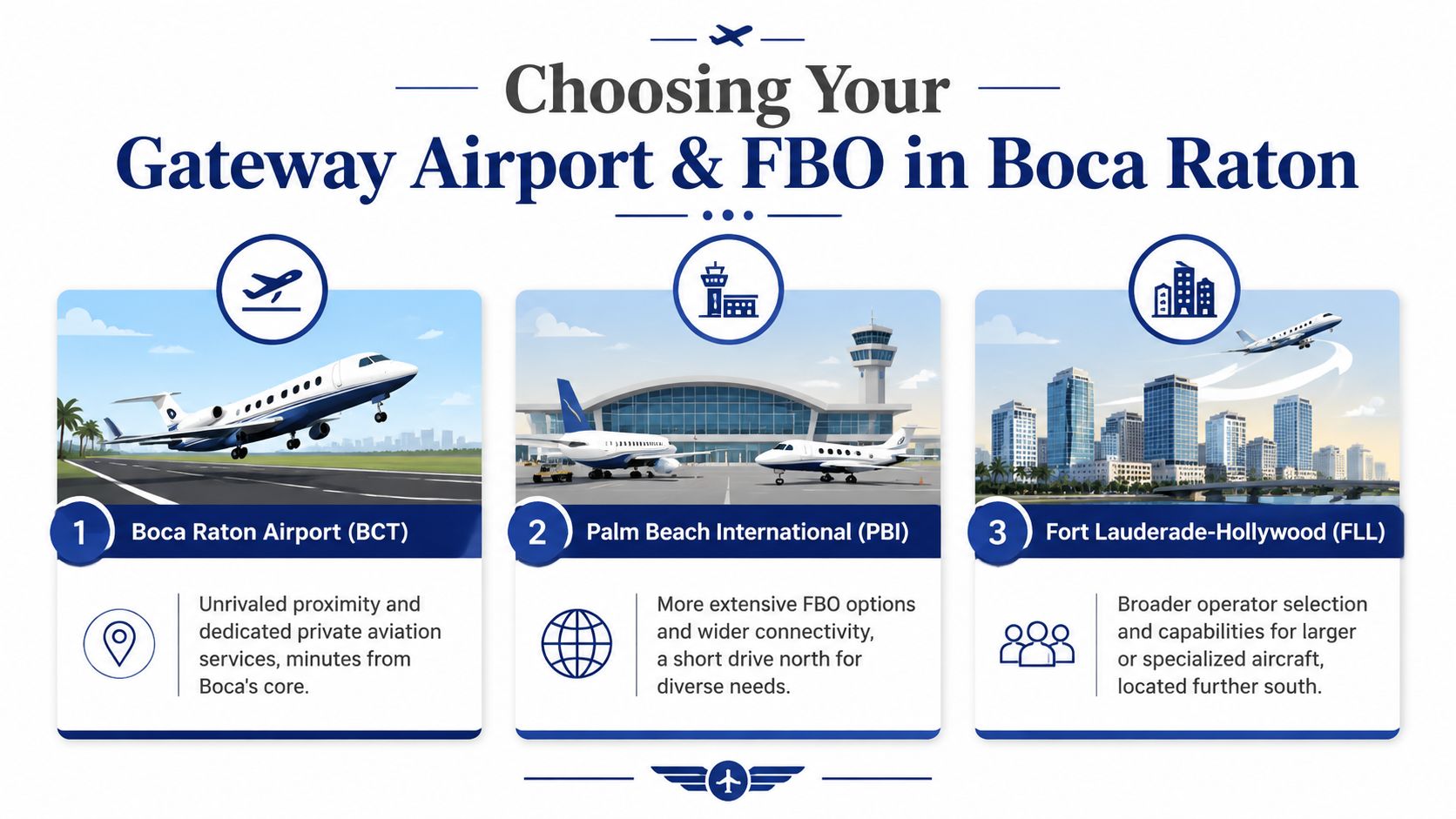
If your destination is central Boca, Boca Raton Airport often wins on convenience. But if your trip requires a larger cabin aircraft, more operating flexibility, or a different ground route for your passengers, another South Florida airport may produce a cleaner overall day.
What Boca Raton Airport does well
Boca Raton Airport is not a minor local strip. In the 12-month period ending December 31, 2020, it recorded 81,550 aircraft operations, averaging 223 per day, with 93% classified as general aviation and 6% as air taxi traffic. The same report listed 242 based aircraft, including 82 jets, according to the Boca Raton Airport reference entry.
Those numbers tell you something practical. BCT is active enough to support real business aviation traffic, but it is still centered on general aviation rather than large-scale commercial airline activity. For many passengers, that means a more direct private travel experience.
What an FBO actually does for your trip
An FBO, or fixed-base operator, is the private terminal and ground support provider that handles the trip on the airport side. The FBO coordinates passenger reception, ramp access, fueling, luggage handling, crew support, and often amenities such as conference areas, lounges, and car service coordination.
If you haven't flown private often, it helps to think of the FBO as the operational front door of the trip. The aircraft matters, but the handoff at the FBO is what shapes the departure and arrival experience. Air Trek's overview of how a private jet FBO works is a useful primer if you want to understand that process before booking.
A polished charter trip can still feel clumsy if the airport choice creates avoidable ground delays, weak handling coordination, or a long transfer after landing.
Comparing BCT with nearby alternatives
Here's the practical framework I use when clients ask which airport to use.
| Airport | Best use case | Main advantage | Main trade-off |
|---|---|---|---|
| Boca Raton Airport (BCT) | Trips ending in Boca Raton or nearby communities | Close-in access and strong general aviation focus | Less forgiving for some larger aircraft missions |
| Palm Beach International (PBI) | North county access or travelers needing broader airport options | Wider operating environment for mixed travel needs | Added drive if the real destination is Boca |
| Fort Lauderdale area airports | Broader operator availability and some larger-aircraft scenarios | More market depth in South Florida | Longer ground leg for Boca-centered itineraries |
The right answer depends on the full mission, not just the airport code.
Three questions worth asking before you confirm
- Where is the final stop on the ground? If the meeting, residence, or resort is in Boca, the airport closest to Boca usually creates the shortest total travel day.
- What aircraft are you trying to use? Don't force an aircraft-airport combination that works on paper but narrows your margins operationally.
- How sensitive is the schedule? If this is a same-day out-and-back, minutes matter more than they do on a relaxed leisure trip.
People searching for Jets Boca Raton often think they're choosing a charter. In reality, they're choosing a routing strategy.
Matching the Right Aircraft to Your Mission
The aircraft should fit the mission, not the other way around. That sounds obvious, but many charter mistakes start when travelers choose by image, cabin label, or habit instead of trip profile.
A short Florida hop, a domestic business leg, and a longer family itinerary are different missions. They deserve different equipment. Boca Raton supports several aircraft classes well, and the simplest way to narrow the field is to match the airplane to passenger count, baggage, distance, and airport conditions.
Start with the mission, not the category name
At the practical level, most Boca departures fall into a few patterns.
A turboprop makes sense when the trip is short, the airport access matters, and operating efficiency matters more than pure speed. A light jet usually fits shorter business travel for smaller groups. A midsize cabin becomes attractive when travelers want more comfort, longer domestic reach, or better baggage flexibility. Large-cabin and heavy aircraft enter the conversation when range, cabin volume, or specific passenger expectations justify them.
The airport itself gives a clue about what works well. Independent flight-planning data show a King Air 350/360 can fly from Boca Raton to Marathon in about 0.6 hours, and the same dataset lists departures for the Hawker HS125-700 / 700|750|800|800XP / 850 / 900XP family from Boca Raton, as shown in this Jet Advisors flight-time result.
That's why Boca works well across more than one aircraft class. It's not only a light-jet field and it's not only a turboprop field either.
Private Jet Categories at a Glance
| Aircraft Type | Typical Passengers | Approx. Range (Nautical Miles) | Best For |
|---|---|---|---|
| Turboprop | 5 to 8 | Short to medium range | Florida trips, island hops, shorter sectors where efficiency matters |
| Light Jet | 4 to 7 | Short to medium range | Small-group business trips and quick regional travel |
| Midsize Jet | 6 to 9 | Medium range | Domestic business travel with more cabin comfort |
| Super-Midsize or Large Cabin | 8 or more | Medium to long range | Longer flights, larger groups, heavier luggage needs |
What usually works best
- Short hops within Florida or nearby islands: Turboprops often deliver excellent value. They're efficient, practical, and often ideal for shorter sectors.
- Business travel with a small team: A light or midsize jet usually balances speed, comfort, and budget well.
- Family vacation departures: Don't underestimate baggage. Families often outgrow a light jet before they outgrow the seating.
- Trips with golf clubs, strollers, or special equipment: Ask about baggage volume early, not after you've chosen the aircraft.
If the trip is under a few hours, the “best” aircraft is often the one that boards quickly, carries the bags without drama, and doesn't create unnecessary operating cost.
What clients often get wrong
The most common mismatch is selecting more airplane than the mission needs. That can raise cost without improving the day in a meaningful way.
The second mistake is going too small. That usually shows up in baggage limitations, cabin comfort on a longer sector, or needing a refueling stop that defeats the purpose of chartering.
A practical booking conversation should cover these questions:
- How many passengers are traveling?
- What bags are coming, including oversize items?
- Is nonstop important, or is overall value more important?
- Are you optimizing for speed, comfort, or total spend?
Get those right and the aircraft decision usually becomes straightforward.
Understanding Private Jet Charter Costs
Private jet pricing feels opaque when you only look at the final quote. It gets easier to judge when you separate the moving parts.
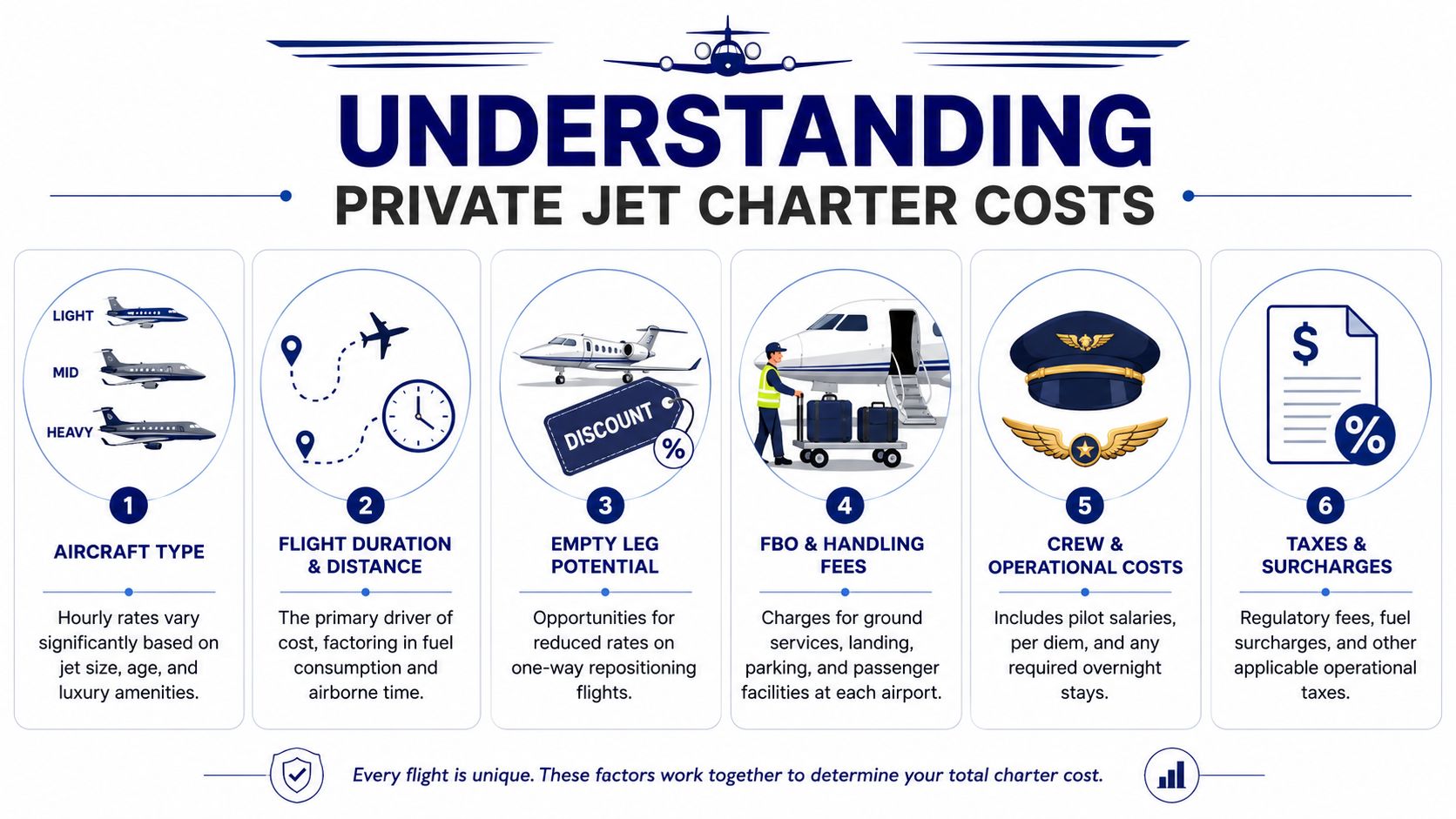
Most charter quotes combine aircraft cost, operational fees, airport handling, tax treatment, and any itinerary-specific expenses tied to crew or repositioning. The right question isn't “What does a jet cost?” The right question is “What is driving this specific quote?”
What makes one Boca quote different from another
A large share of the price comes from aircraft type and flying time. A bigger jet usually costs more to operate than a smaller one, and longer trips add airborne time, fuel burn, crew planning, and handling complexity.
Then there's airport fit. Boca Raton Airport has a single asphalt runway measuring 6,276 feet by 150 feet. That generally supports most light and midsize business jets, but it can become a limiting factor for heavier aircraft on hotter days, with full fuel, or on longer sectors where takeoff margins tighten, as noted in this runway analysis of Boca Raton Airport.
That kind of runway reality affects cost even when passengers never think about it. If the mission pushes the runway or performance envelope, the operator may recommend a different aircraft, a fuel stop, or a different airport. Each of those choices changes the quote.
The cost drivers to ask about
A serious quote review should cover these items:
- Aircraft assignment: The cabin category and specific aircraft affect the base charter amount.
- Flight time: Longer distance and longer airborne time usually increase total price.
- Repositioning: If the aircraft has to come to Boca before your trip or leave empty afterward, that can affect the quote.
- Handling and airport charges: FBO services, ramp use, parking, and related airport costs vary by itinerary.
- Crew logistics: Some trips require overnight crew planning or additional operational support.
- Taxes and surcharges: Regulatory and fuel-related line items may appear depending on the trip structure.
If you want a more detailed breakdown of how those line items are commonly organized, Air Trek's page on private jet charter pricing walks through the structure clearly.
How to improve value without compromising the trip
The easiest savings usually come from adjusting the mission, not negotiating blindly.
- Be flexible on timing: A small shift in departure can improve aircraft availability.
- Consider round-trip planning: In some cases, a round-trip itinerary can work better than two separate one-way bookings.
- Match the cabin to the actual passenger load: Paying for unused space rarely improves the travel day.
- Ask whether another airport solves the mission more efficiently: A short drive can sometimes lower overall operating complexity.
Charter cost isn't random. It's the operational shape of the trip expressed in dollars.
Unlocking Value with Empty Legs and Memberships
If you fly private more than once in a while, the best buying strategy usually sits somewhere between pure on-demand booking and a rigid long-term commitment.
That's where empty leg opportunities and membership-style access become useful. They solve different problems. One is opportunistic. The other is about consistency.
Why Boca can produce more empty leg opportunity
Boca Raton is more than a destination field. It has a local ecosystem tied to aircraft management, on-demand charter, maintenance, and handling. Airport business listings and operator activity point to a dense operating environment where aircraft are often being moved, returned to base, or repositioned for the next trip, as reflected by the Boca airport's Journey Aviation business listing.
That matters because empty legs happen when aircraft need to move whether or not a paying passenger is onboard. In a market where aircraft are based, managed, and serviced locally, those repositioning patterns can create more opportunity.
When empty legs work well
An empty leg can be a strong value play if your schedule has flexibility and your route aligns with the aircraft's operational need.
They tend to work best for travelers who can say yes quickly, adjust by a few hours if needed, or use the deal for a leisure trip rather than a critical meeting. If you need exact timing, exact routing, and zero movement in the plan, an empty leg is less dependable than a standard charter.
For travelers monitoring those opportunities, Air Trek maintains a page for empty leg flights in the USA, which is one practical way to watch repositioning inventory.
Empty legs are a pricing advantage, not a scheduling guarantee. Treat them as flexible value, not as a substitute for a mission-critical charter.
Where memberships fit instead
Memberships and similar access programs appeal to people who want more predictability. They can make sense for repeat flyers who value response time, simpler booking habits, and more consistent planning across multiple trips.
Think of the spectrum this way:
- On-demand charter: Best when every trip is different.
- Empty leg booking: Best when flexibility is high and value is the priority.
- Membership-style access: Best when you fly often enough to want a more repeatable process.
The right choice depends on how you travel, not on marketing language. A family taking a few discretionary leisure trips each year buys differently than a corporate travel manager handling moving schedules and executive changes.
Booking Your Flight with Air Trek
A private charter booking should feel simple on the client side even when the operational side is complex. You give the mission details, review suitable aircraft and routing options, confirm the schedule, and then let the flight coordination team handle the moving parts.
Air Trek is one option in this market. According to the company information provided by the publisher, it has operated since 1978 and has been trusted for over 45 years as a family-owned Florida-based private jet charter company serving destinations across the United States, Canada, the Caribbean, and Central and South America. The same company information states that it offers on-demand charter, empty legs, memberships, customizable travel packages, and accredited air ambulance services.
What a smooth booking process should include
A competent booking process usually covers more than just the airplane.
- Trip review: Passenger count, baggage, destination, and schedule sensitivity.
- Aircraft matching: Choosing the aircraft that fits the mission rather than forcing a familiar model.
- Ground coordination: Car service, arrival timing, and airport-side handling.
- Special requests: Pets, catering, accessibility needs, and family-specific requests.
Pet travel matters more than many first-time charter clients expect. So do small operational details, such as whether the day involves one stop or several, whether the aircraft needs to wait, and whether the itinerary may change after departure.
The practical standard is this. You should know who your point of contact is, what aircraft category is being proposed, what flexibility exists, and what happens if the schedule shifts.
Frequently Asked Questions About Flying Private
How early should I arrive for a private flight out of Boca Raton
Earlier than “right on time,” but much later than you'd need for a commercial departure. Private flying usually removes the long terminal process, so travelers often arrive close to departure. Your coordinator will usually give you a recommended arrival window based on the airport, aircraft, and any special handling needs.
Can I bring pets on a private charter
Often, yes. The main issue isn't whether pets are allowed in the abstract. It's whether the aircraft, operator, and trip details fit the animal's size, crate needs, and comfort. Ask early about breed, size, paperwork for any international segment, and whether your pet will ride loose, leashed, or in a carrier.
How much luggage can I bring
It depends more on baggage compartment shape than passengers assume. Soft-sided luggage is usually easier to accommodate than hard-shell cases. Golf clubs, skis, strollers, and medical equipment should always be disclosed in advance because those items can change the aircraft recommendation even when the passenger count does not.
Can catering be customized
Usually, yes. Most private charters can accommodate anything from light snacks and drinks to more customized meal service. The practical question is timing. Last-minute bookings can still support basic catering, but more specific requests are easier to execute when they're made earlier.
Is Boca always the best airport for Boca Raton travelers
No. It's often the most convenient option for Boca-based trips, but not every mission belongs at the closest airport. Aircraft type, schedule sensitivity, passenger destination, and ground routing all matter. For some itineraries, another South Florida airport is the better operational choice.
If you're evaluating Jets Boca Raton, focus on the full mission. The best result usually comes from pairing the right airport with the right aircraft, then building the trip around the actual schedule on the ground.