
You’re probably here because someone mentioned “we’ll have you meet the aircraft at the FBO,” and you realized that private aviation has its own vocabulary, its own rhythms, and its own ground game.
That’s a smart question to stop on.
A lot of first-time private flyers focus on the aircraft. Discerning repeat flyers often focus on schedule, privacy, and access. But the piece that shapes your day more than many travelers anticipate is the private jet FBO. If the aircraft is the flying office or family cabin, the FBO is the place where the trip either feels effortless or starts to fray.
Clients usually notice the obvious parts first. There’s no crowded terminal. You’re not standing under gate monitors. You’re not walking half a mile with a laptop bag and a child or trying to track down oversized luggage. What they don’t always see is the coordination happening in the background between the charter operator, the crew, the line staff, ground transportation, catering, and, on some trips, customs or medical handling.
That coordination is where good private travel gets better.
What Is a Private Jet FBO
A Fixed-Base Operator, usually shortened to FBO, is the private aviation terminal and ground support provider at an airport. If that sounds dry, think of it this way. It combines parts of a hotel concierge, a pit crew, and a private reception desk for the aircraft and the passengers.
For travelers, the FBO is the calm building you drive up to instead of entering the commercial terminal. For crews and operators, it’s also where fueling, aircraft handling, flight support, and ramp coordination happen.
Why private aviation runs through FBOs
The easiest way to understand a private jet fbo is to compare it to the commercial side of the airport.
At a commercial terminal, the airport experience is built for volume. At an FBO, the experience is built for direct handling. Staff know which aircraft is arriving, who’s on board, what ground transportation is needed, and when the crew wants the cabin stocked, serviced, and ready.
That structure matters because the private aviation network is much broader than commonly understood. There are over 5,000 FBOs across the U.S., compared with roughly 500 commercial airports, which gives private flyers far more destination access and often lets travelers arrive just 15 to 30 minutes before departure, according to Private Jet Card Comparisons’ overview of FBO access and private terminal timing.
Practical rule: If you’re flying private, you’re not “going to the airport” in the commercial sense. You’re going to a specific FBO on that airport field.
What people usually ask first
Clients who are new to private flying often ask the same few questions:
- “Is the FBO just a lounge?” No. The lounge is the visible front end. The operation also includes fueling, baggage handling, aircraft parking, towing, crew support, and often hangar access.
- “Do all airports have one?” Many airports that serve business aviation have one or more. Large private aviation airports may have multiple FBOs competing on service and ramp access.
- “Is security different?” Yes. It’s more discreet and suited for private aviation. The process is still controlled, but it doesn’t resemble a mass-market TSA checkpoint.
- “Why does the specific FBO matter?” Because one airport can have several options, and they’re not all equal in ramp location, service culture, staffing, or suitability for your aircraft and trip profile.
A good charter experience starts before you ever see the airplane. It starts with the right FBO and the right people coordinating it.
Core FBO Services for Aircraft Operations
Most passengers judge an FBO by the coffee, the lounge, or how quickly the car pulls up planeside. Operators judge it by something else first. Can this location turn the aircraft safely, accurately, and on schedule?
That’s where value sits.
Fueling, handling, and the short turn
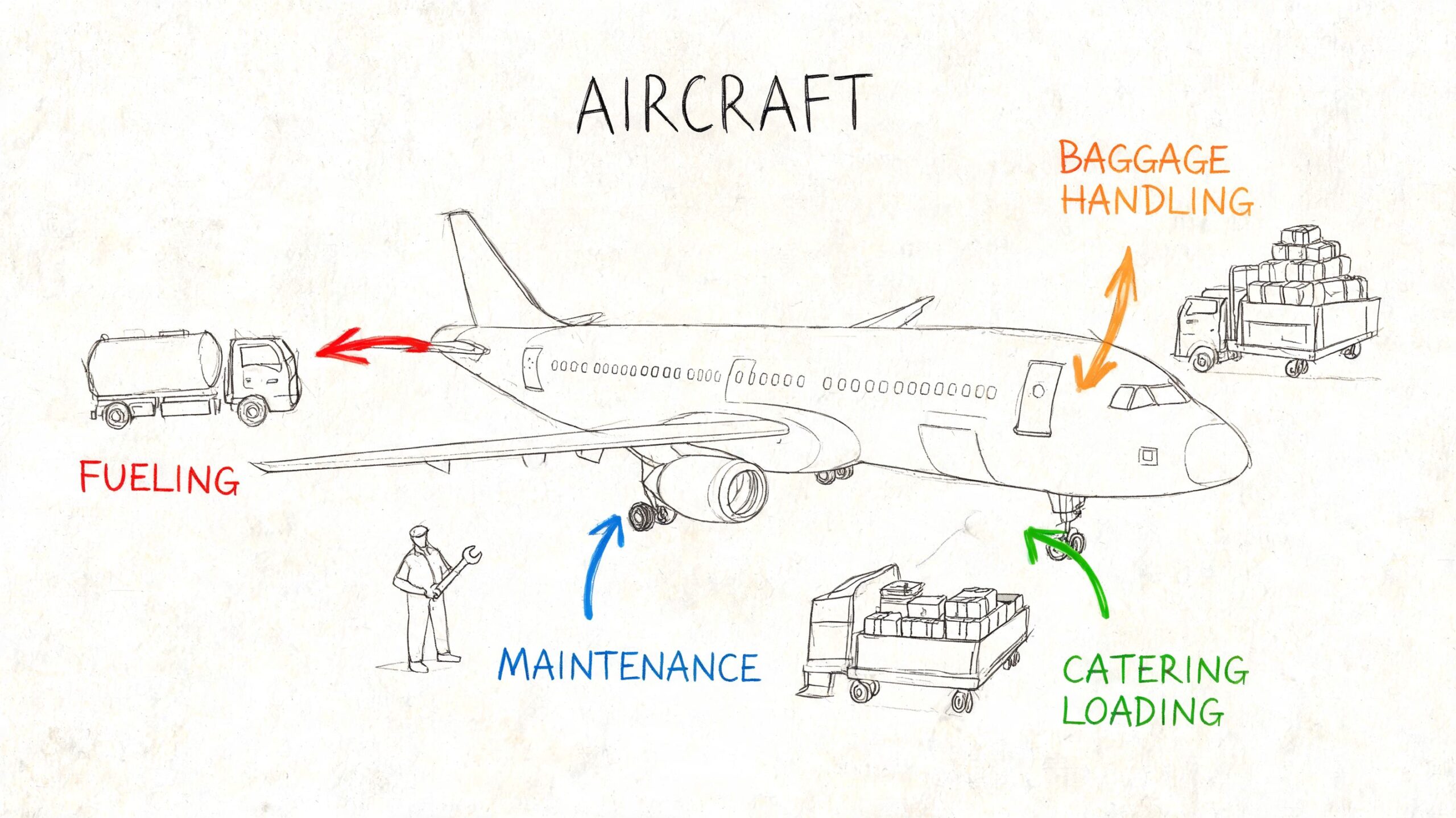
Fuel is usually the first operational issue people underestimate. At an FBO, line crews coordinate Jet A fueling, position the aircraft, manage towing when needed, load baggage, and make sure the airplane is set for the next leg without wasted motion.
The details matter. Fuel loads affect range, payload, and performance. Cabin servicing matters too. Water, lavatory support, cleaning, and crew coordination all happen on the same clock. When those teams are sharp, the aircraft doesn’t sit unnecessarily on the ramp.
According to Amalfi Jets’ explanation of FBO turnaround efficiency, top-tier FBOs can reduce pre-departure ground time to as little as 15 to 20 minutes, and that higher aircraft utilization can lower a charter’s hourly operating costs by 10 to 15%.
A fast turnaround isn’t about rushing. It’s about removing handoff delays.
What’s happening behind the scenes
Passengers rarely see the full sequence, but the operator and crew do. A solid FBO typically handles work like this:
- Aircraft marshaling and ramp positioning: Line staff direct the aircraft to the correct stand, keep clearances safe, and coordinate any towing or repositioning.
- Baggage and cabin support: Bags move directly from car to aircraft or aircraft to car, while the cabin gets reset for the next departure.
- Fuel coordination: The crew and dispatcher confirm required uplift and timing so fueling doesn’t delay boarding.
- Hangar requests: If weather, overnight protection, or a high-value aircraft requires covered storage, the FBO is usually the first call.
- Crew services: Flight planning support, weather access, rest areas, and transport assistance keep the next leg moving.
What works and what doesn’t
An experienced operator learns quickly that “full service” can mean very different things from one field to another.
What works:
- An FBO with disciplined ramp communication
- Reliable fuel truck availability
- Clear handoff between front desk, line service, and flight crew
- Staff who understand the difference between a quick turn and an extended stop
What doesn’t:
- A beautiful lobby with weak line operations
- Slow baggage transfer at a tight-turn airport
- Poor overnight planning for hangar or parking
- Treating every mission the same, whether it’s a day trip, international departure, or aircraft reposition
If you want private travel to feel flexible, the aircraft has to be ready when you are. The FBO is the team that makes that possible on the ground.
The Passenger Experience From Curb to Cockpit
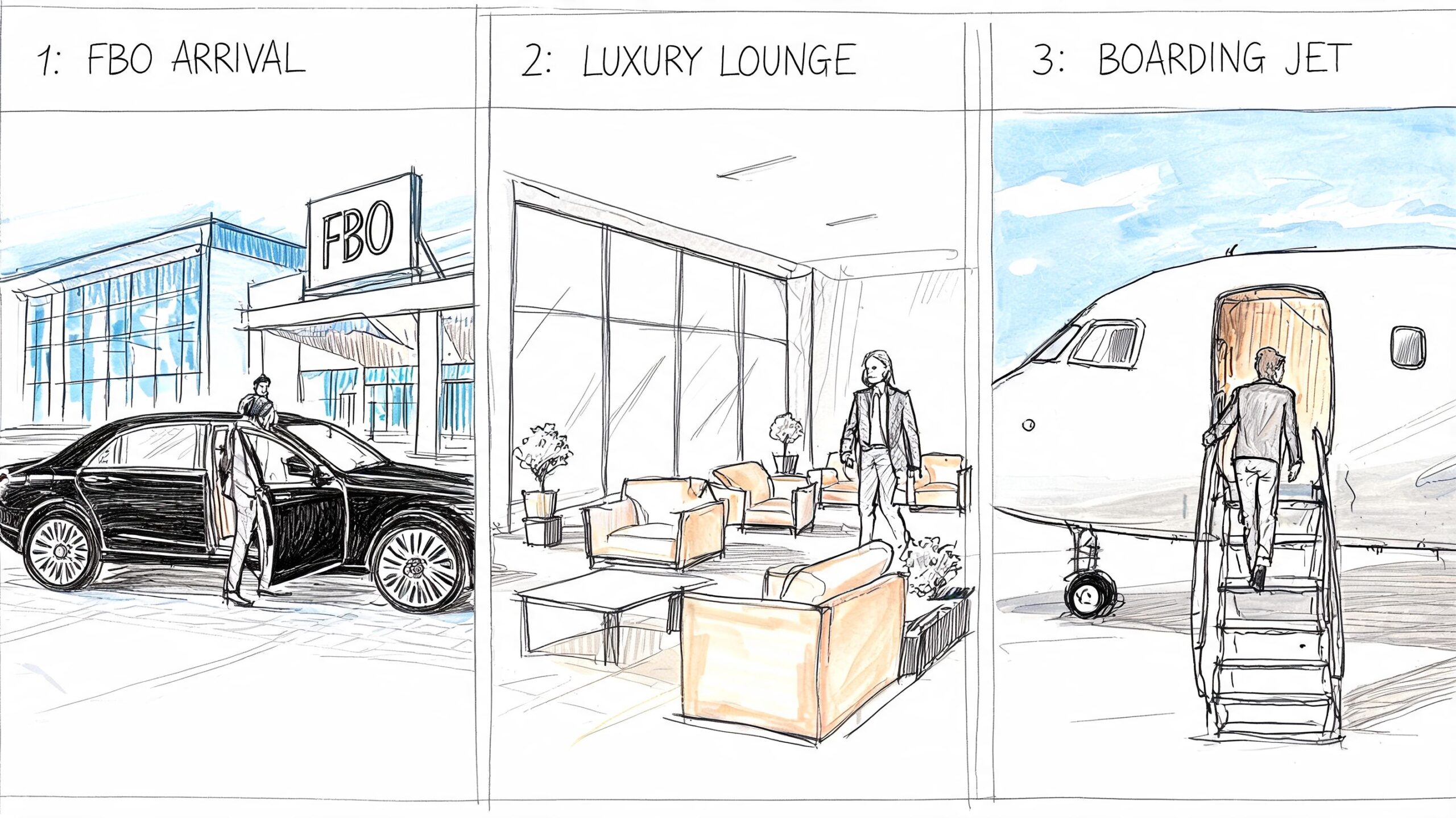
For a passenger, the private jet fbo experience starts at the curb. Not at a parking garage, not at a crowded check-in island, and not under fluorescent gate screens.
You drive to a private terminal entrance. Staff greet you or already know you’re coming. Luggage is handled directly. If you’ve arranged catering, pets, a car on arrival, or a conference room before departure, the FBO is usually where those requests come together.
What the travel day feels like
The biggest difference isn’t just speed. It’s control.
You’re not being processed through a system built for thousands of travelers moving in batches. You’re being handled as a specific party on a specific flight. That changes the pace of everything. Families can settle children before boarding. Executives can stay on calls longer. Travelers with pets don’t have to contend with the same friction they’d face in a public terminal.
A good FBO also protects privacy. Staff typically keep movements discreet, and the environment is designed around low noise, fewer touchpoints, and direct escort to the aircraft.
Here’s the side-by-side reality:
| Factor | Private Jet FBO | Commercial Airport Terminal |
|---|---|---|
| Arrival process | Direct arrival at private terminal | Public terminal entry and check-in flow |
| Waiting environment | Quiet lounge, private areas, concierge-style support | Shared seating, queues, crowded common areas |
| Baggage handling | Handled directly with staff assistance | Checked baggage and public conveyor systems |
| Boarding | Escort to aircraft on the ramp | Gate-based boarding by zone or group |
| Privacy | High discretion and limited foot traffic | Public-facing environment |
| Ground coordination | Often tied closely to your flight party and transport | Standardized for large passenger volumes |
Amenities that matter more than people expect
The visible amenities can sound cosmetic until you use them under real schedule pressure.
- Private lounge space: Useful when a meeting runs long or a family needs a quiet place before wheels up.
- Conference rooms and Wi-Fi: Helpful for executives working until departure.
- Concierge support: Ground cars, hotel changes, catering adjustments, and local handling often route through the FBO desk.
- Crew and passenger separation when needed: Important for privacy and discretion.
A short video can help if you haven’t seen the setting before.
“The best FBO experience feels almost uneventful. You arrive, things happen in the right order, and no one asks you to solve airport problems.”
Questions sophisticated travelers often ask
Two come up often.
Do I still need to show identification?
Yes. Private flying is efficient, not casual. Your operator and the FBO still follow security and identity procedures.
Can the car drive close to the aircraft?
Often yes, depending on the airport, safety rules, and local procedures. That’s one reason travelers remember the FBO experience so clearly. The transition from curb to cabin is short and controlled.
How to Choose the Right FBO for Your Trip
Not all FBOs at the same airport are interchangeable. That’s the first thing to understand.
Some are better for a quick turn. Some handle larger aircraft better. Some have stronger line service than front-desk hospitality. Others are ideal for a passenger-heavy departure but awkward for overnight parking, de-icing needs, or a late-night international return.
Start with the aircraft, not the lounge
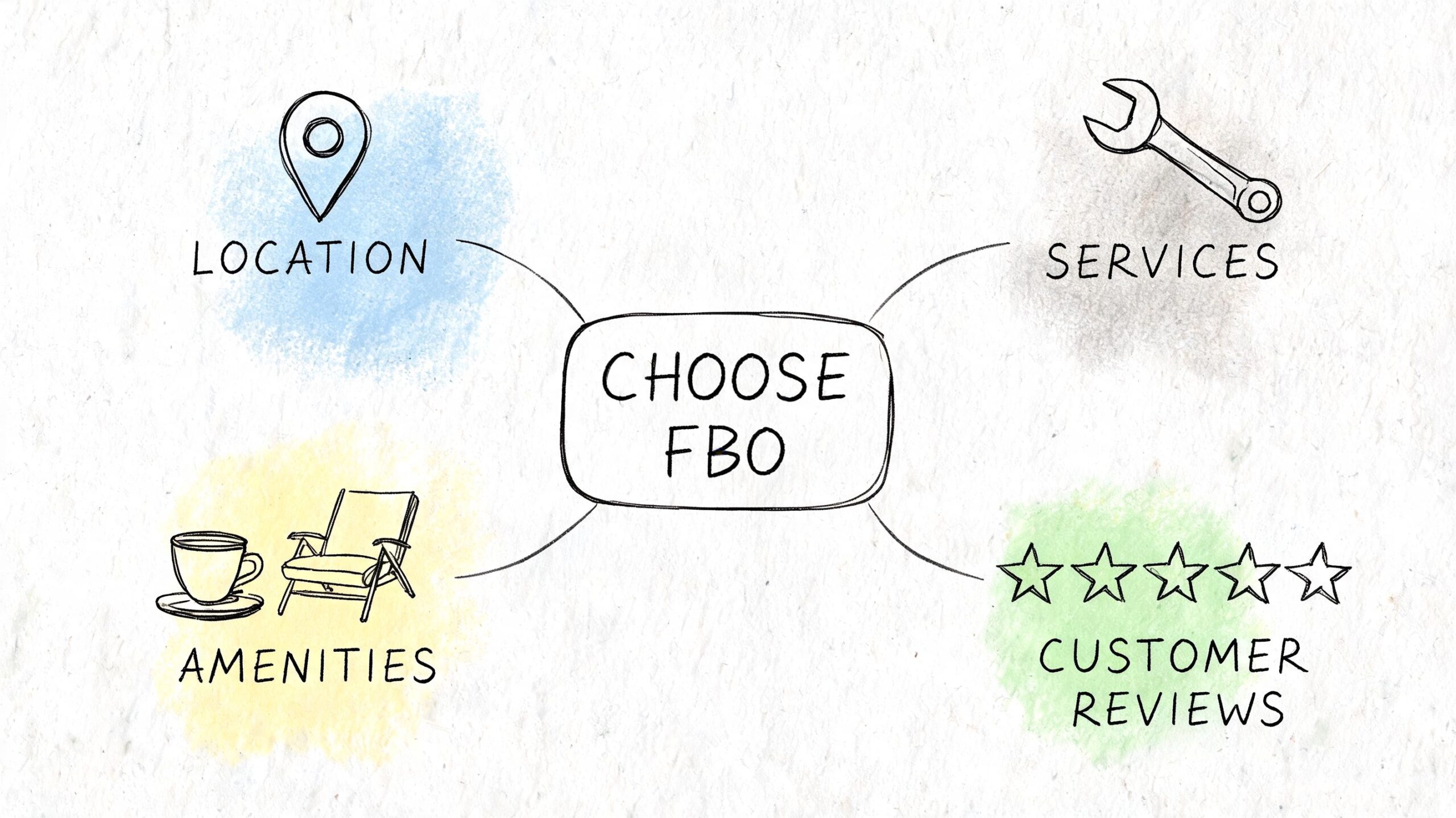
Aircraft compatibility comes first. That sounds obvious, but travelers sometimes evaluate an FBO by passenger amenities before asking whether it’s the best operational fit for the jet itself.
According to Jetcraft’s guide to private jet categories and airport requirements, FBO selection is critical for aircraft compatibility. A light jet might only need a 3,200 ft runway, while a Gulfstream G650 requires FBO ramps and hangars designed for its 99-foot wingspan and weight, in line with FAA and ICAO standards.
That has practical consequences. A suitable FBO for a light jet hop isn’t automatically the right one for a large-cabin aircraft with a longer mission, more baggage, and different servicing requirements.
The questions worth asking
If you’re reviewing trip logistics with your charter provider, these questions usually get to the right answer fast:
Which FBO gives this aircraft the easiest ramp access?
A shorter taxi or cleaner operational flow can reduce friction on both departure and arrival.Does this FBO fit the mission profile?
A winter departure may require de-icing capability. A late return may call for stronger after-hours staffing.How good is the line operation?
This matters more than the furniture. Efficient marshalling, fueling, towing, and baggage handling save time and reduce mistakes.What does passenger access look like?
Families, executives, and travelers with mobility considerations may value ease of curbside handling differently.
Airport choice and FBO choice go together
Sometimes the best FBO decision starts one level higher, with the airport itself. In South Florida, for example, picking between airports can change the whole ground experience before you even compare private terminals. Air Trek’s guide to Fort Lauderdale airport options for private flyers is a useful example of how airport selection and FBO strategy overlap.
Operational shortcut: The right question usually isn’t “Which FBO is nicest?” It’s “Which FBO is best for this aircraft, this schedule, and this day?”
That’s where experience earns its keep. The best choice is situational.
How Air Trek Delivers Seamless Travel via FBO Partnerships
The most overlooked part of private aviation is that the client usually sees only the finished product. They don’t see the sequence of calls, confirmations, revisions, and local coordination that made the day feel smooth.
That’s where the charter operator’s role matters. A strong operator doesn’t just source an aircraft. It manages the relationship with the FBO so the traveler doesn’t have to.
What coordination actually looks like
At busy private hubs, this isn’t optional. At Palm Beach International, for example, the airport handled 41,967 departures in 2024, and peak season from November through April brings 40 to 50% more traffic than summer months, according to Airplx’s review of the busiest U.S. private jet airports and FBO demand. At airports like that, timing, ramp space, and service sequencing all need active management.
That coordination often includes:
- Confirming the right FBO for the aircraft and mission
- Securing ramp space during high-demand periods
- Matching passenger arrival timing to aircraft readiness
- Pre-arranging catering, ground transportation, and special handling
- Keeping crew, dispatch, and line staff aligned if the schedule shifts
When this is done well, the client experiences a calm departure. When it’s done poorly, private flying can still feel hectic. The problems are just different from commercial ones.
Why advocacy matters
The operator is the client’s advocate with the FBO. That’s the inside-baseball part many travelers never hear spelled out.
The FBO serves many aircraft, crews, and operators at once. The charter company’s job is to make sure your mission doesn’t get treated like a generic movement. If your family is traveling with pets, if your executive team needs cars staged in a precise order, if a medical passenger requires quiet handling, or if weather creates timing pressure, someone has to own those details.
Air Trek’s private charter services are built around that kind of coordinated handling across Florida and the broader Western Hemisphere. That matters on short domestic hops, but it matters even more on multi-stop itineraries involving the Caribbean, Central America, or South America, where local airport practices can vary and smooth handoffs become part of the value.
Good private aviation service doesn’t stop at the aircraft door. It extends through the terminal, the ramp, the vehicle transfer, and the arrival plan on the other end.
Where this makes the biggest difference
The payoff is clearest on trips with moving parts:
- Peak-season departures from Florida
- Family itineraries with pets and multiple bags
- Executive day trips with tight meeting windows
- Complex international routings
- Medical or special-assistance travel that needs careful ground handling
In those situations, the FBO is not just a place. It’s a link in the chain. The operator who knows how to manage that link gives you the version of private flying people expect when they choose it in the first place.
Common Questions About Using a Private Jet FBO
Are FBO fees separate from the charter price
Sometimes they are visible as separate line items, and sometimes they’re built into the charter structure. It depends on the trip, the airport, the handling required, and how the operator presents the quote. The right question to ask isn’t “Are there FBO fees?” It’s “What ground handling and terminal costs are included, and what could vary with the airport or schedule?”
How does international customs work at an FBO
On qualifying international private flights, customs and immigration handling is often arranged through the private terminal side rather than through the public commercial flow. The process is usually more direct, but it still needs advance coordination, correct paperwork, and proper timing. That’s one reason experienced operators pay close attention to arrival procedures, not just departure comfort.
Can I bring pets through a private jet FBO
In many cases, yes. Private terminals are often much easier for pet travel than commercial airports because the environment is quieter and the handling is more direct. Even so, pet documentation, destination rules, and any comfort requests should be coordinated ahead of time.
How early should I arrive
Private flyers often arrive much closer to departure than they would for an airline flight, but the exact timing depends on the airport, passenger list, and trip type. Your operator should give you a specific report time, not a generic estimate.
Can I reduce cost if my schedule is flexible
Sometimes. One common option is to take advantage of repositioning opportunities when they fit your route and timing. Air Trek explains that approach well in its guide to empty leg private flights.
If you want help planning a private trip with the right aircraft, airport, and FBO coordination from the start, Air Trek can help arrange a charter that fits the mission instead of forcing the mission to fit the aircraft. Explore Air Trek private charter options to start the conversation.