
You're probably reading this with a trip already half-formed in your head. The meetings are fixed, the family wants something memorable, or the vacation window is narrower than it should be. What's getting in the way isn't the destination. It's the friction between all the moving parts: airline schedules that don't line up, long airport transfers, baggage limits, missed connections, and the constant feeling that your time belongs to the system instead of to you.
That's where personalized travel itineraries matter. In private aviation, personalization isn't a decorative layer added after the booking. It's the operating system behind the whole journey. The aircraft, departure airport, route, pickup time, catering, arrival logistics, and backup plan all need to fit the traveler's actual life.
A well-built itinerary does one thing exceptionally well. It reduces unnecessary decisions and protects the traveler's time.
Beyond First Class The Rise of Personalized Travel
Commercial premium cabins solve only part of the problem. You may get a better seat, lounge access, and earlier boarding, but you're still tied to a published schedule, a crowded airport ecosystem, and routing decisions that serve an airline network rather than your priorities. If your day starts with a board meeting and ends with a resort check-in, or if your group includes children, pets, or older relatives, those constraints add up quickly.
Private aviation changes the sequence of travel. You choose the departure time. You can often use airports closer to where you live and closer to where you need to arrive. Ground transportation can be timed to the aircraft instead of the other way around. That shift is luxury. It isn't champagne or leather seats. It's time, flexibility, and control.
Why this isn't a niche expectation
Demand for personalized travel has moved well beyond a boutique preference. The market for personalized travel and experiences was valued at $91.2 billion in 2020 and is projected to reach $447.3 billion by 2030, according to this personalized travel market projection. That matters because it shows travelers increasingly expect trips to fit their schedule, preferences, and constraints instead of forcing themselves into a standard package.
That expectation also explains why people who charter regularly rarely describe the value in terms of “luxury” alone. They talk about not losing a day to connections. They talk about arriving closer to the final destination. They talk about keeping a family group together and reducing stress at every handoff.
Practical rule: The more complex the trip, the less useful generic booking becomes.
What a personalized itinerary really includes
Travelers often hear “custom trip” and think destination curation. In practice, the harder work sits behind the scenes. A strong itinerary aligns:
- Flight timing: Departure and arrival windows matched to your real schedule
- Airport strategy: Smaller, more convenient airports when that reduces transfer time
- Ground coordination: Car service, luggage handling, and on-arrival timing
- Onboard setup: Catering, cabin use, pets, work needs, and passenger comfort
- Fallback planning: What changes first if weather, fatigue, or a delay affects the day
If you want a useful non-aviation parallel, this breakdown of luxury travel concierge explained captures the broader service mindset well. The best travel planning isn't about adding extras. It's about removing friction before it reaches the client.
Defining Your Perfect Trip With a Preference Blueprint
A personalized itinerary starts long before anyone prices an aircraft. If the intake is shallow, the trip will be shallow too. “Where do you want to go?” is a starting point, not a planning method.
The strongest workflow begins with a structured pre-trip questionnaire, followed by a live consultation, then a persistent client-profile database. That sequence improves signal quality and reduces rework caused by incomplete preference capture, as outlined in this guide to personalization workflows for travel itineraries. In private aviation, that matters because one missed detail can affect aircraft choice, ground handling, catering, timing, or even airport selection.
Here's the intake framework I'd want in place before building the trip:
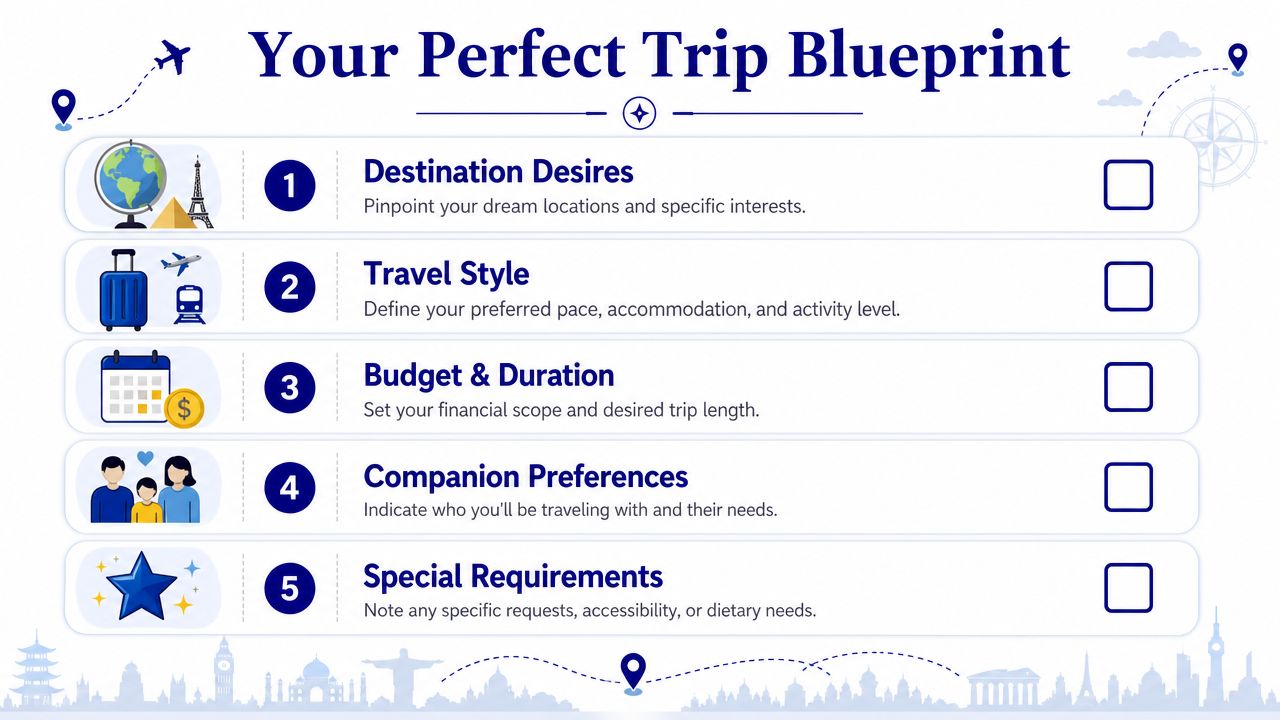
The questions that actually shape the trip
A strong preference blueprint covers more than destination and dates.
Why are you traveling? A deal roadshow, a family holiday, a milestone birthday, and a wellness retreat all require different pacing. A business traveler may want minimal downtime and workspace onboard. A leisure group may care more about arrival timing, rest stops, and scenery.
Who's actually on the passenger list? Passenger count alone doesn't tell you enough. Are there executives taking calls inflight? Young children who need shorter transfer windows? A pet? A grandparent with mobility limits? The manifest drives cabin layout, baggage planning, and airport choice.
How do you want the trip to feel? Some travelers want every hour defined. Others want only anchor points with room to improvise. That difference changes the entire itinerary. A tightly structured trip needs harder timing controls. A looser one needs better options, not more reservations.
What people often forget to mention
The missed details are usually the ones that matter most operationally.
If a traveler tells you they love food but doesn't mention a strict allergy, the itinerary is incomplete. If they say they want a beach destination but don't mention motion sensitivity, the boat day may be a bad fit.
I look for hidden constraints, not just visible preferences. That includes:
Dietary limits and catering expectations
This affects catering sourcing, timing, and airport handling.Loyalty memberships and hotel preferences
Not because points are everything, but because repeat brands often reveal service expectations.Schedule rigidity
Some travelers can shift by hours. Others can't shift by twenty minutes.Energy patterns
Families and executive teams often travel better with a slower first day than with an ambitious arrival schedule.
Why the live consultation matters
Forms collect data. Conversation validates it.
People often answer a questionnaire one way and describe their ideal trip another way when you speak to them. “Relaxed” may mean “one planned activity per day.” “Flexible” may mean “we want choices, but no dead time.” “Family-friendly” may mean “one child naps every afternoon and one teenager wants autonomy.”
That's why a call is so useful. It turns broad preferences into decisions.
For destination-specific activity planning, outside specialists can also sharpen the itinerary. If part of your trip includes Hawaii, for example, reviewing local operator guidance like Kona Snorkel Trips for Hawaii charters can help identify whether a private water excursion fits your group's pace and expectations before it gets dropped into the schedule.
Matching the Aircraft and Route to Your Mission
Aircraft selection is where many travelers assume the answer is simple: bigger jet, better trip. It doesn't work that way. The right aircraft is the one that fits the mission with the least waste and the fewest compromises.
A short regional hop for two passengers has a different ideal setup than a multi-stop family trip with golf bags, strollers, and a pet. So does a same-day executive run where cabin productivity matters more than sleeping comfort. The aircraft decision sits at the intersection of range, runway access, cabin use, baggage volume, and total trip cost.
This planning flow helps illustrate how the moving parts fit together.
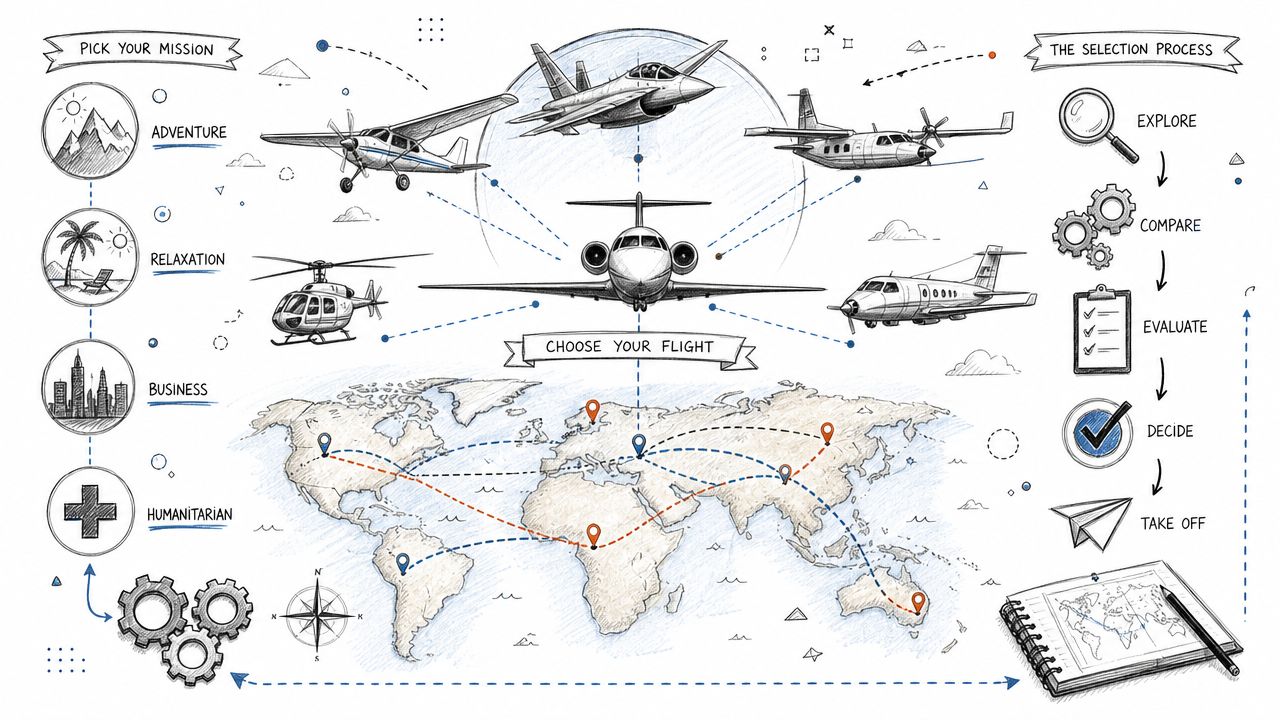
Aircraft fit is a mission question
Here's the practical lens I use.
| Mission factor | What it changes |
|---|---|
| Passenger count | Cabin size, seating layout, baggage assumptions |
| Distance | Whether the flight can go nonstop or needs a fuel stop |
| Airport access | Whether the aircraft can use a shorter runway or smaller field |
| Cabin purpose | Work, dining, family comfort, rest, privacy |
| Special cargo | Skis, golf clubs, medical gear, pet supplies, oversized bags |
A light jet may be ideal for a quick Florida-to-Caribbean trip when the group is small and baggage is manageable. A midsize or heavy jet makes more sense when you need longer range, more cabin room, or more luggage flexibility. The smartest recommendation is rarely the most expensive aircraft in the category. It's the one that prevents operational strain later.
The route is part of the product
Private aviation's biggest advantage often has less to do with the airplane than with the airport network. Major hubs are useful when they're useful, but they're not automatically the best choice. A smaller airport can cut hours from a day once you factor in ground transport, terminal flow, and post-arrival congestion.
That's why route planning has to consider the full door-to-door journey, not just airtime.
Take a simple example. If two airports serve the same region, but one places the traveler much closer to the resort, estate, marina, or meeting site, that may be the better arrival point even if the flight itself is similar. The same applies on departure. A more convenient origin airport can turn a stressful travel morning into a smooth one.
Choose the itinerary that minimizes total friction, not the one that looks most impressive on paper.
Questions clients often ask about aircraft choice
Should I always choose the largest jet I can afford?
Not usually. Bigger aircraft can add capability and comfort, but they can also create unnecessary cost if the mission doesn't need that capacity.
Is nonstop always the priority?
Not always. Nonstop can be valuable, but sometimes a different aircraft or route improves airport access, timing, or overall trip flow.
Can a smaller airport really make that much difference?
Yes. In private travel, the airport closest to your actual destination is often where the itinerary wins or loses.
Smart Strategies for Managing Private Jet Costs
Private aviation pricing becomes easier to manage when you stop treating it as one product. There are different booking models, and each works better for a different travel pattern. The mistake isn't paying for private travel. The mistake is using the wrong model for the mission.
One of the biggest shifts in trip planning is the use of AI to sort options faster. In 2024, approximately 40% of global travelers already use AI in trip planning, and over 60% are open to adopting it, according to this report on AI-driven travel personalization. In private aviation, that kind of technology can help operators surface route efficiencies and identify cost-saving opportunities such as Empty Legs.
Private travel models compared
| Model | Best For | Flexibility | Cost |
|---|---|---|---|
| On-demand charter | Travelers with changing schedules or occasional trips | High | Varies by route, aircraft, timing, and availability |
| Empty Leg flights | Travelers who can adapt to a pre-positioning route or timing | Low to moderate | Often the strongest value when the route aligns |
| Membership or package programs | Frequent flyers who want a more repeatable booking structure | Moderate to high | More predictable structure, but value depends on actual usage |
What works in the real world
On-demand charter is the cleanest fit when timing matters most. If you need to depart after a meeting, change the passenger list, or reposition around a vacation schedule, this model usually gives the most freedom.
Empty Legs work when flexibility runs in your favor. If your destination and timing can align with an existing repositioning segment, they can be a practical way to lower cost. But they aren't a dependable foundation for every trip. They're an opportunistic tool, not a universal plan.
Memberships and packages make sense for travelers with repeat patterns. The value is less about prestige and more about administrative simplicity, access terms, and budgeting comfort.
The trade-offs people should ask about
When clients compare options, these are the questions worth asking:
- What changes if my departure time moves? Some models absorb schedule shifts better than others.
- How predictable is availability? A low advertised cost means less if the model doesn't serve your route when needed.
- Am I paying for flexibility I won't use? Frequent travelers may benefit from structured programs. Occasional flyers often don't.
- Is this trip suitable for an Empty Leg, or am I forcing it? Good value disappears when the trip starts driving your life.
For budgeting context before you book, reviewing a transparent breakdown of private jet charter pricing helps frame what variables affect the quote. Air Trek, for example, offers on-demand charter, Empty Leg options, memberships, and travel packages, which is useful when a traveler wants to compare formats rather than force every trip into one pricing model.
Seamless Coordination From Door to Destination
The itinerary feels effortless only when the coordination is disciplined. That includes the pickup window at origin, the drive time to the airport, ramp access, baggage flow, onboard setup, arrival transport, hotel timing, and the fallback plan if the day shifts.
Personalized travel itineraries transition from preference matching to operations. A family can love the same destination and still need a very different schedule from a corporate team. The same is true inside one group. Multigenerational trips are the clearest example. They look simple at first and become complicated the moment you account for pacing, accessibility, privacy, and energy levels.
Industry guidance on multigenerational travel points to the same conclusion: the better itinerary often uses fewer transitions, shorter travel days, and built-in downtime, not more activity stacking, as discussed in this review of multigenerational trip planning realities.
This flow shows what coordinated execution looks like in practice.
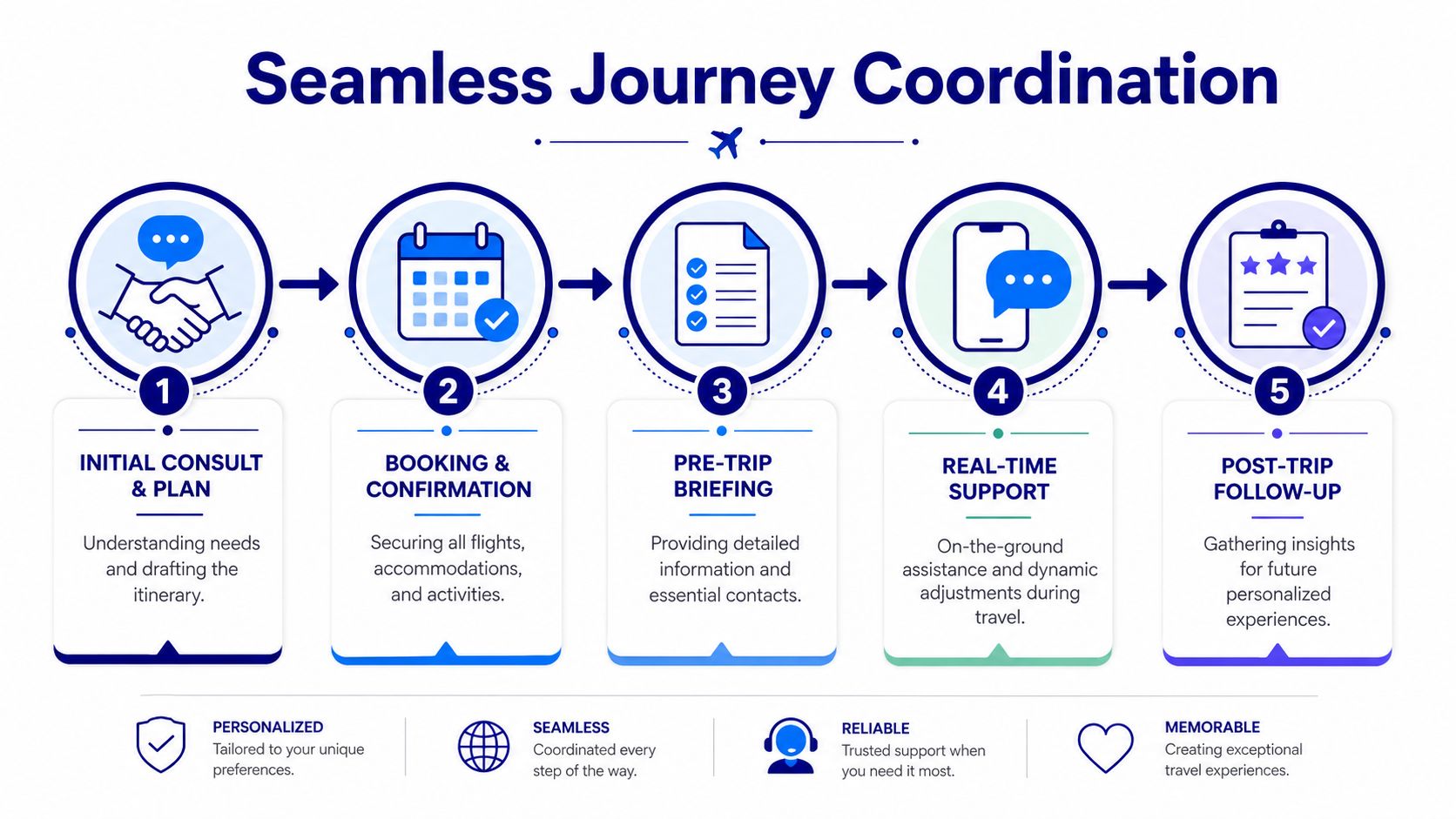
A sample multigenerational private trip
Consider a three-generation group flying from Florida to the Caribbean. The passengers include grandparents, parents, two children, and a nanny. One grandparent walks slowly, one child needs a midday rest, and the parents want the first evening protected from travel fatigue.
A weak itinerary would try to maximize every hour. Early departure, rushed airport arrival, immediate villa transfer, afternoon excursion, dinner reservation off-property.
A better itinerary looks different:
- Late-morning departure so the children aren't starting the day exhausted
- Closest practical departure airport to reduce pre-flight driving
- Aircraft selected for baggage and cabin comfort, not status optics
- Arrival transfer split intelligently, with accessible vehicle placement and minimal waiting
- First day left intentionally light, with villa dining and no forced excursion
- Activity design based on optionality, where the boat day and island tour aren't locked into back-to-back slots
That's a smoother trip because the plan respects the group's weakest links instead of pretending everyone moves the same way.
Coordination points that decide whether the trip feels polished
The details that matter most are usually invisible when they work well.
| Coordination area | What good planning looks like |
|---|---|
| Ground transport | Pickup windows tied to actual departure flow, not guesswork |
| Luggage handling | Counts, oversized items, and special equipment confirmed in advance |
| Catering | Timed to departure and aligned with dietary restrictions |
| Arrival support | Vehicles, driver contacts, and destination timing confirmed |
| Airport experience | Clear use of the private jet FBO process so passengers know exactly where to go and what to expect |
The best trips don't feel busy. They feel well-timed.
What happens when plans change
A weather delay, a tired child, or a guest who wakes up wanting rest instead of activity doesn't mean the itinerary failed. It means the itinerary needs room to adapt. Strong planning builds alternatives before departure, not after stress starts.
That might mean a beach club is ranked above a museum on the same day because outdoor conditions are favorable. It might mean an optional second stop is dropped to preserve energy. It might mean holding a dinner reservation loosely and protecting the transfer home.
Your Pre-Flight Booking and Itinerary Checklist
By the time you're ready to book, the hard part isn't choosing whether to fly private. It's confirming that the itinerary reflects reality. Most trip problems come from assumptions made too late. Someone added a passenger. The bags are larger than expected. The pet carrier wasn't discussed. The arrival transfer was booked against a rough ETA instead of the actual flight plan.
A final checklist keeps those mistakes from becoming expensive.
The confirmation list worth using every time
Passenger manifest is final
Names, ages where relevant, pets, and any mobility considerations should be confirmed before the trip is locked.Baggage is described accurately
Don't estimate. Confirm quantity, size, and unusual items such as golf clubs, skis, strollers, medical equipment, or pet gear.Ground transport is matched to the real schedule
Verify both ends. Departure pickup, arrival vehicle type, driver details, and destination address all need to be aligned.Special requests are documented, not assumed
Catering, child seats, pet handling, accessibility support, and privacy preferences should appear in writing.Payment and cancellation terms are clear
This is where avoidable misunderstandings happen. Make sure someone on your side has reviewed the actual terms, not just the quote summary.
Build the fallback plan before takeoff
A personalized itinerary should include decision rules, fallback options, and a priority ranking of experiences, because plans with built-in contingency are more resilient when weather or schedules change, as explained in this article on adaptive custom travel planning.
That principle is easy to apply. Ask these questions before departure:
- If weather changes, what activity drops first?
- If the outbound slips, which reservation matters most?
- What part of the day is fixed, and what part is flexible?
- Who makes the adjustment call during travel?
For travelers booking their first private charter, this step-by-step guide to how to book a private jet is a practical reference for the booking side of the process.
The best personalized travel itineraries don't just reflect taste. They reflect judgment. They match the aircraft to the mission, protect the traveler's time, coordinate the handoffs, and leave room for reality. That's what turns a private flight into a smooth journey instead of just an expensive seat.
If you're planning a private charter and want the itinerary to work door to door, start with the operational questions first. The destination is only one line item. The schedule, routing, airport choice, ground coordination, and contingency plan are what make the trip feel effortless.