
Orlando trips often start with friction. You’re juggling meeting times, resort check-in, ground transportation, luggage, kids, or a pet, and the flight itself is only one piece of the day. For most first-time private flyers, that’s a significant shift. A charter isn’t only about a quieter cabin. It’s about controlling the whole travel chain from driveway to final destination.
That matters in Orlando more than in many cities. Some travelers need to get downtown quickly. Others want the shortest drive to a resort area. Business teams may care more about a fast turn and a clean handoff to a car service than anything that happens in the air. Families usually care about the opposite of airport chaos. They want the day to feel manageable.
A well-planned private jet to orlando florida trip works because each part is customized together. Airport choice, aircraft category, bags, pets, arrival timing, and ground transfers all affect whether the day feels easy or expensive. The flight is the center of the plan, but it’s not the whole plan.
Your Seamless Journey to Orlando Starts Here
The usual Orlando travel day is familiar. You leave earlier than you want to. You build in extra time for terminal traffic. You stand in a long line with everyone else traveling to the same conventions, resorts, and school-break destinations. If anything slips, the whole day slips with it.
Private flying changes that experience immediately.
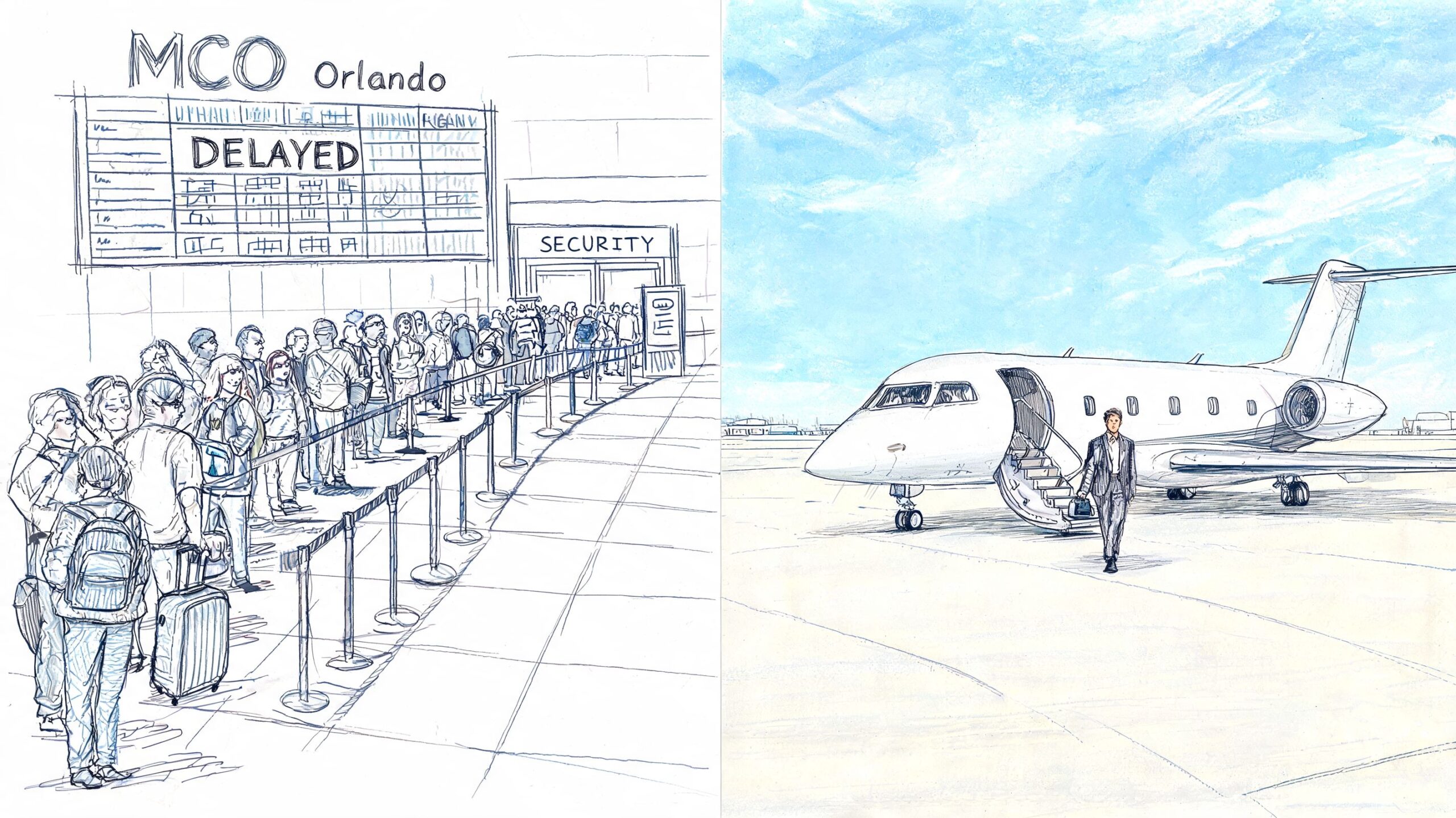
Instead of planning around the airport, you plan around your schedule. Instead of adapting your family or team to a rigid airline timetable, the trip is built around your departure window, your passenger list, your baggage, and your arrival priorities. That’s why people who fly private to Orlando often keep doing it. The reduction in stress is practical, not abstract.
What a smoother Orlando trip actually looks like
A family charter looks different from a corporate charter, but the same principle applies. The day is simpler when the moving parts are coordinated together:
- Departure timing fits the day so you’re not leaving hours early just to absorb commercial delays.
- Ground transfers match the arrival airport so you don’t lose time after landing.
- Baggage planning happens before the flight instead of at the curb.
- Special needs are handled upfront whether that means pet travel, catering preferences, or a meeting-ready cabin.
Private aviation works best when you treat it as a logistics tool, not just a seat upgrade.
Orlando is especially suited to this approach because private travelers have multiple gateway options and a wide mix of aircraft that fit very different trip profiles. A short Florida hop, a Northeast family vacation, and a coast-to-coast executive trip shouldn’t be built the same way.
What first-time clients usually want to know
The first questions are usually practical:
- Which Orlando airport should I use?
- What kind of aircraft is enough, without overbooking cabin size?
- What does a charter quote include?
- How early do I need to arrive?
- Can my dog fly in the cabin?
- What happens after we land?
Those are the right questions. They’re also where experienced trip planning matters most, because the wrong airport or aircraft can create unnecessary cost, drive time, or friction even when the flight itself is fine.
Choosing Your Orlando Gateway Airport
A good Orlando charter plan starts with the drive after landing.
For a family headed to a resort, the wrong airport can add an hour of car time, tired kids, and a rough start to the trip. For a business traveler with a meeting downtown, it can mean sitting in traffic after paying for a fast airplane. Airport choice is not a minor detail. It sets the pace for the whole day.
Orlando gives private flyers more flexibility than many first-time clients expect. As evoJets notes in its Orlando International Airport guide, the area supports a wide network of airports, and MCO’s 12,005-foot runway can handle all aircraft sizes, including nonstop transcontinental missions. That range of options is useful if you plan the trip around your final stop instead of defaulting to the biggest airport.
When MCO makes the most sense
MCO is usually the right call for larger jets, longer nonstop routes, and itineraries that need maximum operating margin. If the trip is coming from the West Coast, if the passenger count is high, or if baggage volume is heavy, MCO often keeps the plan simple.
The trade-off is on the ground. MCO is a busy commercial airport, so the air side may work well while the curbside and transfer piece takes more coordination. That does not make it a poor choice. It means the car service, pickup point, and timing should be planned with care, especially for families traveling with strollers, car seats, or a lot of luggage.
Why ORL often works better for downtown meetings
Orlando Executive Airport is usually the cleaner option for travelers whose day ends in downtown Orlando. The airport is close to the city core, and that shorter transfer can matter more than runway length if the mission is a quick in-and-out business trip.
I usually tell clients to judge ORL by calendar pressure. If the goal is to get from aircraft door to office, hotel, or event venue with as little friction as possible, ORL often wins. It can also suit leisure travelers staying near downtown rather than in the resort corridor.
Pick the airport based on where you need to be 45 minutes after landing.
Smaller airports can save the day for resort and residential trips
Kissimmee Gateway, Sanford, and other nearby fields can make more sense when the destination is a resort, private home, golf community, or meeting point outside central Orlando. In those cases, shaving time off the ground transfer often matters more than arriving at the airport name everyone recognizes.
There is a trade-off. Smaller airports do not fit every aircraft or every route. Runway limits, operating hours, and support services can narrow the choices quickly, which is why airport and aircraft planning should happen together.
If you are weighing options by destination area, not just by airport code, Air Trek’s Orlando private charter destination page is a useful starting point.
A practical way to choose
| Airport choice | Best fit | Main trade-off |
|---|---|---|
| MCO | Larger jets, long nonstop routes, higher baggage loads, broad operating flexibility | More activity on the ground and more transfer coordination |
| ORL | Downtown business meetings, city hotels, shorter ground transfers to the urban core | Aircraft and runway limits matter sooner |
| ISM or other smaller fields | Resort stays, residential arrivals, easier access outside the main commercial flow | Not every aircraft or itinerary will fit |
What usually works best
- Choose the airport based on the final address
- Use MCO for larger aircraft and longer-range missions
- Use ORL when downtown access is the priority
- Ask about smaller fields if the trip ends at a resort, home, or outlying venue
- Confirm the car service plan before the flight, not after landing
What causes problems is simple. Picking the airport by name recognition, then trying to force the rest of the trip around it. Orlando rewards a door-to-destination approach. Done well, the flight feels easy because the arrival works just as well as the departure.
Selecting the Right Aircraft for Your Trip
Aircraft selection gets easier when you stop thinking in labels and start thinking in use cases. You’re not choosing between impressive names. You’re choosing between trip profiles.
For short Florida hops
For routes like Miami to Orlando, a turboprop is often the smartest answer. BlackJet’s Miami to Orlando charter guide notes that turboprops such as the Beechcraft King Air 350i can complete the trip in about 50 minutes and use up to 30 to 40 percent less fuel than light jets. On a short-haul mission, that efficiency matters.
That doesn’t mean a turboprop is the answer for every traveler. It means you shouldn’t pay for speed or cabin category you won’t really use on a short route.
A simple way to choose
Start with these questions:
How many people are flying?
Not “how many could fly.” Actual count matters because extra cabin size changes price quickly.What kind of baggage are you bringing?
Golf clubs, strollers, event materials, and longer-stay luggage can push the aircraft choice as much as passenger count does.Is this trip mainly regional, medium-range, or coast-to-coast?
The answer usually narrows the options fast.
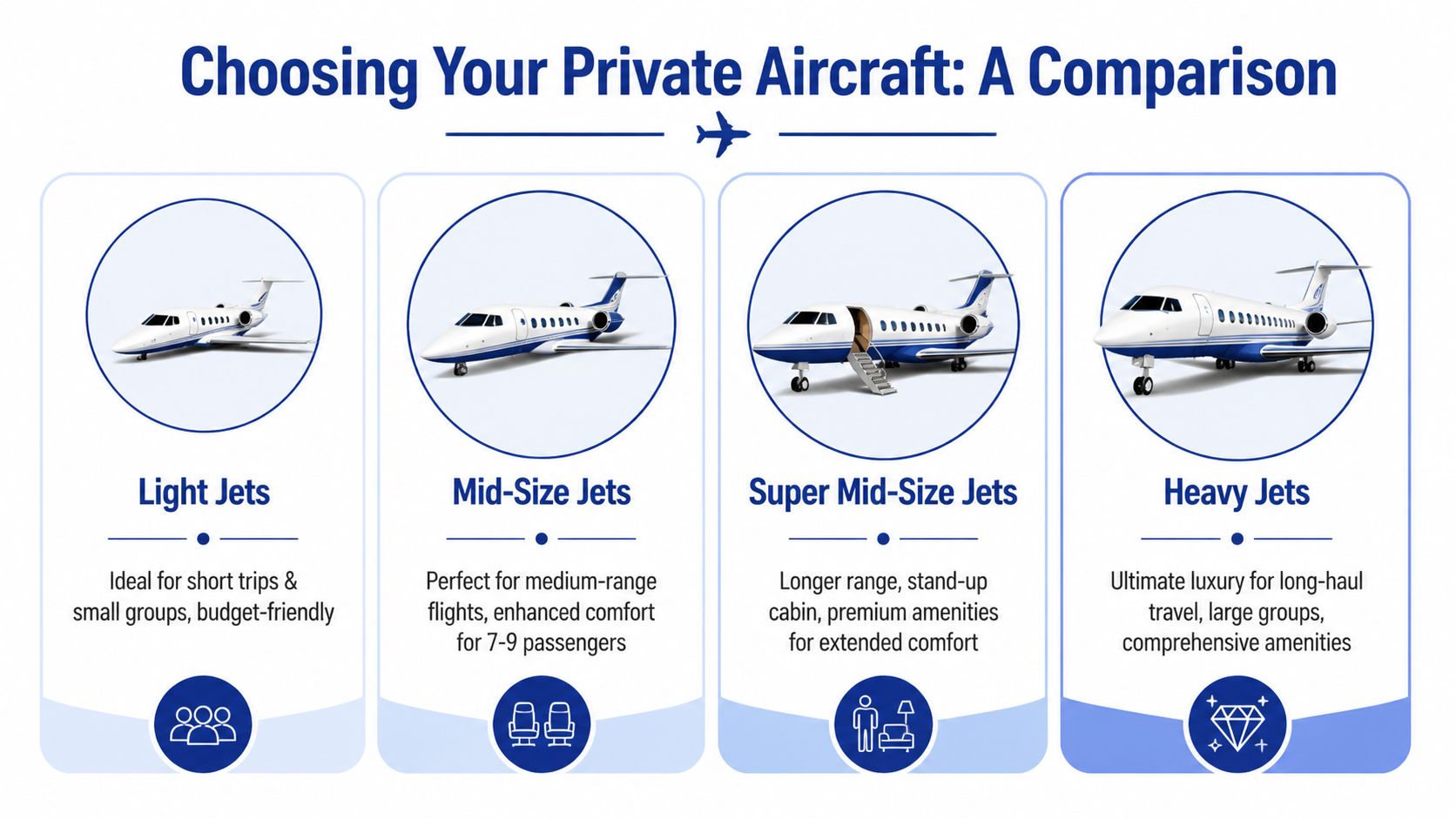
Aircraft categories in plain terms
Turboprops
Best for shorter Florida and regional segments. They’re cost-conscious, practical, and often ideal when runway flexibility matters.Light jets
A strong fit for smaller groups that want jet speed on shorter to medium-range trips.Midsize jets
Usually the sweet spot for family vacations and many business charters. You get better cabin comfort without moving into a heavy-jet budget.Super midsize and heavy jets
Better for longer missions, larger groups, and travelers who need range, baggage capacity, and cabin presence.
What usually fits each Orlando traveler
| Traveler type | Usually a strong fit | Why |
|---|---|---|
| Couple or small group on a short Florida route | Turboprop or light jet | Efficient and easier to justify on short sectors |
| Family vacation | Midsize jet | More room for people and bags |
| Executive team flying longer range | Super midsize or heavy jet | Better for comfort, meetings, and nonstop reach |
If you want to compare available aircraft categories before requesting a trip option, Air Trek’s fleet page gives a helpful overview.
Don’t book the largest cabin you can afford if the mission doesn’t need it. Book the aircraft that matches the route, bags, and people on board.
Understanding Private Jet Charter Costs to Orlando
A family leaving Teterboro for a week at Disney and an executive team flying in for a Lake Nona meeting may both ask for a private jet to Orlando. Their quotes can look very different, even if the passenger count is similar. The reason is simple. Private charter pricing is built around the full mission, not just the miles in the air.
For Orlando trips, four variables usually drive the number: aircraft category, total flight time, airport choice, and any operating details that make the itinerary more demanding. A later-evening arrival, extra waiting time on the ground, or a repositioning leg can matter as much as the cabin size.
What baseline pricing really means
You will often see broad hourly ranges by aircraft type. That can be useful for rough budgeting, but it does not tell you what your Orlando trip will cost. A short hop from South Florida, a same-day out-and-back from Atlanta, and a one-way from the Northeast are priced differently because the aircraft has to be sourced, routed, and scheduled around your day.
That is why I tell first-time clients to treat hourly rates as a starting reference, not a decision tool. The more useful question is: what does this trip require from curbside departure to Orlando arrival?
What you’re paying for
A quote usually includes several moving parts working together:
- Aircraft category and operating cost
- Flight time and total duty time for the trip
- Airport fees, handling, and parking
- Positioning if the aircraft is coming from another airport
- Schedule demands such as late-night operations, holiday periods, or extended waits
- Trip add-ons such as catering, pet handling, or extra ground coordination
When selecting features, clients sometimes overspend. A larger cabin can be the right call for baggage, comfort, or range, but it should solve a real trip need. If it does not, you are paying more without improving the day in a meaningful way.
A practical cost table
| Trip factor | Lower-cost side | Higher-cost side |
|---|---|---|
| Aircraft | Turboprop, light jet | Super midsize, heavy jet |
| Route | Short regional mission | Longer nonstop mission |
| Airport choice | Airport with straightforward access and lower operating friction | Airport with higher fees or more congestion |
| Schedule | Flexible departure and return times | Fixed timing, peak periods, or long wait time |
Where Orlando travelers can control cost
Airport choice matters more than many first-time charter clients expect. If your final stop is a resort area, convention site, or a meeting near Winter Park or Lake Nona, the right airport can cut both ground time and operating friction. That can improve the day and, in some cases, keep costs from drifting upward.
Roundtrip planning also matters. A one-way trip may involve repositioning. A same-day return can trigger crew and scheduling constraints. An overnight stay may add parking and crew expenses. None of that is a problem if it matches your priorities. It just needs to be priced transparently from the start.
Empty legs can offer strong value, especially for one-way Orlando leisure trips with flexible timing. They are less useful for travelers who need a precise departure time, a specific airport, or a guaranteed aircraft category.
If you want a plain-English breakdown of what changes a quote from reasonable to expensive, Air Trek’s guide on what changes the price of chartering a private jet in Florida is a helpful reference before you request options.
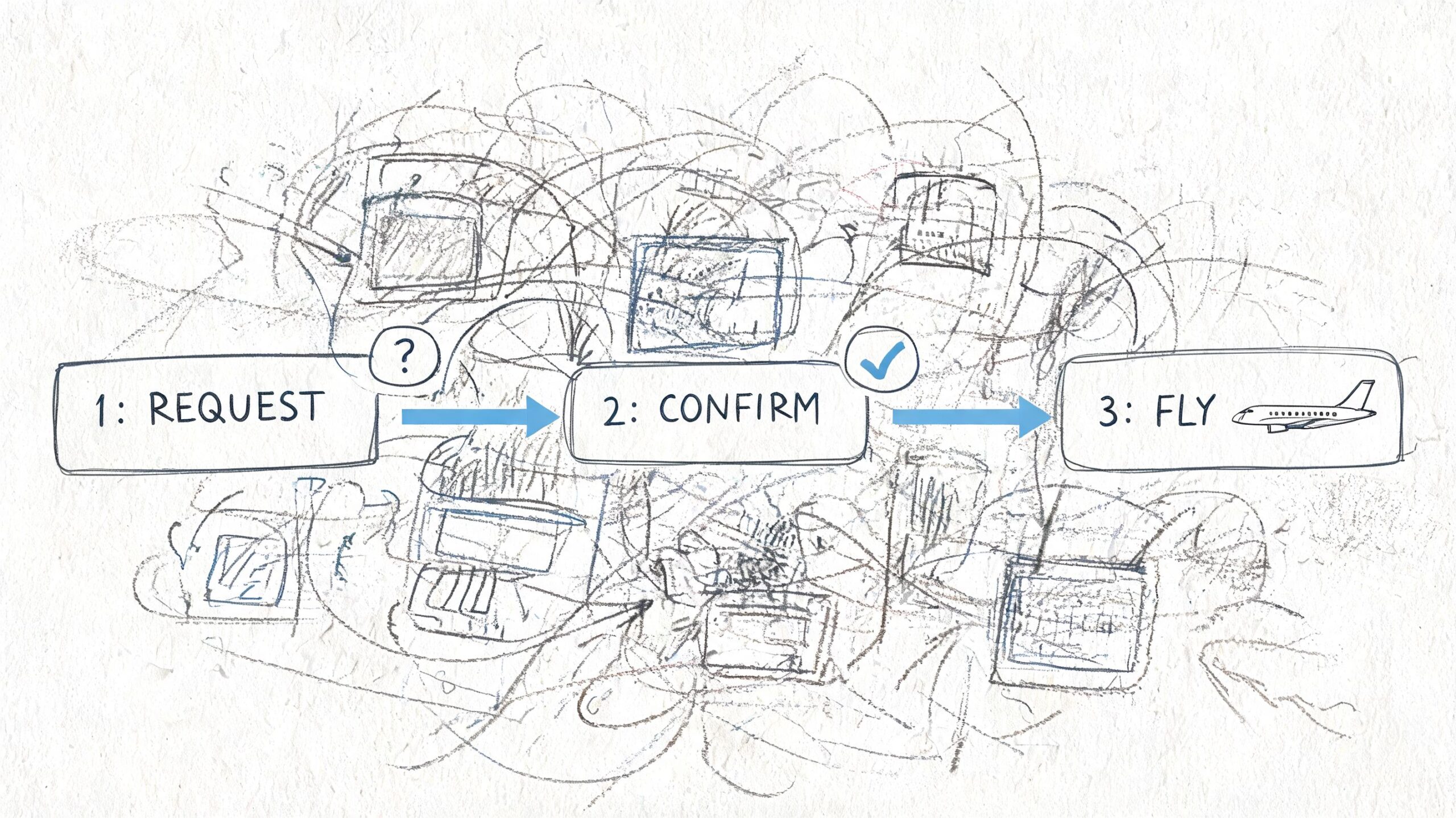
The Step-by-Step Booking and Travel Process
The booking process is much simpler than first-time clients expect. The key is providing clear trip details early, especially if your Orlando day includes ground transfers, pets, or a firm arrival window.
Step one is itinerary, not aircraft
Start with the actual mission:
- departure city
- preferred departure time
- number of travelers
- baggage profile
- Orlando destination area
- pet or family requirements
- whether the trip is one-way or roundtrip
That lets the charter team match airport and aircraft choices to the full day, not just the flight segment.
Then review the quote carefully
A useful quote should be easy to read. You want to know what aircraft is being proposed, which airports are involved, what timing assumptions were used, and whether any trip-specific costs are tied to schedule or routing.
This is also where first-time travelers should ask operational questions, such as:
- Where exactly do we arrive on departure day?
- How early should we get there?
- Can the itinerary move if our meeting runs late?
- What’s the luggage plan?
- How does pet boarding work at the terminal?
Day-of-travel is where private aviation feels different
You won’t use the main terminal. You’ll use an FBO, short for Fixed-Base Operator. That’s the private terminal where you check in, wait briefly, and walk directly to the aircraft.
Most private departures feel calm because the handoff is short. Car arrives, bags are handled, ID is checked, and boarding happens without the commercial-terminal routine. That’s the point where many first-time clients realize the value isn’t luxury branding. It’s friction removal.
A quick visual helps if you’ve never flown private before:
What makes Orlando planning easier
The easiest Orlando trips are the ones where someone has already thought through the final handoff. If you’re landing with kids, a pet, or event materials, the right question isn’t only “When do we land?” It’s “What happens in the first 30 minutes after landing?”
Good charter planning ends at the hotel, office, resort, or home. It doesn’t end at the wheels-down time.
Tips for Families Pets and Corporate Travelers
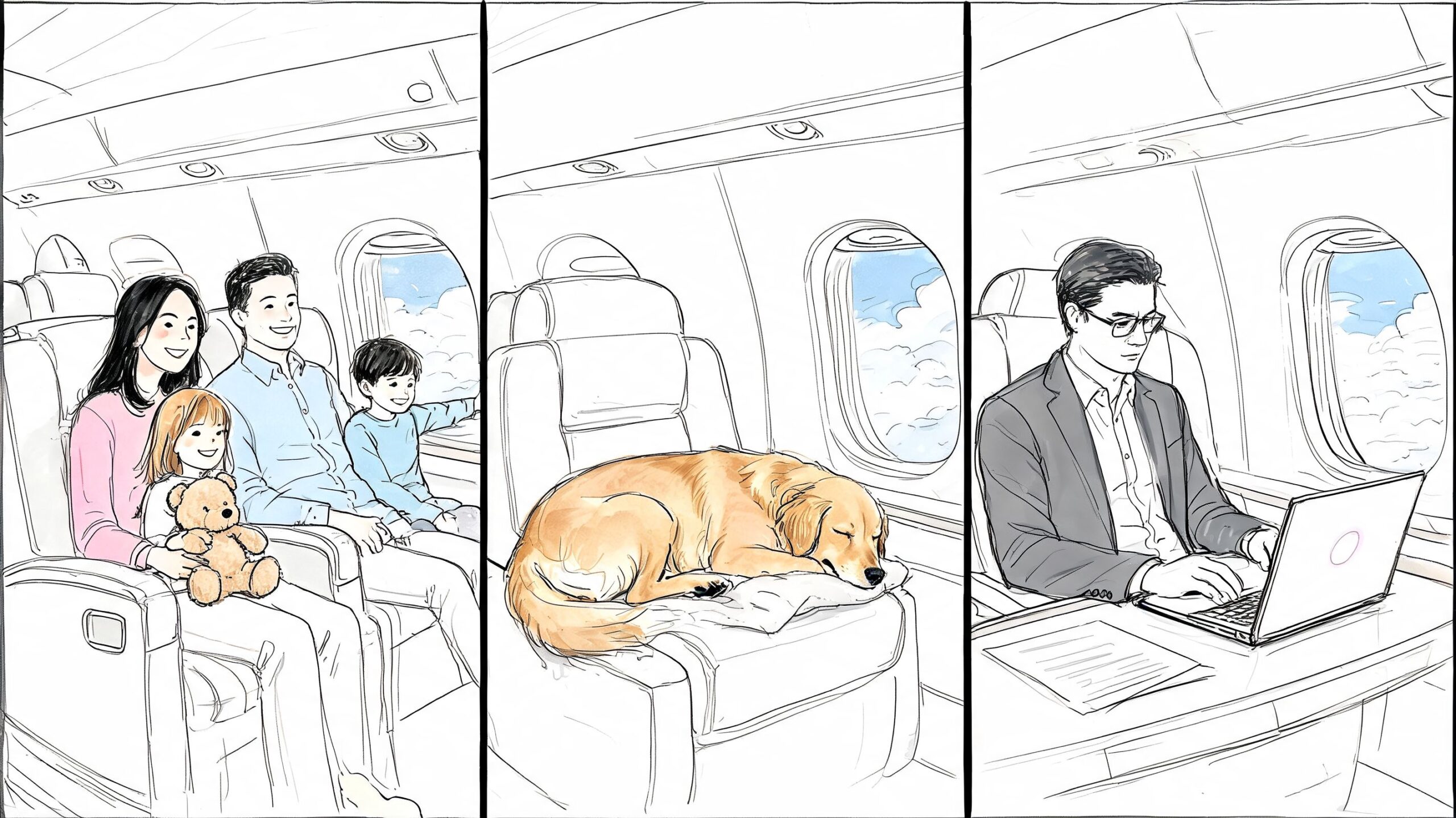
Different travelers need different kinds of efficiency. The mistake is assuming everyone wants the same private aviation experience.
Families
Families usually benefit most from reduced disruption. You can leave on a schedule that fits nap times, school breaks, or villa check-in. You also avoid the parts of commercial travel that are hardest with children, especially long lines, gate changes, and rigid baggage handling.
What tends to work best:
- Morning departures
- Realistic baggage planning
- Choosing the airport that shortens the final car ride
- Bringing the items children already rely on instead of trimming everything down to airline rules
Pet owners
Pet travel is one of the clearest practical advantages of flying private. Orlando Jet Charter notes that pets can travel in the cabin with their family, avoiding the stress of cargo holds, and adds that the global pet travel market has grown 15 percent year over year.
That said, smooth pet travel still takes planning. You’ll want to confirm documentation requirements, feeding timing, leash or carrier expectations, and arrival arrangements before departure. For owners working through pre-trip stress with their animals, Global Pet Sitter’s advice for owners is a practical read.
Corporate travelers
Corporate charters to Orlando work best when the flight supports the business day rather than interrupting it. That usually means choosing the airport based on meeting location, selecting a cabin that allows conversation or quiet work, and leaving enough flexibility in the schedule for a same-day return if needed.
A corporate team should think about these trade-offs:
- Cabin size versus cost if the flight is short
- Downtown access versus runway flexibility
- Meeting privacy in the air
- How much ground coordination is needed after landing
For this kind of trip, Air Trek is one option in the market. The company offers on-demand charter, Empty Leg flights, memberships, and pet-friendly planning across Florida and the Western Hemisphere.
Frequently Asked Questions About Orlando Jet Charters
What is an FBO?
An FBO is the private terminal used for charter departures and arrivals. Instead of moving through the main commercial terminal, you arrive at the FBO, check in there, and board directly from that facility.
How much flexibility do I have if plans change?
More than you’d have on a commercial airline, but flexibility still depends on aircraft scheduling, crew legality, airport conditions, and routing. If your Orlando trip has a moving target, say that upfront. It’s easier to build in flexibility than to force it later.
How should I think about luggage capacity?
Think about luggage before you choose the aircraft, not after. Passenger count alone doesn’t tell the whole story. Families headed to Orlando for a longer stay, or teams carrying presentation materials, often need more baggage room than they expected.
Is Orlando a strong private aviation market?
Yes. BlackJet’s Florida market report states that Florida saw the nation’s largest private flight increase in 2025, with a surge of 21,448 flights, and that private aviation activity was 32.1 percent above pre-pandemic levels as of mid-2024. For travelers, that means strong demand, broad aircraft activity, and good reasons to book thoughtfully during busy periods.
Why do first-time flyers choose a private jet to Orlando Florida?
Because the value is broader than the flight itself. A private jet to Orlando Florida gives you control over timing, airport choice, cabin setup, pet travel, and the handoff to your final destination. For families, that means less stress. For business travelers, it means less wasted time. For both, it usually means a travel day that feels organized from start to finish.
If you’re planning a private jet to Orlando Florida, start with the full itinerary, not just the route. The best trips are built backward from your final stop, your real schedule, and what needs to happen the moment you land.