
You're usually not searching for how to book private jet because you woke up wanting luxury for its own sake. You're searching because the commercial option has already failed your trip on paper.
A connection turns a same-day meeting into an overnight stay. A family itinerary across Florida, the Caribbean, or Central America starts looking fragile the moment one leg slips. A team carrying presentation materials, golf bags, medical equipment, or too many moving parts realizes that “just take the airline” often means giving up control at the worst possible moment.
That's where private charter makes sense. Not as a symbol, but as a planning tool. When the route is awkward, the timing is tight, or the passenger needs are specific, charter gives you control over schedule, airport choice, cabin setup, and pace. It also gives you responsibility. The booking process is simple when the mission is clear, and expensive or frustrating when it isn't.
The Modern Way to Fly Private
Commercial aviation asks you to fit into its system. Private aviation lets the trip fit the mission.
That shift matters more now than it did a decade ago. The old model was simple but limited. If you wanted regular private access, you often had to think in terms of aircraft ownership or a long-term commitment. Today, the market is far more flexible. The American private jet charter market was valued at $28.9 billion in 2025, and fractional ownership departures in North America surged 75.5% from 2019 levels. At the same time, 73% of flights book to depart within a week, which tells you how much modern booking behavior now favors flexibility and short lead times, according to private aviation trends and statistics.

That's why first-time clients shouldn't think of private flying as one thing. It isn't. You can charter one trip, buy into a membership structure, or use discounted repositioning inventory when it fits. Some travelers also look at curated access programs such as exclusive aviation membership for C-suite executives when they want private travel wrapped into a broader lifestyle or executive service model.
When private charter solves a real problem
Private aviation works especially well when you need to:
- Protect time: Skip long terminal processes and fly closer to the final destination.
- Handle unusual itineraries: Multi-stop business travel and cross-border trips don't always line up neatly with airline schedules.
- Travel with specific needs: Pets, children, executives, security staff, or specialized baggage all change the equation.
- Make late decisions: Charter can support short-notice departures in a way commercial airlines often can't.
Private aviation is most useful when the trip has friction. Tight timing, difficult routing, or high-value passengers usually matter more than glamour.
Defining Your Mission Before You Request a Quote
Most bad charter quotes start with incomplete information. If you want a useful price and the right aircraft options, you need a proper trip brief before you contact anyone.
Start with the mission, not the airplane. A multi-city executive roadshow through Florida and Canada has different priorities than a family trip from Naples to Costa Rica. One may value fast turns, reliable Wi-Fi, and cabin workspace. The other may care more about luggage volume, pet handling, and arrival airport convenience.
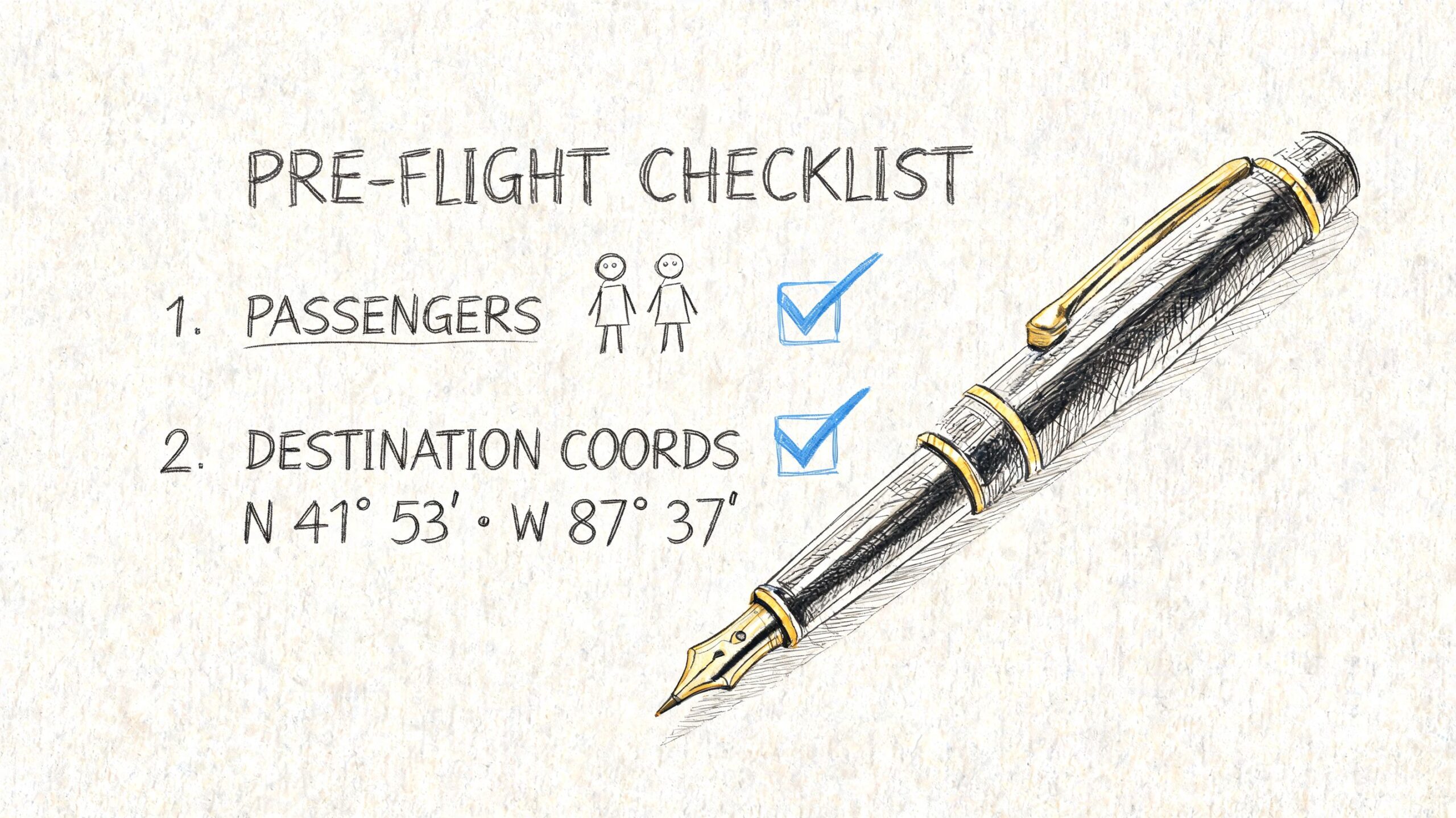
Build your trip brief first
Before you request a quote, answer these questions in writing:
- Who is traveling: Give the exact passenger count, not an estimate. A quote for six people can change if the final count is eight.
- Where are you really going: List preferred departure airport, destination airport, and any alternate airports you'd accept.
- When do you need to move: Include ideal departure time, earliest acceptable departure, and latest acceptable arrival.
- Is it one-way or round-trip: Round-trip planning affects aircraft positioning and crew planning.
- What are you bringing: Count golf clubs, skis, garment bags, pet carriers, trade show materials, or bulky cases separately from standard luggage.
- Are there passenger-specific needs: Tell the operator about children, elderly travelers, pets, dietary restrictions, mobility concerns, or security requirements early.
A vague request gets a vague answer. “Need a jet from South Florida to the Caribbean next week” forces the broker or operator to guess. Guesses create revisions, and revisions cost time.
The details that quietly change the aircraft
A lot of first-time clients focus on cabin photos. In practice, range, runway performance, baggage shape, and passenger comfort over the actual stage length matter more.
A light jet may look perfect on paper until the passenger count rises, the luggage list expands, or the route requires different performance. The reverse happens too. Some clients ask for a larger jet than they need because they assume bigger is safer or more comfortable. Often, it's more expensive and less efficient for the mission.
Practical rule: Describe the trip honestly. Don't minimize baggage, and don't pad the passenger count “just in case.” Accuracy saves more money than aggressive shopping.
This walkthrough gives a good visual overview of what first-time charter clients should think through before booking:
Questions clients often forget to ask themselves
These are the questions that usually surface late, after a quote is already out:
Do we need the aircraft to wait?
Same-day return, event standby, and overnight crew positioning affect cost and scheduling.Is the destination airport the best one?
The closest major airport isn't always the most convenient private airport.Will anyone need ground transportation arranged?
A clean handoff from aircraft to car matters more on executive itineraries than many first-time travelers expect.Is there a return plan if the schedule shifts?
This becomes especially important when the outbound is tied to an event, weather-sensitive destination, or empty leg opportunity.
Comparing Your Private Jet Booking Options
Not every private flight should be booked the same way. The right model depends on how often you fly, how fixed your routes are, and how much flexibility you need.
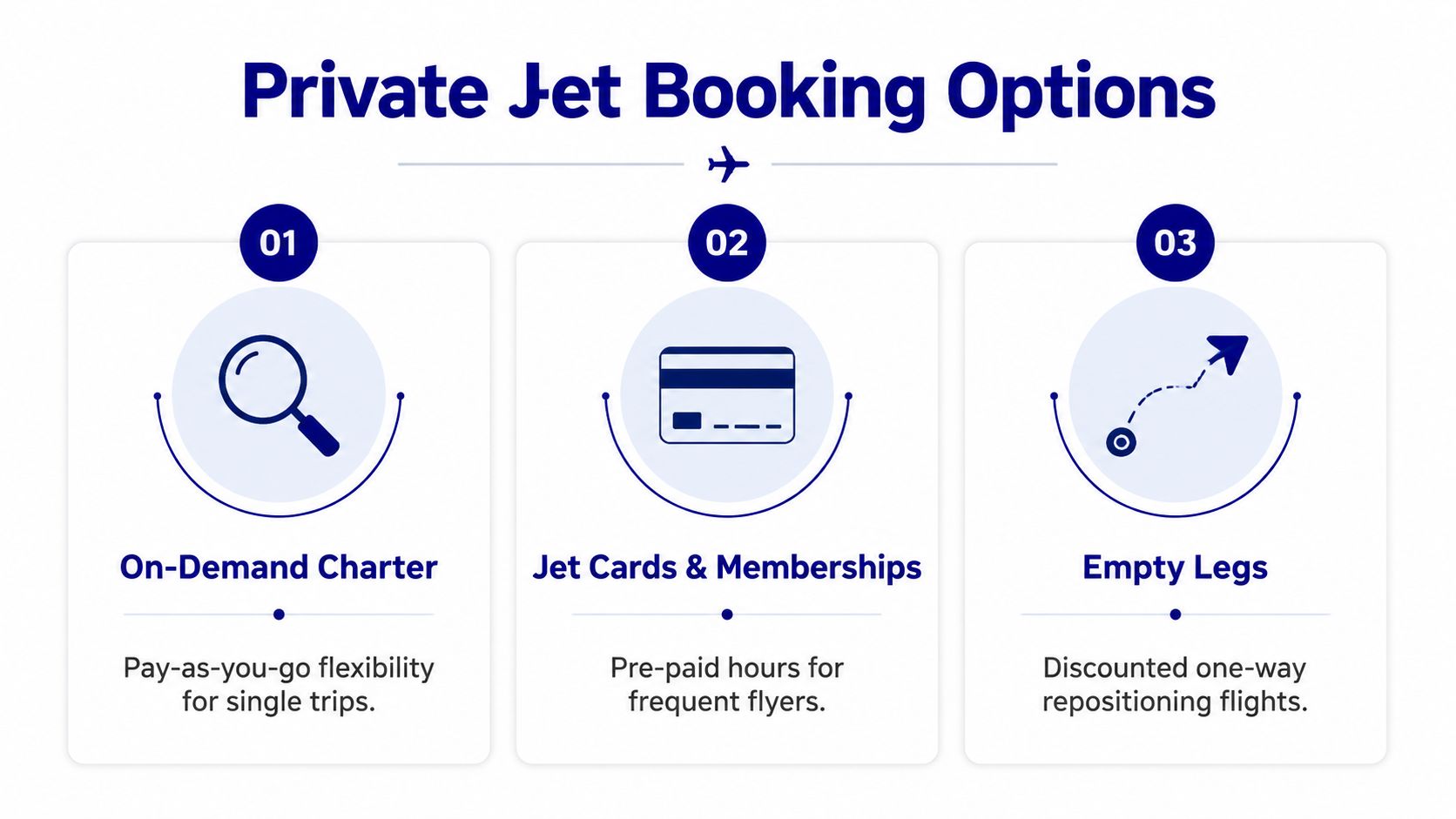
Some clients only need one aircraft for one trip. Others travel enough that a membership structure starts to make operational sense. Then there are empty legs, which can be smart in the right situation and a headache in the wrong one.
Private Jet Booking Models Compared
| Booking Model | Best For | Cost Structure | Flexibility |
|---|---|---|---|
| On-Demand Charter | One-off trips, varied itineraries, travelers who want aircraft matched to each mission | Pay per trip | High |
| Jet Cards & Memberships | Frequent flyers with repeat travel patterns who want a more standardized process | Prepaid or program-based access | Moderate to high, depending on program terms |
| Empty Legs | Flexible travelers chasing one-way value and willing to accept schedule risk | Discounted repositioning inventory | Low |
On-demand charter
This is the cleanest option for most first-time clients. You request a trip, the broker or operator sources aircraft that fit it, and you choose based on the quote, schedule, and terms.
It works well when every trip is different. A corporate travel manager moving executives between Miami, Bogotá, and Toronto won't always benefit from a fixed-hour product. On-demand charter lets each itinerary stand on its own.
If you want to see how this model can apply when schedules or destinations are less conventional, Air Trek also publishes information on public charters and flight options, which can help clarify where nonstandard routing fits into the broader private aviation industry.
Jet cards and memberships
These programs make sense for travelers who fly often enough to value process consistency over pure trip-by-trip flexibility. They can reduce friction because the pricing method and booking pathway are usually more standardized than ad hoc charter.
They are not automatically cheaper. They're often better for buyers who want predictability, not necessarily lowest trip cost. Read the usage terms closely, especially around service areas, peak days, aircraft category access, and upgrade or downgrade policies.
If your routes vary widely across the Americas, a membership can simplify booking, but it won't remove the need to think carefully about aircraft suitability on each trip.
Empty legs
These are repositioning flights. The aircraft was already going to move, and the operator is trying to fill that segment.
The attraction is obvious. The trade-off is just as real. The route is fixed, the timing is less forgiving, and the trip depends on another charter's operational reality. Empty legs are best for travelers who can adapt, not travelers who need certainty.
Which option usually works best
A simple rule helps:
- Choose on-demand charter if your trips change often.
- Choose a jet card or membership if you fly regularly and want a repeatable system.
- Choose empty legs only if schedule flexibility is genuine, not aspirational.
A lot of frustration comes from buying one model while expecting the behavior of another. Empty legs are not custom charter. Memberships are not unlimited access. On-demand charter is not always the cheapest per hour. Match the product to the mission.
How to Vet Operators and Analyze Quotes
A polished quote doesn't tell you much by itself. What matters is who is operating the aircraft, what exactly is included, and whether the trip has been built around your real requirements.
The first discipline is simple. Ask direct questions and expect direct answers. If the operator or broker gets slippery when you ask about the aircraft, crew, or substitution terms, stop there.
What to ask before you compare price
Start with safety and operational clarity:
- Who is the actual operator of record: Don't assume the company sending the quote is the one flying the aircraft.
- What safety credentials do they hold: Ask about recognized third-party safety programs such as ARGUS, Wyvern, or IS-BAO.
- What substitution language is in the agreement: Aircraft swaps can happen, but the process should be clearly defined.
- Has this operator handled this route profile before: Cross-border itineraries, island airports, and multi-leg trips require experience, not just availability.
- Who will manage day-of-trip communication: You want one accountable contact, not a relay between sales, dispatch, and a third party.
The second discipline is aircraft specificity. This matters more than many first-time clients realize. When booking, always insist on the specific tail number of your aircraft, not just a generic aircraft type. For complex trips such as flights from the US to South America, giving 5 to 7 days' notice can increase flight options by 40-60% because operators use dynamic pre-positioning to optimize availability and secure better rates, according to private jet booking guidance on tail numbers and lead times.
Why the lowest quote often isn't the best quote
Cheap quotes usually hide risk in one of four places:
Weak aircraft specificity
If the quote only says “midsize jet” or “light jet,” you don't yet know what you're getting.Aggressive assumptions
Some quotes are built on optimistic routing, minimal wait time, or thin operational margins.Loose fee treatment
You need to understand how fuel surcharges, repositioning, overnight crew costs, and international handling are treated.Fragile availability
A quote can look attractive because the aircraft isn't in a stable position for your trip.
For a useful primer on how charter costs are typically broken down, private jet charter pricing is worth reviewing before you compare proposals side by side.
A practical way to read a quote
Read every quote against the same checklist:
| Quote Check | What to Confirm |
|---|---|
| Aircraft identity | Tail number and exact aircraft model |
| Operator details | Who operates the flight and their safety credentials |
| Schedule realism | Departure windows, flight time assumptions, and airport feasibility |
| Terms | Cancellation, substitution, weather, and waiting terms |
| Extras | Ground transport, catering, deicing, handling, or international items |
Ask for the quote to be explained line by line. A good charter advisor won't rush that conversation.
On complex routes across the Americas, the best operators don't just sell lift. They solve for permits, customs timing, fuel planning, and airport practicality. That's where seasoned trip design beats bargain hunting.
Securing Your Flight Contract and Payment
Once you've chosen the aircraft and accepted the quote, the process becomes contractual. Many first-time clients assume the aircraft is “held” while they sort out internal approvals. Usually, it isn't.
Nearly all operators require payment to be cleared 48 hours before the flight in order to legally reserve the aircraft and schedule the crew. After payment, clients must immediately submit passenger passport copies for the security manifest. That sequence means budget approval and payment authorization need to happen at the same time as the flight request if you want to avoid delay, according to this private jet booking and payment guide.
What to review in the contract
Don't skim the agreement because the trip feels urgent. Read these areas carefully:
- Cancellation policy: Know what happens if your plans change.
- Weather terms: Weather can affect timing even when the aircraft and crew are ready.
- Fuel and operating surcharges: These vary by operator and aircraft.
- Minimum flight time commitments: Some contracts include minimums that affect pricing on shorter sectors.
- Substitution terms: If the original aircraft becomes unavailable, what is the replacement standard?
If you're booking for a company, get finance involved early. The most common delay in charter isn't aircraft sourcing. It's internal approval arriving after the aircraft should have been secured.
What happens right after payment
Once funds clear, the trip moves into execution mode. At that point, the operator or advisor will usually need immediate confirmation of passenger names and travel documents. For international travel, passport copies need to be accurate and complete. A spelling mismatch or expired document can become a real operational problem.
You should also confirm the exact FBO, or Fixed Base Operator, for departure and arrival. In busy markets such as South Florida, using the wrong FBO address can create unnecessary day-of-trip confusion.
Personalization happens after the aircraft is secured
This is the right point to finalize the comfort details:
- Ground transportation
- Catering preferences
- Pet arrangements
- Special assistance
- Security or privacy handling
Those details matter, but they come after the aircraft is legally reserved.
The fastest way to lose a good aircraft option is to treat payment as a later administrative step. In charter, payment is part of the booking itself.
A smooth close usually comes from having three things ready before you say yes: authority to pay, passenger documentation, and internal agreement on the schedule.
Mastering Cost Savings with Empty Leg Flights
Empty legs get marketed as if they're merely discounted private flights. That framing causes trouble. They're discounted because you are accepting constraints.
The upside is real. Empty leg flights can offer 25-75% savings, but they carry high cancellation potential because they depend on the primary charter's schedule. Travelers can reduce the risk by using multi-platform alerts, building a 20-30% time buffer, and working with operators that have strong partner networks for rebooking, based on guidance on empty leg bookings and risk mitigation.
What goes wrong with empty legs
Three problems show up repeatedly.
First, the originating customer changes plans, and the repositioning flight disappears. Second, the route is useful but not perfect, so travelers end up spending back the savings on ground transfers or a separate return. Third, people try to use empty legs for mission-critical travel when they should have booked dedicated charter.
That doesn't mean empty legs are a bad tool. It means they are a tactical tool.
How to use them intelligently
The smartest empty leg buyers do a few things differently:
- Set alerts on more than one platform: Don't rely on a single feed. Use services like PrivateFly and Jettly to widen visibility.
- Keep timing flexible: Build real schedule slack into both departure and arrival plans.
- Plan the return separately: If the trip matters, don't assume the outbound discount solves the full itinerary.
- Work with a rebooking-capable partner: If the empty leg cancels, you need alternatives quickly.
If you want a clearer explanation of how this category works, what an empty leg flight is is a useful starting point before you commit.
Empty legs work best for opportunistic trips, not immovable ones.
For executives, that usually means using them for low-pressure one-way segments, family positioning flights, or leisure travel with flexible timing. For a board meeting, legal closing, or a must-make event, dedicated charter is usually the safer decision.
Frequently Asked Questions About Booking Private Jets
How far in advance should I book?
For straightforward trips, earlier is better because it expands your aircraft options. For more complex routes across the Americas, meaningful lead time gives the operator more room to build a better trip. Last-minute charter is possible, but it narrows choice.
Do I need to know which aircraft I want?
No. You need to know your mission. A good broker or operator should match the aircraft to your passenger count, route, baggage, and schedule. You should still ask for the exact aircraft details before you sign.
Can I bring pets or special luggage?
Often, yes. But say it early. Pet travel, sports equipment, and unusual baggage can affect aircraft selection and handling.
Is a broker better than an operator?
Neither is universally better. What matters is transparency, operational competence, and whether the person selling the trip can support it well.
What's the biggest mistake first-time clients make?
They ask for a quote before they've defined the trip properly. The second biggest mistake is delaying payment or documents after choosing an aircraft.
If you're booking private travel for the first time, keep it simple. Define the mission clearly, compare the right booking model for that mission, insist on aircraft specificity, and treat contract and payment timing as operational steps, not paperwork. That's how private charter stays efficient, predictable, and worth the premium.