
You’re probably seeing the same pitch many travelers see now. A seat on a “private” jet. Private terminal access. Fewer people. Less airport friction. A fare that looks far closer to business class than to chartering an entire aircraft.
That offer can be legitimate. It can also be misunderstood.
A public charters flight sits in the middle ground between airline travel and true private aviation. It borrows the language of private travel, but the operating reality is different. If you’re booking for a board meeting, a family holiday, a high-profile event, or a tight multi-city schedule, those differences matter far more than the marketing headline.
The right question isn’t “Is public charter good or bad?” The right question is simpler. What are you giving up for the lower entry price, and does that trade help your trip?
The Rise of the "Semi-Private" Flight Experience
A client sees a seat to a popular destination sold as a private-jet-style experience. The website highlights a quieter terminal, a faster check-in process, and a cabin that looks far better than a crowded airline aisle. For a leisure trip with fixed dates, that can sound smart. For an executive flying to close a deal, it can be the wrong product entirely.
That tension explains why this segment has grown. Travelers want more control than the airlines usually offer, but many don’t want to commit to the full cost of booking an entire aircraft. Public charters stepped into that gap and built a strong consumer story around convenience, privacy, and reduced airport friction.
The broader private aviation market has supported that momentum. By late 2023, flights in the private aviation sector, including public charters, had risen to nearly 15% higher than pre-pandemic 2019 levels, according to aviation statistics cited by FSANA and WingX. That tells you something important. Demand for alternatives to commercial travel didn’t fade when the pandemic did.
Why the offer feels so compelling
For the right traveler, the promise is attractive:
- A better airport experience: You may avoid the scale and chaos of a large airline terminal.
- A more comfortable cabin: Smaller aircraft and fewer passengers usually feel calmer.
- A lower buy-in than full private charter: You’re purchasing a seat, not taking on the cost of the whole aircraft.
That’s why the model keeps drawing attention from both leisure travelers and corporate assistants trying to reduce friction without blowing up the travel budget.
Practical rule: If the trip is date-fixed and the main goal is avoiding the commercial terminal experience, public charter may fit. If timing, discretion, or itinerary control matters, start with caution.
The first question to ask
Before you book, ask one blunt question: Am I buying transportation, or am I buying control?
If all you need is a seat on a predefined route, public charter can work. If you need the aircraft to revolve around your day, not the operator’s schedule, you’re no longer shopping in the same category.
That’s also why some frequent travelers eventually move into more structured private flying solutions such as jet membership programs. They want predictability, not just a nicer-looking booking page.
What Exactly Is a Public Charter Flight
At a technical level, a public charter is not the same thing as hiring a jet operator directly. The simplest way to understand it is this: you’re usually buying a seat from a seller that arranged the aircraft, not from the company that flies it.
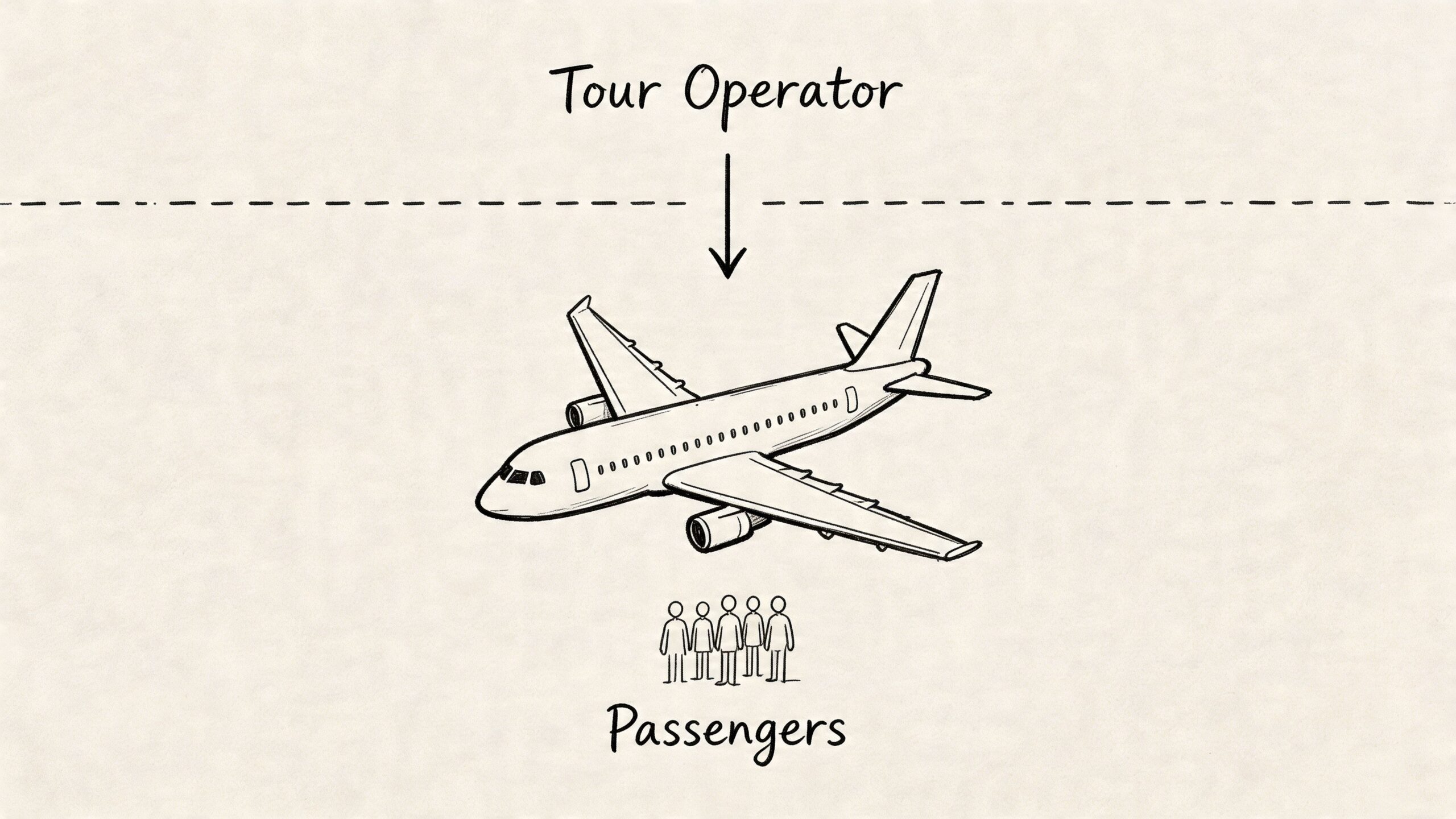
Think of it as a pop-up airline model
A public charter operator, legally treated as an indirect air carrier, contracts the full aircraft from a direct air carrier. Then it resells individual seats to the public. That structure is governed by the DOT under 14 CFR Part 380.
The practical consequence is easy to miss. The brand selling the ticket may not be the company operating the aircraft.
According to the U.S. Department of Transportation public charter rules, public charter operators must file a detailed prospectus under 14 CFR Part 380, outlining schedules and securing customer funds in an escrow account. That requirement exists to protect consumers, but it also makes clear that the seller is an intermediary rather than the ultimate flight operator.
What that means in plain English
With a true private charter, you charter the entire aircraft for your group. You decide departure time, routing, and passenger list, subject to operational limits.
With a public charters flight, the operator decides the route and timing first, then sells seats into that plan. Even if the aircraft uses a private terminal or feels more exclusive, you are still joining their trip, not creating your own trip.
That distinction affects nearly everything:
- Schedule control is limited.
- Changes are harder because there are other booked passengers.
- Privacy is partial, not absolute.
- Accountability is layered because seller and operator may be different parties.
Questions smart buyers ask early
If you’re evaluating a public charters flight, ask these questions before entering payment details:
- Who is the direct air carrier? You need the actual operator name, not just the sales brand.
- Has the charter prospectus been accepted? If the answer is vague, pause.
- What happens if the schedule changes? Don’t assume flexibility that wasn’t promised.
- Who handles refunds or disruptions? The intermediary structure matters when plans move.
The more a public charter is marketed as “just like private,” the more carefully you should read who controls the aircraft, the schedule, and the customer funds.
This isn’t a criticism of the model. It’s a reminder to buy the product that exists, not the one implied by the ad.
Public vs Private Charter Key Differences
Most confusion comes from one mistake. People compare the feel of public charter to the function of private charter. Those are not the same standard.
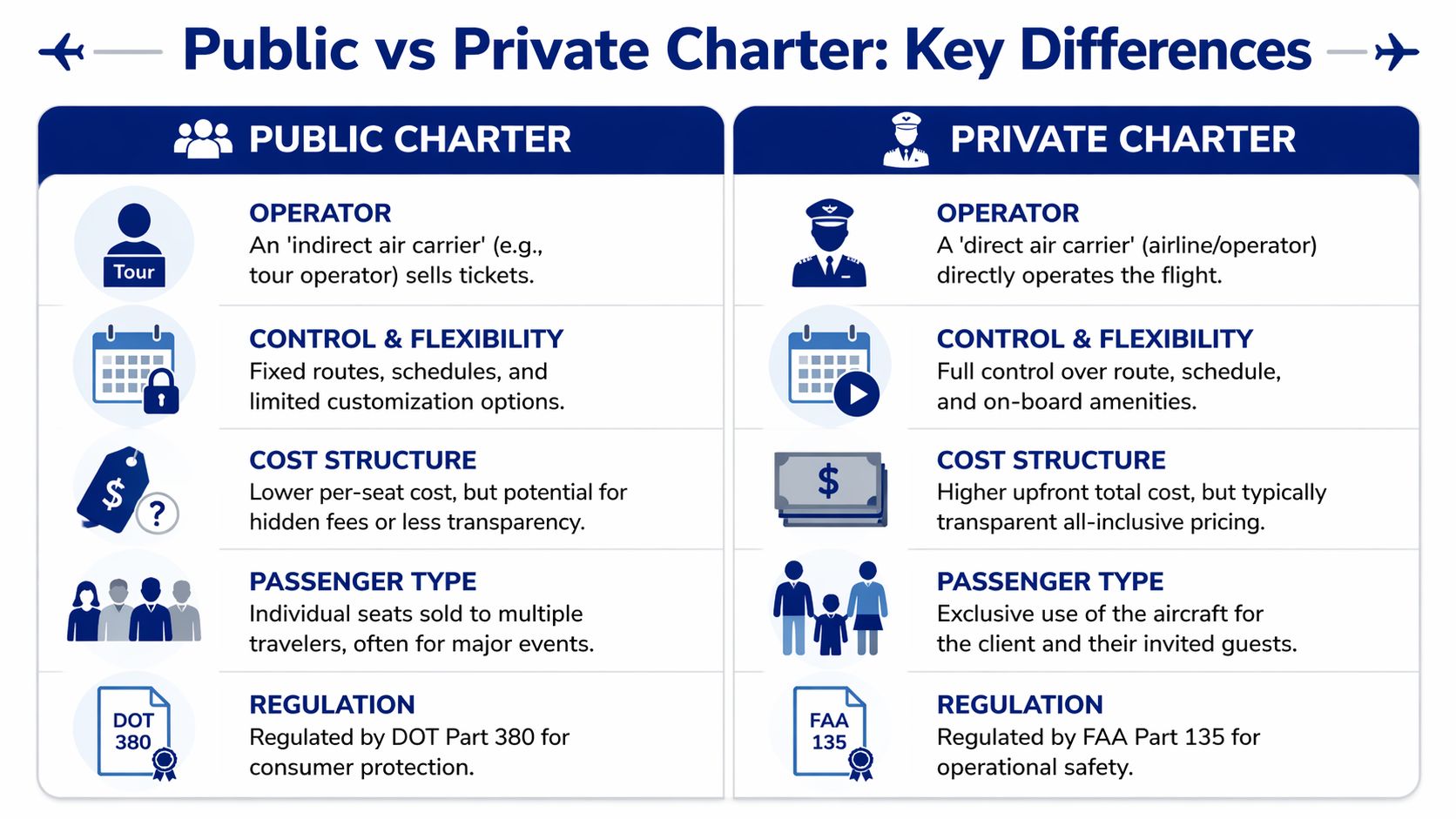
The side-by-side reality
| Decision factor | Public charter | Private charter |
|---|---|---|
| What you buy | A seat on a prearranged flight | Exclusive use of the aircraft |
| Who sets timing | The operator | You and your charter provider |
| Passenger list | Mixed travelers | Only your invited passengers |
| Route flexibility | Limited | High, subject to aircraft capability and operations |
| Privacy level | Better than airlines, not fully private | Fully private within your party |
| Change tolerance | Lower | Much stronger |
| Booking dynamic | Transactional seat purchase | Consultative trip design |
Control is the dividing line
For a high-net-worth traveler or corporate travel manager, the key issue is usually not luxury. It’s control under pressure.
If a dinner runs long, a meeting shifts, a family member needs to join late, or the destination changes, a private charter can often adapt because the aircraft was booked for your use. A public charter generally can’t flex the same way because the schedule was built for many passengers, not just for you.
That’s why experienced travelers often compare public charter against alternatives only when the mission is simple. For broader planning, reviewing available private jet options can help clarify what level of control and routing flexibility you need before you commit.
Regulation is also different
Public charters often operate under FAA Part 135 rules, while major airlines operate under Part 121. That distinction has drawn attention because some high-frequency public charters can start to look like scheduled airlines without identical oversight. The NATA public charter overview notes that proposed 2026 FAA rulemaking aims to address those inconsistencies when public charter operations begin to resemble scheduled airline service.
You don’t need to be a regulatory specialist to understand the practical takeaway. If the regulatory environment itself is being examined, you should assume the model still has moving parts.
What works and what doesn't
Public charter works best when all of the following are true:
- Your dates are fixed: You’re going when the operator says the flight goes.
- Your route is simple: One clear city pair or event-driven destination.
- You can tolerate shared conditions: Other travelers affect the experience.
- You prioritize lower entry cost over full command of the trip.
Private charter works better when the trip has consequences if it slips:
- Time matters more than ticket price
- Confidentiality matters
- You may need to add stops, alter timing, or reposition
- Your group wants one decision-maker, not an intermediary chain
If your trip falls into the second group, direct private charter service is usually the cleaner answer.
Understanding the Real Costs and Hidden Risks
The headline appeal of public charter is simple. A lower price of entry. What many buyers miss is that lower entry cost doesn’t always equal better value.
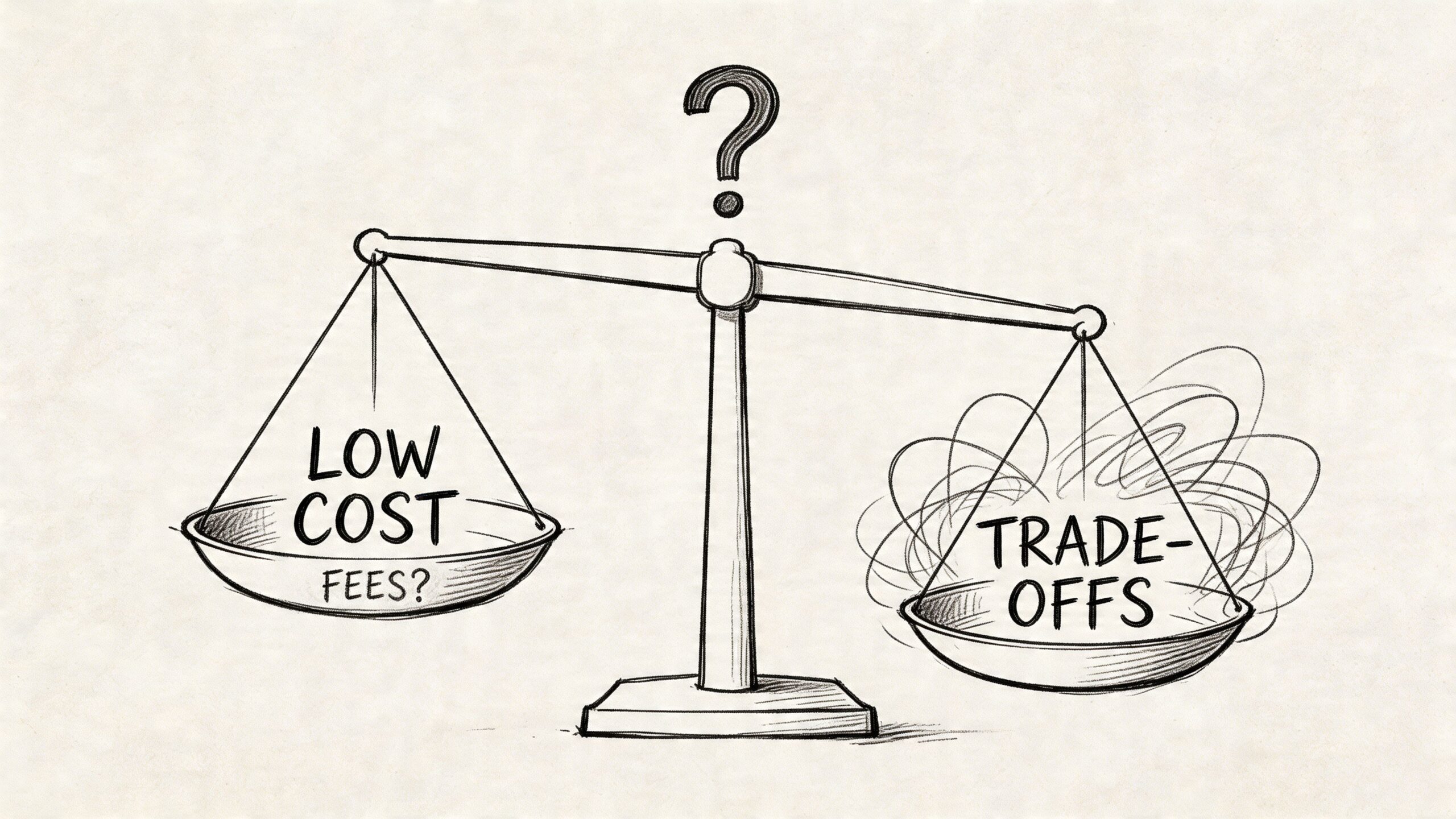
The biggest problem is not always the fare
The hardest part of evaluating a public charters flight is that two important areas remain unusually opaque for the average buyer: pricing structure and comparable safety data.
On safety, there is a major information gap. As noted in federal comments discussing the public charter loophole debate, there is no publicly available, audited data directly comparing accident rates or safety incidents between Part 380 public charters and traditional private charter services. That doesn’t prove one is unsafe and the other is safe. It means buyers don’t have the clean, audited comparison they often assume exists.
That matters because many travelers ask for “the data” before making a risk judgment. In this niche, the data many people want isn’t available in a public, audited side-by-side form.
If someone claims a public charter is just as safe as another charter category, ask what audited comparison they’re using. In many cases, there isn’t one available to the public.
Lower fare doesn't mean simpler economics
Public charter marketing often highlights affordability, but the underlying cost model is not especially transparent to consumers. The operator has regulatory obligations, commercial risk, and security requirements to manage. The buyer usually sees only the selling price and a set of terms.
That’s where travelers get tripped up. They compare a public charter seat to a private charter quote without recognizing that they’re buying two different things. One is shared access to a predefined operation. The other is a dedicated aircraft mission.
A related option worth understanding is the empty leg flight model. Empty legs can reduce the cost of true private flying when your timing and route align, but they come with their own constraints. They’re not the same as public charter, and they shouldn’t be evaluated as if they are.
Where hidden risk usually shows up
The hidden trade-offs are rarely dramatic on paper. They show up operationally:
- Schedule rigidity: The flight leaves on the operator’s terms.
- Intermediary complexity: The seller and operator may not be the same entity.
- Policy friction: Rebooking, refunds, or trip changes can become procedural quickly.
- Expectation mismatch: Travelers expect private-style freedom from a seat-based model.
A short explainer on charter categories helps frame that distinction:
A practical cost test
Before you choose public charter on price, run this test:
- What is the cost of being early, late, or inflexible?
- Who absorbs the disruption if plans change?
- Are you optimizing for comfort, or for mission certainty?
For leisure with a fixed plan, public charter may be sensible. For a transaction, investor roadshow, sensitive family travel, or a multi-stop day, the cheaper seat can become the more expensive decision once friction enters the picture.
When to Choose Public or Insist on Private
Not every trip deserves a full aircraft. Some do.
The mistake is assuming public charter is a general substitute for private charter. It isn’t. It’s a specific tool for a narrower use case.
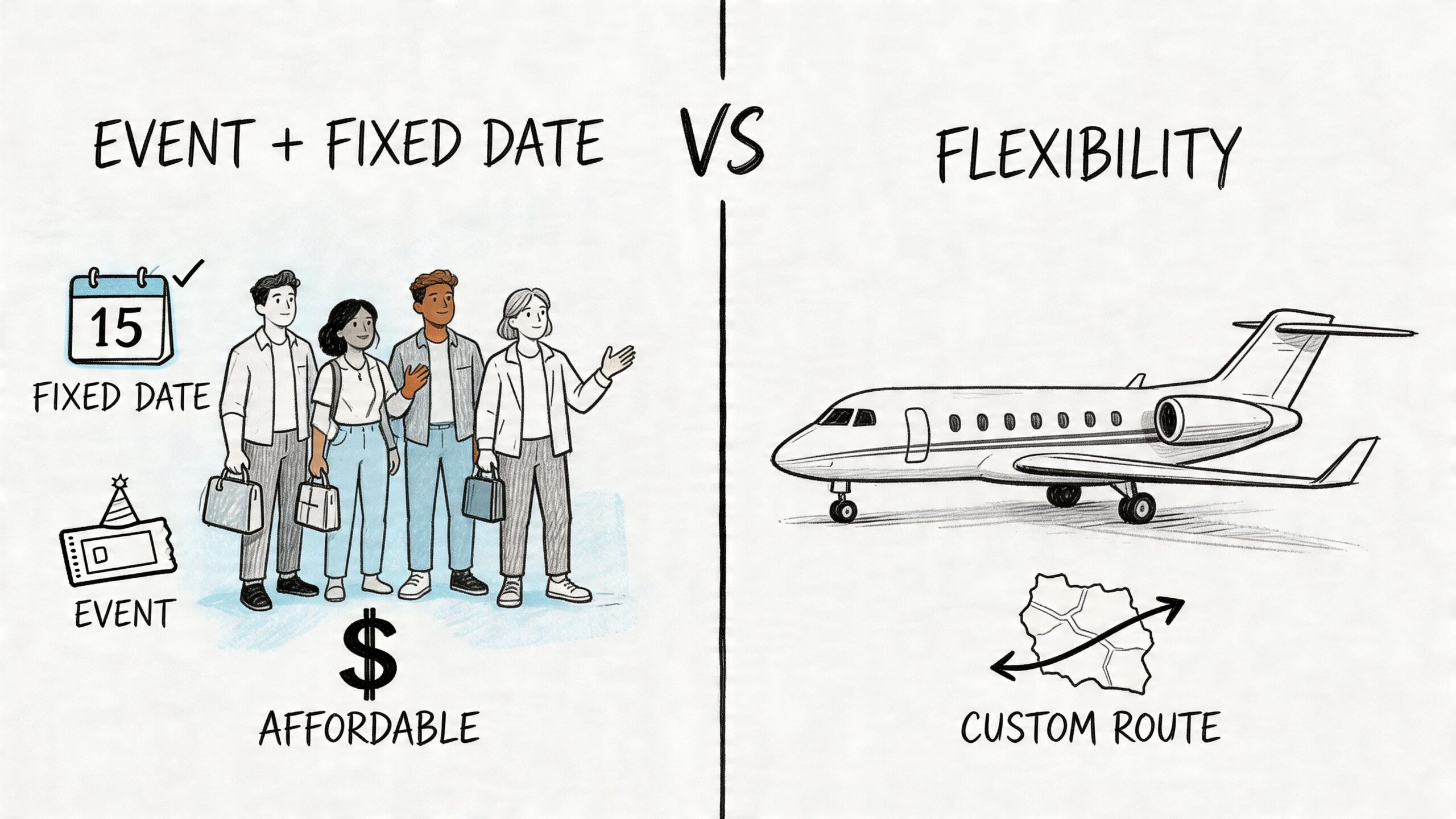
When public charter can be the right call
Public charter is usually a rational choice when the trip is straightforward and the schedule is already fixed.
Good examples include:
- Event travel: Sporting events, festivals, or seasonal routes where departure timing isn’t negotiable anyway.
- Small-group leisure with budget discipline: Travelers who want a better airport experience but don’t need to command the aircraft.
- Simple out-and-back itineraries: One destination, one purpose, minimal chance of change.
In those cases, a public charters flight can give you a more polished experience than a standard airline booking without requiring the full commitment of private charter.
When private is the only sensible answer
Private charter becomes the logical choice when the trip cannot tolerate compromise.
Insist on private if any of these are true:
- Your schedule may move
- Your party needs confidentiality
- You’re traveling with family, pets, or executives who need personalized handling
- You’re flying multiple legs in a day
- A delay or cancellation has real business or personal cost
The more valuable your time is, the less useful “good enough” aviation becomes.
The pricing question matters here too. The public charter model often markets lower fares, but there is virtually no concrete public data showing how regulatory compliance, security fees, and operational costs are translated into the final ticket price, as discussed in this public charter pricing transparency overview. That makes it harder to know when the bargain is real and when it’s less visible.
A simple decision framework
Use this filter before you book:
| If your priority is | Better fit |
|---|---|
| Lower entry price for one seat | Public charter |
| Full control of departure and arrival timing | Private charter |
| Shared travel with limited customization | Public charter |
| Confidential meetings in the air | Private charter |
| Fixed event attendance | Public charter |
| High-stakes business or family logistics | Private charter |
For affluent travelers, the decision usually comes down to one sentence. If the trip matters enough that failure is expensive, book control.
Booking Your Flight and Avoiding Common Pitfalls
Booking public charter often looks easy on the surface. That’s exactly why buyers skip the due diligence.
A polished website, attractive cabin photos, and premium language can make the product feel simpler than it is. In reality, the smartest move is to verify the structure before you verify the card.
Due diligence questions for public charter
Ask these in writing if possible:
- Who is selling the flight, and who is operating it? Those are not always the same company.
- Is the DOT prospectus accepted for this specific charter? You want confirmation, not a vague statement about compliance.
- What are the cancellation and refund terms? Read the operational language, not just the headline policy.
- How are schedule changes communicated? Timing matters if the trip connects to meetings, yachts, villas, or drivers.
- What baggage, pet, and name-change rules apply? Don’t assume private-style flexibility.
A general primer on how to charter a private jet is useful here because it sharpens the contrast between a seat-based transaction and a true aircraft booking. Once you understand how direct charter works, the public charter trade-offs become easier to spot.
Common mistakes that cause the most frustration
Travelers usually run into trouble in four places:
- They assume “semi-private” means customizable. It often doesn’t.
- They ignore the operator identity. The sales brand is only part of the picture.
- They judge value only by fare. The cost of inflexibility is left out.
- They book a shared model for a mission-critical trip. That’s a category error.
What a smoother booking process looks like
With direct private charter, the process is usually far more consultative. You discuss aircraft fit, routing, passenger needs, pets, catering, and ground coordination in one conversation. The result is a mission plan built around your group, not a seat on someone else’s operating plan.
That’s why experienced travelers often pay close attention to one thing above all else. Who owns the decision-making once the trip starts to move. If the answer is unclear, expect friction.
Frequently Asked Questions About Charter Flights
Below is a practical FAQ for travelers comparing public and private charter options.
| Question | Answer |
|---|---|
| Is a public charters flight the same as a private jet charter? | No. A public charter usually sells individual seats on a flight arranged by an intermediary. A private charter gives your party exclusive use of the aircraft. |
| Can I bring pets on a public charter? | Sometimes, but policy varies by operator and aircraft. Confirm it before booking. Private charter is usually easier when pet travel is a priority because the aircraft is reserved for your group. |
| Are public charters safer than private charters or airlines? | There isn’t publicly available, audited side-by-side data comparing accident or incident rates between Part 380 public charters and traditional private charter services. You should review the operator structure carefully rather than rely on broad claims. |
| Why are public charter prices often lower at first glance? | Because you’re buying a seat instead of the entire aircraft. That lower entry point comes with reduced control, shared conditions, and less customization. |
| Can I change departure times on a public charter? | Usually not in the way you can with a dedicated private charter. Public charter schedules are generally fixed by the operator. |
| What should I verify before booking? | Confirm the direct air carrier, the applicable charter prospectus status, cancellation terms, baggage and pet rules, and how schedule changes are handled. |
| Who should choose private charter instead? | Executives, families with complex logistics, travelers needing discretion, and anyone whose plans may change should usually favor private charter. |
| Is public charter worth it for leisure travel? | It can be, especially for fixed-date leisure trips where avoiding a commercial terminal is valuable and schedule flexibility is less important. |
A final rule helps cut through the noise. If you’re buying the trip for convenience, public charter can work. If you’re buying the trip for certainty, private charter is usually the correct tool.
If you want a direct assessment of which model fits your itinerary, Air Trek can help you evaluate whether a public charter, an empty leg, or a fully customized private charter is the smarter move for your route, schedule, and privacy requirements.