
You're probably weighing this choice in a very specific moment. A team trip is getting complicated, a family itinerary has too many moving parts, or you've paid for first class before and still lost half a day to airport friction.
That's why private jet vs first class is the wrong comparison if you only look at the seat. Instead, the comparison should be about door-to-door control, schedule flexibility, privacy, and what happens when you split charter cost across several travelers.
For some trips, first class is still the smart buy. For others, especially group travel or regional itineraries, private charter gets closer to first-class pricing than is generally thought. The practical answer depends on who's flying, where they're going, and how expensive delay is for that group.
| Decision factor | First class | Private charter |
|---|---|---|
| Best for | Solo travelers, couples, simple hub-to-hub routes | Groups, time-sensitive trips, regional access, privacy-heavy travel |
| Pricing model | Per seat | Per aircraft or trip |
| Schedule control | Airline schedule | Traveler-driven schedule |
| Airport access | Major commercial airports | Regional and secondary airports |
| Privacy level | Premium but shared | Exclusive cabin |
| Strongest advantage | Lower cost for one or two passengers | Better total value when time and group size matter |
| Weakest point | Less control over routing and timing | Higher total spend for small parties |
Beyond the Lie-Flat Seat
A lie-flat seat helps. Lounge access helps. Priority boarding helps a little. But even experienced first-class travelers know the weak point. You still work around the airline's timetable, the airport's process, and the route network the carrier wants to sell.
That's where the conversation gets more serious. Luxury in travel isn't just a better meal or more legroom. It's control over the trip itself. Can you leave when the meeting ends instead of the next morning? Can you land near the destination instead of near the destination's nearest major airport? Can your group stay together instead of splitting across rows and connections?
Those questions matter more than the seat once travel becomes high stakes.
What people usually ask first
Most readers come to this topic with one of these questions:
- Is flying private ever worth it? Yes, but not for every route or every traveler.
- Is first class still the better financial choice? Often, especially for a solo traveler on a straightforward route.
- When does private charter stop being a luxury splurge and start being a rational tool? Usually when time is expensive, privacy matters, or several people are traveling together.
- Can private flights work for family travel too? Yes, especially when flexibility, pets, and regional destinations matter.
Practical rule: Don't compare a private jet to a first-class seat. Compare a private trip to the total commercial travel day.
I've found that travelers make better decisions when they stop asking, “Which is fancier?” and start asking, “Which option protects my time, my schedule, and my group?” That shift usually clarifies the answer fast.
What actually drives the decision
Three variables decide most private jet vs first class choices:
- Group size. Charter economics change once you spread the aircraft cost across several passengers.
- Trip shape. A simple nonstop between major hubs favors first class. A regional or multi-stop itinerary often favors private.
- Cost of lost time. If missing half a day has real business or personal consequences, the math changes.
The True Cost of Flying Private vs First Class
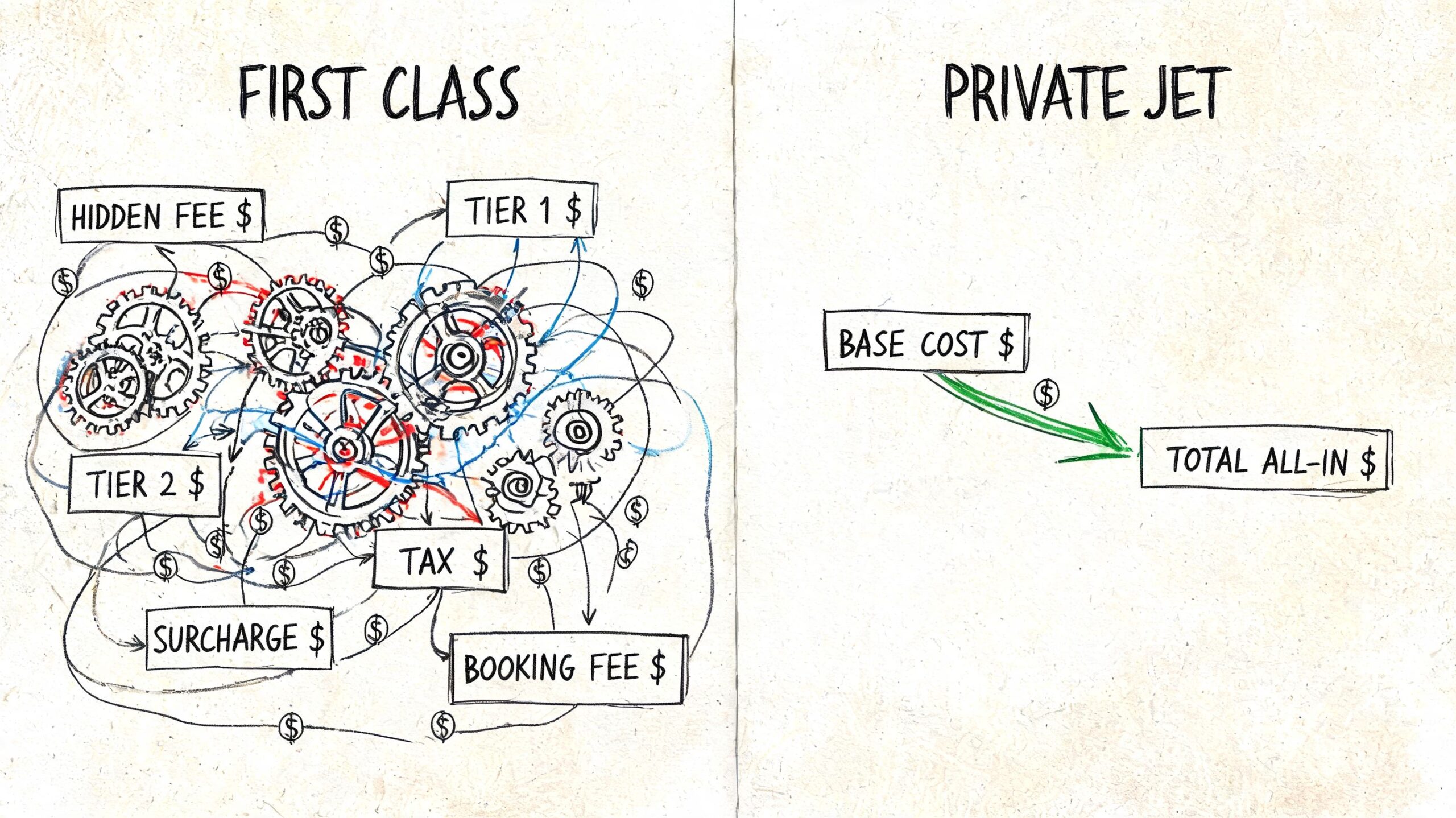
A traveler booking one seat and a team moving together are solving two different problems. That is why private jet pricing confuses people at first. First class is sold by the seat. Charter is sold by the aircraft.
Where first class still wins
For a solo traveler, and often for a couple, first class usually remains the lower-cost choice. Earlier pricing comparisons from Iona Jets put first-class fares in the low thousands up to the mid-five figures per person on some routes, while private charter starts at an hourly aircraft rate for the entire cabin, not one seat.
That difference matters most on straightforward trips between major airports. If the airline schedule works, the traveler does not need privacy, and there are only one or two passengers, buying first class is usually the disciplined decision.
Where charter starts to make sense
Charter gets more interesting when the cabin is shared.
As noted earlier, Iona Jets found that private flying starts to look cost-competitive around 4 to 9 passengers, depending on route and aircraft. That tracks with what I see in trip planning. Once several executives, family members, or clients are traveling together, the conversation shifts from total aircraft cost to per-person cost and schedule control.
A full light jet can bring the per-seat figure much closer to first class than many travelers expect. That is especially true on regional trips, airport pairs with weaker premium-cabin service, and itineraries where the group would otherwise need multiple commercial bookings.
| Travel setup | Cost pattern |
|---|---|
| Solo traveler | First class usually wins on price |
| Couple | First class usually remains more affordable |
| Small group | Charter starts to get competitive |
| Larger business or family group | Charter can make strong per-person sense |
The pricing variables that change the answer
Hourly rate is only the starting point. Real charter quotes move up or down based on aircraft category, minimum flight time, crew overnight costs, repositioning, airport fees, and whether the operator can match your trip with an existing aircraft movement.
That last point is where many travelers save real money. Empty legs and one-way positioning opportunities can reduce the premium significantly if your schedule has some flexibility. They are not dependable enough for every mission, but for leisure travel, last-minute getaways, or travelers who can shift by a few hours, they can narrow the gap between private and first class far faster than headline pricing suggests.
Regional access changes the math too. A private itinerary into a smaller airport can avoid hotel nights, extra ground transfers, and lost work time. If a group would otherwise land at a major hub and then arrange a long drive, services like EC Minibus transfer solutions can help on the commercial side, but the more moving parts you add after landing, the more attractive private aviation becomes.
Long-term economics depend on usage discipline
Frequent private flying gets expensive quickly if the aircraft is half full or the routes are easy commercial nonstops. Shared usage improves the economics. So does choosing the right aircraft instead of booking more cabin than the trip requires.
I tell clients to be suspicious of broad averages. A short hop on a turboprop, a light jet for six passengers, and a midsize jet for a coast-to-coast mission are different products with different cost structures. For trip-specific estimates, a detailed private charter pricing guide with route, aircraft, and repositioning factors is far more useful than a single hourly number.
A private jet is expensive. An underused private jet is expensive in the wrong way.
Comparing Door-to-Door Travel Time and Flexibility
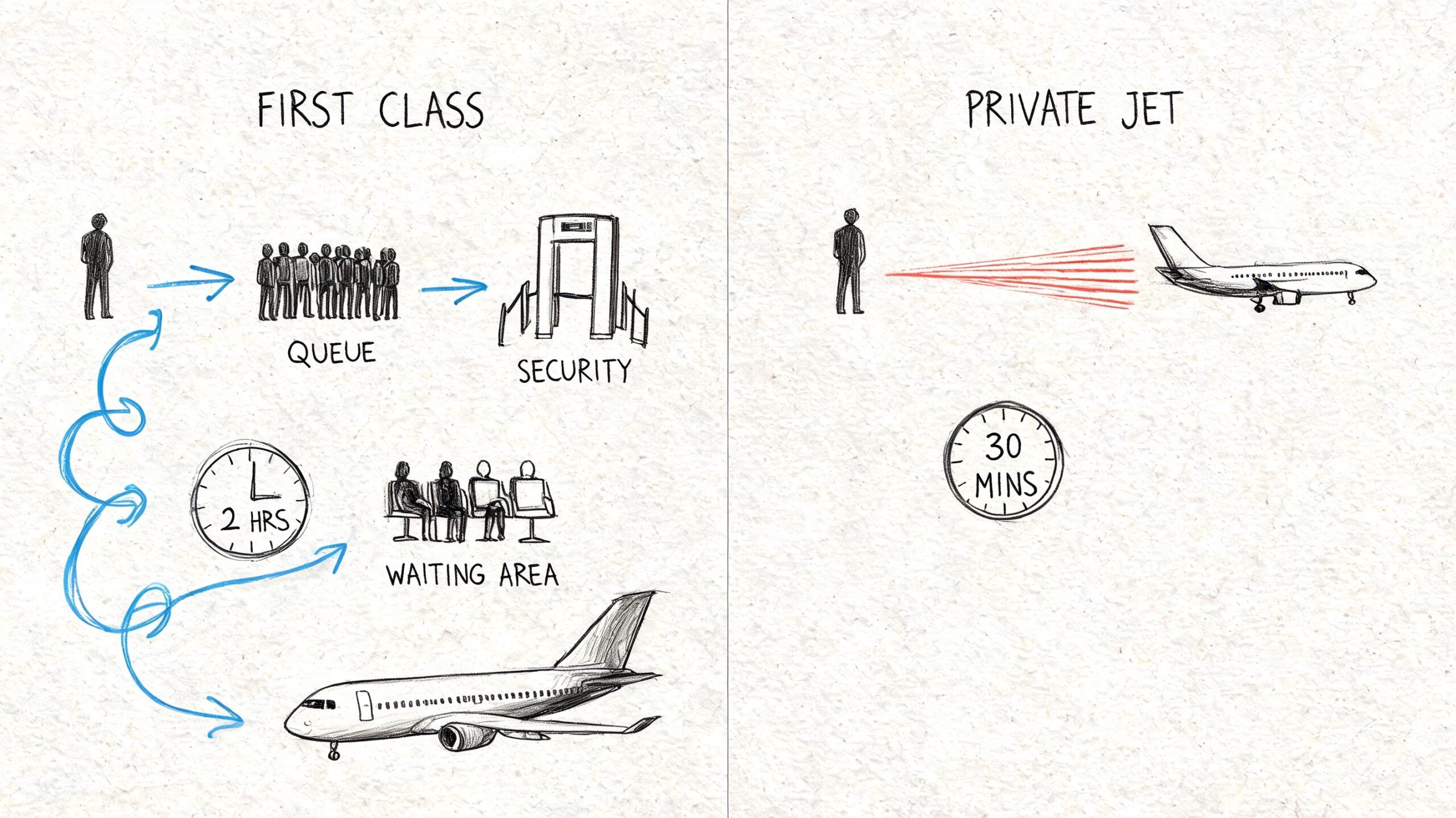
A traveler leaving Midtown for Teterboro at 8:15 a.m. can be airborne soon after and arrive closer to the actual destination than a first-class passenger who left home earlier for a major airline terminal. That is the comparison that matters. Door to door decides whether private aviation is a smart tool or an expensive indulgence.
The real time savings
The flight time itself is often similar. The difference comes from everything wrapped around it. Commercial travelers still have to budget for earlier airport arrival, longer walks through the terminal, boarding queues, baggage delays, and schedules built around the airline's network instead of their own.
Aviator Aircraft Sales' comparison of private jet and first-class travel gives a useful illustration. On a London to Geneva business trip, the private option saved about 3 hours and 20 minutes on a round trip. The same analysis found that someone making that trip 30 times a year saves over 100 hours annually, or more than 12 full working days.
Those numbers line up with what frequent charter clients usually care about. They are not buying a faster cruise speed. They are buying back parts of the day that commercial aviation tends to waste.
Why airport choice changes the equation
Airport access is often the bigger advantage than the aircraft itself. First class still ties you to the airline map. Private charter lets you choose from a much wider set of airports, including many regional fields that cut out a connection or a long drive on arrival.
That changes the trip in practical ways:
- Closer arrivals: The aircraft can often land nearer the meeting site, resort, second home, or yacht marina.
- Fewer schedule compromises: Departure times can follow the traveler's day instead of a published timetable.
- Less wasted ground time: Avoiding a hub can remove hours that never show up in airline fare comparisons.
This matters even more for groups. Four to eight passengers heading to the same regional destination can spread the charter cost while also avoiding multiple commercial tickets, separate arrivals, and a long transfer from the nearest major airport. On trips like that, private aviation starts to compete on total trip efficiency, not just comfort.
Commercial travel can still work well if the final destination is close to a major airport and the schedule is fixed. If there is still a meaningful ground segment after landing, these EC Minibus transfer solutions are a useful reference point for mapping the full trip instead of comparing airfare alone.
FBO access removes airport friction
Private flights usually depart through fixed-base operators rather than the main airline terminal. That changes the day more than many first-time charter clients expect. Arrival is simpler, the walk is shorter, boarding is direct, and the process is built around the aircraft you booked rather than the flow of hundreds of other passengers.
That is why experienced travelers pay attention to the terminal side of the trip. A clear explanation of the private jet FBO experience shows why the savings often come from reduced airport handling as much as the flight itself.
That difference is easiest to understand when you see how private terminals work in practice:
Private does not win every time. If you are flying solo between major cities with a good nonstop and your destination is near the airline airport, first class can be the sensible choice. If you are traveling with a small group, adjusting departure times, using an empty leg, or trying to reach a regional destination without losing half a day in connections and transfers, private travel becomes more attainable than many travelers assume.
Privacy Productivity and Personalization
Some travelers care most about speed. Others care most about control inside the cabin. That's where private jet vs first class becomes less about transport and more about the environment you need during the trip.
Privacy changes what you can do onboard
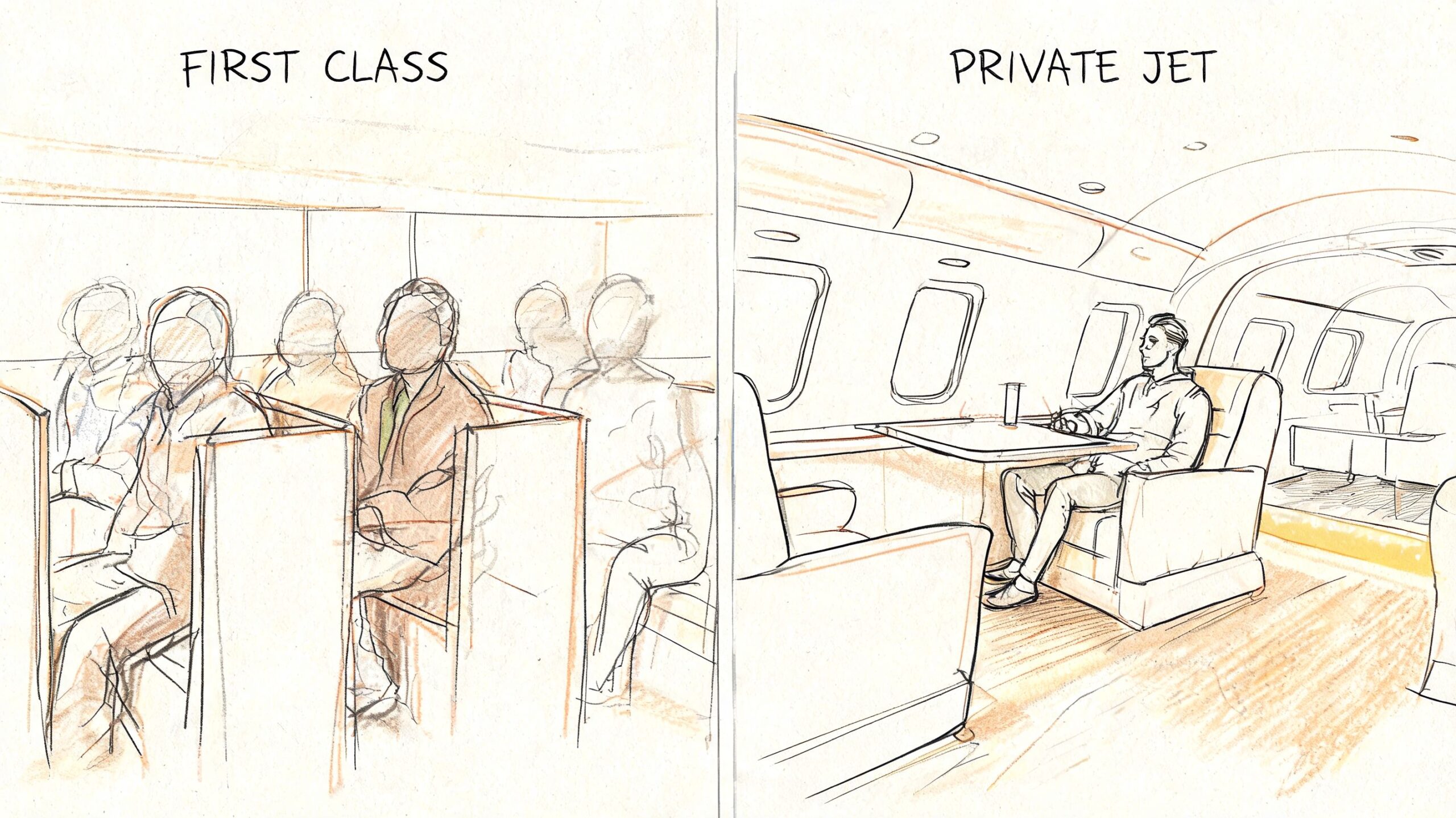
First class is premium travel in a public system. You get more space, better service, and a quieter cabin than the rest of the aircraft. But you're still sharing that environment with other passengers, airline crew workflows, and the limits of commercial operations.
A private charter gives your group the whole cabin. For business travelers, that means real confidentiality. You can review sensitive material, hold a meeting, or make decisions in a setting that isn't half-private and half-public.
For leisure travelers, the advantage looks different. Parents don't have to manage children in a crowded terminal environment, and the trip feels coordinated instead of fragmented.
Personalization is practical, not decorative
The best private trips aren't defined by champagne or prestige. They're defined by fewer points of friction.
That usually shows up in areas like these:
- Cabin use: A team can work, rest, or talk without managing around strangers.
- Food and timing: Catering and departure plans are built around the travelers, not an airline service sequence.
- Family comfort: The trip can be calmer for children, older relatives, and travelers with specific routines.
- Pets in cabin: For many families, this is one of the most meaningful differences between charter and commercial premium travel.
Ground coordination matters too. When a trip needs a polished arrival experience on the other side, resources like Uptown Rent A Car's luxury chauffeurs show the level of handoff many premium travelers look for after landing.
Access shapes privacy too
Privacy doesn't start at cruising altitude. It starts with where you depart, where you land, and how much public process the trip requires. According to Gold Aviation's value comparison of private charter and first class, private jets can access over 5,000 U.S. airports compared with 500 served by commercial airlines, often reducing ground travel by 1 to 2 hours per trip. The same analysis notes that this can save executives time valued at $750 to $1,000 per trip in opportunity cost recovery.
That's why privacy and productivity often travel together. The traveler who avoids public terminals, lands closer in, and keeps the group together also protects more usable time.
A Clear-Eyed Look at Environmental Impact
A private flight saves time and gives a group more control. It also carries a heavier environmental cost per passenger than flying first class on a commercial route. That trade-off needs to be stated plainly.
According to Air Trek's discussion of practical luxury and efficiency choices, private jets can emit significantly more CO2 per passenger than first-class commercial flights on comparable trips. For a solo traveler flying between major cities with strong airline service, that point alone can tip the decision toward first class.
Group size changes the equation.
If four to eight travelers are heading to the same place, especially on a regional route with limited nonstop service, the private option starts to look different. The emissions burden is still real, but the value side improves because one aircraft can replace multiple commercial itineraries, extra ground transfers, and in some cases an overnight stay caused by airline schedules. That does not erase the environmental cost. It does mean the comparison should be made against the full trip, not just the seat.
One practical way to reduce waste is to use empty leg flights on routes that already need repositioning. That approach does not put private aviation on par with commercial flying from an emissions standpoint, but it can make better use of a flight that would operate anyway.
I advise clients to ask a few direct questions before booking:
- Is there a commercial nonstop or simple connection that gets the job done without disrupting the trip?
- How many passengers are traveling, and will the cabin be used efficiently?
- Is the destination poorly served by the airlines, making private aviation more defensible on a time basis?
- Can an empty leg or a more efficient aircraft type cover the mission?
That is the practical standard. Use first class when the route is easy, the group is small, and emissions are a primary concern. Use private charter when the mission involves a full group, a regional airport, or a schedule that commercial service handles poorly.
Real-World Scenarios When to Choose Each Option
Abstract comparisons only go so far. Travelers often make their choice based on a trip they already have in mind. Here are three common situations where the private jet vs first class decision becomes much clearer.
Corporate team on a multi-city tour
A leadership team needs to visit several cities in a short window. They're carrying sensitive information, schedules may move, and losing half a day to each commercial segment would ripple into missed meetings.
Private charter usually earns its keep. The value isn't just the cabin. It's the ability to keep the group together, work in transit, and avoid rebuilding the schedule around airline inventory.
First class can still work for a simple single-destination trip. It gets clumsy when the team is trying to stack stops efficiently.
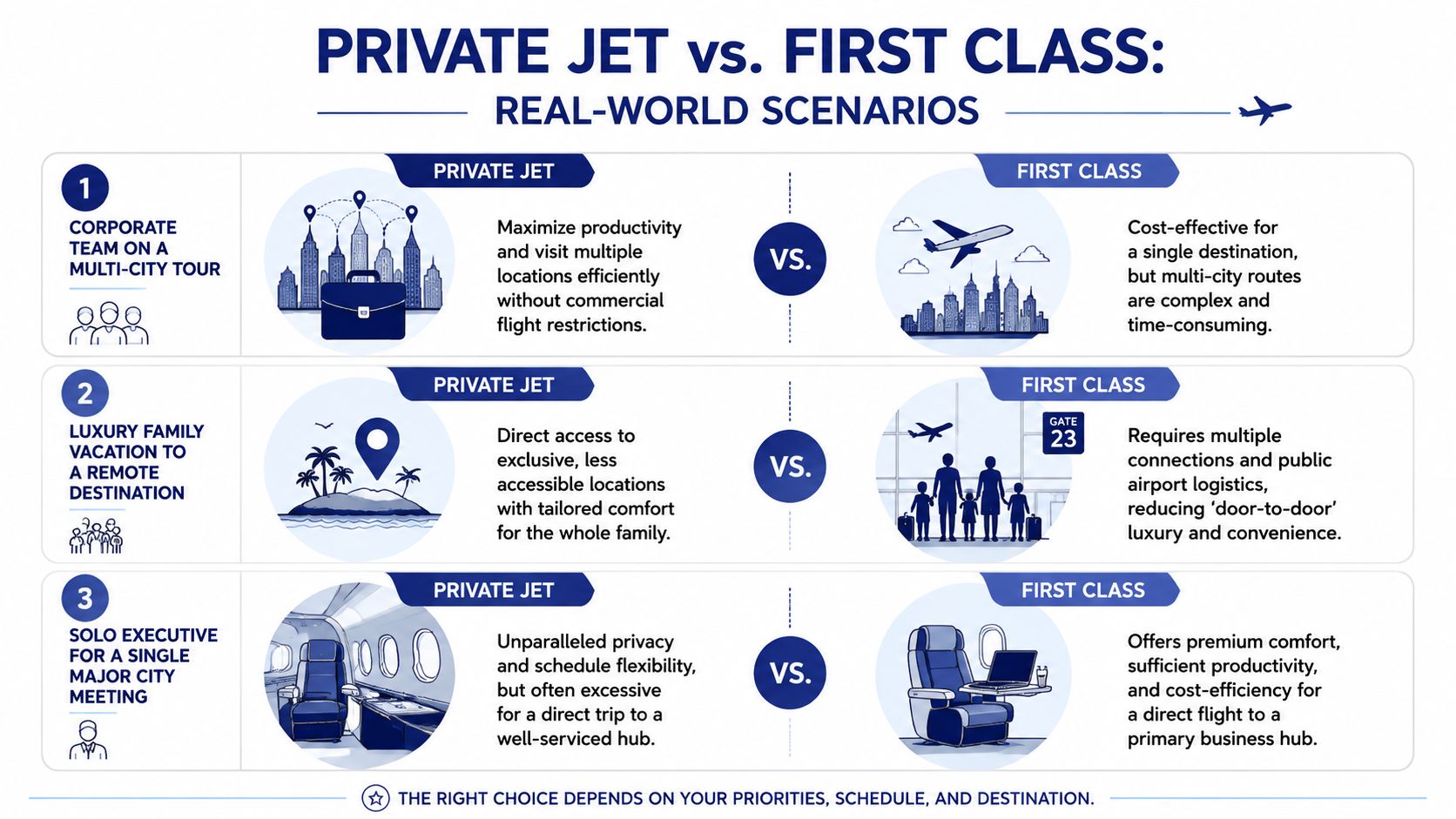
Family vacation to a remote destination
This case gets underestimated. A family traveling with children, luggage, and possibly a pet often values predictability more than luxury signaling. Connections, crowded terminals, and long ground transfers chip away at the vacation before it starts.
Private charter often fits well here, especially for destinations outside major airline patterns. The family stays together, the trip can be timed around real life, and the arrival point is often closer to the final property or island destination.
If the route is simple and the destination is a major hub with strong premium service, first class can still be the better buy. But once the trip gets remote or logistically fragile, private becomes much more compelling.
Solo executive flying to a major city meeting
This is the scenario where first class frequently wins. If one person is flying on a straightforward route between major business centers, commercial premium cabins often offer enough comfort and enough productivity at a lower total cost.
That doesn't mean private charter never makes sense for a solo executive. It can, especially when timing is unforgiving or confidentiality is central. But as a default decision, first class is usually the more efficient spend for a simple hub-to-hub mission.
A quick decision framework
| Scenario | Usually better fit | Why |
|---|---|---|
| Multi-city corporate travel | Private charter | Better schedule control, group coordination, confidentiality |
| Family trip to a regional or remote destination | Private charter | Less travel friction, simpler logistics, easier with pets and children |
| Solo trip to a major commercial hub | First class | Lower cost with sufficient comfort and convenience |
| Group trip where seats can be shared across one aircraft | Private charter | Per-person economics improve as the group grows |
One wildcard here is flexibility on timing. Travelers who can work with repositioning schedules can sometimes lower the barrier to entry by using empty leg flight options. That won't fit every trip, but for the right route and traveler, it can make private aviation much more attainable.
Frequently Asked Questions About Private Travel
After comparing private jet travel with first class, the next questions are usually operational. How booking works, whether pets can travel in cabin, and when private aviation is financially reasonable all affect the decision more than marketing language does.
How does booking a private charter actually work
Booking a charter is closer to trip planning than buying an airline seat. The aircraft has to fit the route, passenger count, baggage load, airport options, and schedule tolerance. A good operator will ask for those details early, then narrow the field to aircraft that make sense for the mission. A useful outside reference is how premium travel teams approach arranging private flights, because the process is typically handled more like concierge coordination than standard ticketing.
Clear trip details matter. If the departure time can move by a few hours, if a smaller regional airport is preferred, or if pets and ground transfers are part of the plan, those points can change both aircraft choice and price.
Can you bring pets on a private jet
Usually, yes.
For families and second-home travelers, that is often one of the strongest arguments for charter. Private flights are generally much easier for in-cabin pet travel than commercial service, especially on routes where airline size limits, carrier rules, and connection stress create problems.
Policies still vary by operator and route. Confirm pet size, carrier requirements, cleaning fees, and any health or customs paperwork before the aircraft is booked.
What is an empty leg flight
An empty leg is a repositioning segment the aircraft already needs to fly. Operators sometimes sell that one-way trip at a lower rate instead of moving the aircraft without passengers.
The savings can be meaningful, but the trade-off is control. Route, timing, and cancellation risk are less forgiving than a custom charter. Empty legs work best for travelers with flexible timing, smaller groups, or leisure itineraries that do not depend on a fixed departure window. They can also shift the cost comparison with first class more than many travelers expect, especially for couples, families, or small groups heading to regional destinations.
Is private always better for business travel
No. It depends on what the trip is trying to solve.
Private flying earns its keep when the schedule is tight, the destination is outside the main airline network, or several travelers need to move together without losing half a day in connections and airport handling. For one executive flying between major hubs on a predictable schedule, first class is often the better use of budget.
What should you ask before choosing private jet vs first class
Use this shortlist before you book:
- Who is traveling? A solo traveler and a group of five produce very different math on a charter quote.
- Where does the trip end? The final destination matters more than the nearest major airline airport.
- How much flexibility do you have? Flexible timing can open up empty legs and better aircraft availability.
- What does delay cost you? Missed meetings, overnight stays, and lost team time can outweigh a lower airline fare.
- Do you need privacy or discretion? Some conversations, clients, and family situations are easier to handle on a private aircraft.
If you're weighing a real itinerary and want a practical recommendation, Air Trek can help you compare charter options, empty legs, routing, and aircraft fit based on the trip you're taking, not a generic luxury pitch.