
You're trying to get to a meeting, a resort, or a family home without wasting half the day getting there. The departure time may shift. The closest commercial airport may still leave you an hour from your real destination. And if the trip has to run on your schedule, the usual airline process starts to feel like the least efficient part of the plan.
That is where a private jet at airport option starts to make practical sense. The value is not only shorter waits. It is the ability to choose an airport that fits the trip, set a schedule that works for the people on board, and cut out steps that do not add anything for the passenger.
Private aviation is also more active than many first-time flyers expect. Charter clients, aircraft owners, and fractional users are relying on it more often because it solves real logistics problems.
I tell first-time clients the same thing early on. Private flying gives you more control, but it still runs inside a real airport system with rules, operating hours, customs requirements, and aircraft availability. Once you understand those limits, you can use the system well and avoid the common mistakes that make a trip harder than it needs to be.
This confirms what people in charter already see every day. Private flying is no longer a niche backup plan for a small group of travelers. For many passengers, it is a practical transportation choice built around time, access, and better airport strategy.
The Private Jet Airport Experience A Different World
Your driver turns off the main airport road, passes the airline terminal traffic, and pulls up to a much smaller building on the private side of the field. There is no hunt for a check-in counter, no gate area, and no crowd to work through. In most cases, you are a few steps from the lounge and a few more from the aircraft.
That is the first real difference. Private flying changes the airport from a mass transit process into a coordinated handoff between your car, the ground team, and the crew.
For a first-time passenger, the experience often feels quieter than expected. Bags are taken care of. The aircraft is being prepared nearby. If the trip has a car service, catering request, or timing change, those details are usually handled in the same place instead of being spread across an airline app, a terminal desk, and a gate agent.
What changes for the passenger
At a commercial airport, the system is built to move large numbers of people through the same sequence. With a private jet at an airport, the sequence is shorter and more suited to the flight. That does not remove the rules. It reduces the unnecessary steps between arrival at the airport and boarding.
The practical benefit is control.
For a business traveler, that usually means less idle time on both ends of the flight. For a family, it can mean fewer transitions, less noise, and a simpler way to handle children, luggage, or pets. For passengers with a tight schedule, airport choice can save more time than the flight itself.
Practical rule: Treat the airport as part of the itinerary. The right airport can shorten the drive, reduce delays, and make ground handling easier. The wrong one can erase much of the advantage of flying private.
That is also where first-time travelers need a realistic view. Private aviation offers more options, not unlimited options. Some airports have better operating hours. Some have runway or parking limits. Some work well for domestic trips but are poor choices for international arrivals because they do not handle customs. If you want a useful background on how the private terminal side functions, this overview of private jet FBO operations helps explain what happens on the ground.
Why more travelers are using it
The growth in private flying is tied to logistics as much as comfort. More travelers use charter, fractional access, and aircraft management because these services solve real routing and scheduling problems, especially on trips where airline schedules do not line up with the actual destination.
This is important for anyone booking their first trip. The system is established, but it still has constraints. Popular airports can have slots. Overnight parking may be limited. Late arrivals can run into local noise rules or operating-hour restrictions. A good charter plan accounts for those limits early, before they turn into last-minute changes.
First-time questions are usually practical ones:
- Where do you go at the airport? Usually to the private terminal area, not the main airline terminal.
- How early do you need to arrive? Often much closer to departure than on a commercial flight, but your operator will set the actual timing.
- Can private jets use any airport? No. Access is broader, but runway length, hours, fees, customs status, and parking all affect the answer.
- What happens with security, customs, and ground transportation? Those steps still exist. They are handled in a different setting and in a more direct order.
Once passengers understand that private flying is a better-managed airport experience, not a rule-free one, they make better decisions. They ask smarter questions, choose airports more carefully, and get the time savings they are paying for.
Understanding FBOs Your Private Airport Terminal
The most useful term to know is FBO, short for Fixed-Base Operator.
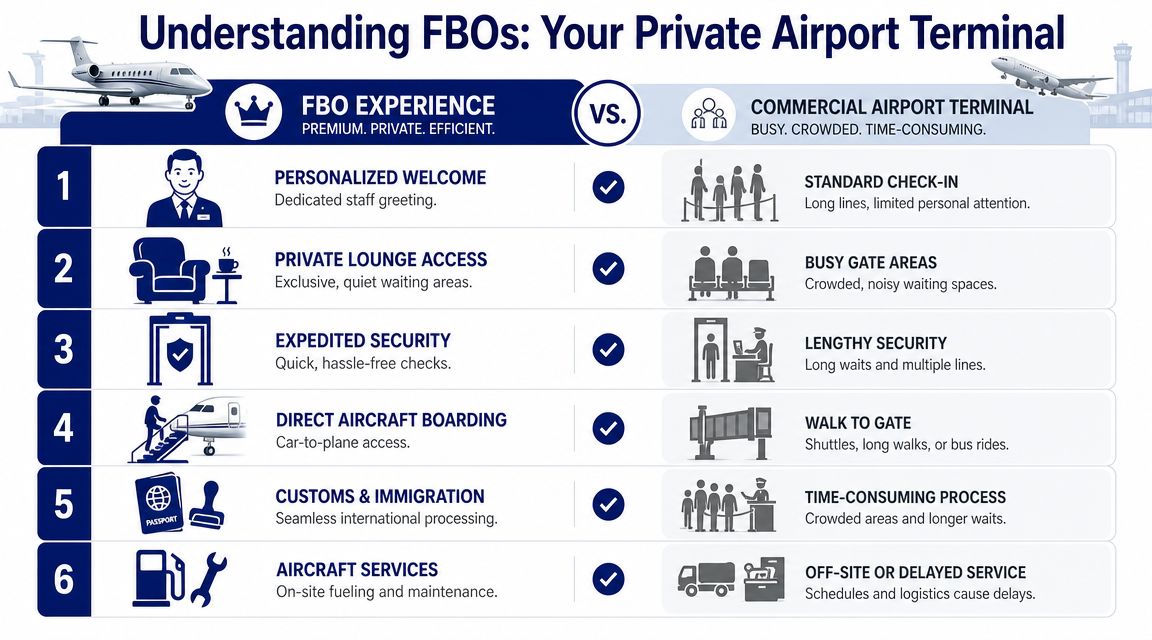
An FBO is the private aviation side of the airport where non-scheduled aircraft are handled. For a passenger, it's best to think of it as part concierge desk, part private lounge, and part operational base for the aircraft. It's where you arrive, check in, wait if needed, board, and often where your car will meet you after landing.
What an FBO actually does
Passengers tend to focus on the lounge, but the operational side matters just as much. FBOs provide specialized ramp access, fueling, parking, and passenger handling, and those details affect both service quality and trip cost, as outlined in this overview of how private jet terminals and FBO services work.
That's why experienced dispatchers don't choose airports by runway alone. They look at the FBO's responsiveness, ramp setup, after-hours support, parking environment, and local fee structure.
If you want a deeper primer, this guide to private jet FBO operations is useful for understanding what happens behind the scenes.
Commercial terminal vs private FBO experience
| Feature | Commercial Airport Terminal | Private Airport FBO |
|---|---|---|
| Arrival flow | Large public terminal, airline counters, shared traffic | Direct arrival at a private facility |
| Waiting environment | Crowded gate areas and public seating | Quiet lounge spaces with more privacy |
| Baggage handling | Airline process with conveyor and claim systems | Handled directly through the FBO team |
| Boarding | Gate call, queue, jet bridge or bus | Direct walk or short drive to the aircraft |
| Ground coordination | Often separate from the terminal experience | Commonly coordinated through the same location |
| Aircraft support | Hidden from the passenger | Visible ramp, fueling, parking, and servicing nearby |
Questions to ask before your flight
Not all FBOs feel the same, and not all are equally efficient. Ask these before confirming your trip:
- Which FBO will we use? Some airports have multiple options with very different ramp access and passenger flow.
- Is the FBO best for quick turns or longer stays? That matters if you're dropping off, waiting briefly, or parking overnight.
- Are there after-hours limitations? Staffing can affect everything from catering handoff to late-night arrivals.
- How close is the FBO to the runway and local roads? Small differences here can affect both departure pace and drive time.
A polished private flight can still feel clumsy if the airport side isn't planned well. The FBO often decides whether the trip feels seamless or patched together.
For first-timers, the simplest takeaway is this. You're not going to “the airport” in the commercial sense. You're going to a dedicated private access point inside the airport ecosystem.
Navigating Your Arrival and Departure
The day of the flight is where the value becomes obvious.
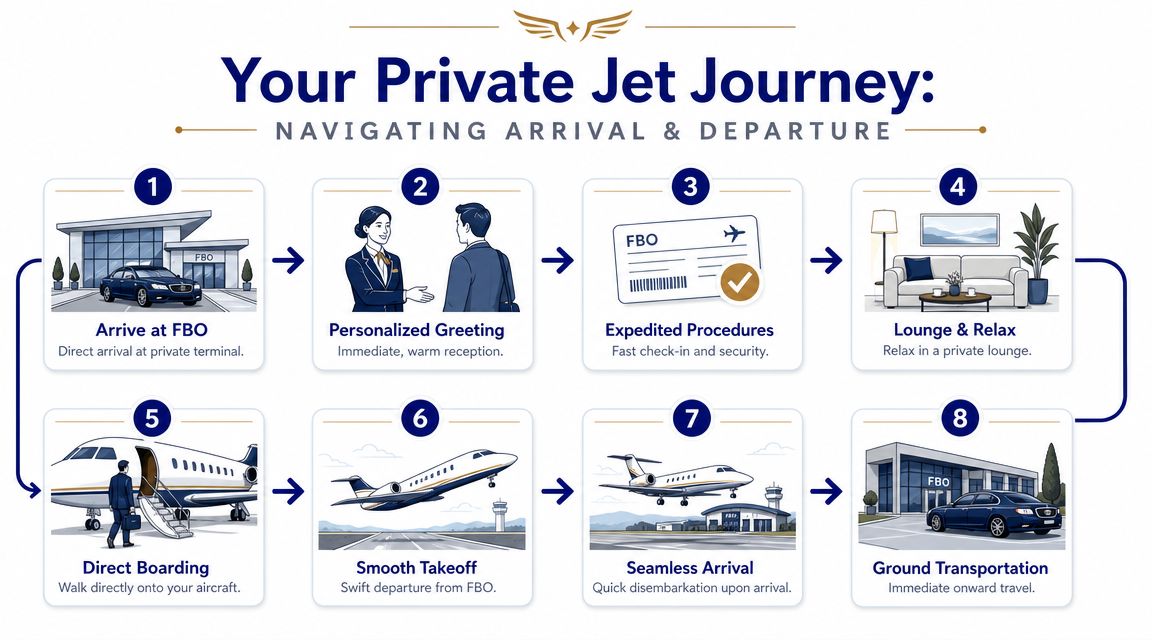
You don't park in a giant garage and start walking. You pull up to the FBO entrance, usually close to the ramp. A staff member or line crew member takes the bags. If you've flown commercially for years, the lack of friction can feel unusual at first because there's no crowd telling you where to stand next.
What departure usually looks like
Inside the FBO, the process is brief. You confirm passenger details, settle into the lounge if the aircraft is still being readied, and then board directly when the crew is ready. On many trips, that means walking out to the aircraft rather than waiting for a formal boarding announcement.
The useful question isn't “How fancy is it?” It's “How many handoffs are there?” In private aviation, there are usually very few.
A typical departure flow looks like this:
- Vehicle arrival at the FBO
- Bags moved directly by staff
- Passenger check and any required document review
- Brief wait in the lounge, if any
- Walk or drive to the aircraft
- Board and depart
What's happening operationally
Even though the passenger experience feels simpler, the aircraft is still entering a controlled airport environment. At towered airports, private jets follow the same core air traffic rules as other aircraft. The FAA notes in its Airman's Information Manual guidance on airport traffic patterns and tower communications that large turbine aircraft must enter the traffic pattern at least 1,500 feet AGL or 500 feet above the established pattern altitude. That keeps them above lighter traffic and helps reduce wake-turbulence and sequencing conflicts.
You don't need to memorize that as a traveler. You only need to understand the implication. Your flight is not bypassing airport operations. It's being integrated into them efficiently.
Arrival is where private flying really feels different
Landing is usually the most satisfying part for first-time clients. The aircraft taxis to the private side of the field. You step off close to the FBO instead of entering a terminal maze. If the trip has been planned well, your car is already there.
For travelers who want the airport handoff to stay just as smooth on the ground, coordinated executive chauffeur services for private jets can remove another common weak point in the journey, especially when timing matters after landing.
Ask yourself these practical questions before departure:
- Will our vehicle meet us planeside or at the FBO entrance?
- If the arrival airport is busy, is there a backup pickup plan?
- Who's handling bags at destination?
- If the schedule shifts, who updates the ground transportation team?
The flight may only be part of the travel day. The airport handoff on both ends often decides whether the trip feels efficient.
Clearing Private Security and International Customs
One of the most common questions is straightforward. Do you still go through security on a private flight?
Yes, but not in the airline-terminal sense.
Private aviation security is built more around passenger identification, manifest control, operator procedures, and advance vetting than around the public checkpoint model associated with commercial travel. That's why the process usually feels quieter and faster. You're not moving through the same kind of screening lane built for hundreds of unrelated passengers at once.
What to expect on domestic trips
For most domestic private flights, the passenger experience is simple. Bring the identification your operator requests, make sure the passenger list is accurate, and arrive on time. The staff and crew already know who is expected.
That doesn't mean the process is casual. It means the checks happen in a more controlled and less theatrical environment.
Questions travelers often ask include:
- Do I need a boarding pass? Usually not in the airline sense.
- Do they scan bags the same way? Procedures vary by operator, airport, and trip profile.
- Can a last-minute guest be added? Sometimes, but never assume. Manifest changes need approval.
International flights have real limits
Private travel is flexible, but it isn't “land anywhere” travel. The biggest reality check comes with customs and immigration. International private flights must land at designated ports of entry for customs clearance, which limits airport choice more than many travelers expect, especially on Caribbean and other cross-border trips, as noted in this discussion of private aviation customs and airport access constraints.
That single rule shapes routing decisions in a major way. A smaller airport might be closer to your villa, resort, or meeting site, but if it isn't the right place for lawful entry, it cannot be your first stop.
International private flying feels easier than airline travel when it's planned correctly. It becomes frustrating when travelers assume flexibility overrides border rules.
If you're traveling with animals, customs planning gets even more important because health paperwork has to align with the destination's entry requirements. For pet owners, your pet's international health guide is a practical reference before any cross-border itinerary is finalized.
A good charter coordinator will confirm the correct entry airport, required documents, and handling process before wheels up. A rushed trip built on assumptions is where private travel stops feeling easy.
How to Book a Private Jet and Understand Pricing
Booking private air travel gets simpler once you stop thinking in airline terms.
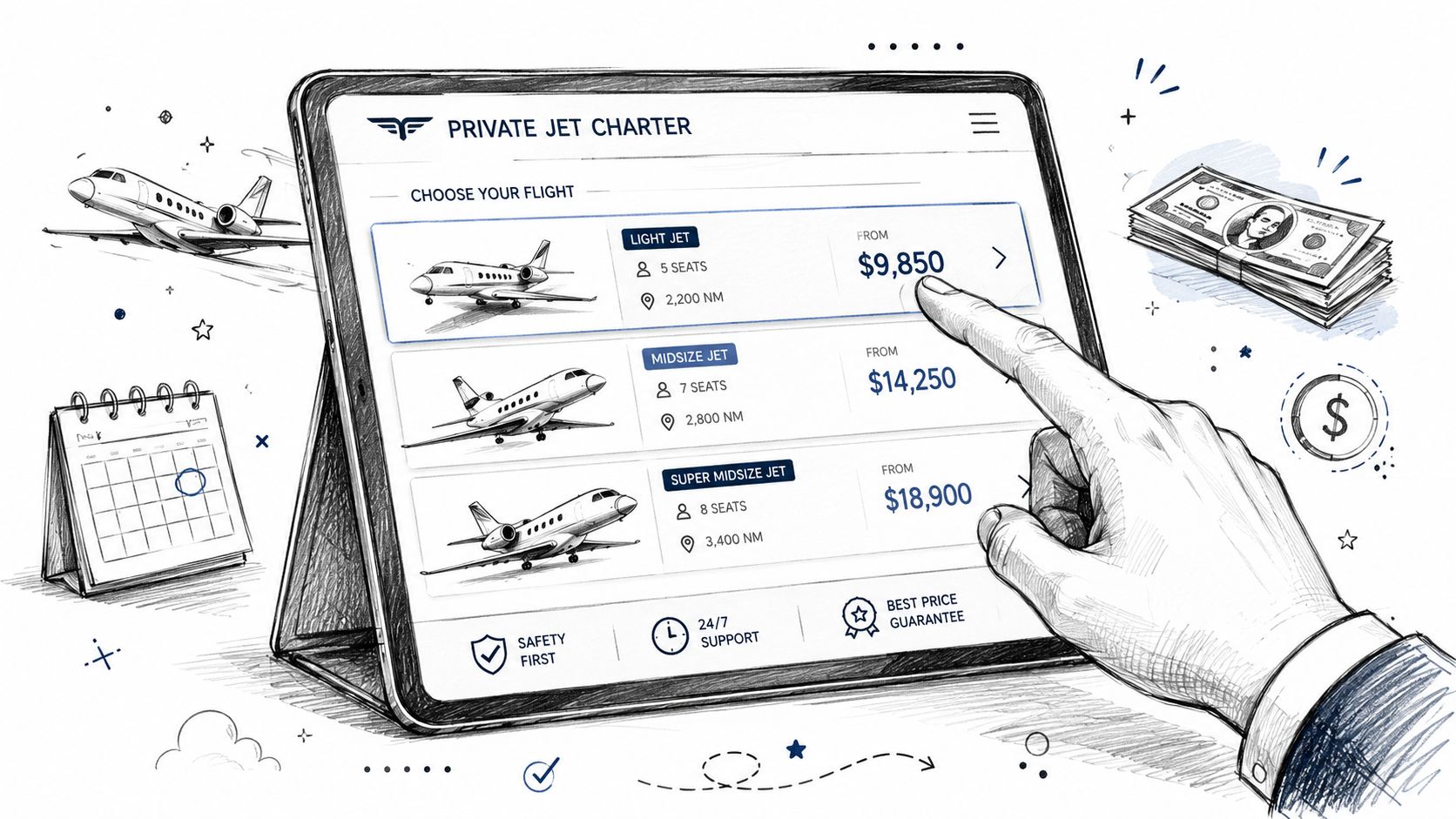
You're not buying a seat on a fixed schedule. You're arranging an aircraft, crew, airport pairing, timing, and service plan around a specific trip. In a market with around 23,000 private jets worldwide as of 2023, with the United States accounting for roughly 63% to 68% of that fleet, there's real depth in aircraft availability and charter infrastructure, especially in the U.S., according to this summary of global private jet fleet size and market scale.
The main ways people book
The right booking method depends on how often you fly and how fixed your schedule is.
- On-demand charter works well for travelers who want flexibility without a long-term commitment. You book trip by trip.
- Empty leg flights can suit travelers with flexible timing and airport tolerance. They can be useful, but they're not ideal if your plans cannot move.
- Membership or jet card style access can make sense for people who fly regularly and want a more standardized booking rhythm.
If you want a useful reference point for how operators explain cost drivers, this page on private jet charter pricing gives a straightforward overview. Providers such as Air Trek also offer on-demand charter, empty leg options, and membership-based access, depending on the trip profile.
What actually drives the price
The final quote isn't just “the plane.” It usually reflects a chain of operational choices.
A few of the biggest variables are:
Aircraft category
A light jet, midsize jet, and larger cabin aircraft solve different problems. The right aircraft depends on route, passenger count, baggage, and airport capability.Trip length and routing
Nonstop capability matters. So does whether the aircraft must reposition before or after your trip.Airport-related charges
Parking, handling, and local airport or terminal-related costs can differ by airport.Crew logistics
If the itinerary requires waiting, overnighting, or repositioning, that affects the quote.Timing pressure
Last-minute travel can reduce aircraft options and may push you toward a more expensive fit than an earlier booking would have allowed.
Smart booking questions
First-time buyers usually get better results when they ask operational questions instead of shopping by aircraft photo.
Ask these:
| Question | Why it matters |
|---|---|
| Is this aircraft a fit for the airport pair? | Runway and airport support matter as much as cabin preference |
| Is the quote based on a repositioning leg? | That affects efficiency and overall cost |
| What flexibility do I have if my schedule changes? | Private travel is flexible, but contracts still matter |
| Which airport on each end gives us the best total trip time? | A slightly different airport can improve the whole journey |
A strong booking process feels transparent. You should understand what you're paying for and why a given aircraft and airport plan were recommended.
Essential Tips for Your First Private Flight
The first private trip tends to raise small questions people don't always ask out loud. What should you wear? How much can you pack? How early should you show up? Can you bring the dog?
Those details matter because confidence comes from knowing the rhythm before the day begins.
What to do before you leave home
Start with the basics.
Confirm the exact FBO address
Don't assume your navigation app should take you to the airport's main terminal. Private departure points are often on another side of the field.Pack for the aircraft you booked
Private travel is usually more forgiving than airline baggage rules, but bag shape and total volume still matter. Soft-sided luggage is often easier to load than bulky hard cases, especially on smaller aircraft.Keep your ID easy to reach
Even when the airport process is smooth, document checks still happen.
What to expect on arrival
Dress for the trip you're taking. Business travelers often arrive meeting-ready. Leisure travelers usually favor comfort over formality. There's rarely a need to dress for a public terminal performance.
If you're unsure when to arrive, ask your charter provider and follow that instruction closely. Private flights move on a tighter, more coordinated timeline than airline departures. Arriving too early usually isn't a problem. Arriving late can be.
Bring what you need for the trip, not what you think an airport expects. The private terminal process is far less performative than commercial travel.
Good etiquette that makes the day smoother
A few habits make a noticeable difference:
Reply quickly to manifest requests
Passenger names and details should be accurate the first time.Tell the operator about unusual baggage early
Golf clubs, skis, instruments, and pet crates are manageable when planned in advance.Ask before making catering assumptions
Private aviation is flexible, but special requests still need lead time.Be direct with the crew
If you're traveling with children, pets, or a tight onward schedule, say so upfront.
For pet travel, private aviation is often much easier than commercial flying because animals can usually remain with their owners in the cabin environment, subject to operator and route requirements. That said, the smart move is to confirm documentation, handling, and arrival rules before the day of departure.
The first trip feels easiest when you stop overthinking the theater of flying and focus on the logistics.
Airport Strategy for Florida and the Americas
In Florida and across the Americas, airport choice often matters as much as aircraft choice.
A traveler might assume the obvious airport is the best airport. In practice, that's often wrong. The closest major commercial hub can create extra congestion on the ground, longer taxi times, more complicated vehicle access, or a less efficient customs process than a nearby executive or regional field.
Why regional airport strategy matters
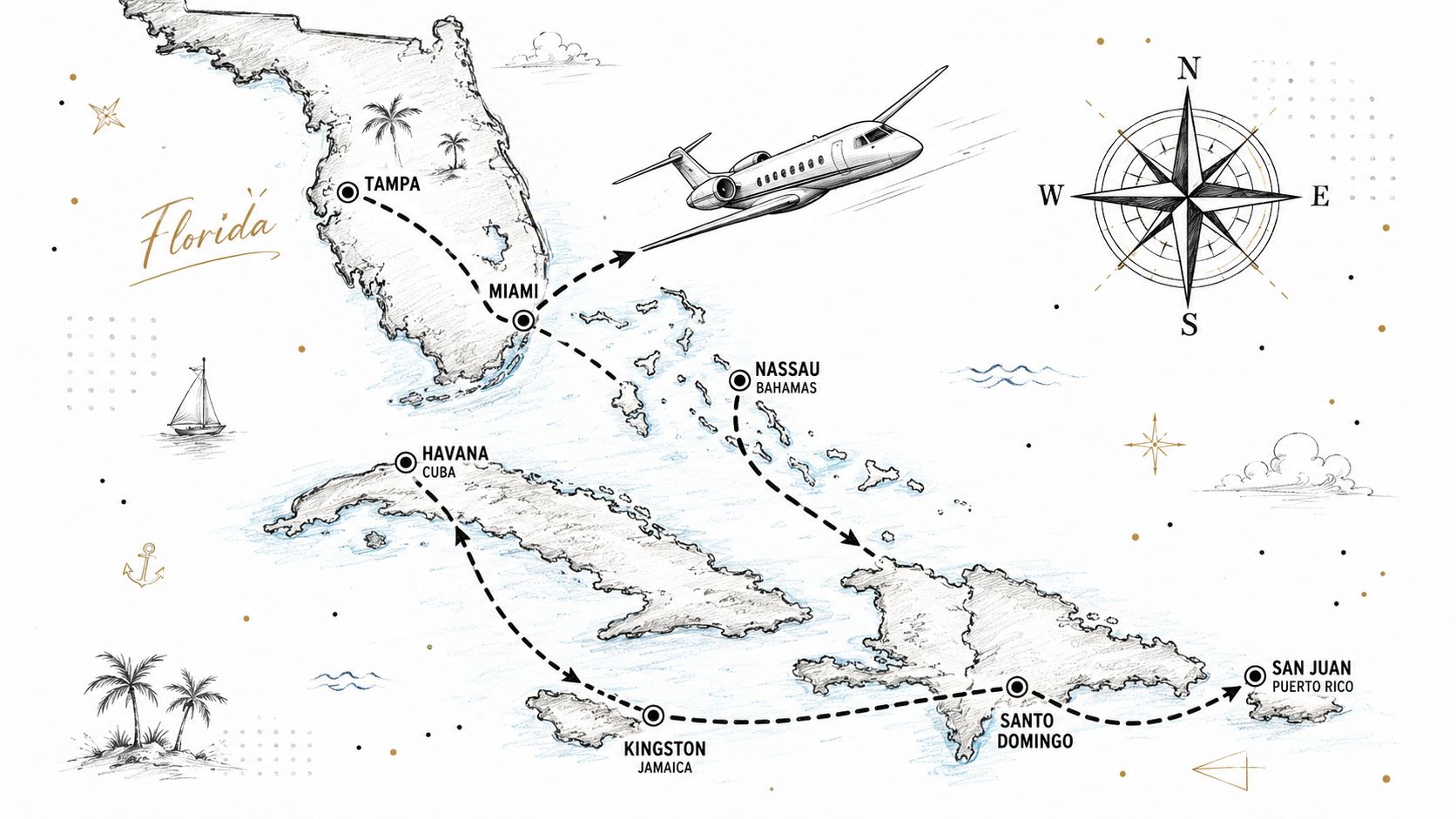
Florida is a strong example. Depending on the trip, travelers may be better served by an executive or regional airport than by the biggest scheduled-airline gateway in the same metro area. That can mean shorter drive times to the final destination, easier FBO access, and a smoother departure window.
This is especially relevant for:
- South Florida business travel where multiple airport options may serve the same meeting area
- West Coast Florida leisure trips where resort access matters more than airline visibility
- Island and Caribbean routing where customs and airport hours can shape the whole itinerary
- Central and South America connections where legal entry points and handling quality matter as much as runway access
For travelers evaluating these options, this overview of private air charter in Florida is a useful starting point for understanding the regional airport network.
The hidden constraint in cross-border flying
The most important planning mistake in this region is assuming private aviation erases border logistics. It doesn't. International private flights must use designated ports of entry for customs clearance, which makes airport strategy critical for the Caribbean and other cross-border routes, as discussed in the earlier section.
That changes how smart planners build the itinerary. Sometimes the best answer is a two-step approach. Clear at the proper airport first, then continue to the more convenient local field if needed and permitted.
What works better than chasing the “closest” airport
When choosing a private jet at an airport in Florida or the broader Americas, ask:
- Does this airport reduce total door-to-door time, or only look good on a map?
- Is customs available where we need it?
- Will this airport be easier for our vehicle, crew, and baggage flow?
- If weather or congestion shifts the plan, what's the next-best airport nearby?
The most efficient private trips in this region rarely happen by accident. They come from matching the aircraft, the FBO, the border requirements, and the purpose of the trip.
If you're planning your first private flight, start with the airport question, not the cabin photo. The right airport and FBO setup often saves more time, hassle, and uncertainty than any onboard upgrade ever will.