
You're probably here because you've looked at private aviation before, liked the idea, then closed the tab the moment you saw a headline rate. That reaction is common. Most travelers don't reject private charter because they hate the experience. They reject it because they assume every option is priced for someone else.
That assumption isn't always right.
If you want to charter a flight cheap, true skill isn't finding the lowest advertised number. It's knowing which kind of trip, aircraft, airport, and booking structure gives you the lowest total trip cost for what you need. That's a different question. It's also where most savings happen.
The Dream of Private Flight Is More Attainable Than Ever
A lot of people start from the same place. They're tired of commercial travel, tired of long airport dwell times, tired of trying to coordinate family, luggage, pets, or a tight business schedule around an airline's timetable. They want the speed and control of private flying, but they assume it's unrealistic.
That's outdated thinking.
Private charter is still a premium product. Nobody should pretend otherwise. Standard trips can range widely, from smaller short-haul flights to large long-range itineraries, and the spread can be enormous. But the market has grown enough to create more entry points for travelers who know where to look. One industry summary reported 5 million private flights in 2023, a 15% rise since the pandemic began, which matters because a busier charter market creates more aircraft movement and more opportunities for lower-cost inventory such as repositioning segments and flexible on-demand options, according to Element Aviation's market overview.
What changed for value-focused travelers
More flights in the system means more planes moving between assignments. More movement creates more chances for pricing that doesn't require paying full bespoke charter economics. That doesn't mean private travel has become cheap in the everyday sense. It means the market now gives flexible travelers more ways to buy unused capacity instead of commissioning every leg from scratch.
That's the key mindset shift.
If you've ever compared private travel with premium commercial service, it can help to also look at how experienced travelers evaluate comfort versus cost in other cabins. Passport Premiere's premium cabin insights are useful for that reason. The same principle applies. Smart travelers don't chase prestige. They chase value for a specific trip.
Cheap private flying isn't about lowering standards. It's about buying the right product for the mission instead of paying for flexibility you won't use.
The question to ask instead
Don't ask, “Can I afford private aviation in general?”
Ask these instead:
- Can I be flexible on timing
- Do I need a round trip or just one direction
- Am I paying for more aircraft than I need
- Would a smaller airport save money and time
- Is the lowest quoted rate the lowest final bill
Those are the questions that separate sticker shock from a workable plan.
Deconstructing Your Private Charter Quote
Most frustration with charter pricing comes from one mistake. Travelers fixate on the hourly rate, then feel blindsided by the final quote. The hourly rate matters, but it's only one part of the price.
Published market ranges show that aircraft class is a major cost lever. Depending on aircraft type, hourly rates can run from $2,000 to $7,000 per hour for turboprops and light jets before additional costs are added, as outlined in Icarus Jet's rate guide.
Here's the visual version of what sits inside a quote:
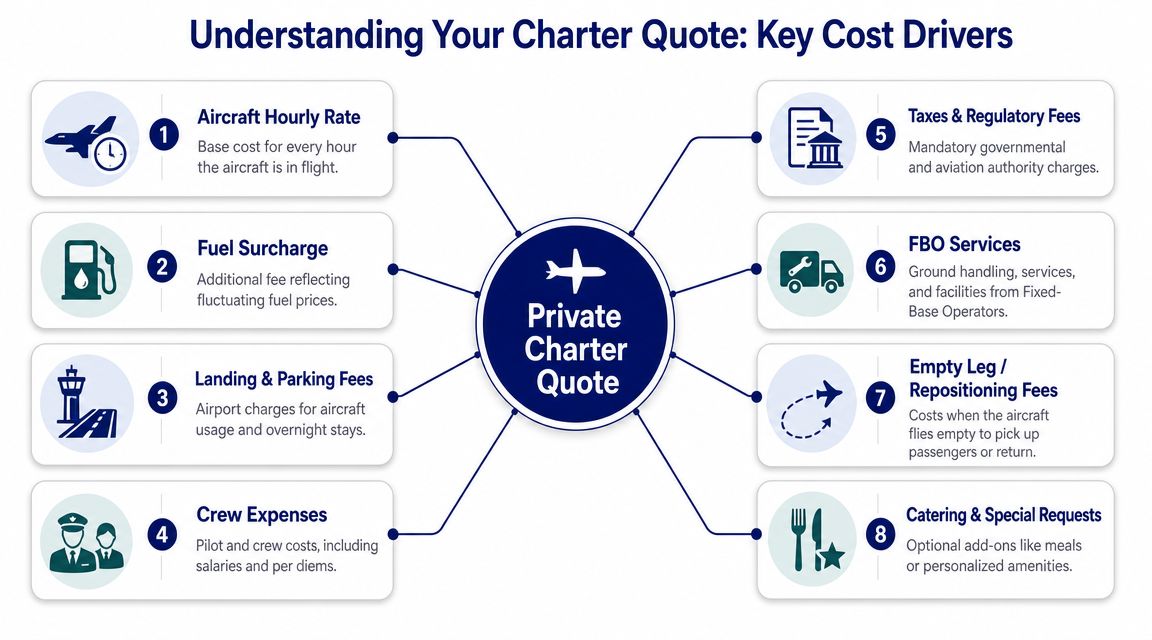
The base rate is only the starting point
A charter quote usually begins with the aircraft's flying time. That's the visible number people notice first. It feels simple, especially when a provider advertises a low hourly figure.
But the aircraft has to be in the right place at the right time. The crew has to operate within the trip's routing. Airports charge fees. Ground handlers charge fees. Some requests add cost quickly.
If you want a more transparent look at how operators present these line items, review a dedicated private jet charter pricing breakdown.
What pushes the final quote higher
The line items vary, but these are the usual cost drivers:
- Aircraft category: A smaller aircraft generally lowers the base cost. A larger cabin raises it.
- Repositioning: If the aircraft has to fly empty to pick you up or return to base, that movement affects price.
- Airport charges: Landing, parking, and handling fees change by airport.
- Crew-related expenses: Some trips trigger crew waiting time or overnight logistics.
- Fuel and tax items: These often appear after travelers have mentally anchored to the hourly figure.
- Optional extras: Catering, special ground transport, and custom requests all move the total.
Why two “similar” trips price differently
Travelers often compare two routes of similar length and wonder why one quote comes back much higher. Usually, the cause isn't mystery pricing. It's trip geometry.
One itinerary might line up with an aircraft already nearby, use less expensive airports, and avoid operational complexity. Another may require more empty positioning, more constrained airport access, or a less efficient aircraft for the mission. Same city pair on paper. Very different economics in practice.
Practical rule: Don't evaluate a charter by asking, “What's the hourly rate?” Ask, “What am I paying all-in for this exact itinerary?”
That's the moment pricing starts to make sense.
The Three Best Ways to Fly Private for Less
If your goal is to charter a flight cheap, three paths usually produce the best value. They don't solve the same problem, which is why travelers often pick the wrong one.
Empty legs
An empty-leg flight is a repositioning segment with no paying passenger on board. Operators may sell that unused segment at a discount because the aircraft is flying anyway. Industry and media summaries say empty legs can be discounted by up to 75% off standard charter pricing, with some short-haul light jet examples in the $2,000 to $5,000 range, according to this private jet charter industry summary.
That's the closest thing private aviation has to a bargain bin.
It's also the least flexible option. Route, timing, and one-way structure are usually fixed. If your plans line up, the value can be excellent. If you need schedule certainty, the low price can become expensive once backup planning enters the picture. For a plain-language overview, this guide on what an empty leg flight is is a useful starting point.
Shared charter and by-the-seat products
Some travelers don't need the whole aircraft to themselves. Shared charter and seat-based models reduce cost by spreading the flight across multiple travelers. This can make private-style access more realistic for solo passengers, couples, or very small groups.
The trade-off is control. You're no longer buying a fully custom mission. You're buying access to a defined route, a defined schedule, or a shared operating structure. For travelers who care most about avoiding airline friction, that can still be a strong value play.
Memberships and fixed-structure programs
Memberships can make sense for travelers who fly often enough to care about repeatability more than one-off bargains. Instead of chasing whatever appears on the market, they're buying a more structured way to access aircraft.
The mistake people make is assuming memberships are automatically cheaper. They aren't always. They're often better for predictability, planning speed, and access terms. For some travelers, that translates into better value over time. For others, occasional on-demand booking still wins.
The cheapest private option for one trip might be a terrible strategy for the next one.
Comparing cost-saving charter options
| Method | Best For | Typical Savings | Flexibility |
|---|---|---|---|
| Empty legs | Travelers with flexible timing and one-way needs | Up to 75% off standard charter pricing on qualifying repositioning flights | Low |
| Shared charters and by-the-seat products | Solo travelers, couples, and people open to fixed routes | Can reduce per-traveler cost by spreading the aircraft expense | Medium to low |
| Memberships | Repeat flyers who want more consistency | Depends on how often and how specifically you fly | Medium |
Which option works for which traveler
Consider the trip, not the marketing.
- For a spontaneous leisure trip: Empty legs are often the first place to look.
- For one or two travelers who don't need exclusivity: Shared access may lower the practical cost most.
- For repeat business use: A membership may provide better operational value than bargain hunting.
What doesn't work is forcing every trip into the same mold.
How Aircraft and Airport Choices Impact Your Price
Most travelers overbuy aircraft.
They picture “private jet” as a category, when it's really a menu of tools. If the mission is a short regional hop, a smaller aircraft can be the smarter financial choice. That isn't settling. It's proper trip design.
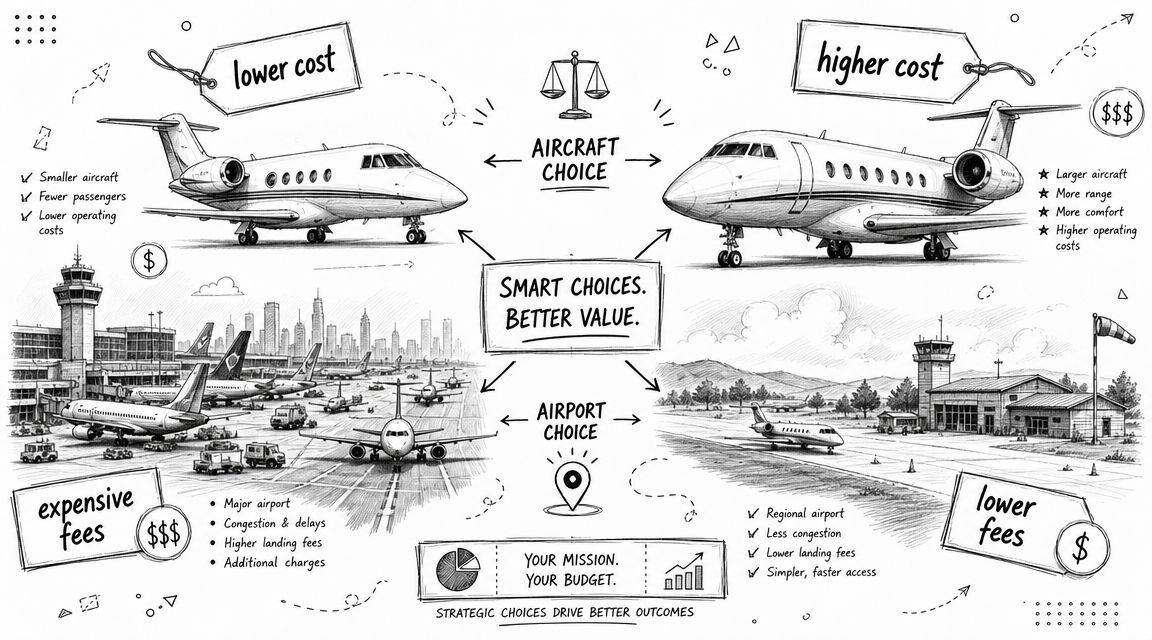
Smaller aircraft often create the better deal
Industry guidance consistently points to aircraft class as one of the strongest pricing levers. The practical takeaway is simple. If your route, passenger count, and luggage profile fit a smaller aircraft, moving up a class just because it sounds more premium usually raises cost without improving the mission.
For some regional trips, a turboprop can produce better total economics than a light jet. For some light-jet missions, moving into a midsize aircraft only adds cost unless you specifically need the cabin, baggage, or range.
A lot of travelers ask, “What's the cheapest type of private plane?” That's not quite the right question. The right one is, “What is the smallest safe and appropriate aircraft for this exact trip?”
Airport choice can matter as much as aircraft choice
Airport selection changes both price and friction.
Major hubs can introduce higher fees, more congestion, tighter operating windows, and more ground delay. Smaller regional airports often improve the experience while also improving the economics. In many charter scenarios, the traveler saves time on the ground and may reduce fee exposure at the same time.
If you're comparing departure options, it helps to understand the role of private jet FBO access and airport handling, because that's where a lot of the practical convenience of private travel lives.
A “cheaper” quote to a major airport can lose its advantage if the airport itself adds delay, handling complexity, or expensive support services.
A better way to think about route planning
Use this filter when reviewing options:
- Passenger count: Don't pay for seats and cabin space you don't need.
- Luggage reality: Golf clubs, skis, pet gear, and large bags can change the right aircraft.
- Stage length: Match the aircraft to the route instead of defaulting to a jet.
- Airport alternatives: Ask for nearby regional options, not just the largest airport in the city.
That combination often produces more savings than chasing a flashy discount.
The Smart Traveler's Guide to Booking and Negotiation
Booking private air travel well has less to do with haggling and more to do with asking better questions early.
Many shoppers see an advertised rate, mentally calculate a rough total, then get a quote that feels too high. Independent guidance on cheap charter pricing notes why that happens: the all-in price often rises because of repositioning, taxes, landing fees, and other trip-specific variables, so the cheapest headline rate isn't always the cheapest final trip, as explained by Air Charter Service USA's cost discussion.
Ask for the all-in quote first
When you request pricing, don't ask only for aircraft options. Ask for the full trip economics.
A useful request sounds like this:
- What is the all-in total
- Which airports are included
- Is there repositioning in this quote
- Are catering and ground services included or separate
- What could still change before departure
That last question matters. Some costs are fixed once the trip is set. Others depend on routing details, airport handling, or optional services.
Flexibility saves money more often than “negotiation”
People love the idea of a last-minute deal. In reality, last-minute pricing is only attractive in certain situations, mostly when an operator is trying to recover value from an aircraft movement that would happen anyway. Outside of those windows, waiting can reduce your options instead of lowering your price.
Your strongest advantage is usually flexibility, not bargaining posture.
If you can shift departure by part of a day, accept a nearby airport, or consider a different aircraft class, you give the charter desk more room to build an efficient solution. That often produces a better result than asking for a discount on an inefficient trip design.
Know what is and isn't negotiable
Some parts of a trip are operationally grounded. Others are preference-based.
Usually more flexible:
- Catering level
- Ground transportation choices
- Preferred airport within a metro area
- Departure window, if your schedule allows
Usually less flexible:
- Core aircraft operating cost
- Regulatory charges
- Required airport fees
- Safety-driven crew and routing constraints
If a traveler says, “I just want the cheapest option,” the right response isn't a lower number. It's a clearer definition of what they can be flexible on.
Questions smart buyers ask
A serious buyer usually asks some version of these:
- What's driving this quote up most
- Is there a smaller aircraft that still works
- Would a nearby airport lower the total
- Is there any matching repositioning inventory
- If I need round-trip certainty, is this still the lowest-risk option
One practical option in this market is Air Trek, which offers on-demand charter, memberships, and empty-leg access across its service network. The useful part for budget-minded travelers isn't branding. It's having multiple booking structures available when one product type doesn't fit the trip.
Your Pre-Flight Checklist for an Affordable Charter
A cheap charter usually comes from discipline before booking, not luck after it.
Use this shortlist before you approve a trip:
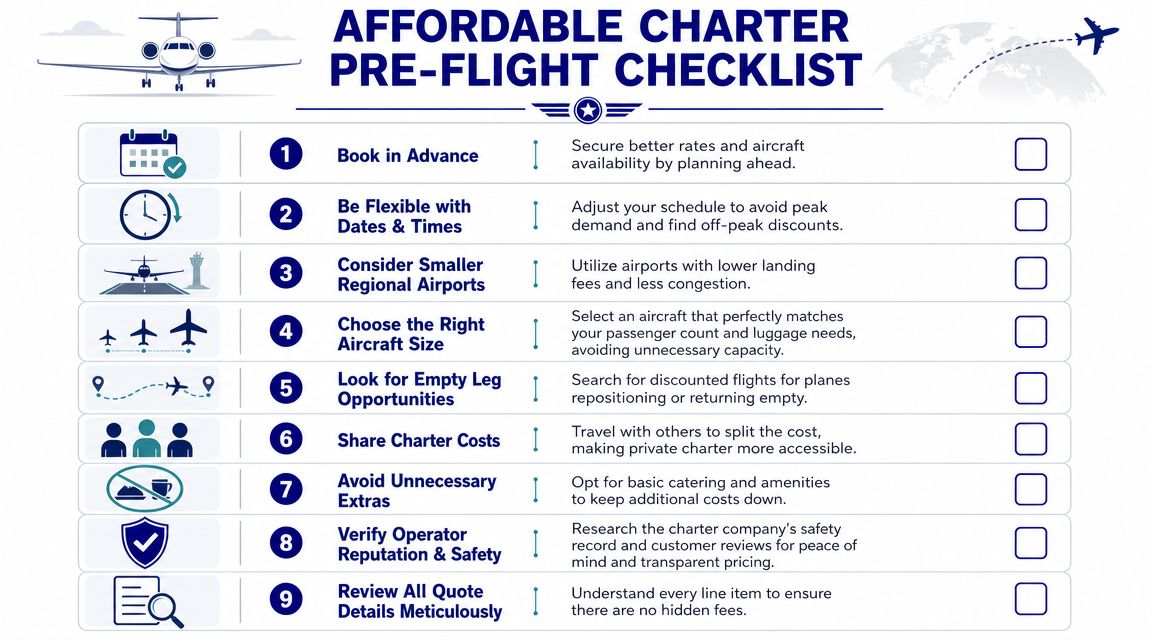
Quick checklist before you book
- Check empty-leg availability: If your timing is loose and the trip is one-way, this can change the math fast.
- Test schedule flexibility: Even a modest departure window can enable better routing.
- Right-size the aircraft: Don't choose by image. Choose by passengers, bags, distance, and airport access.
- Compare airport pairs: Regional airports often improve both cost and convenience.
- Ask for all-in pricing: Don't approve a trip off a headline hourly rate.
- Trim optional extras: Keep catering and add-ons aligned with what you'll use.
- Confirm reliability needs: If the trip is time-critical, avoid building around fragile inventory.
- Verify operator standards: Price matters, but safety and operational clarity matter more.
A traveler who checks those items is far less likely to overpay.
Frequently Asked Questions About Cheap Charters
Is it cheaper to fly private with a group
Often, yes. Private charter prices are usually for the aircraft, not for each seat. If your group fills the aircraft efficiently, the per-person cost can fall meaningfully. Significant savings depend on choosing the right aircraft size instead of paying for excess cabin you won't use.
Are last-minute private charters cheaper
Sometimes, but only in the right scenario. Last-minute value is most often tied to opportunistic inventory such as repositioning segments. If your travel is time-sensitive or falls during heavy demand, waiting can make the trip harder and more expensive to book.
What is the absolute cheapest kind of private flight
That depends on the trip. Industry guidance on low-cost private flying stresses that the best strategy is trip-type dependent. For some travelers, a discounted empty leg is the right answer. For others who need round-trip certainty, the better value may come from a smaller, more efficient aircraft such as a turboprop on a regional route, as noted in BlackJet's guide to flying private for less.
Why was my quote higher than the advertised rate
Because the advertised rate usually isn't the full trip cost. Airport charges, repositioning, taxes, and service choices can all affect the final number. That's why experienced charter buyers compare quotes based on total mission cost, not just the aircraft's posted hourly figure.
If you want to charter a flight cheap, don't chase the cheapest-looking number. Chase the best-fit itinerary. That means matching the trip to the right aircraft, the right airport, the right booking structure, and a quote that shows the full cost up front. That's how private flying gets more affordable without becoming unpredictable.