
You're probably looking at a trip that commercial airlines have made harder than it needs to be. Maybe it's a leadership team that has to be in two cities in one day. Maybe it's a family trying to reach an island destination without burning a full day on connections. Maybe it's a short-notice flight where schedule control matters more than lounge access.
That's usually when people start searching for charter flight price and run into the same problem. There isn't one simple fare. There's an aircraft, a route, an operating plan, and a set of trip-specific costs that all combine into the final quote.
The good news is that charter pricing isn't random. It follows a logic. Once you understand that logic, it gets much easier to judge whether a quote is reasonable, where the money is going, and when private flying creates real value for a group instead of just looking expensive on paper.
How Charter Flight Pricing Really Works
A common scenario goes like this. Six people need to travel together. The commercial option involves separate bookings, tight connections, baggage uncertainty, and airport timing that nobody controls. On paper, the airline seats may look cheaper. In practice, the group loses time, flexibility, and often a clean same-day schedule.
That's where private charter changes the conversation. You're not buying a seat. You're hiring an aircraft and an operating plan built around your trip.
That distinction matters because a charter flight price isn't a shelf price like an airline ticket. It's more like reserving a staffed, mission-specific transportation asset. The quote depends on the aircraft category, how long the aircraft is billable, where it starts, where it has to reposition, what airports are involved, and whether the trip requires anything beyond standard service.
The fastest way to misunderstand private aviation pricing is to compare it to airline seat pricing. The economics are completely different.
People often ask, “Why can't someone just tell me the price right away?” Sometimes they can, but only if the trip details are clear. Two trips that look similar on a map can price differently because of aircraft availability, airport fees, timing, and routing efficiency.
What travelers usually want to know first
Before they care about aircraft model names, most travelers want answers to practical questions:
- What am I paying for
- Is the quote based on the whole plane or per person
- What fees are normal
- Can this make sense for a group
- How do I keep the price under control without choosing the wrong aircraft
Those are the right questions. Charter pricing becomes much easier once you separate the base flying cost from the trip-specific additions and then translate the total into cost per passenger for your actual group.
Understanding Per-Hour Billing and Aircraft Tiers
A charter quote usually starts with one question: how many billable flight hours does the mission require, and what aircraft can fly it efficiently?
That sounds simple, but many travelers either overspend or choose the wrong cabin. Hourly pricing is only the starting point. The key decision is matching the aircraft's range, cabin size, baggage capacity, and airport performance to the trip you are flying.
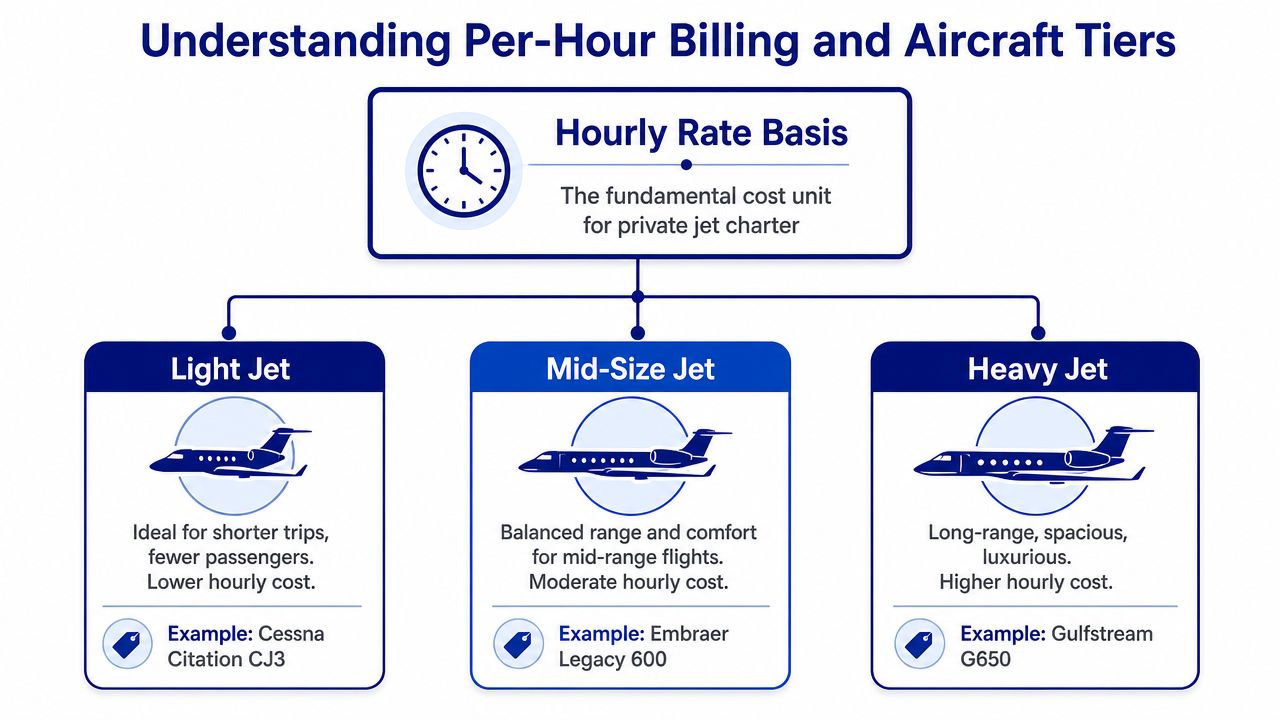
The aircraft tier is the first pricing decision
Aircraft category drives a large share of the base cost because each step up in size usually brings higher fuel burn, higher crew cost, and more operational capability. Sometimes that added capability is worth every dollar. Sometimes it is expensive dead weight.
This is why experienced charter buyers focus on mission fit first.
A practical way to look at the tiers:
Turboprops: These are good for shorter sectors, smaller groups, and airports where efficiency matters more than jet speed. On the right route, a turboprop can deliver a strong cost-per-passenger result.
Very light jets and light jets: These work well for short to moderate trips where travelers want privacy, speed, and easy access to smaller airports without paying for more cabin than they need.
Midsize and super midsize jets: These often make sense when the trip is long enough, the passenger count is high enough, or the baggage load is heavy enough that moving up avoids fuel stops, comfort compromises, or payload restrictions.
Heavy jets: These are built for longer legs, larger groups, and trips where cabin space, nonstop capability, and onboard amenities are part of the operating requirement.
Matching the aircraft to the mission
The right aircraft is the one that solves the trip cleanly at the lowest sensible total cost.
For a short business day trip with four passengers and light bags, a light jet may price far better than a midsize aircraft with no meaningful sacrifice. For a family ski trip or a corporate group carrying trade show materials, the cheaper category can become the expensive mistake if bags do not fit or the aircraft has to make a fuel stop. I see this often. Travelers compare hourly rates, then realize too late that the lower-rate aircraft cannot do the mission comfortably or directly.
Cost per passenger is where private charter starts to make practical sense. A six-person group splitting one aircraft can end up much closer to commercial first-class pricing than many people expect, especially once you factor in time saved, direct airport access, and the ability to keep the group on one schedule. That does not make charter cheap. It does make it easier to justify when the trip would otherwise involve premium airline fares, overnight stays, or lost work time.
Reviewing available on-demand charter flights side by side helps expose the trade-offs. One option may have a lower hourly rate but tighter baggage limits. Another may cost more per hour but reduce total travel time or handle the route nonstop.
Good charter planning is rarely about booking the most impressive aircraft. It is about paying for the capability the trip needs, and no more than that.
Deconstructing Your Full Charter Flight Quote
A client sees a jet quoted at $3,500 per hour and assumes a three-hour trip should cost $10,500. Then the final number arrives higher, and the quote feels harder to trust than it should.
The gap usually comes from treating the hourly rate as the full charter flight price. It is only the flight portion. A real quote also has to cover the aircraft's position, airport charges, taxes, crew logistics, and any trip requirements tied to your specific itinerary.
Flying Magazine's private jet charter cost calculator gives a straightforward example of the math. A 3-hour mission at $3,500 per hour produces a $10,500 base fare before taxes and trip-related fees. That distinction matters because it changes how smart buyers compare options. The better question is not “What is the hourly rate?” It is “What is the full trip total, and what does that total buy us in time, flexibility, and cost per passenger?”
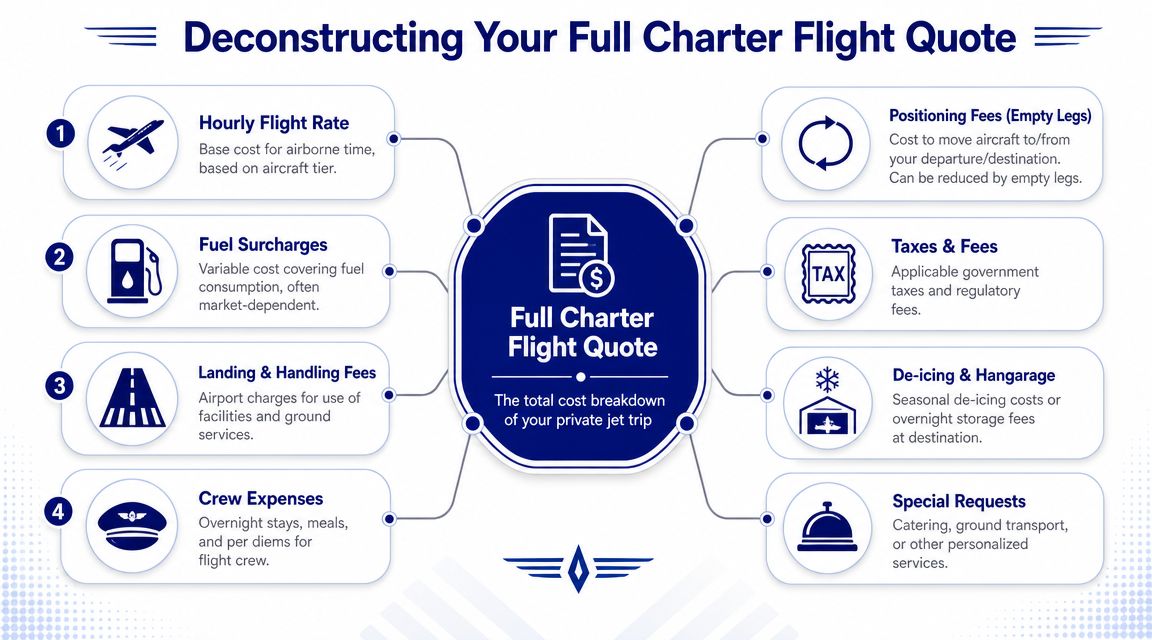
The major parts of a quote
A solid charter quote usually breaks into a few predictable categories.
Positioning fees
The aircraft may need to fly to your departure airport before your trip starts, or return to its home base after your trip ends. That repositioning time can be billable.
Federal Excise Tax (FET)
Domestic U.S. charter flights commonly include federal excise tax. As noted earlier, this is a standard part of charter pricing, not a surprise add-on.
Other line items often include:
Landing and handling fees
Airports and FBOs charge for ramp access, ground handling, parking, and facility use. A major metro airport often costs more than a secondary airport nearby.Crew expenses
Multi-day trips can require hotel rooms, meals, and ground transportation for the crew.Fuel-related charges
Some operators show fuel as part of the hourly rate. Others separate it. Either way, fuel affects the total trip cost.Catering and special requests
Basic refreshments may be included. Custom catering, premium beverages, pet handling, or other special arrangements can raise the quote.Operational charges
De-icing, hangar storage, or unusual ground support may appear when weather or airport conditions require them.
Why these are normal operating costs
These items are not padding if they are disclosed clearly. They reflect what it takes to run the trip safely and legally.
Two passengers can charter the same city pair and receive different totals because the missions are different in ways that matter. One flight departs from a congested primary airport with higher handling fees. Another uses a reliever airport where the aircraft is already nearby. One itinerary turns the aircraft the same day. Another requires the crew and aircraft to stay overnight.
This is also where group economics matter. A quote that looks high on its face can become much more reasonable when spread across five, six, or seven travelers who would otherwise buy commercial first-class tickets, lose half a day in connections, or need hotel nights because the airline schedule does not fit the meeting. The aircraft cost is fixed for the trip. Your cost per passenger drops as you fill the seats intelligently.
Three questions to ask before you approve a quote
How much billable flight time is included?
Ask whether the total reflects only occupied flight time or also any minimums tied to the aircraft.Is repositioning included?
If the aircraft is not already near your departure point, that should be clear in the quote.Which charges are fixed, and which can change?
Taxes are predictable. Weather-driven items such as de-icing may not be.
A simple way to read the number
Most quotes make more sense when you separate them into two buckets:
| Quote component | What it reflects |
|---|---|
| Base flight cost | Aircraft category multiplied by billable flight time |
| Trip-specific costs | Taxes, airport charges, crew expenses, fuel-related items, and service requests |
Read the quote this way and the pricing becomes easier to judge. You can see what you are paying for, compare aircraft on total mission cost instead of headline hourly rate, and decide whether the convenience is worth it for your group. That is how experienced buyers keep private charter in the category it belongs in. Premium travel, priced with real operating logic.
Typical Charter Prices by Route and Aircraft Class
The market is large enough now that broad pricing bands are well established. According to Element Aviation's industry trends and statistics summary, the U.S. charter flights industry is projected to reach $52.6 billion in revenue in 2026, with the source also noting about 5 million private flights globally in 2023, pricing that can range roughly from $1,500 to $15,000 per hour, and North America at 31% of global market share in 2023.
That matters for buyers because it confirms something seasoned coordinators already know. There is no universal charter fare. The market supports a wide range of aircraft, missions, and pricing outcomes.
A practical benchmark for a short trip
For a quick reference point, here's a simple table using a 2-hour flight and the published aircraft-rate ranges already discussed. This is best used as a rough planning tool, not a final quote.
Estimated Charter Flight Price by Aircraft Class (2-Hour Flight)
| Aircraft Class | Passengers | Avg. Hourly Rate | Estimated Trip Price |
|---|---|---|---|
| Turboprop | 4 to 8 | $1,200 to $1,800 | $2,400 to $3,600 |
| Light Jet | 6 to 8 | $2,200 to $3,000 | $4,400 to $6,000 |
| Midsize Jet | 7 to 9 | $2,800 to $3,800 | $5,600 to $7,600 |
| Heavy Jet | 10 or more | $5,000 to $8,000 | $10,000 to $16,000 |
Those figures reflect base flying cost for the aircraft over the flight duration. They don't include the quote components discussed earlier.
What that means on real routes
Take a few common trip types:
South Florida to the Bahamas
Buyers often focus on keeping the aircraft right-sized because the mission is short. Oversizing the jet can raise the price without improving the trip much.Miami to New York
For this route, midsize and super midsize options often enter the conversation because travelers want speed, cabin comfort, and a straightforward nonstop profile.Naples to a mountain destination during peak seasonal demand
Airport choice, baggage profile, weather planning, and schedule precision can affect the quote as much as the raw route length.
Why one route prices differently from another
Two things can make a similar route feel more expensive than expected:
Airport economics
Some airports are more expensive to use and handle.Aircraft positioning reality
If the best aircraft for your mission has to come to you from somewhere else, the quote reflects that movement.
If your goal is value, don't ask only for a city-pair price. Ask which aircraft at which nearby airports create the most efficient total trip.
That's usually where the best charter decisions get made. Not by chasing the lowest hourly rate, but by reducing unnecessary complexity in the mission.
Strategic Ways to Reduce Your Private Jet Cost
The best savings usually come from planning choices, not hard negotiation. Private aviation rewards travelers who are flexible on aircraft, timing, and airports.
The biggest mindset shift is this. Since the aircraft is priced as a whole, cost per passenger becomes the number that matters for many families, executive teams, and event groups. As noted in International Jet's explanation of one-way private jet pricing, private jet pricing is for the whole aircraft rather than per seat, which changes the economics for groups, and empty-leg or repositioning opportunities can materially change the final price.
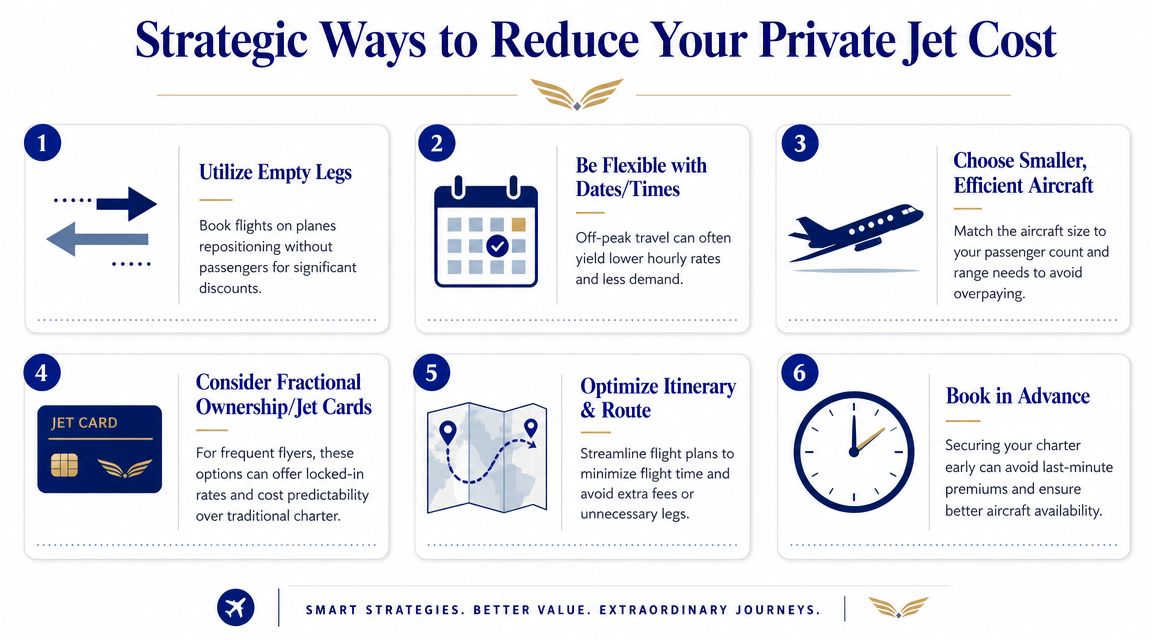
The decisions that usually help most
Some savings tactics are practical. Others create more inconvenience than they save. These are the ones that usually work.
Use empty legs when the schedule allows
If an aircraft already needs to reposition, that can create a better buying opportunity than a custom one-way. If you want the mechanics behind that, Air Trek's overview of what an empty leg flight is gives the basic operating logic.Stay flexible on nearby airports
A nearby executive airport can lower handling friction and improve aircraft availability. For a charter coordinator, this is often one of the cleanest ways to improve total value.Choose the smallest aircraft that fits
“Fits” includes people, bags, route, and comfort for the actual duration. Misjudging these factors often leads to many avoidable overspends.Book before the trip becomes urgent
Last-minute charter is absolutely possible, but urgent demand narrows your options. More time usually means more aircraft choices and a better chance of avoiding a poor fit.
Cost per passenger is where the math changes
This is the part many travelers miss. A charter can look expensive until you divide it by the actual group and account for the convenience delivered.
If a whole aircraft is moving a business team, the comparison often isn't “private jet versus one airline seat.” It's “private aircraft versus several premium commercial tickets, multiple ground transfers, schedule losses, and a less reliable day.”
That doesn't mean private will always cost less. It won't. But for a group, the pricing can become more predictable than people expect because everyone travels on one contract, one schedule, and one aircraft.
What doesn't work well
A few approaches sound smart but often backfire:
Chasing the lowest advertised hourly rate
The wrong aircraft can increase total trip cost if it creates baggage issues, refueling complications, or repositioning inefficiency.Assuming one-way is always cheaper
Sometimes it is. Sometimes round-trip structure is cleaner and more efficient.Ignoring commercial pricing patterns entirely
Even if you plan to fly private, it helps to understand how broader airfare timing works. A useful outside reference is the CoraTravels guide to flight prices, especially for thinking about timing, demand shifts, and how traveler flexibility changes the deal.
Smart charter buying isn't about making private aviation cheap. It's about making the spend intentional.
Getting an Accurate and Transparent Price Quote
The fastest way to get a useful quote is to provide clean trip details upfront. Vague requests produce vague pricing.

Have these details ready
When you request pricing, gather the basics first:
Passenger count
Not a rough guess. A real number. Aircraft selection depends on it.Departure and arrival airports or cities
If you're open to alternate airports, say so.Preferred date and departure timing
Even a time window helps.One-way or round-trip intention
This affects aircraft planning immediately.Luggage profile
Standard carry-ons are one thing. Golf clubs, ski gear, product samples, or musical instruments are another.Pets or special onboard needs
These are manageable, but they need to be part of aircraft selection early.
Ask for quote clarity, not just quote speed
A solid charter quote should tell you what's included, what is route-specific, and what may change if your schedule changes.
If you're comparing providers, ask each one to outline the aircraft category, the trip assumptions, and the major cost components in plain language. That makes the offers comparable.
For travelers who want to understand the booking process before requesting pricing, this step-by-step guide on how to book a private jet is a useful checklist.
The simplest test of a good quote
You should be able to answer these questions after reading it:
- What aircraft is being proposed
- Why it fits the mission
- What is included in the total
- What could change if my itinerary changes
If those answers aren't clear, the quote may still be usable, but it isn't fully transparent.
Common Questions About Charter Flight Prices
Is it cheaper to book a charter flight last minute
Sometimes, but not reliably. Last-minute availability can create opportunity if an aircraft already needs to reposition. It can also narrow your choices and leave only less efficient options. Flexibility helps more than urgency.
How is the charter flight price calculated per person
The operator prices the aircraft, not the seat. To get a per-person view, divide the full trip cost by the number of travelers in your group. That's why private charter starts making more sense when several people are traveling together on the same schedule.
Are pets allowed, and do they add to the cost
Pets are often allowed, but they should always be disclosed at quote stage. The main issue usually isn't a pet fee by itself. It's aircraft suitability, cabin rules, cleaning requirements, and any operational planning needed to support the trip smoothly.
What is the difference between an estimate and a firm quote
An estimate is a planning number based on likely aircraft and trip assumptions. A firm quote reflects an actual available aircraft and a defined itinerary. If your timing, airports, baggage, or passenger count changes, the firm quote can change too.
What question should I ask before I book
Ask this: Is this the most efficient aircraft for my actual mission, not just the lowest hourly option? That one question prevents a lot of expensive mistakes.
Charter flight price makes the most sense when you stop treating it like a luxury fare and start treating it like a logistics decision. For the right trip, especially for a group, the value often comes from control, time saved, cleaner routing, and a more predictable travel day.