
If you ask, how safe are private jets, most articles answer the wrong question.
They compare “private aviation” to airlines as if every private flight belongs in one bucket. It doesn't. A professionally operated charter jet with a trained crew, formal maintenance oversight, and disciplined operating standards has very little in common with a lightly supervised personal flight flown under looser conditions. That distinction matters more than the paint scheme on the aircraft or the size of the cabin.
For a business executive, family office, or travel manager, the useful question isn't “Are private jets safe?” It's “How safe is this operator, this crew, and this aircraft?” Once you frame it that way, the picture gets clearer. You stop reacting to broad headlines and start looking at the factors that drive risk: who's flying, who maintains the aircraft, what operating rules apply, and whether the company runs a real safety culture or just markets one.
Answering the Question of Private Jet Safety
Private jets can be very safe. But that answer only means something when you define which kind of private flying you're talking about.
Professionally operated business jets sit in a different safety category from general aviation as a whole. That's because “general aviation” includes a wide range of flying, from owner-flown piston aircraft to training flights and recreational trips. Many travelers hear one statistic about private aviation and assume it applies equally to every charter flight. It doesn't.
The better question to ask
If you're booking charter travel, the decision should turn on operator quality. A strong operator controls the variables that shape outcomes:
- Crew standards: Two-pilot operations, recurrent training, and disciplined cockpit procedures
- Maintenance quality: Structured inspections, documented maintenance programs, and reliable technical support
- Operational judgment: Clear weather minimums, standardized checklists, and no pressure to “make the trip work” at the expense of safety
- Oversight: Certification, audits, and internal accountability
Practical rule: Don't evaluate private aviation by category alone. Evaluate the operator behind the flight.
That's why experienced travelers, procurement teams, and security-conscious families shouldn't stop at “private jet” as a label. The aircraft matters. The operator matters more.
What gives passengers real peace of mind
The safest private flights usually come from organizations that act like aviation companies first and luxury brands second. They brief thoroughly, train continuously, maintain conservatively, and cancel when conditions don't meet standards. That discipline may be less visible than leather seats or catering, but it's what protects passengers.
People also ask:
- Are private jets safer than small planes?
- Are charter flights as safe as commercial airlines?
- What makes one private jet operator safer than another?
- Should I care more about the aircraft or the crew?
Those are the right questions. The answers start with the data.
Understanding the Real Data on Aviation Safety
Broad accident headlines often lump very different kinds of flying into one bucket. That is where private jet safety gets misunderstood.
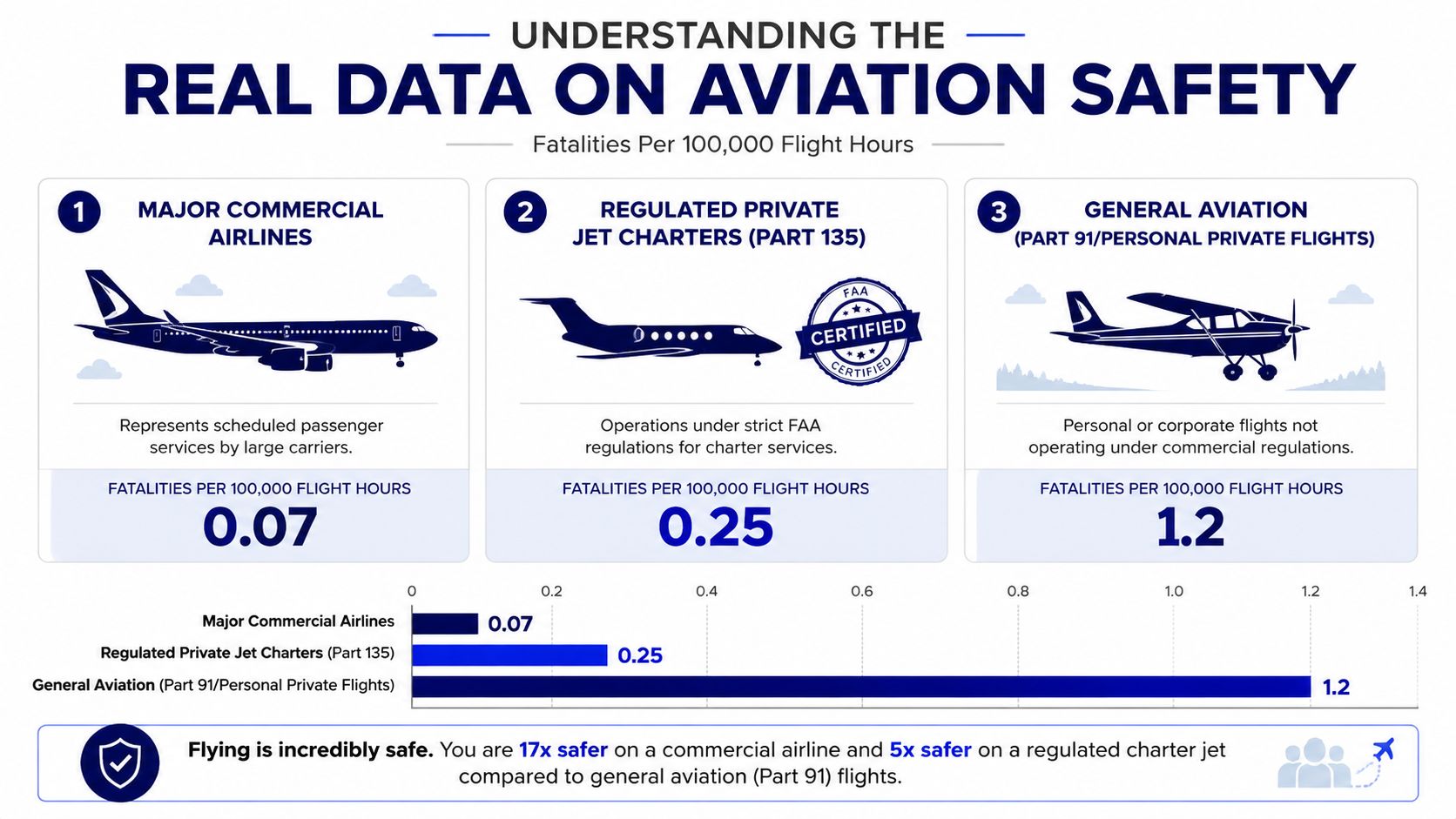
A useful way to read the numbers is to separate three categories: major commercial airlines, professionally operated business jets, and general aviation as a whole.
The three-tier safety picture
According to an aviation safety comparison reported by RESQ, business jets see roughly 0.1 to 0.3 fatal accidents per 100,000 flight hours, scheduled commercial airlines sit around 0.006 per 100,000 flight hours, and general aviation overall falls near 0.9 to 1.1 per 100,000 flight hours.
That comparison matters because each category reflects a different operating environment, not just a different aircraft.
Airlines remain the benchmark. They have the deepest standardization, dispatch support, maintenance infrastructure, and regulatory control.
Professional business jet operations sit in the middle. They do not match the airline system, but they perform much better than the broad general aviation category, which includes the highest-risk segment of private flying. In the RESQ summary, that gap is tied in large part to the fact that many general aviation fatalities occur in light piston aircraft rather than turbine business jets flown by trained crews.
What those numbers mean in practice
Passengers get into trouble when they hear "private aviation" and assume one safety profile applies to all of it. It does not.
A professionally crewed charter flight in a turbine jet is a different risk picture from recreational flying in a small piston aircraft, even though both may be labeled "private." That distinction also matters on repositioning sectors and empty leg charter flights, where the aircraft may be the same but the operator's standards still determine how the trip is conducted.
Here is the practical comparison:
| Flight type | Safety profile |
|---|---|
| Major commercial airline | Lowest fatal accident rate and the industry benchmark |
| Professional business jet charter | Higher risk than airlines, but materially safer than general aviation overall |
| General aviation overall | Broad category with the highest risk of the three |
The key point is simple. "Private aviation" is too broad to answer the safety question on its own.
Trend direction matters too
The same RESQ summary also points to a decline in business jet fatalities over recent years. The percentage cited in that source appears internally inconsistent, so I would not rely on the exact arithmetic. The direction is still useful. It suggests safety performance in the business jet segment has been improving, which fits what many operators have invested in through better training, stronger safety systems, and more disciplined operating procedures.
For a client choosing charter, that is the practical takeaway. Private flying should not be judged by airline standards alone, and it should not be judged by the weakest end of general aviation either. The safety outcome depends on which part of private aviation you are buying.
Why Not All Private Flights Are Created Equal
Most confusion about private jet safety comes from one mistake. People assume all private flying follows the same rules.
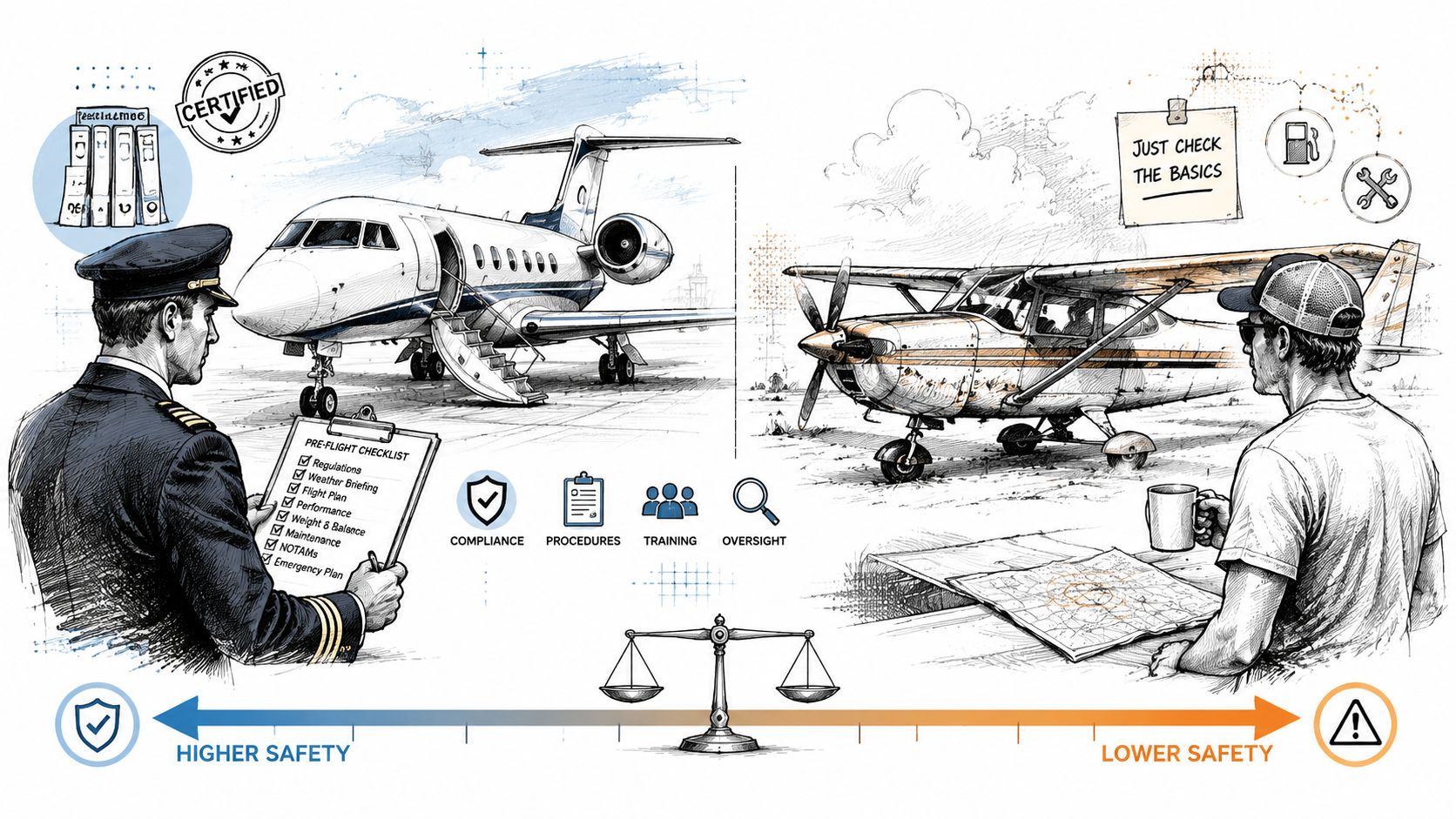
It doesn't. The sharpest line in U.S. charter safety is between professionally run commercial charter operations and more lightly supervised private operations. That's why two flights on similar-looking aircraft can represent very different levels of operational control.
What separates a professional charter operation
Industry and safety databases show that business and general aviation often look worse than scheduled commercial air transport in broad comparisons, but that gap is driven largely by lower-standard operators and non-professional flying, not by well-run charter companies. Data from U.S. accident reporting indicate that most general aviation accidents occur in unsupervised, single-pilot, or minimally maintained operations, rather than in professional, two-pilot charter or business-jet flights operating under Part 135 or similar regulations (discussion of operator differences using NTSB and FAA historical accident context).
That distinction isn't a technical footnote. It's the heart of the issue.
A high-standard charter operator typically works with more formal dispatch discipline, more structured crew procedures, clearer maintenance documentation, and more accountability around operational decisions. In weaker private operations, those controls may be thinner or inconsistent.
What travelers should watch for
If you're evaluating a flight, don't stop at “Is it a private jet?” Ask what kind of operation is behind it.
Look for signs of a professional charter environment:
- Two-pilot standard: Crew pairing reduces single-point human error.
- Operational control: Someone beyond the pilot is involved in flight release, planning, or oversight.
- Maintenance traceability: Records, inspections, and vendor quality are treated seriously.
- Conservative trip acceptance: The operator is willing to decline or delay a mission when conditions don't support it.
If you're comparing options, it also helps to understand pricing structures like empty leg flights in private aviation. Cost-saving opportunities can be legitimate, but the same safety questions still apply. A lower price doesn't tell you whether the operator runs a disciplined system.
If a charter provider seems reluctant to discuss certification, crew structure, or maintenance practices, that's useful information by itself.
The uncomfortable reality is that “private aviation” can describe both top-tier professional transport and much looser forms of flying. Serious travelers should never treat them as interchangeable.
The Three Pillars of Aviation Safety
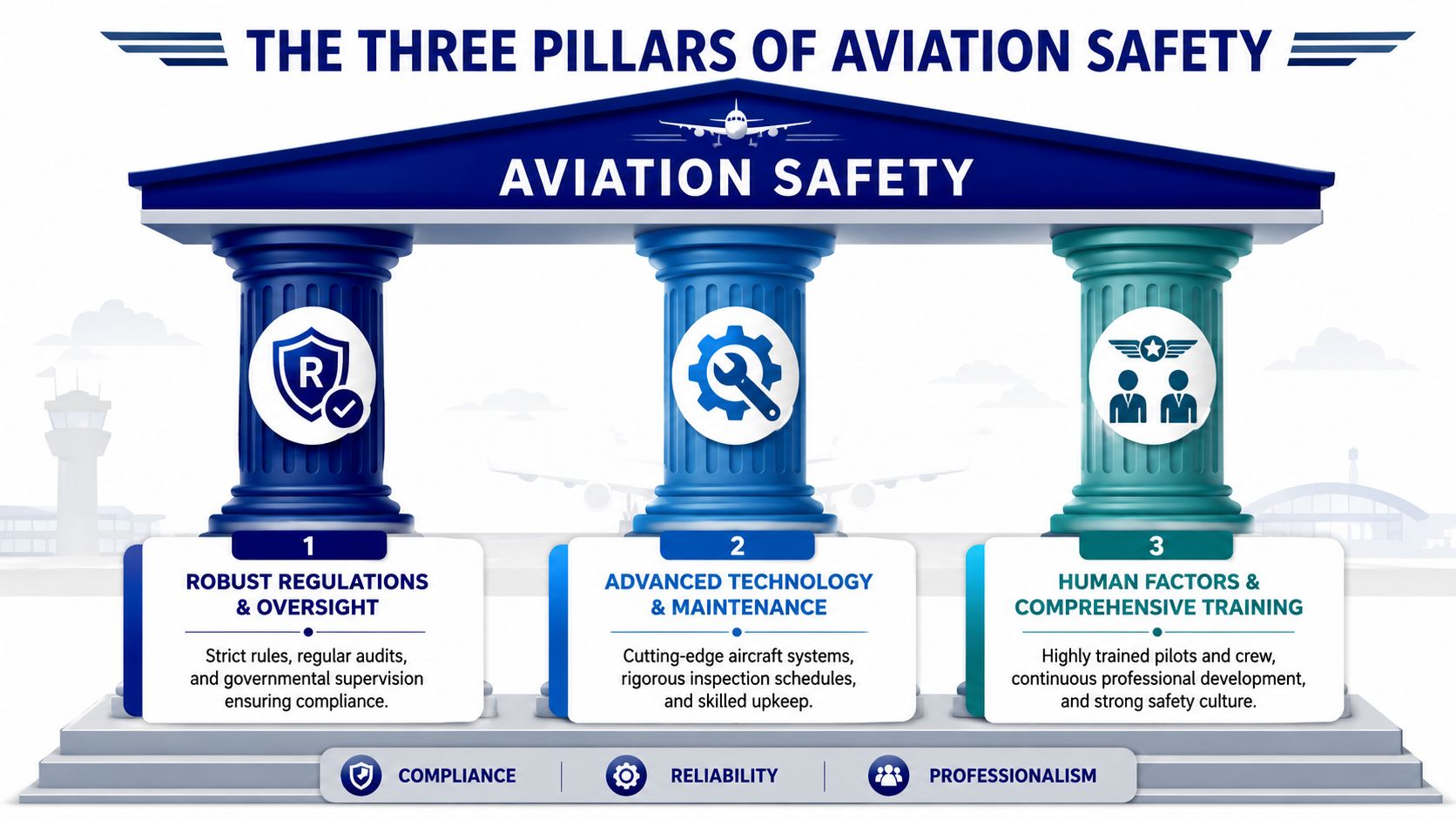
What makes one private flight feel routine and well controlled, while another carries more risk than the passenger realizes? In practice, it comes down to three things: the crew, the aircraft, and the operating system behind both.
That distinction matters because “private aviation” covers very different standards of operation. A professionally run charter company can apply airline-style discipline to pilot training, maintenance, and decision-making. An owner-flown or loosely managed private operation may not. The airplane alone does not determine the safety standard.
The pilots
The first pillar is the crew. Hours matter, but judgment, standardization, and recurrent training matter more.
In the strongest charter operations, pilots train to a defined standard, brief every leg the same way, divide cockpit duties clearly, and follow procedures even on easy days. That is what reduces avoidable errors. I pay close attention to whether a crew works inside a disciplined program or relies mostly on personal experience, because those are not equivalent.
Cabin safety is part of this pillar too, especially on larger-cabin aircraft where trained flight attendants contribute to emergency readiness as well as service. Travelers who want a better sense of that professional standard can review this overview of private aviation cabin crew careers.
The aircraft
The second pillar is the aircraft itself, but the crucial point isn't whether the jet is new or expensive. Rather, the essential consideration is how it is maintained, equipped, and dispatched.
A twenty-year-old business jet with clean records, current inspections, capable avionics, and disciplined upkeep is often a better risk than a newer aircraft run carelessly. Terrain awareness systems, weather tools, and modern cockpit displays help, but only if the operator keeps the airplane in proper condition and fixes discrepancies the right way instead of chasing dispatch at all costs.
For a practical view of what that work involves, this guide to business jet maintenance standards shows the inspection, documentation, and preventive maintenance practices that support safe operations.
The process
The third pillar is the operating process. Passengers rarely see it, but the process is how high-standard charter operators separate themselves from casual private flying.
Good operators use written procedures, formal flight release practices, duty and rest controls, maintenance tracking, risk assessment tools, and a functioning Safety Management System, or SMS. Those controls create consistency. They also give pilots support when the right decision is to delay, reroute, or cancel.
Strong operators build an environment where safe decisions are expected, documented, and backed by management.
That is why serious buyers should judge safety by operator quality, not by the phrase “private jet.” When the crew is trained well, the aircraft is maintained properly, and the company runs a disciplined system, private charter can be a controlled and dependable form of travel. When one of those pillars is weak, the risk changes quickly.
Your Checklist for Choosing a Safe Charter Operator
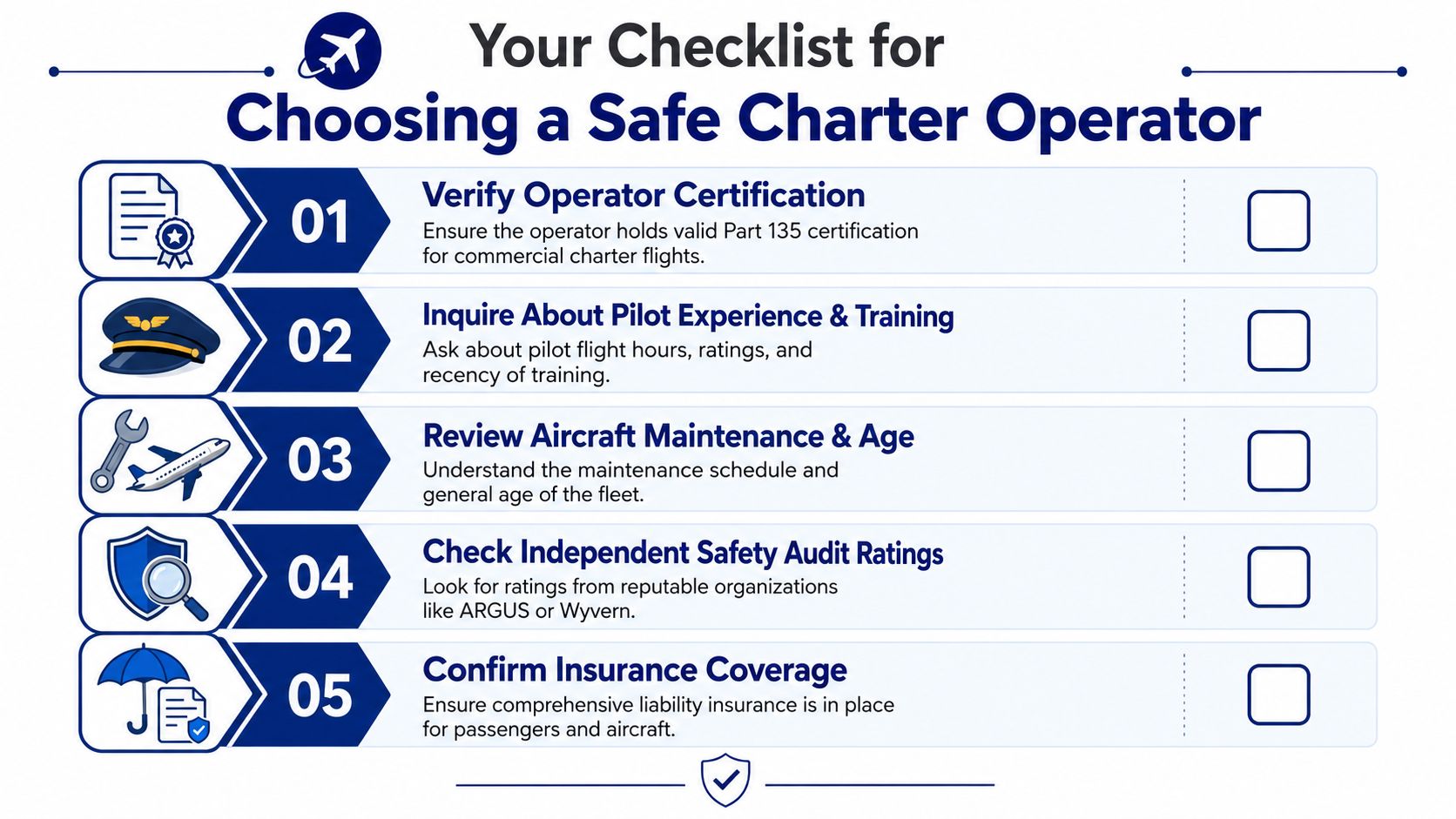
How do you tell the difference between a true charter operator and a private flight that only sounds professional? Ask questions that tie the trip to the company controlling it. Safety in private aviation is not one thing. It depends on who operates the flight, under what certificate, with what crew standards, and with what oversight.
If you book for executives or family travel, build a repeatable screening process. Good operators expect that. In my experience, the better the operation, the less resistance you get when you ask for specifics.
Start with the company running the flight
Cabin photos do not tell you much about risk. The first question is simpler and more important. Who is the certificated operator, and are they the direct air carrier for this trip?
That question helps separate professional charter from the broad and misleading category of "private aviation." A managed aircraft, an owner flight, and a properly conducted charter may all look similar to a passenger. Operationally, they are not the same. If the answer is vague, or if the sales team keeps shifting attention back to the airplane, keep pressing until you know exactly which company holds operational control.
Questions worth asking before you book
Use questions that require a clear, specific answer.
- What certificate governs this flight? Confirm that the trip is being conducted under the operator's charter authority, and ask whether they are the direct air carrier.
- Who are the pilots assigned, or what are the minimum crew standards? Ask about recurrent training, time in type, and whether the flight is staffed with two pilots.
- How is maintenance managed? Ask whether the aircraft follows a formal inspection program and where major maintenance is performed.
- What independent safety reviews does the company hold? Third-party audits and recognized safety registrations add another layer of scrutiny.
- Who makes the weather and go or no-go decision? You want to hear about company procedure, dispatch support, and captain authority, not confidence or sales language.
- What happens if the assigned aircraft goes down for maintenance? A strong operator can explain substitution standards without lowering crew or operational quality.
A simple decision table
| Question | Strong answer | Weak answer |
|---|---|---|
| Who is operating the flight? | Clear identification of the certificated operator and direct air carrier | Vague language, broker-only answers, or no clear operator named |
| What crew will fly it? | Defined crew standards, recurrent training, and two-pilot operations where appropriate | “We'll assign someone” |
| What oversight exists? | Specific mention of audits, documented procedures, and operating records | Focus stays on luxury, availability, or price |
| How do you handle weather or delays? | Conservative decision process with clear company standards | “We always find a way” |
Watch how they answer
Credentials matter. Behavior matters too.
Serious operators answer directly, and they do it without sounding irritated or evasive. They can explain who controls the flight, what standards apply, and why a delay or cancellation may be the right call. Operators with weaker discipline often answer around the question. They talk about service, access, and aircraft appearance because those points are easier to sell.
If you are still comparing options, it helps to review a provider's process from first quote to confirmed itinerary. This guide on how to book a private jet charter can help you spot whether a company is transparent about operator identity, trip terms, and flight responsibility.
Client-side test: If you cannot get a clear answer on who is flying you, under what authority, and with what operating standards, do not book until you can.
That is not overcautious. It is competent trip planning.
Common Myths and Realities of Private Flying
Fear usually grows in the gaps between headlines and operating reality. A few myths come up over and over when people ask how safe private jets are.
Myth one: Smaller aircraft are automatically unsafe
Size alone doesn't determine safety. Operating standard does. A professionally crewed turbine aircraft flown under disciplined procedures isn't in the same risk category as casual personal flying, even if both are smaller than an airliner.
Myth two: Older jets are the problem
Poor maintenance is the problem. Aircraft age by itself doesn't tell you much unless you also know how the aircraft is maintained, updated, and inspected. A conservatively maintained jet can be a better choice than a newer aircraft run under weaker standards.
Myth three: Private pilots push through bad weather
Weak operators and undisciplined pilots can make bad decisions in any category of aviation. Professional charter crews reduce that risk through standard procedures, crew coordination, and conservative weather judgment. In serious operations, declining a trip is part of the safety culture, not a service failure.
Myth four: Private aviation hasn't improved
That's outdated. Private flying safety has improved over the past two decades. One summary reports that the NTSB found general aviation accident rates have declined by up to about 25% since 2002, driven by better training, improved avionics, more rigorous maintenance programs, and standardized operating procedures (private flying safety improvement summary).
The right lesson isn't that every private flight is equally safe. It's that modern private aviation has improved, and the best operators make those improvements visible in how they train, maintain, and decide.
When travelers hear “private jet,” they often picture one thing. In reality, they're hearing a label that covers everything from disciplined corporate transport to much looser forms of flying. That's why myths persist. The label is too broad to be useful on its own.
Conclusion Flying with Confidence
So, how safe are private jets?
Safe enough to trust, if you choose the flight the way experienced buyers do. The right question at the end of this discussion is simple: who is operating the trip, and what standards do they follow when conditions are less than ideal?
That is what separates a reassuring private flight from an expensive unknown. Clients who focus on operator quality, crew standards, maintenance discipline, and operational control usually make better charter decisions than those who focus on cabin finish or aircraft age alone.
My practical advice is straightforward. Treat charter selection the way you would treat any other serious risk decision. Ask direct questions, expect direct answers, and be cautious with any provider that avoids specifics.
Confidence in private aviation does not come from the word private. It comes from evidence.
If you're evaluating charter options across the Americas and want a provider that will discuss safety standards, aircraft selection, and trip planning clearly, Air Trek private jet charter services are a practical place to start.