
Your flight is booked. The meeting in Miami is set. Or the family has already checked out of the resort and expects to leave the island on time. From the passenger side, the aircraft should be there, fueled, crewed, and ready.
From the maintenance side, that clean departure only happens because a lot of disciplined work took place long before anyone stepped onto the ramp.
That's the part many owners and travel managers don't see. Business jet maintenance isn't just a regulatory requirement or a line item on an operating budget. It's what protects the schedule you sold internally, the trip your family planned around, and the safety margin every serious charter operator has to preserve. When maintenance is treated as a paperwork exercise, dispatch reliability suffers. When it's run as a reliability program, the airplane stays available, problems get found earlier, and cross-border trips across the Americas become much easier to support.
For charter clients, that distinction matters more than is commonly realized. A domestic round trip with slack in the calendar is one thing. A multi-stop itinerary through Florida, the Caribbean, Mexico, and South America is another. The farther an aircraft roams, the more important maintenance planning becomes.
Why Maintenance Is the Foundation of Private Travel
A charter itinerary can look fully under control at noon and start slipping by 4 p.m. because a part timed out, a write-up needed deeper troubleshooting, or the aircraft arrived at a stop where support is thin. On a domestic day trip, an operator may still recover. On a run that touches the U.S., the Caribbean, Mexico, or South America, one maintenance miss can turn into a permit problem, a crew duty problem, and an overnight change for the client.
That is why disciplined operators build maintenance into trip planning from the start. Maintenance protects safety first, but it also protects the two things charter clients notice immediately: whether the airplane leaves on time and whether the backup plan is credible.
Reliability starts before the flight is sold
Aircraft availability is set well before the wheels start rolling. A sound maintenance department looks at upcoming inspections, deferred items, recurring discrepancies, parts position, vendor capacity, and where the aircraft is headed next. Those details shape whether an operator should commit that specific tail to a demanding itinerary or keep it closer to home support.
Usage drives the trade-off. More flying improves utilization and revenue potential. It also pulls inspections forward, increases wear on brakes, tires, and consumables, and raises the chance that a small discrepancy becomes a schedule event at the wrong airport.
For charter operators in the Americas, the mission profile matters as much as the calendar. An airplane running short domestic legs out of major U.S. airports is easier to support than one moving through island stations, high-cycle resort routes, or multi-country business trips where parts, tooling, and approved maintenance vendors are less predictable. Good operators account for that before they sell the trip.
Practical rule: If you want a jet to perform like a dependable travel tool, maintain it like a machine that has no room for guesswork.
A reliability program helps management make those calls with discipline instead of optimism. It tracks repeat faults, component behavior, inspection exposure, and the operational consequence of a delay. For a broader framework, this RCM guidance for maintenance managers is useful because it explains how maintenance decisions should follow function, failure modes, and operational consequence.
What passengers feel when maintenance is done right
Passengers usually experience good maintenance as silence. No last-minute aircraft swap. No call from the FBO saying departure moved two hours. No crew explaining that a minor item became a grounding item after a previous stop.
That quiet outcome takes work. It means the operator did not push a marginal component into a cross-border sequence with limited recovery options. It means the airplane had enough inspection margin left to complete the trip sensibly. It also means maintenance control, flight operations, and scheduling were working from the same picture.
Reactive maintenance creates fragile schedules. One avoidable issue can force a tail change, strand baggage, break a customs plan, or leave passengers waiting in a location where qualified support is scarce. For owners and travel managers, the better question is not whether the aircraft can depart today. It is whether the operator manages maintenance in a way that protects the rest of the trip as well.
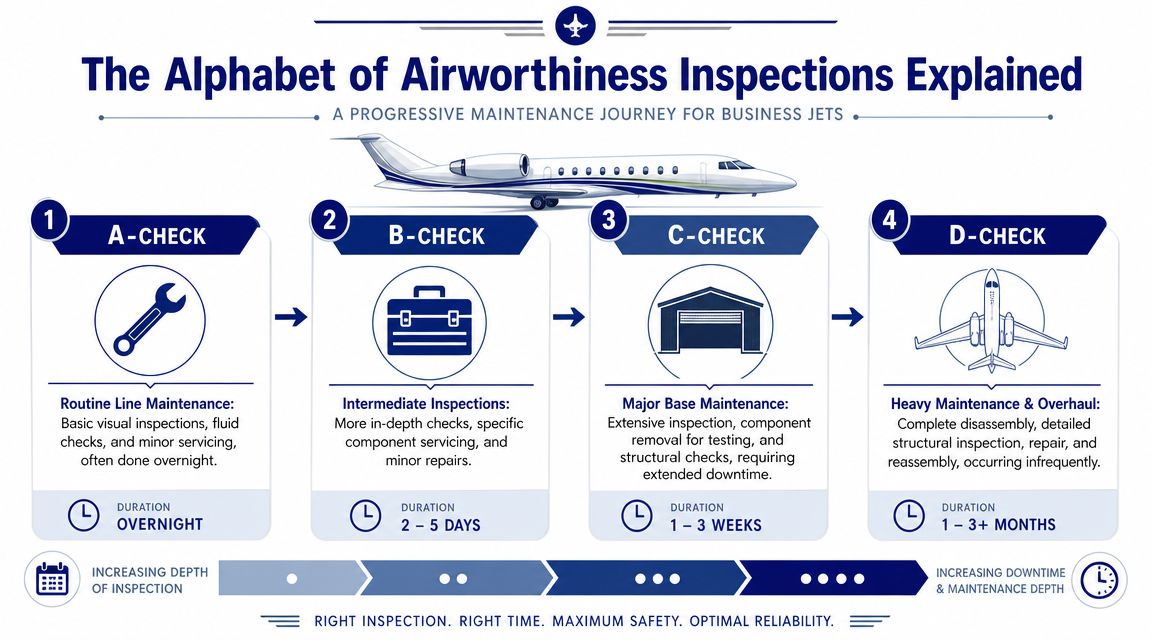
The Alphabet of Airworthiness Inspections Explained
People hear A-check, B-check, and C-check and assume it's all airline jargon. The easier way to understand it is to think about car ownership. You have basic walk-around checks, then routine service, then bigger shop visits, then major teardown-level work. Aircraft follow the same logic, just with far less room for sloppiness.
The inspections deepen over time. They demand more labor, more planning, and more downtime.
Line maintenance and A checks
At the shallow end, routine line maintenance covers basic checks such as wheels, brakes, and fluid levels. These are the everyday condition checks that help crews and technicians catch obvious issues before they become bigger ones.
An A check is the next step up. According to the National Aviation Academy's overview of aviation maintenance check intervals, A checks typically occur every 400 to 600 flight hours or 200 to 300 flights, and may require at least 10 working hours in a hangar. For a charter operation, that's manageable if the aircraft schedule has been built intelligently. If not, even a relatively light inspection can disrupt a revenue trip.
Think of an A check like routine scheduled service on a vehicle you depend on heavily. It's not optional, and it's not a surprise.
B and C checks
A B check goes deeper into systems and component servicing. The same source notes that B checks can take about 160 to 180 labor hours every 6 to 8 months. That's enough time and labor that a smart operator doesn't just “fit it in.” The shop visit has to be positioned on the calendar.
A C check is where owners start to feel the full operational weight of maintenance. The aircraft goes into a more extensive inspection environment, and technicians perform structural inspections, corrosion checks, and lubrication of fittings and cables. The same National Aviation Academy reference says C checks may require up to 6,000 maintenance hours.
That has major implications:
- Aircraft availability changes: The airplane isn't casually pulled for this work. It must be planned well in advance.
- Charter scheduling gets tighter: High-cycle aircraft reach these intervals faster.
- Findings can expand scope: Once panels are open and deeper access begins, additional corrective work may be required.
A maintenance interval on paper is one thing. The real issue is how well the operator prepared for the findings that often come with it.
Where D checks fit for business aircraft
You'll also hear people mention a D check or heavy overhaul concept. The simplest way to understand it is as the deepest maintenance event in the progression. It involves extensive disassembly, detailed structural review, repair, and reassembly. On some business aircraft, operators may use phased inspection programs rather than talking about a classic airline-style D check, but the operating principle is the same. The deeper the visit, the more the maintenance event shapes cost and fleet availability.
Here's the practical view:
| Inspection level | What it means operationally |
|---|---|
| Line maintenance | Daily readiness work that keeps minor issues from becoming dispatch issues |
| A check | Short scheduled visit that still requires calendar discipline |
| B check | Intermediate labor event that affects aircraft assignment |
| C check | Major base maintenance that can reshape schedule planning |
| D or heavy overhaul | Long-horizon maintenance strategy, not a last-minute task |
If you're an owner or travel manager, ask a plain-language question when someone references an inspection. Don't ask for jargon. Ask, “How long is the aircraft likely to be unavailable, and what backup plan exists if findings expand the scope?”
That question gets to the core issue every time.
Navigating FAA Rules and Charter Regulations
Regulation matters most when you translate it into passenger outcome. The FAA's role is to ensure civil aircraft airworthiness through standardized regulations, directives, and policy, as outlined by the agency's Aircraft Maintenance Division. For passengers, that broad oversight becomes meaningful when a charter operator turns it into a disciplined maintenance program.
Why charter maintenance standards feel different
A private owner flying under Part 91 and a charter operator flying under Part 135 do not carry the same operational burden. That difference matters. When an aircraft is carrying paying passengers, maintenance control, inspection discipline, discrepancy handling, and recordkeeping have to support public operations, not just private convenience.
That doesn't mean every charter client needs to memorize regulations. It means they should understand the practical consequence. A serious charter operator runs maintenance as an operating system, not as occasional compliance paperwork.
The FAA framework exists so operators can maintain airworthiness consistently. In charter, that means using maintenance data, tracking recurring discrepancies, and building a reliability approach that protects both safety and dispatch performance. It also means minimizing unscheduled AOG events by catching trends before they become trip-breaking failures.
The passenger benefit of a reliability program
Passengers feel the benefit in three ways:
- Fewer avoidable delays because recurring issues are tracked instead of repeatedly patched.
- Better release decisions because maintenance control has a clearer view of aircraft condition.
- Stronger documentation when the aircraft is operating across different airports, vendors, and jurisdictions.
A good safety management culture supports that process. If you want to see how an operator documents safety responsibilities and reporting structure, reviewing a published SMS manual framework is a useful way to understand what formal oversight looks like in practice.
The safest operation usually isn't the one that talks the most about safety. It's the one that documents decisions, tracks defects, and refuses to normalize repeat problems.
What to look for in real life
When owners ask, “Is this airplane legal?” they're asking the narrow question. The better one is, “How does this operator manage continuing airworthiness over time?”
Here's what tends to separate strong charter maintenance from weaker programs:
- Defect tracking matters: Repeated write-ups on the same system should trigger analysis, not annoyance.
- Inspection planning matters: Heavy work should be coordinated with utilization, not left to collide with peak demand.
- Maintenance control matters: Someone must own the decision process when an issue appears away from base.
- Records matter: In charter, poor records can create just as much disruption as a mechanical fault.
Clients don't need to become mechanics. They do need to recognize that FAA oversight only works when the operator has the internal discipline to carry it out well.
Understanding Business Jet Maintenance Costs
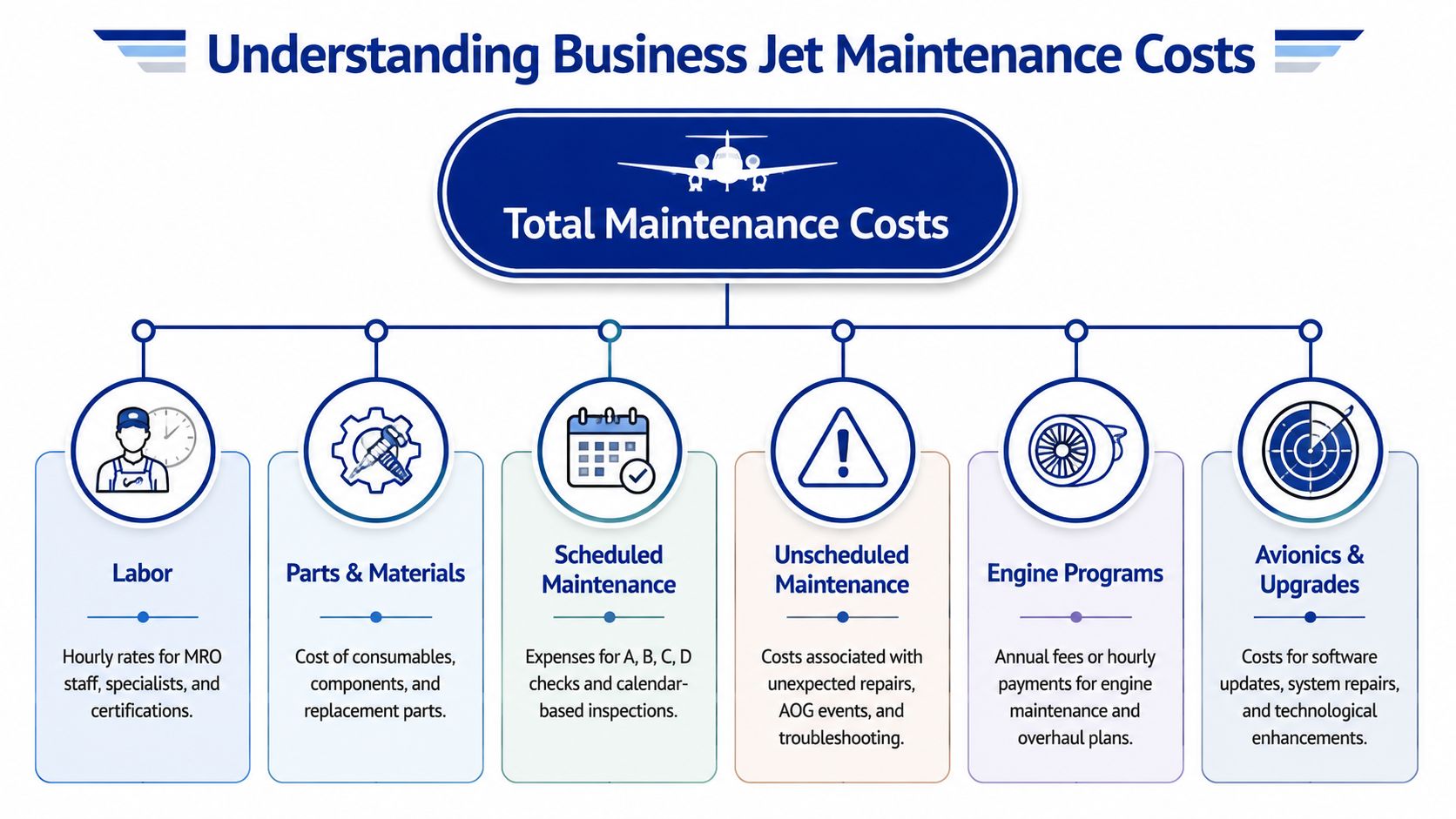
A first-time owner often sees the acquisition price, crew, hangar, and insurance, then gets hit by the part of the budget that moves the most. Maintenance does not behave like a flat annual fee. It rises and falls with utilization, aircraft condition, where the airplane is operating, and how quickly you need it back in service.
The useful way to view maintenance cost is operational, not accounting-only. You are paying to keep the aircraft legal to fly, dependable on the schedule, and in a condition that protects resale value. In charter, those three goals pull on the same budget.
The budget range owners should understand
There is no honest single number that fits every business jet. A newer aircraft on a disciplined program can be predictable for long stretches. An older jet with deferred cosmetic upgrades, weak records, or heavy cross-border use can swing sharply from one quarter to the next.
That is why experienced operators budget in layers. They carry a base expectation for routine inspections and recurring items, then maintain reserve for findings, component removals, avionics discrepancies, and schedule disruption. If the aircraft will be placed on a charter or owner-use program, a structured aircraft management services plan usually gives a clearer picture of those moving parts than a simple annual estimate.
What drives the bill
Two midsize jets can sit side by side and produce very different maintenance spend over a year. These factors usually explain why:
Utilization pattern
Hours matter, but cycles matter too. Frequent short legs often create a different maintenance rhythm than fewer long trips.Aircraft age and baseline condition
An older airframe is not automatically a bad one. But age, corrosion exposure, and prior maintenance quality show up in labor hours and repeat discrepancies.Mission profile
Cross-border flying in the Americas adds planning friction. Parts positioning, customs timing, local vendor capability, and return-to-service coordination can all affect cost.Aircraft complexity
Larger cabins, more advanced avionics, and more systems usually mean higher parts prices and more specialized labor.Inspection findings
The inspection itself is only part of the event. The larger variable is what the inspection uncovers once panels come off and components are tested.
Scheduled versus unscheduled spending
Scheduled work is easier to live with because it can be forecast, coordinated, and combined with other downtime. Unscheduled work is what hurts dispatch reliability. A generator fault in South Florida is one problem. The same fault in the Caribbean, Mexico, or a smaller Central American station can become a parts, logistics, and permit problem at the same time.
Here's a simple comparison:
| Cost category | Why it matters |
|---|---|
| Scheduled inspections | Predictable in timing, but cost rises with inspection depth, labor access, and required corrective work |
| Parts and materials | Prices change with availability, OEM sourcing, and whether the part is rotable, repairable, or must be replaced |
| Labor | Troubleshooting, avionics work, and sheet metal or interior access can add hours quickly |
| Avionics and updates | Software updates, compliance work, and intermittent faults often cost more in diagnosis than owners expect |
| Unscheduled repairs | They affect budget and trip completion at the same time, which is why operators watch this category closely |
Owner's shortcut: Judge maintenance spend by the cost of keeping the aircraft available for the missions you fly, not by the invoice from the last inspection.
What works and what doesn't
What works is matching the maintenance budget to real use. If the airplane is flying charter, crossing borders often, or serving tight executive schedules, reserve planning needs to reflect that operating pattern. Good operators also align heavy work with slower demand periods so the aircraft is not parked when clients need it most.
What fails is treating maintenance as a simple labor line item or assuming low annual hours guarantee low cost. A lightly flown aircraft can still generate expensive discrepancies if components age out, records are incomplete, or the airplane spends too much time waiting for issues to accumulate.
This is also why many charter clients prefer access over ownership. The client pays for lift and reliability. The operator carries the maintenance volatility, along with the responsibility to manage it well.
Choosing Your Maintenance Partner
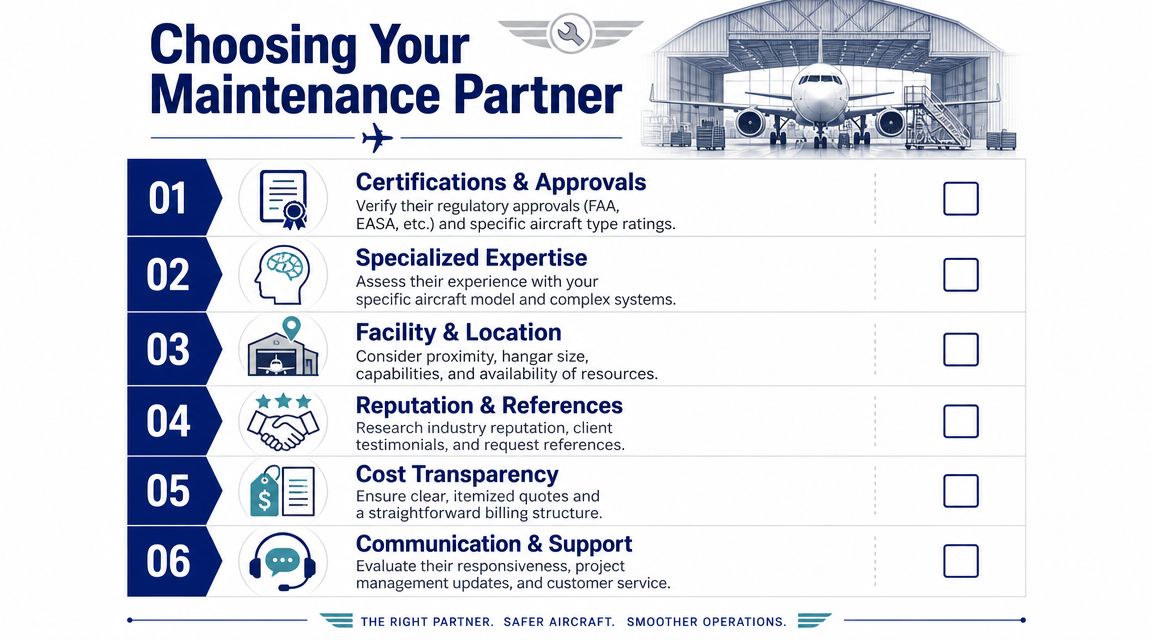
Choosing a maintenance provider is not a purchasing exercise. It's an operational risk decision. A cheap invoice can become an expensive trip disruption if the shop lacks type experience, can't source parts promptly, or communicates poorly once the aircraft is opened up.
That's why experienced operators evaluate maintenance partners the way they evaluate critical vendors. Capability first. Price second.
The non-negotiables
If you're reviewing an MRO or trying to assess the standards behind your charter provider's fleet, start here:
Approvals and aircraft-specific authorization
General maintenance capability isn't enough. The provider should be properly approved for the work being performed and familiar with the exact airframe and engine combination involved.Technician depth
Ask who will touch the aircraft. The best shops have strong supervision, current training, and technicians who know the common failure patterns of specific platforms.Parts access
A skilled shop without parts access can still leave your aircraft parked. Inventory strategy and supplier relationships matter, especially for operators moving across the Americas.Communication discipline
You want itemized findings, realistic timelines, and quick escalation when scope changes. Silence during a maintenance event is always a bad sign.
Questions that reveal quality fast
A few questions usually tell you a lot:
| Ask this | Why it matters |
|---|---|
| How much experience do you have on this aircraft model? | Type familiarity shortens troubleshooting and reduces avoidable errors |
| What's your process when additional findings appear? | Scope control and approval discipline affect both cost and downtime |
| How do you handle parts sourcing for AOG situations? | Response speed often depends on vendor network, not just shop skill |
| Who manages the project updates? | Clear ownership prevents confusion between maintenance, operations, and owner expectations |
One practical option some owners consider is working with an operator that already has an established maintenance structure through aircraft management services. That can simplify oversight because maintenance planning, scheduling, and operational use are managed together rather than in separate silos.
Red flags worth taking seriously
Some warning signs show up early:
- The low quote with vague scope often turns into change orders and delay.
- No clear point of contact usually means poor coordination once the aircraft is down.
- Weak documentation habits can create downstream airworthiness and resale issues.
- Limited cross-border support becomes a serious problem if the aircraft operates outside a narrow domestic footprint.
The best maintenance partner is rarely the cheapest. It's the one most likely to return the aircraft to service correctly, document the work properly, and keep surprises from multiplying.
Minimizing Downtime and Responding to AOG Events
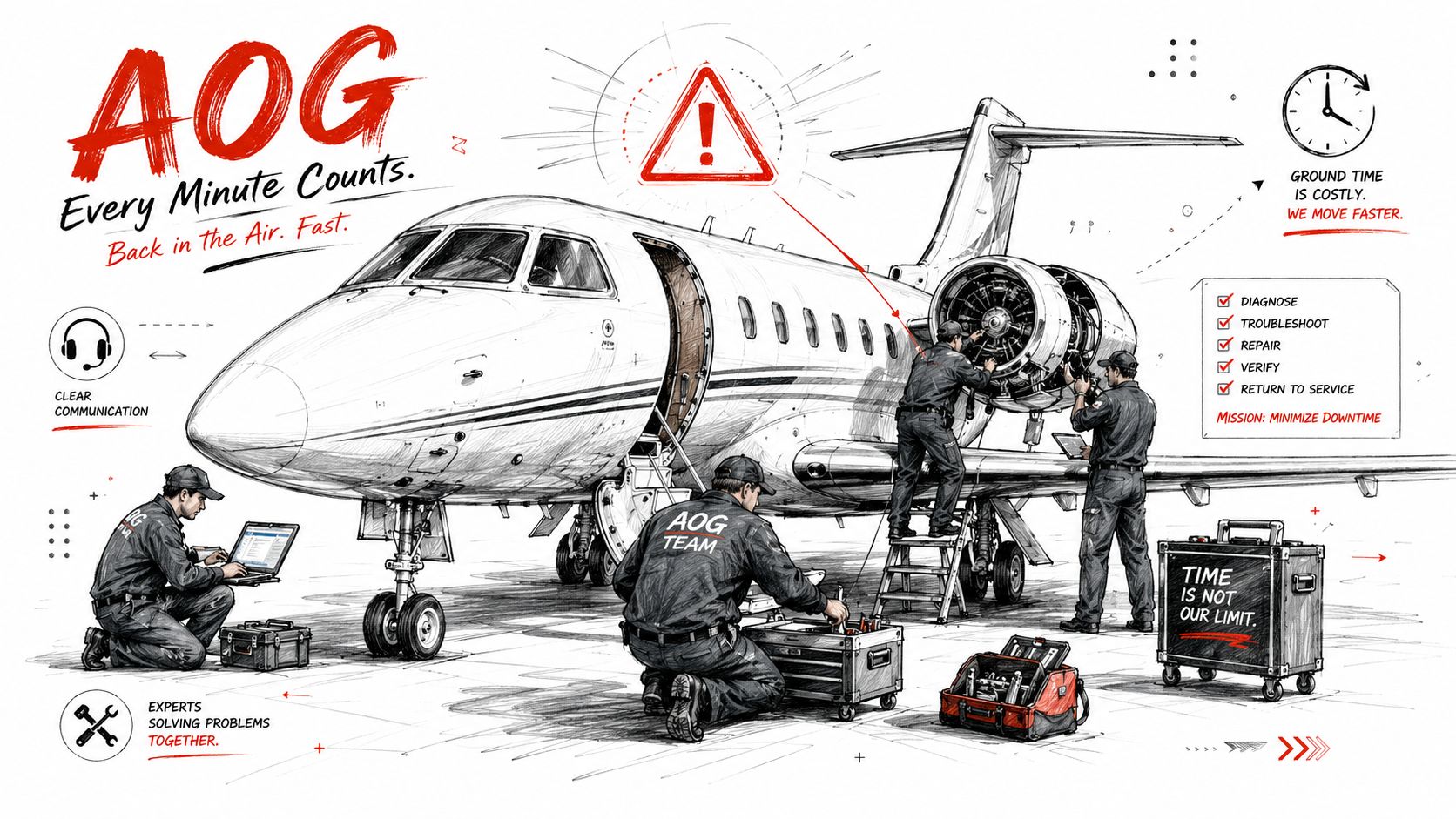
Every operator talks about service. The ultimate test comes when the aircraft can't leave. AOG, or aircraft on ground, is where maintenance philosophy becomes visible. If the operator has planned well, the response is organized. If not, everyone starts improvising.
For charter clients, improvisation is exactly what you're trying to avoid.
Downtime prevention beats downtime recovery
The strongest maintenance teams spend more time preventing AOG events than reacting to them. That means reviewing repeat discrepancies, watching component history, planning inspections around utilization, and making sure known issues don't hitch a ride into a critical trip.
A major trend behind that shift is predictive maintenance. A business aviation industry article explains that predictive maintenance has become a major priority as more aircraft data, lower storage costs, and better analytics have improved forecasting, and that operators can use maintenance records, pilot-reported defects, onboard data such as FDR and QAR data, and aircraft utilization data to reduce unplanned downtime and improve lifecycle planning as described in this business-jet predictive maintenance article.
That doesn't mean a business jet fleet can predict every failure. Business jets often generate less standardized data than airline fleets, and that makes forecasting harder. But even imperfect trend tracking is better than waiting for the airplane to tell you it's broken at departure time.
AOG response starts weeks before the event. It starts with the maintenance decisions that either reduced the risk or let it grow.
What a real AOG response looks like
When an aircraft goes down away from base, the maintenance team has to solve several problems at once:
Diagnose the issue accurately
Guessing wastes time. Good maintenance control gets reliable information from the crew, aircraft records, and any available troubleshooting data.Confirm airworthiness path
The operator must determine whether the issue requires immediate repair, additional inspection, parts replacement, or a different maintenance action.Source labor and parts
This is often the longest pole in the tent, especially outside major hubs.Coordinate operations and passenger recovery
Maintenance doesn't work in isolation. Charter, crew scheduling, and customer communication all have to move together.
For passengers, fixed-base operator coordination becomes part of that recovery chain. Ground access, hangar support, and local vendor capability can all affect how quickly an operator stabilizes the event. That's one reason understanding the role of a private jet FBO matters operationally, especially during irregular events.
Cross-border flying adds a different layer
AOG response gets harder when the trip crosses the Americas. A key operational question for charter operators flying between the U.S., Canada, the Caribbean, and Latin America is how they align maintenance programs, logbooks, and component traceability with multiple authorities while avoiding unexpected grounding events, as discussed in this cross-border maintenance perspective for private jets.
In plain terms, an operator has to think beyond the mechanical problem itself. Can the needed part arrive quickly? Is there approved support at that station? Will the documentation satisfy the relevant authority? Is the local capability suitable for the task, or does the aircraft need a different recovery plan?
The strategy that actually protects itineraries
Operators protect schedules best when they do three things well:
- They schedule deeper work during lower-demand windows
- They maintain vendor and parts relationships before they need them
- They treat maintenance data as a planning tool, not just a recordkeeping obligation
That's the difference between a fleet that looks available on paper and one that stays available in real service.
What to Ask Your Private Jet Charter Provider
Most clients ask about cabin size, Wi-Fi, baggage, and catering. Those are reasonable questions. But if schedule reliability and safety really matter, you should also ask how the aircraft is maintained.
You don't need a mechanic's vocabulary. You need questions that reveal whether the operator is disciplined, prepared, and honest about operational risk.
Questions worth asking before you book
Start with direct questions that are hard to bluff through:
How do you manage scheduled maintenance so it doesn't collide with active charter demand?
You're listening for planning discipline, not vague reassurance.What happens if the aircraft becomes AOG away from base?
A serious operator should be able to describe a response process clearly.Do you track recurring maintenance discrepancies across the fleet?
This tells you whether they learn from repeat problems or clear write-ups individually.How do you handle maintenance support for trips across the Caribbean, Mexico, or Latin America?
Cross-border flying exposes weak logistics fast.Who controls the maintenance records and airworthiness documentation?
Good records are part of operational readiness, not just office filing.
The cross-border question many clients miss
If your travel includes the Americas, ask one more question in plain language: How do you align maintenance programs, logbooks, and component traceability across multiple regulatory environments so the aircraft doesn't get unexpectedly grounded?
That's not a theoretical concern. It gets to the heart of international reliability. A provider can operate a safe domestic trip and still struggle once parts, paperwork, local support, and authority expectations change from one region to another.
The right charter question isn't “Can you fly me there?” It's “Can you support this aircraft properly before, during, and after that trip?”
What strong answers sound like
Strong operators usually answer with specifics. They'll talk about maintenance control, record discipline, approved vendors, inspection planning, and what they do when an itinerary changes quickly.
Weak operators usually answer with broad comfort language. They'll say the aircraft is maintained to high standards, but they won't explain how the system works.
Use this quick screen:
| If they say this | It usually means |
|---|---|
| “We can walk you through our maintenance control process.” | They probably have a real process |
| “We coordinate scheduled work around utilization.” | They understand availability planning |
| “We use approved providers and maintain documentation discipline.” | They recognize recordkeeping as operationally critical |
| “Don't worry, it's all taken care of.” | You still don't know very much |
The more time-sensitive or international your travel is, the more these answers matter. A smart buyer asks them early, before the trip depends on the response.
Business jet maintenance sits underneath every smooth charter experience. Clients may never see the inspections, data tracking, vendor coordination, or documentation reviews, but they benefit from them every time the aircraft departs as planned. If you're evaluating charter options, ask about maintenance with the same seriousness you bring to aircraft type and schedule. It's one of the clearest ways to judge whether an operator is built for reliable travel across the Western Hemisphere.