
Private flying gets complicated right when you want it to become simple.
A busy executive starts with on-demand charter because it feels flexible. Then, a pattern emerges. One trip prices cleanly, the next comes back higher because the aircraft is repositioning. One operator can confirm quickly, another needs more lead time than expected. A family office tries to keep things organized, but every trip still becomes a fresh round of quotes, comparisons, aircraft questions, and contract review.
That friction is why jet card programs keep coming up in serious private aviation conversations. They promise a middle ground. You don't buy an aircraft. You don't lock yourself into the full economics of ownership. You prearrange access, rates, and service terms so each trip takes less effort to book.
The key question isn't whether jet cards sound convenient. It's whether they are the smarter financial and operational choice for the way you fly, especially across the Americas where routes, customs, and repositioning can change the economics fast.
The Search for Simpler Private Travel
The usual path is easy to recognize.
Someone begins with private charter because they want control over schedule, privacy, and airport access. That works well for a while. Then the travel pattern becomes more regular. Miami to New York for meetings. Florida to Aspen during peak periods. Caribbean family trips where timing matters more than finding the absolute lowest quote.
At that point, on-demand booking can start to feel like rebuilding the same trip from scratch every time. You compare aircraft categories. You watch pricing move. You ask whether the operator can really deliver the departure window you need. You review terms again because one small clause can affect cancellation, recovery flights, or peak travel days.
If that sounds familiar, a good starting point is understanding how private jet booking usually works. Once you see all the moving pieces, the appeal of a more structured model becomes obvious.
Practical rule: If you're spending too much time managing the booking process, not just paying for the flight, you may be ready for a more systemized solution.
Jet card programs exist for that exact problem. They're designed for travelers who fly often enough to value consistency, but not necessarily enough to justify the capital commitment and operational complexity of owning an aircraft or buying a fractional share.
That doesn't mean a jet card is automatically the right answer. It means you're asking the right question. The smart buyer isn't looking for a luxury label. The smart buyer is looking for a repeatable way to save time, reduce uncertainty, and keep travel planning from turning into another job.
What Exactly Is a Jet Card Program
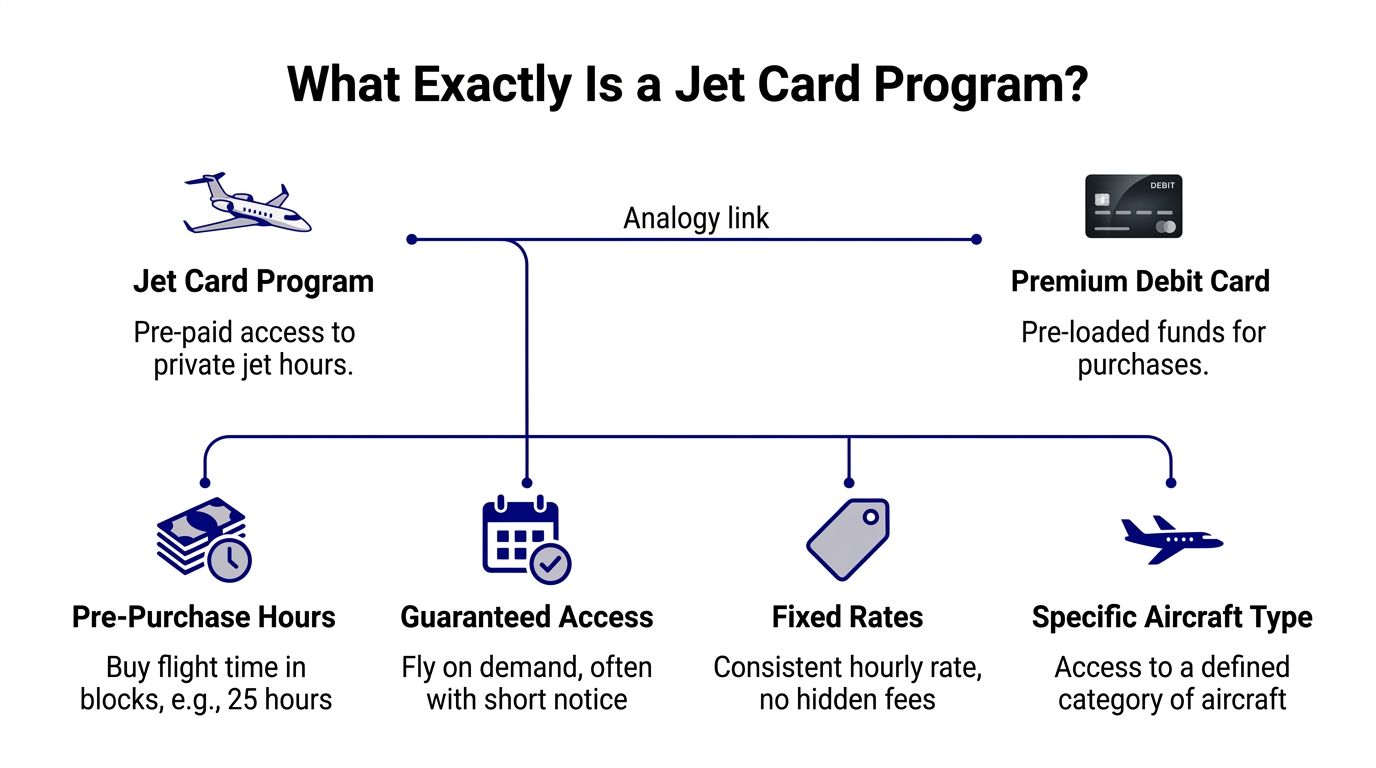
A jet card is easiest to understand if you think of it as a premium debit card for private flying. You pre-fund access. In return, you get a defined set of booking rights, pricing terms, and aircraft access rules.
The basic structure
Most jet card programs are sold as pre-purchased flight-hour blocks or as prepaid deposits tied to fixed or capped hourly rates. In plain language, you commit money up front so you don't have to negotiate every trip at the full market rate each time.
Industry descriptions commonly frame this as buying access in 25-hour increments or through deposit-based structures with access across multiple aircraft categories. That's one reason the category sits neatly between ad hoc charter and ownership. You gain more predictability than charter, without taking on the asset burden of buying into an aircraft.
Why this became a real category
Jet cards aren't a brand-new idea anymore. Sentient says it launched the industry's first jet card in 1999, and by 2024 it reported more than 1 million passengers flown, service to over 2,500 destinations, 6,700 active card owners, and 549% revenue growth over 25 years in its Robb Report Best of the Best coverage.
Those numbers matter less as a marketing story and more as a market signal. They show the model matured from a niche purchasing format into a mainstream access product that frequent private flyers understand and use.
Where it fits against the alternatives
A jet card is not the same as on-demand charter. Charter is pay-as-you-go. Each trip is priced in the moment, based on aircraft availability, routing, timing, and market conditions.
It's also not fractional ownership. Fractional ownership brings a much heavier commitment because you're buying into an asset structure and accepting a longer-term relationship with associated operating economics.
A jet card sits in the middle:
- More structured than charter
- Less capital-intensive than ownership
- Usually easier to budget than trip-by-trip booking
- Usually less flexible than fully open-market charter if your needs vary a lot
That last point is the one buyers sometimes miss. The structure is the benefit, but the structure is also the limitation.
How Jet Card Pricing and Hours Really Work
You approve a last-minute New York to Miami trip on Tuesday, then add a Chicago stop for Thursday. With on-demand charter, each request gets repriced against that week's market. With a jet card, the question is different. How much of that trip is already covered by the program's billing rules, and how much still sits outside the headline rate?
That is where buyers either get cost control or overpay for convenience they do not use.
What you're actually buying
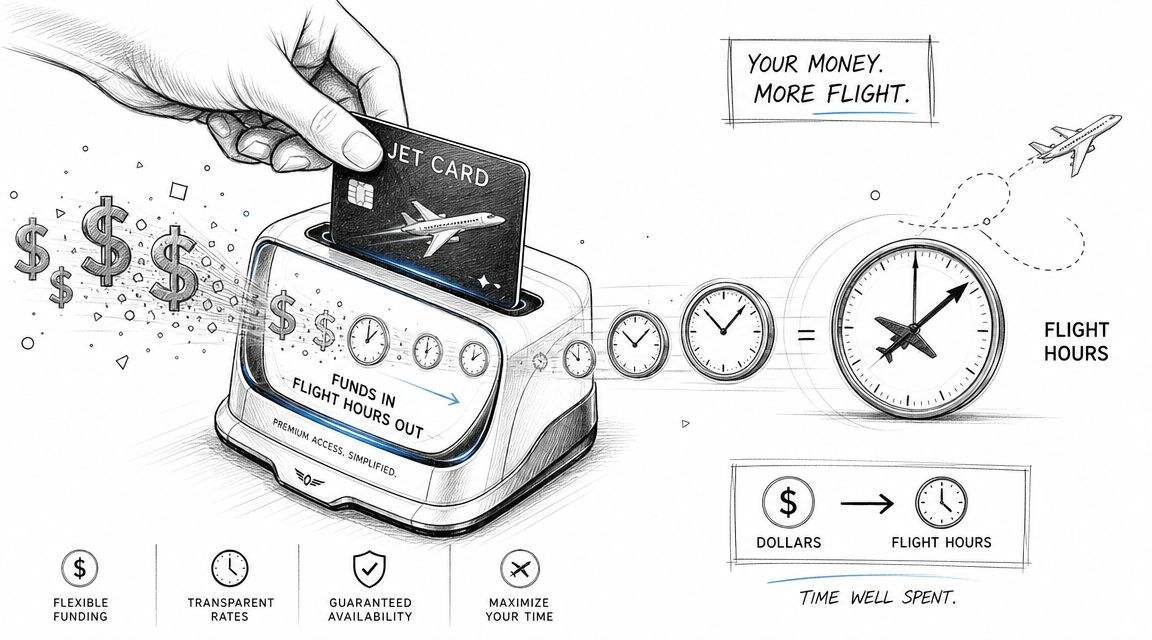
A jet card usually means prepaid flight hours at a fixed or capped rate, wrapped in a service agreement that defines aircraft category, booking notice, service area, cancellation terms, and extra charges. BlackJet's discussion of jet card contracts and prepaid rate structures covers that basic structure well.
The important point is economic, not cosmetic. You are prepaying to reduce uncertainty.
That can be smart if you fly enough short-notice trips within a fairly consistent mission profile, especially around major city pairs in the Americas where schedule reliability matters more than squeezing every last dollar out of each leg. It is less attractive if your flying is irregular or your mission changes from trip to trip.
What counts as an hour
Here, break-even decisions are made.
Some cards charge actual flight time. Others add taxi time, use segment minimums, or apply daily minimums that can make a one-hour hop bill like something much longer. A busy executive doing frequent short legs in the Northeast, Florida, Texas, or Southern California can burn through a card faster than expected if the contract is built around minimums rather than true airborne time.
Use the same framework you would use for any serious travel budget. Compare the effective trip cost, not the posted hourly rate. Air Trek's overview of private jet charter pricing is useful because it focuses attention on the full cost stack, including the items that turn an attractive rate into an expensive trip.
Effective hourly cost comes from billing rules, not marketing language.
The charges that change the math
A good jet card quote should answer five questions before you fund it.
| What to check | Why it matters |
|---|---|
| Hourly rate definition | Confirms whether fuel, taxi time, and standard fees are included |
| Minimums per segment or per day | Drives the true cost of short trips |
| Peak-day and short-notice rules | Affects whether the card actually solves your access problem |
| Service area coverage | Matters for trips across the U.S., Caribbean, Mexico, and Latin America |
| Expiration and refund terms | Determines how much prepaid value you can realistically use |
These details decide whether a card beats charter on a per-trip basis. A traveler doing repeated two- to three-hour legs with consistent passenger counts often benefits from the structure. A traveler mixing short hops, long transcontinental flights, ski weekends, holiday peaks, and occasional international trips may find the card's “fixed” pricing is only fixed in narrow conditions.
Where buyers misread the value
The common mistake is treating a jet card like discounted charter. It is closer to prepaid access with pricing protection inside a defined box.
If your flying stays inside that box, the card can save time on sourcing, reduce quote volatility, and make quarterly budgeting easier. If your trips fall outside it, the premium you paid for predictability starts working against you.
That is the decision framework to use. Estimate your likely annual hours, check how many of those hours are on short segments, then model the trips under the card's actual billing rules. If the convenience premium is modest and you will use the structure often, a jet card can make sense. If not, on-demand charter usually keeps more money and flexibility in your hands.
Jet Cards vs Other Private Aviation Options
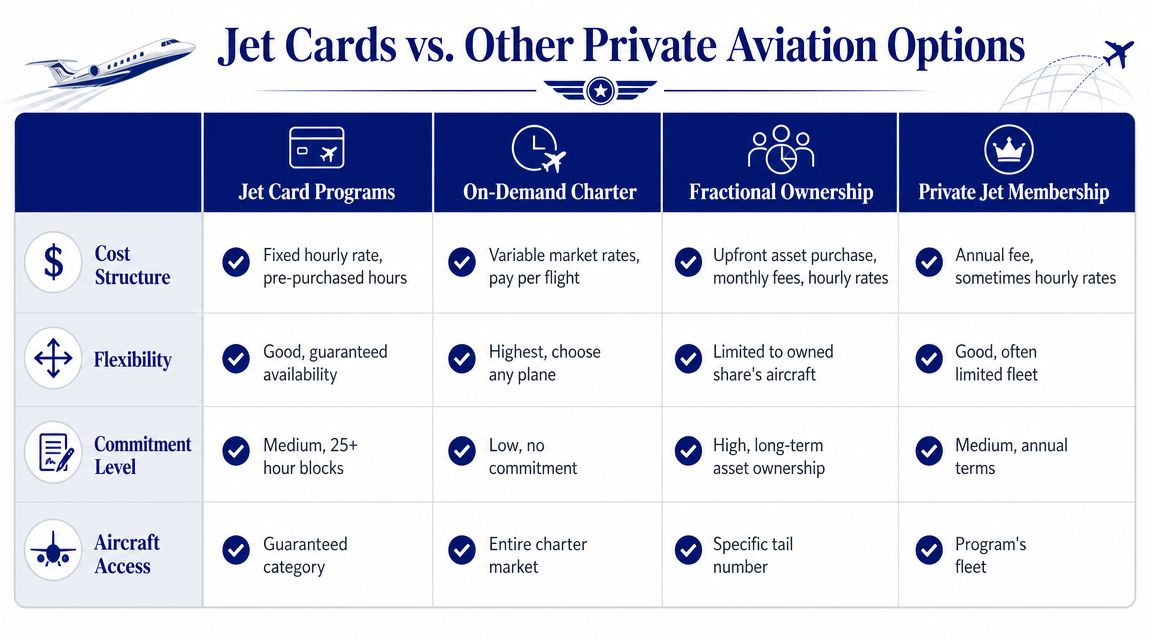
The right choice depends less on status and more on travel pattern. Buyers usually compare four models: on-demand charter, jet cards, memberships, and fractional ownership.
The side-by-side decision view
| Option | Best for | Main strength | Main drawback |
|---|---|---|---|
| On-demand charter | Infrequent or irregular flyers | Maximum flexibility | Less pricing consistency |
| Jet card programs | Predictable frequent flyers | Budgeting and access structure | Upfront commitment |
| Memberships | Travelers wanting recurring access with lighter structure | Simpler ongoing relationship | Terms vary widely |
| Fractional ownership | Higher-use flyers with long-term commitment | Deep operational consistency | Asset-style commitment and complexity |
When charter usually wins
If you fly occasionally, or your trips vary a lot by distance, passenger count, and timing, charter often remains the cleaner answer. You stay liquid. You can source the best aircraft for the mission. You don't have to prepay a large amount just to preserve optionality.
SherpaReport notes that jet cards are usually prepaid blocks of 20 to 50 hours, and estimates an entry-level 25-hour light-jet card at $185,000 to $215,000 before FET and sometimes fuel surcharges in its jet card buyer guide. For travelers flying under 50 hours a year, the value of a card is often convenience, not always cost.
That's the break-even issue many sales pages avoid. If your usage is light, the structure can be pleasant but financially unnecessary.
When a jet card becomes more rational
Jet cards start making more sense when a traveler values these three things at the same time:
- Consistency of booking process
- Predictable rate structure
- Reliable access during important travel windows
This is especially true for executives or families who repeat similar missions. If you often fly the same corridor, use the same aircraft class, and need less administrative friction, a card can outperform open-market charter operationally even when it doesn't produce the absolute lowest trip cost.
Buy a jet card for repeatability. Buy charter for optionality.
Where memberships and fractional fit
Memberships sit in a broad middle zone. Some are close to a jet card in practice. Others are lighter-access programs with annual terms and less rigid hour accounting. They can suit travelers who want a relationship with a provider but don't want a classic prepaid hour block.
Fractional ownership is a different conversation. It suits travelers with heavier utilization and a tolerance for longer-term commitment. The service experience can be very consistent, but the economics and obligations are much closer to ownership than to charter.
One practical note. If you want access to more than one model, a traveler can compare providers that offer charter, memberships, and structured access under one roof. For example, Air Trek offers on-demand charter as well as the Trek Select membership program, which places it in the broader conversation even if a classic jet card isn't always the best fit.
Key Factors to Evaluate in a Jet Card Program
The mistake most buyers make is comparing only the hourly rate. That's rarely where the key decision lies.
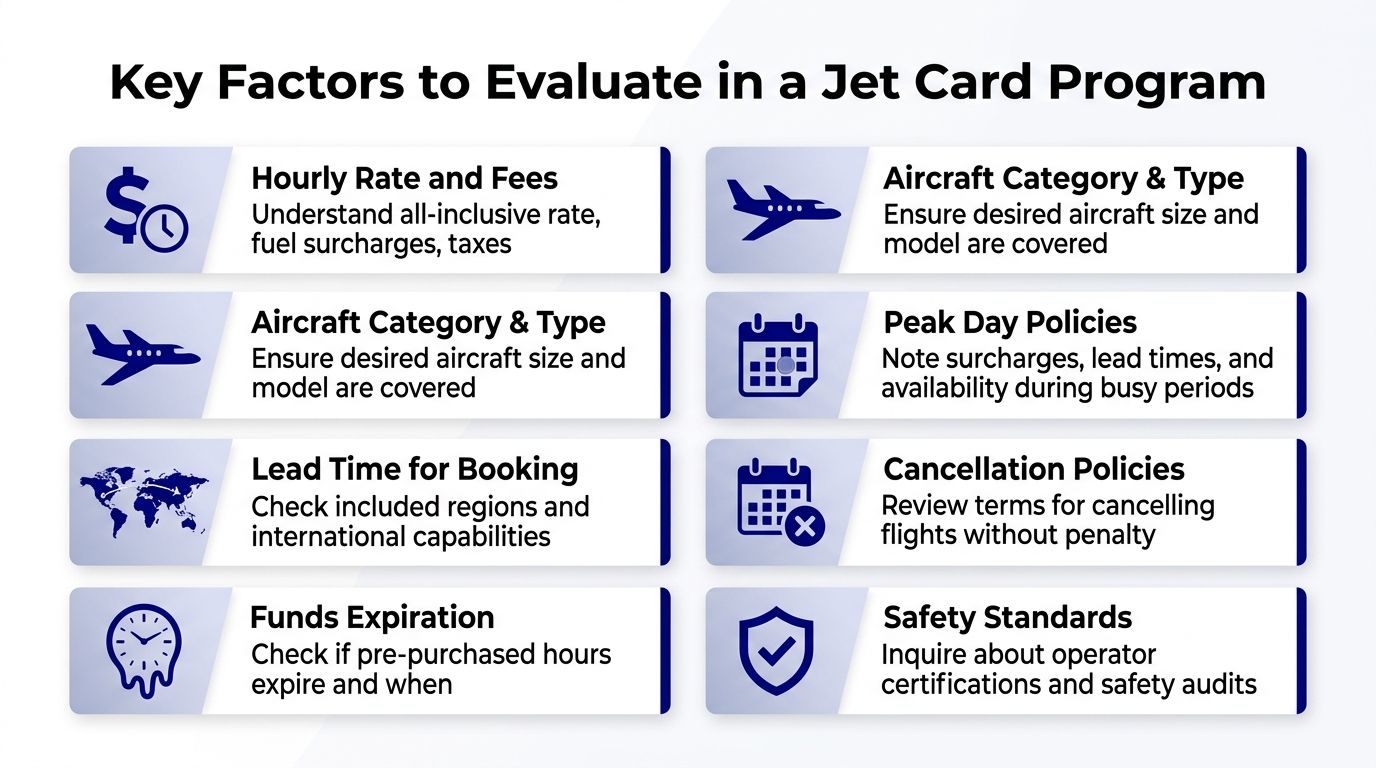
The critical decision lies in the operating terms. Two cards can look similar on the first page and behave very differently when you need an aircraft on a busy day, change a departure time, or fly outside the provider's strongest service area.
Availability is not a slogan
Jet card marketing often leans hard on guaranteed access. That can be meaningful, but only if you know exactly what it means.
Some programs advertise availability with as little as 2-hour notice, fixed hourly rates, and private terminal access. Others promote no blackout dates, no peak-day surcharges, or no overage charges within the contracted model, as described on Jet Linx's jet card service page.
Those promises matter because they are operationally expensive to deliver. A provider can only honor them consistently if it controls enough fleet depth or sourcing capacity to recover from maintenance issues, peak demand, and repositioning complexity.
Ask these questions directly:
- How much notice is required for a standard booking and for peak travel days?
- What does guaranteed availability mean in practice? Aircraft category, not specific model, is often the actual answer.
- Are there blackout dates or peak restrictions hidden in the contract language?
The fee structure tells the truth
The base rate is only one line item. The contract tells you the rest.
A useful evaluation checklist looks like this:
- Fuel and operating add-ons: Are fuel surcharges, taxi-time charges, or international handling billed separately?
- Minimums: Does the program apply daily minimums that make short flights less efficient?
- Recovery and repositioning: If the aircraft has to be sourced from outside the core service area, who pays?
- Taxes and international charges: Cross-border flying can change the economics fast.
Expiration and rollover matter more than people expect
A jet card is prepaid access. If your schedule changes, that prepaid structure can become less attractive in a hurry.
Check the contract for:
| Contract term | Why it matters |
|---|---|
| Expiration window | Unused hours may lose value if plans change |
| Rollover rules | Flexible terms reduce pressure to burn hours |
| Refundability | Important if your travel pattern softens |
| Transferability | Useful for companies or families with multiple travelers |
Due diligence question: If I fly less than expected this year, what exactly happens to my unused value?
Match the card to your actual mission profile
Don't buy a large-cabin solution because the brochure looks impressive if most of your flying is short-haul domestic travel. Don't buy a tight regional program if your real goal is effortless travel across the Caribbean, Canada, and Latin America.
The strongest buyers start with their real use case:
- Which routes repeat?
- How often do departure times shift?
- Is peak-period access essential?
- Do you need one aircraft category most of the time, or several?
A jet card earns its keep when the contract mirrors how you travel. If it doesn't, the structure becomes friction you paid for in advance.
Navigating Private Jet Travel Across the Americas
A client based in New York may fly to Toronto one week, Nassau the next, then Mexico City with two days' notice. That traveler is not comparing a jet card to charter in the abstract. They are testing whether prepaid access will reduce friction and cost on a route map that crosses borders, customs regimes, and service-area lines.
That is the primary question in the Americas. A jet card can be the smarter tool for regional flying if your trips repeat, your notice window is short, and your provider is already strong in the places you use most. If those conditions are missing, on-demand pricing often holds up better because you are not prepaying for a structure that may fit only part of your schedule. Travelers still weighing that trade-off often start by comparing actual trip economics through on-demand charter flights before committing capital to a card.
Why geography changes the break-even point
Travel across the Americas looks regional. Operationally, it is fragmented.
South Florida to the Bahamas is a good example. For one provider, that can be a routine mission with local lift, predictable ground support, and little wasted positioning. For another, the same trip can carry higher real cost because the aircraft and crew are coming from farther away, or because the program treats the destination as outside its strongest coverage area.
That difference matters more with a card than many buyers expect. A jet card only beats charter when the program's fixed structure lines up with your actual flying pattern. Once your itinerary regularly includes Canada, the Caribbean, Mexico, Central America, or parts of South America, the break-even analysis starts to depend less on the published hourly rate and more on execution. Repositioning, permit coordination, handling, customs support, and out-of-area rules can wipe out the convenience you thought you were buying.
Where buyers usually misjudge the economics
The mistake is assuming "coverage" and "efficiency" mean the same thing. They do not.
A provider may technically serve your destination but still reach it in a costly or awkward way. That shows up in three places. More ferry time, more pass-through charges, and less flexibility when a meeting runs long or the return date changes.
For travel within the Americas, I focus on whether the provider is operationally dense in the regions you use most:
- Florida and the Caribbean: Often favorable for cards if the operator has real lift in South Florida and routine customs coordination.
- Canada: Usually manageable, but weather, deicing, and airport logistics can change trip costs and timing fast.
- Mexico, Central America, and parts of South America: Often more sensitive to permits, handling quality, and local operating relationships.
- Secondary and remote airports: Frequently where headline guarantees start to lose practical value.
Questions that expose whether a card really fits
Before buying a card for cross-border flying, ask questions that get past the brochure:
- Where does the provider have aircraft availability, not just sales coverage?
- Which international costs are built into the program, and which are billed after the trip?
- How often will your typical routes require repositioning from outside the core network?
- Who handles customs revisions, permit changes, and ground coordination if the itinerary shifts mid-trip?
- On your most common Americas routes, is the card cheaper than chartering trip by trip, or just easier to budget?
That last question matters most. If you are flying the same U.S.-Caribbean or U.S.-Canada patterns repeatedly, and you value fast booking with fewer variables, a jet card can earn its premium. If your destinations move around the hemisphere and your schedule changes often, the prepaid model can turn into expensive convenience.
Choose the program that matches your map, not the one with the strongest brand presence. In cross-border private aviation, regional execution is what determines whether a jet card saves time and protects margin, or adds a layer of prepaid cost.
Finding Your Fit From On-Demand Charter to Memberships
A good decision framework is simple.
If you fly privately only a handful of times a year, and your dates or destinations move around, on-demand charter is often the better answer. You keep flexibility and avoid prepaying for structure you may not use. If that sounds like your profile, start with on-demand charter flights.
If your travel is more predictable, especially in the 25 to 50 hour range often associated with card-style planning in industry discussions, a jet card or membership-style program can make sense. The case gets stronger when you value time saved in booking, access reliability, and cleaner budgeting more than squeezing every trip for the lowest possible quote.
If your utilization is materially higher, or your organization needs a more customized aviation solution, the conversation shifts toward more personalized arrangements and possibly ownership-style models.
The smartest private aviation purchase is the one that matches your actual flying pattern, not the one with the most polished sales language.
Most travelers don't need a harder sell. They need a clear-eyed analysis of routes, frequency, notice requirements, and total trip economics. That's the right way to decide when jet card programs are useful, and when they're only a more expensive way to buy convenience.
If you want a practical review of your own travel pattern, contact Air Trek for a route-by-route assessment of whether charter, a membership, or a card-style program fits your needs better.