
You're probably reading this after another commercial trip that looked fine on paper and wasted half a day in practice. The seat was up front. The terminal was still crowded. The departure moved. The connection tightened. By the time you arrived, the value of the “premium” ticket had evaporated.
That's why more travelers are looking at affordable private flights differently. Not as a flashy substitute for airline travel, but as a tool for protecting time, reducing friction, and keeping control of the day. For an executive with two meetings in different cities, or a family trying to start a vacation without airport chaos, the smartest question usually isn't “what's the cheapest private jet?” It's “what gives me the best total value?”
That distinction matters. In private aviation, low headline pricing can create expensive problems later. A rigid one-way deal can force a poor return option. The wrong aircraft can add cost without improving the trip. A schedule that looks flexible at booking can become brittle when plans shift.
The good news is that private flying has become more accessible than many people assume. You no longer need to think in terms of ownership or long-term commitments to use it well. The practical buyer uses charter, selective empty leg opportunities, and right-sized aircraft to buy convenience where it matters most.
Beyond First Class What Are Affordable Private Flights
Affordable private flights sit in a different category from “cheap travel.” They're about high-value access to private aviation, where the actual return comes from time saved, privacy preserved, and fewer moving parts on the day of travel.

A familiar example helps. A founder based in Florida needs to visit two clients, return the same evening, and still make dinner at home. Commercial first class might offer comfort, but it won't solve the actual problem. The day is still dictated by airline schedules, major airport timing, and all the dead space between check-in, boarding, taxiing, and waiting.
Private flight changes the shape of that day. You arrive through a private terminal, board quickly, use airports closer to your real destination, and leave when your itinerary says it's time to leave. That's where “affordable” starts to make sense. It's not about comparing a private cabin to an economy seat. It's about comparing outcomes.
The market itself supports that shift. The global private aviation market recorded 5.4 million flights in 2023, with the United States accounting for over 3.5 million departures, and economy services can range from $2,000 to $3,500 per hour according to JetFinder's private aviation market data. That matters because it confirms there's now a broad, tiered market rather than a single ultra-luxury lane.
What affordable means in practice
For most travelers, affordable private flights mean one of three things:
- Using charter instead of ownership so you avoid the capital commitment and ongoing fixed costs.
- Choosing smaller, more efficient aircraft for shorter regional missions.
- Paying for precision rather than excess, meaning the trip is built around your schedule and not the other way around.
Affordable private travel works when the flight solves a business or lifestyle problem that commercial service can't solve cleanly.
Questions travelers ask early
A few questions usually come up right away:
| Question | Practical answer |
|---|---|
| Is private flying only for ultra-wealthy travelers? | No. Many travelers use charter occasionally for specific routes or group trips where time and flexibility matter most. |
| Is “affordable” the same as “cheap”? | No. In this market, affordable means sensible value, not stripped-down service or unreliable logistics. |
| Can private really compete with first class? | For groups and certain regional missions, the total value can compare very well because you're buying time and convenience too. |
What Really Determines the Price of a Private Flight
A private flight quote isn't like buying a restaurant meal. It's closer to planning a catered event. The final number depends on the venue, timing, staffing, logistics, and whether the setup is efficient. The aircraft is only the starting point.
Aircraft choice is the biggest lever
The most cost-efficient aircraft for affordable private flights are typically Very Light Jets and turboprops, because they're built for shorter missions with lower fuel burn and lighter maintenance needs. They're especially well suited to short and mid-haul routes, and matching the aircraft to the mission is the single most important cost lever according to Element Aviation's guide to affordable jets.
That point gets missed all the time. Travelers often focus on cabin image instead of mission fit. If you're flying a small group on a regional route, stepping up to a larger jet may feel more luxurious on paper, but it usually increases cost without meaningfully improving the trip.
What a quote is really built from
A private charter price is usually shaped by several variables at once:
- Aircraft type: Smaller aircraft generally cost less to operate on short sectors.
- Distance and route profile: Longer flights need more capability, which can push you into a different aircraft category.
- Repositioning: If the aircraft has to move into place before your trip starts, that affects the quote.
- Airport selection: Some airports are operationally simpler and less costly than others.
- Crew and trip structure: Same-day turns are often cleaner than multi-day itineraries with waiting time.
Why stage length matters so much
The smartest buyers think in terms of stage length, which is the distance and structure of the trip. A turboprop or very light jet can be highly efficient for regional flying. A larger aircraft makes sense when range, passenger count, luggage, or comfort requirements justify it.
Consider this simple approach:
| Trip profile | Usually smarter choice | Why |
|---|---|---|
| Short regional flight with a small group | Turboprop or VLJ | Lower operating cost and better mission fit |
| Business route with moderate distance | Light jet | Balances speed, comfort, and cost |
| Longer route with more passengers or bags | Midsize or larger jet | Needed for range, space, or payload |
Practical rule: Don't buy cabin you won't use. Buy capability you actually need.
What works and what doesn't
What works is straightforward. Be clear about passenger count, luggage, flexibility, and whether the trip is same-day, overnight, or multi-stop. That helps the operator match the flight correctly from the start.
What doesn't work is shopping on hourly rate alone. A lower headline rate on the wrong aircraft, or on an airplane positioned far from your departure point, can produce a weaker total result than a slightly higher quote with better trip geometry.
Another common mistake is treating all airports as interchangeable. They aren't. The private aviation system gives you choices, and those choices shape both cost and convenience. The right airport can shorten your drive, simplify ground handling, and make the day feel effortless.
How to Choose Your Smartest Private Flight Option
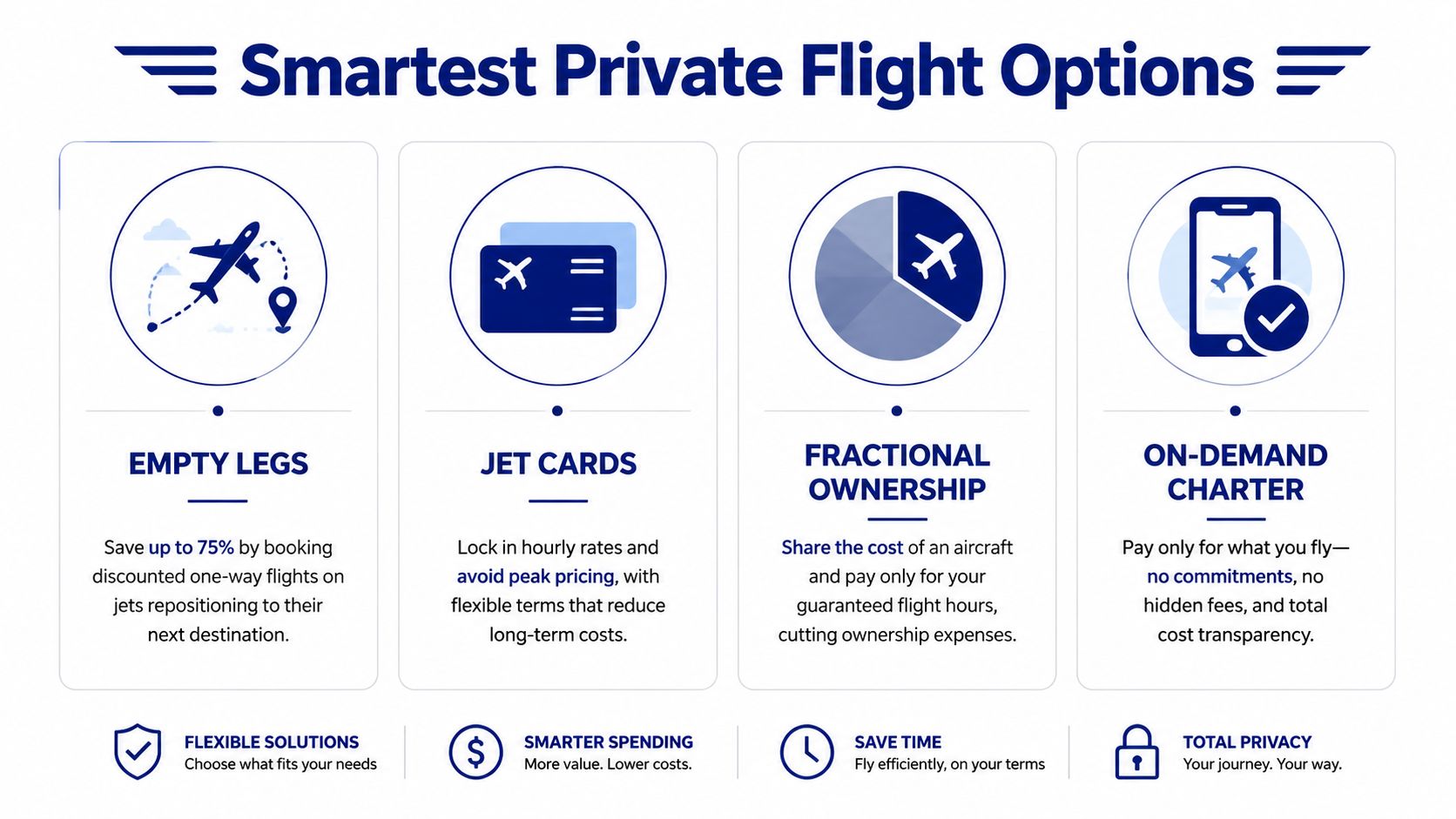
There isn't one “best” way to access private aviation. There's only the model that best fits how you travel. For some people, that's on-demand charter a few times a year. For others, a prepaid program makes planning easier. And for travelers with unusual flexibility, empty legs can occasionally create real bargains.
On-demand charter
This is the most practical entry point for many travelers. You book trip by trip, choose the right aircraft for the mission, and avoid ownership commitments.
It works well if your schedule changes, your routes vary, or you do not want capital tied up in a flight program. It also gives you the most room to compare options based on the actual trip rather than a prepaid structure.
Empty legs
Empty legs are attractive because the advertised discount can be dramatic. But they only work when your schedule can bend to the flight, not the other way around.
According to Jettly's explanation of empty leg flights, these flights can offer discounts of up to 75% off standard charter pricing, but they come with fixed routes, fixed departure windows, and they're one-way only. That's the key trade-off. The low fare may stop being low if you need a reliable return, if timing changes, or if the route isn't an exact match.
If you want a clearer picture of how private terminals affect the overall experience, it helps to understand the role of the private jet FBO in the booking and departure process.
The cheapest advertised option isn't always the lowest total-trip-cost option.
Jet cards
Jet cards appeal to travelers who want simplicity. You commit funds in advance, get a more standardized access model, and often reduce the time spent sourcing each trip.
That convenience can be worthwhile if you fly regularly on similar routes and want budgeting predictability. The trade-off is reduced flexibility compared with open-market charter. If your travel patterns change a lot, the structure can feel tighter than expected.
Memberships
Memberships sit between pure charter and a more formal prepaid program. Some focus on access, some on service terms, and some on pricing consistency.
They can make sense for frequent users who value a repeatable process. But they're not automatically cheaper. The value depends on how often you fly, where you fly, and whether the membership rules match your actual behavior rather than your idealized travel plan.
A practical comparison
| Option | Best for | Flexibility | Cost logic |
|---|---|---|---|
| On-demand charter | Variable schedules and mixed routes | High | Pay for what you need, when you need it |
| Empty legs | Highly flexible leisure travelers | Low | Strong one-way value if the route aligns perfectly |
| Jet cards | Frequent flyers who want predictability | Medium | Better for planning and budgeting than occasional bargain hunting |
| Memberships | Travelers who want ongoing access structure | Medium | Can add value if usage is consistent |
Questions worth asking before you choose
- Do I need exact departure control, or can I adapt to available inventory?
- Is this a one-off trip, or part of a repeat pattern?
- Am I optimizing for lowest fare, or lowest stress?
- Will I need return flexibility if plans change?
For most executives and families, on-demand charter remains the most strategic place to start. It lets you learn your own travel patterns before committing to a more structured access model.
How to Book Private Flights and Save Money
Saving money in private aviation usually comes from better structuring, not aggressive bargain hunting. The best outcomes come from decisions that reduce wasted aircraft time, reduce operational friction, and keep the trip aligned with what you need.
Use the trip shape to your advantage
Budget-conscious charter pricing can start around $4,000 to $4,900 per hour for a turboprop, and a short round-trip on a light jet for a group can run about $15,000 to $20,000 total, which can make the per-person cost competitive with commercial first class according to Stratos Jets' private flight pricing overview.
Those numbers make more sense when the trip is structured well.
- Book round trips when possible: A clean out-and-back often reduces unnecessary aircraft movement.
- Travel as a group: Per-person value improves when the aircraft cost is shared sensibly.
- Stay flexible on timing: Even modest schedule flexibility can open up better aircraft placement.
- Choose the right airport: Smaller private-friendly airports can simplify the operation and reduce friction.
Tactics that usually work
Here's the practical checklist I'd use before requesting quotes:
- Right-size the aircraft. Don't upgrade categories unless range, luggage, or passenger comfort demands it.
- Bundle meetings intelligently. If private travel is solving a time problem, use it to stack multiple obligations into one efficient day.
- Ask about one-way versus round-trip logic. Sometimes the “obvious” routing isn't the most efficient one.
- Be honest about flexibility. A broker or operator can only find efficiencies you're willing to accept.
- Learn when an empty leg is useful. If you're considering one, read a practical explanation of what an empty leg flight is before assuming it's the right fit.
What usually backfires
Trying to force the absolute lowest quote can create hidden cost elsewhere. The wrong aircraft, awkward departure windows, and poor return planning can erase any initial saving.
A better approach is to ask one direct question: What structure gives me the lowest total cost without increasing schedule risk?
Good private aviation buying is disciplined. You're not trying to spend the least. You're trying to waste the least.
Finding Value with Air Treks Fleet and Services
Value in private aviation comes from alignment. The aircraft has to fit the mission, the routing has to fit the day, and the service model has to fit the traveler. When those three line up, the experience feels easy and the spend feels justified.

One reason smaller entry-level aircraft matter so much is their operating design. Low-cost entry jets such as the Cirrus Vision Jet and Citation Mustang are often associated with lower total mission cost because single-pilot certification and efficient engine architecture help keep operations lean, as explained in BlackJet's look at the cheapest private aircraft. That matters most on the short business and family leisure routes where private charter tends to create the clearest value.
Why fleet mix matters
A versatile fleet gives a charter client more room to make smart decisions. If every mission gets pushed toward the same aircraft type, you usually lose value somewhere. Either you overpay for capability you don't need, or you accept compromises that make the trip less comfortable than it should be.
That's why fleet visibility matters. If you want to understand what aircraft categories are available for different route types, it helps to review a provider's charter fleet options before discussing trip design.
A right-sized fleet approach is especially useful for:
- Regional business flying where speed and timing matter more than a larger cabin
- Family vacation routes where luggage, pets, and simple boarding matter more than image
- Caribbean and cross-border trips where airport access and operational planning shape the day
Service value is not just the airplane
The best-value private travel usually includes choices that lower friction around the flight itself. That might mean a clearer empty leg option for a flexible one-way itinerary. It might mean tailoring the route around easier airports. It might mean pet-friendly handling so a family doesn't need separate logistics for an animal.
Those benefits don't always show up cleanly in a quote. They show up in the day you didn't lose.
A short look at the charter experience makes that point better than any brochure:
For travelers evaluating providers, Air Trek is one option in this space. The company operates on-demand charters, empty leg flights, memberships, and medical transport services across the Western Hemisphere, with a fleet and service model oriented around flexible private travel rather than ownership.
Questions that reveal real value
When comparing providers, ask:
| Question | Why it matters |
|---|---|
| Can you recommend a smaller aircraft if it fits? | This reveals whether the provider is solving for your trip or just filling lift. |
| How do you handle pets and family-specific requests? | Good service reduces hassle outside the aircraft too. |
| Are you showing me all viable options or only one? | Choice is where value often appears. |
Your Questions on Affordable Private Flying Answered
When should I book if I want the best pricing?
Book as early as you reasonably can, especially if your dates are fixed. More lead time usually gives you more aircraft options and a better chance of matching the mission cleanly. If your travel is flexible, it also creates room to compare alternatives without rushing.
Are empty legs the best way to save?
Sometimes. But only when your route and schedule match the available leg almost perfectly. If you need a dependable return or the freedom to shift departure time, a conventional charter often delivers better overall value.
Is private flying practical for families with pets?
Yes, often far more practical than commercial travel. The biggest benefit isn't just comfort for the animal. It's reducing transitions, waiting, and airport stress for everyone involved. Policies vary by operator, so it's worth confirming details early.
What's the difference between a charter operator and a broker?
A charter operator flies aircraft under its own operating authority. A broker arranges lift through operators. From a client perspective, the key issue is transparency. You want to know who is operating the flight, what aircraft is being used, and who is responsible for execution on the day of travel.
Is safety different on affordable private flights?
Price and safety shouldn't be treated as a trade-off. Serious travelers should expect clear operator information, professional crew standards, and proper regulatory compliance. The right question isn't “is this cheap enough?” It's “is this structured responsibly?”
Ask who is operating the flight before you focus on cabin photos or catering menus.
Are memberships worth it?
They can be, if your travel pattern is consistent. If you fly often, want a simplified booking process, and prefer a more predictable framework, a membership may make sense. If your flying is occasional or varied, on-demand charter often stays more practical.
Can private aviation work for occasional travelers?
Absolutely. In fact, occasional use is often the most rational starting point. You can deploy private flight when the route, the timing, or the group size makes it worthwhile, without committing to a year-round program.
What question should I ask before booking any trip?
Ask this: What option gives me the best total value once flexibility, return planning, airport choice, and disruption risk are included? That one question tends to separate smart decisions from expensive shortcuts.
The Smart Way to Approach Private Aviation in 2026
The smartest way to buy private aviation isn't to chase the lowest visible number. It's to understand what you're paying for, match the aircraft to the mission, and choose a booking model that fits the way you travel.
That's what makes affordable private flights realistic for more people now. You can use charter selectively. You can evaluate empty legs with clear eyes. You can build trips around time saved, fewer handoffs, and better control of the day.
For most time-poor travelers, that's luxury. Not excess. Precision.
If you're planning business travel, a family trip, or a route that commercial service handles poorly, speak with a charter specialist and ask for the trip to be built around value, not just price. The right itinerary should feel efficient before you board, not only once you're in the air.