
You're probably not looking for “luxury.” You're looking for control.
A Seattle departure can unravel fast. Traffic to the airport eats into your morning, the terminal is crowded, a delay turns one meeting into three missed commitments, and a simple family trip starts with friction before anyone leaves the ground. That's why charter flights from Seattle appeal to executives, travel managers, and families who care more about time, flexibility, and predictability than lounge aesthetics.
Used well, private charter is a logistics tool. It lets you pick the airport that fits the mission, choose an aircraft that matches the route, and build the day around your schedule instead of the airline's bank of departures. In Seattle, that matters more than many travelers realize because airport choice alone can change the whole experience.
Why Private Jet Travel from Seattle Makes Sense
Seattle is a strong charter market because the city sits at the intersection of business travel, regional access, and long-haul leisure demand. That combination creates a lot of reasons to fly. It also creates a lot of pressure on the commercial system.
Seattle-Tacoma International Airport handled 52.72 million passengers in 2025, with 45.61 million domestic passengers, a 1.7% increase over its pre-pandemic 2019 high of 51.83 million. The airport also recorded about 435,896 flights, more than 400,300 total aircraft operations, and service to 96 nonstop domestic and 36 international destinations, according to SEA passenger and operations statistics. For a charter client, those numbers matter because they show just how much activity Seattle's main gateway is managing on any given day.
What private charter solves
Commercial flying works well when your destination lines up with the airline schedule and you can absorb delay, connection risk, and terminal time. Charter works better when the day has to run on your timing.
Common reasons Seattle travelers choose charter include:
- Time-sensitive business travel: Same-day meetings in multiple cities are much easier when you can depart when you're ready.
- Airport access: You can route into airports closer to a final destination instead of accepting a major-airline endpoint and adding more ground transfer.
- Family simplicity: Traveling with kids, grandparents, ski gear, golf bags, or pets is usually smoother in a private environment.
- Privacy and continuity: Sensitive conversations and work don't stop just because you're in transit.
Practical rule: If the cost of being late is higher than the cost of chartering, private aviation becomes a business decision, not a lifestyle decision.
Seattle is especially well suited to on-demand flying
The Seattle area supports both short regional missions and longer departures into California, Canada, Mexico, and Hawaii. That range of use cases is one reason charter has grown broadly in the U.S. market. IBISWorld estimates the U.S. charter flights industry reached $52.6 billion in 2026 and counted 19,165 businesses in 2025, after growing at a 10.9% CAGR from 2020 to 2025, as shown in its U.S. charter flights industry profile.
For a Seattle traveler, the takeaway is simple. You're not forcing a niche service into an unsuitable market. You're using a mature on-demand model in one of the country's busiest aviation corridors.
Choosing Your Seattle Departure Airport
The first real decision isn't aircraft. It's airport.
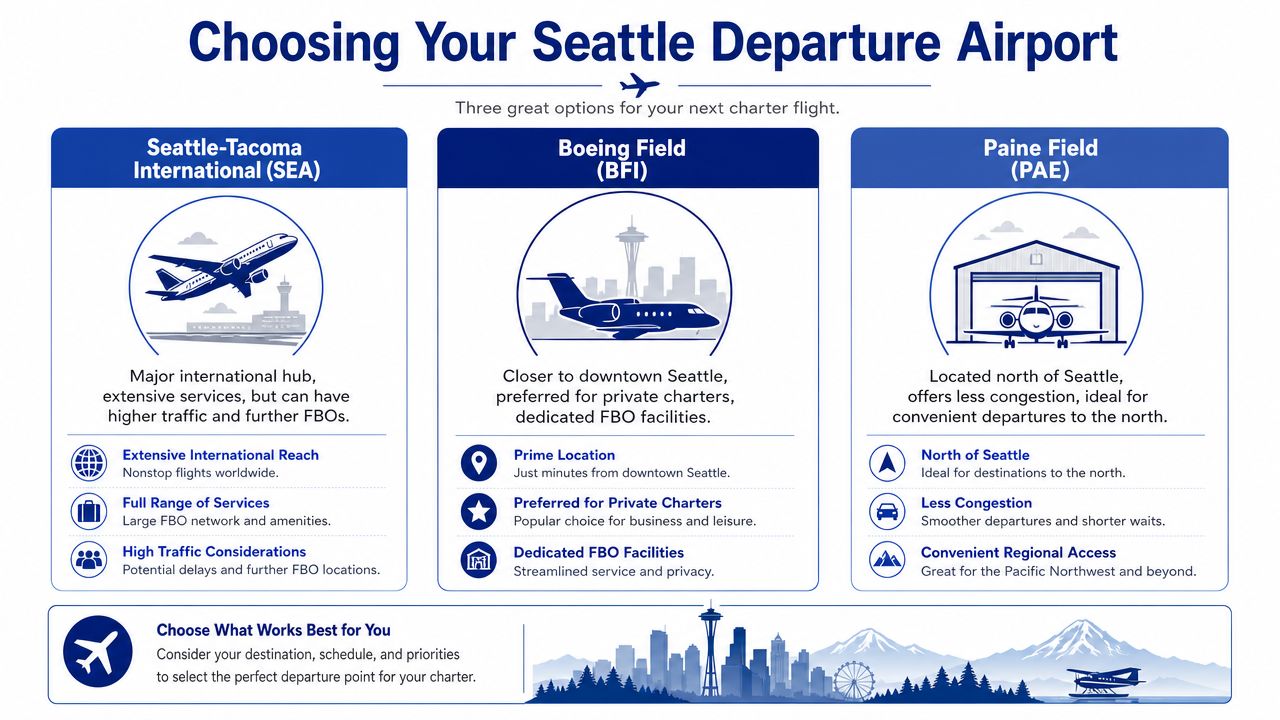
Searching for charter flights from Seattle often leads to the assumption of one obvious answer. There isn't. In practice, the right departure point depends on where you live, where you're going, how much cabin you need, and whether minimizing drive time matters more than maximizing aircraft options.
Boeing Field for speed and discretion
Boeing Field sits about 5 miles from downtown Seattle, while Sea-Tac is about 14 miles south, according to Boeing Field private jet airport details. For many executives based in downtown Seattle, SODO, or nearby business corridors, that difference is substantial on a busy day.
Boeing Field is often the cleaner private aviation experience because it's oriented toward non-airline traffic. You'll typically deal with a dedicated FBO environment, less terminal complexity, and a shorter path from curb to cabin. If you want to understand how airport layouts and movement patterns affect the traveler experience more broadly, this guide on ways to enhance passenger flow in airports is a useful reference.
That said, convenience has limits. Boeing Field's documented longest runway is 3,050 feet, and the field elevation is 21 feet. It also has port-of-entry status, which helps on certain itineraries, but the runway length means aircraft performance becomes a real filter. You can't pick a jet based only on cabin photos and assume it will work.
Sea-Tac for capability and network support
Sea-Tac is usually the better choice when the mission calls for a larger aircraft, longer runway margin, or more operational flexibility tied to a major commercial hub environment. It's farther from downtown, but for some trips the extra drive is worth it.
Sea-Tac tends to make more sense when:
- The route is long: Longer sectors usually favor aircraft that benefit from fewer runway constraints.
- The passenger count is higher: More people often means a larger cabin class and more baggage, which narrows the airport options.
- The weather or schedule is complex: Major airports can offer operational advantages on certain days.
Choose the airport after choosing the mission profile. Not the other way around.
Paine Field for north-end convenience
Paine Field often deserves more attention than it gets, especially for travelers based north of Seattle. It can be a practical option when Everett, the Eastside north corridor, or nearby communities are the natural starting point.
Independent charter and airport pages also make clear that Seattle-area charter traffic is not limited to one field. Boeing Field is a regular private-jet departure point, Sea-Tac supports charter access, and operators such as Kenmore Air serve Boeing Field and Seattle-Paine Field for charter activity, as outlined on this Boeing Field charter location page.
For travelers comparing FBO experiences, ground handling, and access points, it helps to review how a private jet FBO works before booking. That's often where expectations become realistic.
Aircraft Options and Charter Costs Explained
Aircraft selection drives charter cost more than anything else. If you understand that, most quotes stop looking mysterious.
The easiest way to think about it is by comparing aircraft to vehicles. A turboprop is the efficient regional tool. A light jet is the quick business sedan. A midsize or super-midsize jet is the step up when range, cabin comfort, and baggage matter more. A heavy jet is for larger groups, longer distances, or both.
Why one Seattle quote can look nothing like another
Two trips leaving Seattle can have very different pricing even if the route sounds similar at first glance. The cost changes with aircraft category, routing, repositioning, airport choice, timing, and how tightly the schedule is built.
A published Seattle to Los Angeles example shows the spread clearly. That trip can run about $12,400 for a turboprop, $14,000 for a light jet, $22,500 for a midsize jet, and $32,200 for a heavy jet, based on Seattle to Los Angeles charter pricing examples. The lesson isn't that one class is better. It's that asking “what does a private jet from Seattle cost?” is too broad to get a useful answer.
Here's the practical breakdown of what usually moves the quote:
- Aircraft class: Bigger cabins and longer-range jets cost more to operate.
- Route length: Longer trips increase airborne time and can require different equipment.
- Positioning: If the aircraft has to come to Seattle before your trip starts, that affects the price.
- Airport fees: Different airports and FBOs can change trip economics.
- Schedule rigidity: Tight timing can remove lower-cost options.
Estimated Charter Costs from Seattle by Aircraft Type
| Route | Turboprop | Light Jet | Midsize Jet | Heavy Jet |
|---|---|---|---|---|
| Seattle to Los Angeles | $12,400 | $14,000 | $22,500 | $32,200 |
That table includes only published route pricing that was provided. If you see another article showing exact Seattle prices for multiple city pairs without stating a real source, be skeptical.
What works and what doesn't when picking a cabin
For short regional trips, many travelers overbook the airplane. They pay for more range and more cabin than the mission needs. That's common on Pacific Northwest hops.
What usually works:
- Turboprops for short sectors: Efficient, practical, and often the right answer when runway flexibility matters.
- Light jets for quick West Coast trips: Good fit when speed matters and passenger count is moderate.
- Midsize and up for longer comfort: Better for travelers who want more stand-up room, baggage flexibility, or a smoother long-leg experience.
What often doesn't work:
- Choosing by photos alone: A pretty cabin doesn't tell you whether the aircraft fits the runway or route.
- Ignoring baggage reality: Golf clubs, skis, strollers, and bulky luggage can force a different aircraft.
- Fixating on hourly slogans: A low advertised hourly figure can be meaningless without route context and repositioning details.
For travelers comparing quote structures, this guide to private jet charter pricing helps frame the cost components in plain terms.
Don't shop for the cheapest jet. Shop for the lowest total-friction solution that still fits the mission safely and cleanly.
Popular Charter Routes and Destinations
Seattle works well as a charter origin because the route mix is broad. Some trips are short business hops. Others are leisure flights where avoiding connections matters more than anything else.
Regional trips that save the most time
Short-haul charter from Seattle often delivers the clearest value because it compresses the parts of travel people dislike most. You're not buying a longer inflight experience. You're avoiding wasted hours around it.
Popular use cases include:
- Pacific Northwest business travel: Quick access to regional cities where a same-day return matters.
- Resort and island access: Destinations that become much easier when you can fly closer to the final stop.
- Cross-border itineraries: Seattle's position makes Canada a natural consideration for private flyers who want more direct routing.
This is also where airport choice becomes tangible. A short regional flight from Boeing Field can feel very different from driving farther south for a larger-airport departure, especially if your final destination doesn't require a big jet.
Longer flights where aircraft choice matters
Longer departures shift the conversation from convenience to capability. Once you move into California, Mexico, or Hawaii, the aircraft's range and cabin systems matter much more.
A published Seattle to Honolulu example highlights that point well. A Gulfstream G280 is listed with 3,600 nautical miles of range, 100% fresh-air circulation, and a lower cabin-pressurization setting than typical commercial cabins. The same example lists midsize charter pricing starting at $42,440 and super-midsize starting at $51,810, according to Seattle to Honolulu private charter details.
That's useful because it connects three things travelers often separate in their minds:
- Mission feasibility
- Passenger comfort
- Total cost
If the goal is a nonstop overwater flight, range margin isn't optional. Neither is choosing a cabin environment that passengers can tolerate for the whole leg.
For West Coast and island flying, the right airplane is the one that completes the trip with operational margin and leaves passengers functional on arrival.
The Charter Booking Process and Timeline
Booking a charter is simpler than most first-time clients expect. The confusion usually comes from not knowing which details matter at the start.
What to have ready before you ask for a quote
A strong charter request is specific. The operator doesn't need a polished brief, but they do need the facts that affect aircraft fit and routing.
Have these ready:
- Travel dates and preferred departure windows
- Passenger count
- Origin and destination airports, if known
- Luggage profile, especially oversized items
- Any pets, catering, or ground transport needs
The more precise you are, the more useful the quote will be.
The normal booking flow
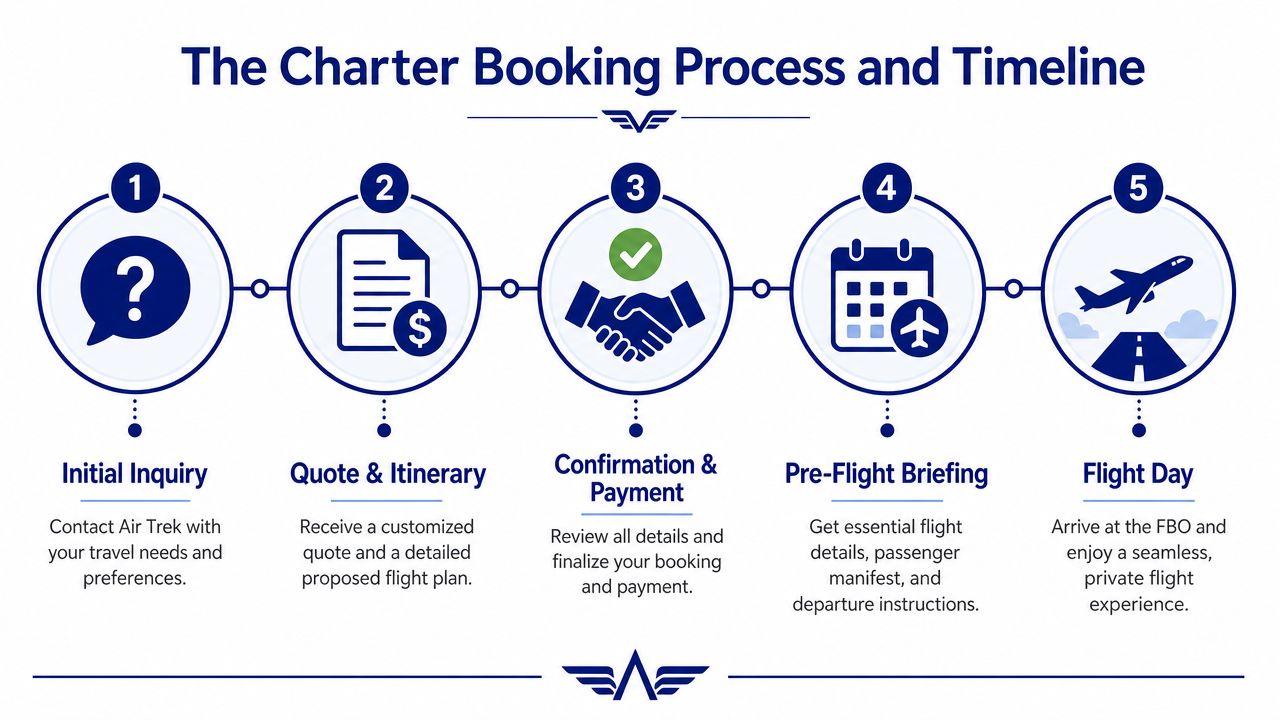
Most bookings follow a straightforward sequence:
Inquiry
You provide the route, timing, passenger details, and any special requirements.Quote and aircraft options
The operator returns one or more aircraft choices with itinerary details and pricing.Review and confirmation
You check timing, airport selection, baggage fit, and contract terms before payment.Pre-flight coordination
Passenger manifest details, ID requirements, catering, and ground instructions get finalized.Flight day
You arrive at the FBO, board quickly, and depart without the normal airline terminal process.
If you want a baseline for how on-demand service is structured, this overview of on-demand charter flights gives a useful summary.
Where empty legs fit
Empty legs can be a smart option, but they're frequently misunderstood. An empty leg exists because an aircraft already needs to reposition. If your route and timing match that movement, you may get attractive pricing. If they don't, there's nothing to buy.
The trade-off is control. Empty legs work best for travelers who can be flexible on timing, airport, or even destination. They're less reliable for executive trips that require guaranteed departure windows and no surprises.
A good rule is simple:
- Use on-demand charter when the trip is schedule-critical.
- Use an empty leg when flexibility matters more than precision.
Flying with Air Trek from the Pacific Northwest
A Seattle family trying to make a Friday departure to Palm Springs has one set of priorities. A CEO heading to a Monday investor meeting in the Bay Area has another. The right charter operator should handle both without forcing the client to guess which airport, aircraft, or schedule buffer makes sense.
Seattle has plenty of charter choices, so the question is not availability. It is judgment. You want a team that can explain why Boeing Field may save time on one trip, why Sea-Tac may be the better operational call on another, and when an attractive-looking quote creates problems later with baggage, range, or repositioning costs.
That is the practical value of experience. Air Trek has been in business for more than 45 years, and that kind of operating history matters most in the moments clients usually do not see. Weather adjustments, airport swaps, cross-border paperwork, late passenger changes, and aircraft matching all get easier when the charter team has handled them many times before.
What matters in day-to-day service
Busy travelers from Seattle usually care about a short list of things:
- Clear advice on airport selection
- Aircraft recommendations that fit the trip, not just the headcount
- Quotes that explain cost drivers
- Fast, accurate communication
- Clean handling of luggage, pets, catering, and ground transport details
That last point gets underestimated. A charter trip feels easy on flight day when the planning was done carefully the day before.
Why that matters more in Seattle
Seattle departures have a few recurring variables that generic charter guides tend to gloss over. Boeing Field often wins on speed and convenience, especially for business travelers who want to stay close to downtown. Sea-Tac can still be the better choice in some cases, particularly when airline connections, specific operating needs, or passenger positioning make it more practical.
The operator should be able to walk you through that trade-off quickly and without sales language. The same applies to empty legs. They can be a smart fit from the Pacific Northwest, but only when the timing and routing genuinely match your plans. If the trip matters too much to slip, on-demand charter is usually the safer choice.
Air Trek provides private jet charter service and offers both on-demand and empty-leg options. For Seattle-based clients, that flexibility is useful because the best answer changes by trip. A short hop to Spokane, a family ski departure, and a longer international itinerary do not belong in the same booking template.
A good charter partner should save you time, reduce avoidable friction, and tell you when a lower headline price is likely to cost you more in schedule risk or operational compromise. That is the standard worth using, whether you book with Air Trek or any other operator serving the Pacific Northwest.
Frequently Asked Questions About Seattle Charters
How early should I arrive before a charter flight?
Usually much closer to departure than you would for a commercial airline. The exact timing depends on the operator, airport, and trip details, but charter clients typically use an FBO rather than the main terminal. Your confirmation should include the recommended arrival time. If it doesn't, ask.
How much luggage can I bring?
It depends on the aircraft, not just the number of passengers. This is one of the most common mistakes in charter planning. A group may fit in the cabin but not fit comfortably once ski bags, golf clubs, strollers, or large suitcases are added. Give the operator a realistic luggage list early.
Are pets allowed on charter flights?
Often, yes. Pet-friendly travel is one of the clearest practical advantages of flying private. The key is to disclose the pet in advance so the aircraft and crew can be planned appropriately.
What kind of catering can I request?
That varies by route length, departure airport, and lead time. On a short Seattle-area departure, many clients keep it simple with coffee, snacks, and light refreshments. On longer flights, travelers often request more substantial catering that fits dietary preferences and the time of day.
Can I book at the last minute?
Sometimes, yes. On-demand charter can accommodate short-notice trips when aircraft and crew are available. But last-minute availability is never something to assume, especially during busy travel periods or when your trip requires a specific aircraft category.
If you're comparing charter flights from Seattle, start with the mission, not the marketing. Pick the right airport, make sure the aircraft fits the route, and ask direct questions about timing, baggage, and flexibility. That's what turns private aviation from an expensive guess into a useful travel tool.