
You’re probably looking at the same bad set of options most first-time Key West travelers see. You can connect through a crowded commercial itinerary, rent a car and commit to the Overseas Highway, or try to make a short Florida hop fit an airline schedule that doesn’t really fit your day.
That’s why key west air travel is less about flash and more about solving a destination problem correctly. Key West is easy to love once you arrive. It’s the getting there that causes friction, especially for families, executives, and anyone who values privacy, timing, or a calm start to the trip.
A good charter plan strips out the weak points. You pick the airport based on where you’re staying. You choose the aircraft based on runway, baggage, and range, not guesswork. You understand what drives the quote before you book. And you treat the day of travel as a managed service, not a gamble.
Why Private Air Is the Key to Key West
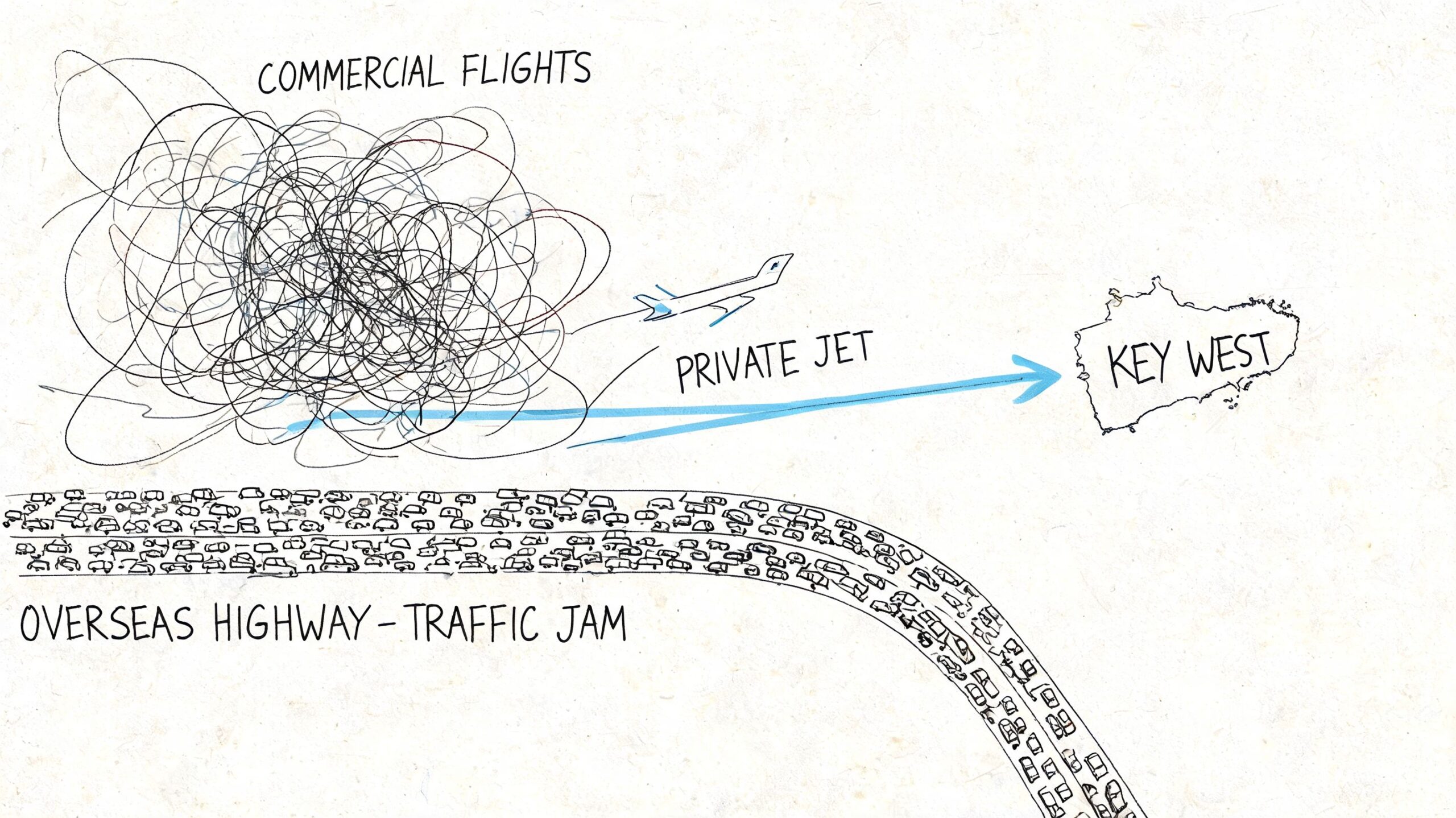
Key West exposes every weakness in commercial travel. If you’re starting from South Florida, the route often feels absurdly inefficient. A destination that looks close on a map can still eat most of a day once traffic, parking, check-in, delays, and connections pile up.
The hard truth is simple. Key West lacks scheduled commercial nonstop flights from major Florida hubs like Miami, Fort Lauderdale, Tampa, and Orlando, forcing travelers into a 3+ hour drive on the often-congested Overseas Highway or indirect connecting flights. Private charters fill this service gap, cutting travel time to under an hour, as noted in AOPA’s Road Trip Key West overview.
What private travel fixes immediately
Private charter doesn’t just shorten the flight. It removes the wasted parts surrounding the flight.
- You leave on your schedule instead of building your day around an airline bank.
- You skip the chain reaction of delays that starts with traffic and ends with missed connections.
- You arrive closer to the actual experience you paid for, whether that’s a resort weekend, a fishing trip, or a same-day meeting.
That matters more in Key West than in many other markets. On a typical mainland trip, a delay is annoying. On a Keys trip, it changes dinner plans, boat departures, hotel check-in rhythm, and often the whole mood of arrival.
Where the value shows up
People often ask whether private air is worth it for such a short route. For Key West, the better question is what your time and flexibility are worth when the alternatives are so awkward.
Practical rule: Private charter makes the most sense when the ground journey is the real problem.
This is also where flexible travelers can find better value. If your schedule has some room, empty leg flight options can line up with Florida and Caribbean repositioning routes, which is often the smartest entry point for someone trying private aviation for the first time.
What doesn’t work is treating Key West like any other leisure city and assuming the commercial market will handle the last mile elegantly. It usually won’t. The more important the trip, the more private air stops looking indulgent and starts looking like the cleanest operational choice.
Choosing Your Key West Gateway Airport Options
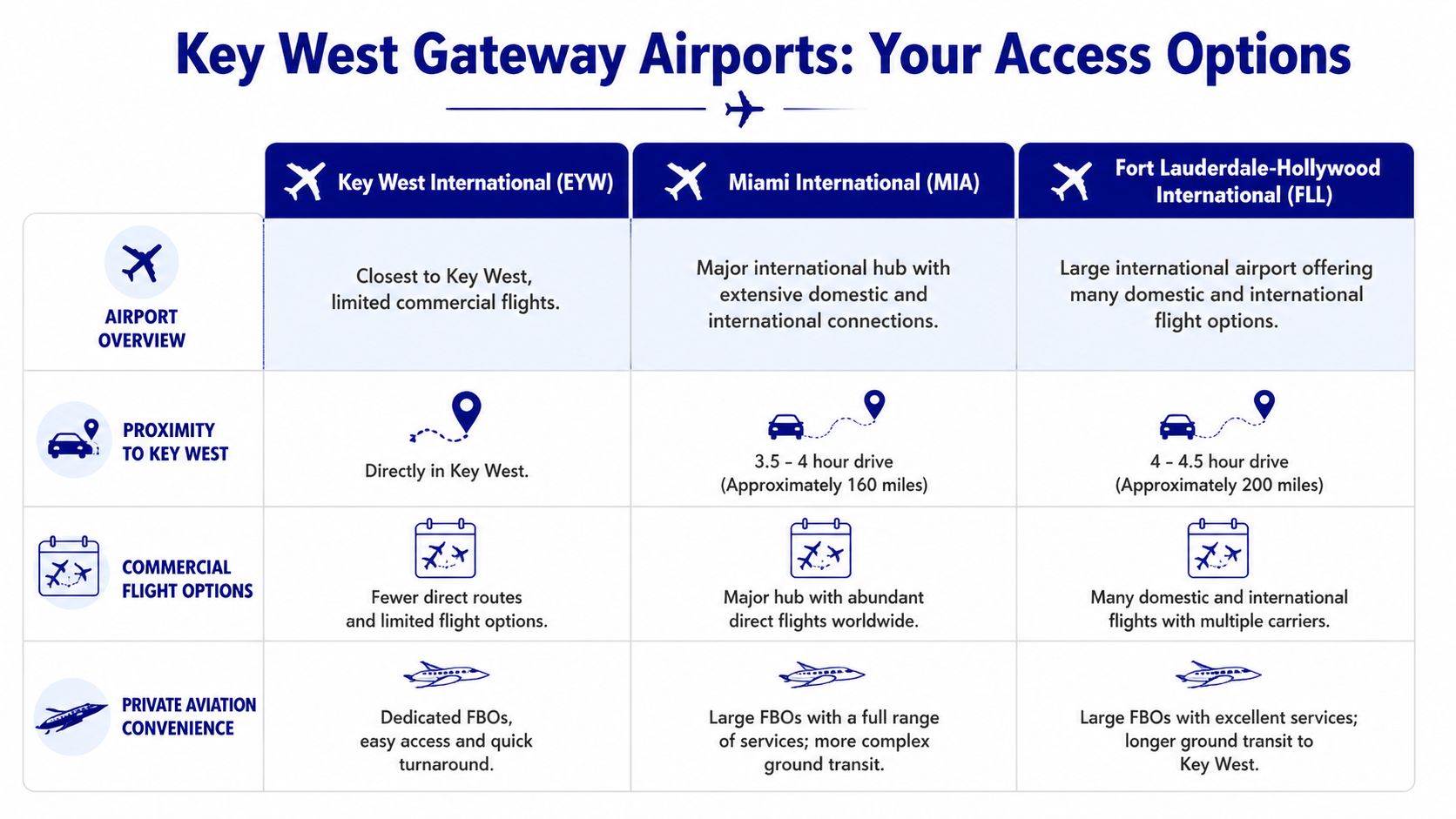
The airport decision shapes the whole trip. Most passengers focus only on “closest airport,” but that’s not always the best answer in the Keys. The right choice depends on where you’re staying, what aircraft you need, and how much you care about minimizing on-island ground time versus maximizing operating flexibility.
EYW for shortest arrival time
If your destination is in Key West, Key West International Airport (EYW) is usually the first airport to consider. It’s the obvious choice for passengers who want the shortest possible transfer from plane to hotel, marina, or residence.
EYW also has deep roots as the Keys’ main air gateway. Its first scheduled service began on February 10, 1944, and it saw its first jet service in 1968 with Boeing 727s, establishing it as the region’s primary hub long before recent growth pushed annual traffic above 1.3 million passengers in 2023, according to the airport history summarized on Wikipedia’s Key West International Airport page.
For passengers, that history matters because it explains why EYW is the instinctive arrival point. It’s the established airport. It’s close in. It fits the “land and go” expectation.
When Marathon can be the smarter play
There are trips where Marathon International Airport (MTH) makes more operational sense, even if your final destination is Key West. This tends to come up when passengers want more aircraft flexibility, a quieter arrival flow, or an easier option during busy periods.
A practical comparison looks like this:
| Airport | Best passenger use case | Main advantage | Main trade-off |
|---|---|---|---|
| EYW | Staying in Key West proper | Closest arrival to final destination | Can feel tighter during peak periods |
| MTH | Staying in the Middle or Lower Keys, or prioritizing aircraft flexibility | Often a useful alternative for charter planning | Longer drive if your hotel is in Old Town |
| MIA | Mixing airline travel with South Florida ground plans | Major commercial hub | Not a true Key West arrival |
| FLL | Broward or Palm Beach origin planning | Strong South Florida access | Still requires substantial ground routing if not flying onward privately |
Questions worth asking before you book
A good charter adviser should ask these before recommending an airport:
- Where are you staying. Stock Island, Old Town, Marathon, and the private islands create very different ground plans.
- What matters more, nonstop convenience or aircraft options. Sometimes the closer airport isn’t the smoothest answer.
- Are you arriving on a peak weekend. Event demand can change the practical value of each gateway.
- Do you need quick ground handling for pets, children, or specialty baggage.
The best airport for Key West isn’t always the one with the shortest map distance. It’s the one that creates the least friction for your exact itinerary.
What doesn’t work is choosing an airport in isolation. Passengers sometimes lock in EYW because it sounds simplest, then discover their aircraft options narrow or their arrival window becomes harder to protect. Other travelers overcorrect, land too far away, and give back their saved flight efficiency in a long car transfer. The right answer is situational, and that’s exactly why the airport conversation should happen before the aircraft is finalized.
Matching the Right Aircraft to Your Trip
Aircraft selection gets overcomplicated fast. Most passengers don’t need a lecture on cabin cross-sections or avionics. They need to know what will get into Key West cleanly, carry the right people and bags, and fit the trip without paying for capability they won’t use.
That means thinking in terms of mission, not status. A short Florida hop, a family vacation with soft bags, and a nonstop trip from the Northeast are three different missions. They may all end in Key West, but they should not all use the same aircraft category.
Start with the route, not the airplane
For short-haul key west air trips inside Florida or nearby markets, a turboprop can be the most sensible tool. Passengers sometimes assume “jet” automatically means better. It doesn’t. On short sectors, a strong turboprop often offers excellent runway performance, easy boarding, and very practical economics.
Light jets enter the conversation when passengers want a classic private jet experience on a shorter route with a smaller group. They work well when baggage is manageable and the trip profile fits the aircraft cleanly.
Midsize jets are often the better fit for longer nonstop routes, larger executive groups, or passengers who need more cabin comfort and luggage flexibility. The trade-off is straightforward. More capability usually means more cost, and not every trip needs it.
A simple suitability guide
| Aircraft Type | Typical Passengers | Non-Stop Range (approx.) | Best For |
|---|---|---|---|
| Turboprop | Small groups and families | Short to moderate trips | Florida routes, practical family travel, easy baggage mixes |
| Light jet | Small executive groups or couples | Short to moderate trips | Fast regional trips with classic jet comfort |
| Midsize jet | Larger groups | Longer nonstop missions | Northeast to Key West, more baggage, more cabin space |
What passengers should say during the quoting process
The fastest way to get the right aircraft recommendation is to give your charter team real trip details, not a rough guess.
- Name the actual passenger count. Don’t say “around six” if there might be eight.
- Describe the baggage accurately. Golf clubs, fishing gear, pet carriers, garment bags, and coolers all change the answer.
- Mention your return timing early. Same-day turns and wait time can affect the best aircraft choice.
- Say whether anyone dislikes cramped cabins. Comfort matters more on some routes than others.
One useful place to compare categories before you request a quote is Air Trek’s private charter fleet overview, which shows the kinds of aircraft profiles typically considered for Florida, Caribbean, and longer-range trips.
A good recommendation should sound boringly logical. If the aircraft choice feels like overkill, it probably is.
What doesn’t work is shopping by aircraft name alone. Passengers often ask for a specific jet they’ve heard of, without knowing whether it’s ideal for the runway, route length, or baggage load. The best operators reverse that process. They solve the trip first, then match the metal.
Understanding Private Charter Pricing for Key West
The smartest way to read a charter quote is to stop asking, “Why is this expensive?” and start asking, “What exactly am I paying for?” Once you break the quote into parts, the numbers make more sense.
Private charter pricing for Key West usually comes down to aircraft category, total flight time, where the aircraft starts, and how efficiently the routing lines up. The same destination can price very differently depending on whether the airplane is already nearby or has to reposition to pick you up.
What usually drives the quote
A charter invoice often reflects a mix of operating and trip-specific factors:
- Aircraft type. Larger or longer-range aircraft generally cost more to operate.
- Positioning. If the aircraft has to fly empty to your departure airport, that time still counts.
- Airport and handling costs. Those can vary by location and by how the trip is structured.
- Schedule shape. One-way, same-day return, overnight crew needs, and multi-stop routing can all matter.
This is why two passengers taking “the same trip to Key West” may get very different quotes. One may be catching an aircraft already moving through South Florida. Another may need an airplane brought in from elsewhere.
Where value usually hides
Flexible clients often save money by adjusting one of three things: departure time, airport choice, or aircraft category. Even a small change in one of those can lead to better routing.
A strong charter adviser will also tell you when a lower-cost option is a worse value. That happens when a cheaper airplane forces a fuel stop, cuts baggage too close, or creates operational stress around weather and timing.
Worth knowing: The cheapest quote isn’t always the least expensive trip once delays, repositioning, and compromises show up.
For travelers who want more context on pricing logic, what changes the price of a Florida private charter gives a useful breakdown of the moving parts.
How to think about empty legs
Empty legs are one of the few real opportunities to improve value without lowering the quality of the experience. They happen when an aircraft needs to reposition for its next booked assignment and can sell that otherwise empty segment.
That said, empty legs work best for a specific type of traveler:
- You have date flexibility
- You’re open on departure airport
- You don’t need a highly customized time window
If you need total schedule control, standard on-demand charter is usually the better answer. If your weekend is movable and you want to get to the Keys privately, empty legs can be a smart fit.
What doesn’t work is treating private pricing like airline pricing. There isn’t one public fare bucket that everyone sees. Charter is a custom transportation solution. The cleaner and more realistic your itinerary, the cleaner the quote tends to be.
Navigating Seasonal Demand and Major Events
Key West doesn’t have one demand pattern. It has layers. Weather season, holiday weekends, event weekends, fishing calendars, and social travel all stack on top of each other. That’s why booking strategy matters so much more here than in a routine business market.
Commercial traffic gives a useful clue about the pressure on the destination as a whole. Key West International Airport recorded 147,175 total passengers in January 2024, a 16% increase over January 2023, and airlines scheduled a 20.8% increase in seat capacity for Q1 2024, according to Keys Weekly’s report on the January passenger record. For private travelers, the takeaway isn’t just that Key West is busy. It’s that the broader system around the island gets tighter when demand surges.
What that means for charter clients
When commercial traffic rises, several things usually happen around a destination like Key West:
- Preferred slots and arrival windows get harder to secure
- The most suitable aircraft categories get booked earlier
- Ground handling and vehicle coordination require more lead time
That doesn’t mean private charter stops working. It means private planning becomes more important.
The booking pattern that works
For major weekends and signature island events, early booking gives you the best aircraft choice and the cleanest timing. For quieter periods, you can often afford to be more opportunistic, especially if you’re open to alternative airports or routing.
A practical rule of thumb is to decide which of these matters most:
| Priority | Best approach |
|---|---|
| Exact schedule | Book early and lock the aircraft before the market tightens |
| Best value | Stay flexible on departure time and aircraft category |
| Low-stress arrival | Build in ground transport planning at the same time you book the flight |
Busy periods don’t just raise demand. They reduce your margin for indecision.
What doesn’t work is waiting until the last minute for a high-visibility weekend and expecting every aircraft and every ideal timing window to still be available. Key West is small enough that pressure shows up quickly. That’s especially true when leisure demand and event traffic hit at the same time.
Seamless Logistics From Door to Destination
The difference between airline travel and private charter becomes most obvious on the day of departure. You’re not navigating a terminal system built for thousands of passengers. You’re using an FBO, a private terminal designed for small-volume, managed departures.
That changes the whole rhythm of the trip.

What the travel day usually feels like
At a private terminal, passengers typically arrive close to departure time instead of building in long airport buffers. The check-in process is simple. The environment is quieter. Staff handle baggage directly, and the transition from lounge to aircraft is short.
That matters in Key West travel because many passengers are already trying to protect a vacation mindset. Families don’t want a chaotic start. Executives don’t want to burn half a day in transit. Pet owners don’t want to hand their animals over to an airline system that treats them like cargo.
Common requests are easy to coordinate in advance:
- Ground transportation waiting plane-side or just outside the terminal
- Cabin pet travel rather than separated handling
- Baggage support for golf clubs, fishing gear, garment bags, or medical equipment
- Catering preferences matched to a short hop or a longer inbound route
International and specialty coordination
Key West trips aren’t always simple domestic leisure flights. Some passengers arrive from the Caribbean. Others travel for medical reasons, family matters, or time-sensitive business.
That’s where a good charter operation earns its keep. Customs coordination, handling of specialty baggage, and arrival planning should happen before the day of flight, not during it.
This short video gives a useful feel for the private terminal experience:
Small details that make the trip feel finished
Passengers often focus on the airplane and overlook the handoffs. The handoffs are where luxury either holds together or falls apart.
- Driver timing matters. A car that’s five minutes late feels much longer on a private trip.
- Pet paperwork should be checked early if the itinerary includes international elements.
- Return-day planning matters too. Don’t treat the outbound leg as the only leg that needs coordination.
Smooth charter travel isn’t just air time. It’s the sequence from front door to final destination.
What doesn’t work is booking “just the flight” and assuming the rest will sort itself out. The best private Key West trips feel easy because someone planned the details before wheels up.
Frequently Asked Questions About Key West Charters
Can I fly private directly to Key West from South Florida?
Yes, and for many passengers that’s the whole point. Private charter solves the gap between nearby Florida cities and a destination that doesn’t align well with commercial schedules. If your priority is speed and control, direct private routing is usually the cleanest option.
Is EYW always the best airport for a Key West charter?
Not always. If you’re staying in Key West proper, EYW is often the natural choice. If aircraft flexibility, routing, or a different part of the Keys matters more, another airport may fit better. The right answer depends on the full itinerary, not just the destination name.
How far in advance should I book?
For high-demand weekends, book as early as you can once your dates are firm. If your trip falls in a quieter window and your schedule is flexible, you may have more room to compare options. The earlier you decide, the more likely you are to get the aircraft and timing you want.
Can I bring pets in the cabin?
Often yes, and that’s one of the clearest advantages of private charter for family travel. Pet planning should happen at quoting stage so the operator can match the right aircraft and confirm any documentation requirements, especially if the itinerary touches international points.
What if I’m arriving from the Caribbean?
That’s a common charter scenario. The key is to coordinate customs and arrival handling in advance. A well-run trip should have those steps mapped before departure day so arrival feels organized, not improvised.
Can private charter help with medical transport to Key West?
Yes. Private charters can integrate accredited air ambulance services for urgent medical transport, a niche underserved by commercial airlines and volunteer flight networks in the Florida-Caribbean corridor, as described in TravelPulse’s discussion of underserved air travel needs and route gaps. That matters for patients, families, and care teams who need privacy, direct routing, and specialized handling.
What specialty baggage should I mention before booking?
Tell your charter provider about anything beyond standard suitcases. That includes golf clubs, fishing gear, dive equipment, pet carriers, strollers, and medical devices. Small omissions cause big aircraft mismatches.
Is private charter worth it for a short Key West trip?
If the goal is to save time, avoid the highway, keep pets with you, or protect a tight schedule, often yes. Key West is one of those destinations where the friction around the trip can outweigh the mileage of the trip itself.
If you’re planning a Key West trip, the best next step is simple. Ask for an aircraft recommendation based on your real passenger count, baggage, dates, and destination in the Keys. That one conversation usually tells you more than hours of searching ever will.